
Verwandte Artikel zu Knowledge and Human Liberation: Towards Planetary Realizatio...
Knowledge and Human Liberation: Towards Planetary Realizations (Key Issues in Modern Sociology) - Hardcover
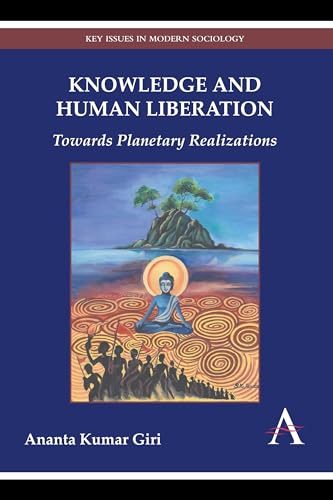
Inhaltsangabe
Human liberation has become an epochal challenge in today’s world, requiring not only emancipation from oppressive structures but also from the oppressive self. It is a multidimensional struggle and aspiration in which knowledge – self, social and spiritual – can play a transformative role. ‘Knowledge and Human Liberation: Towards Planetary Realizations’ undertakes such a journey of transformation, and seeks to rethink knowledge vis-à-vis the familiar themes of human interest, critical theory, enlightenment, ethnography, democracy, pluralism, rationality, secularism and cosmopolitanism. The volume also features a Foreword by John Clammer (United Nations University, Tokyo) and an Afterword by Fred Dallmayr (University of Notre Dame).
Die Inhaltsangabe kann sich auf eine andere Ausgabe dieses Titels beziehen.
Über die Autorin bzw. den Autor
Ananta Kumar Giri is an associate professor at the Madras Institute of Development Studies in Chennai, India.
Auszug. © Genehmigter Nachdruck. Alle Rechte vorbehalten.
Knowledge and Human Liberation
Towards Planetary Realizations
By Ananta Kumar GiriWimbledon Publishing Company
Copyright © 2013 Ananta Kumar Giri
All rights reserved.
ISBN: 978-0-85728-452-5All rights reserved.
Contents
Preface, ix,
Acknowledgments, xiii,
Foreword John Clammer, xvii,
Introduction The Calling of Transformative Knowledge, 1,
Part I Nurturing the Garden of Transformational Knowledge: Roots and Variants,
1. Knowledge and Human Liberation: Jürgen Habermas, Sri Aurobindo and Beyond, 33,
2. Beyond West and East: Co-evolution and the Calling of a New Enlightenment and Non-duality, 51,
3. The Modern Prince and the Modern Sage: Transforming Power and Freedom, 71,
4. Kant and Anthropology, 93,
5. Tocqueville as an Ethnographer of American Prison Systems and Democratic Practice, 99,
Part II Rethinking Knowledge,
6. Some Recent Reconsiderations of Rationality, 119,
7. Contemporary Challenges to the Idea of History, 127,
8. Rule of Law and the Calling of Dharma: Colonial Encounters, Post-colonial Experiments and Beyond, 139,
9. Compassion and Confrontation: Dialogic Experiments with Traditions and Pathways to New Futures, 165,
10. Rethinking Pluralism and Rights: Meditative Verbs of Co-realizations and the Challenges of Transformations, 171,
11. The Calling of a New Critical Theory: Self-Development, Inclusion of the Other and Planetary Realizations, 185,
Part III Aspirations and Struggles for Liberation: Towards Planetary Realizations,
12. Rethinking the Politics and Ethics of Consumption: Dialogues with "Swadeshi" Movements and Gandhi, 205,
13. Swaraj as Blossoming: Compassion, Confrontation and a New Art of Integration, 219,
14. Civil Society and the Calling of Self-Development, 233,
15. The Calling of Practical Spirituality: Transformations in Science and Religion and New Dialogues on Self, Transcendence and Society, 249,
16. Spiritual Cultivation for a Secular Society, 265,
17. Cosmopolitanism and Beyond: Towards Planetary Realizations, 287,
Afterword Fred Dallmayr, 303,
Advance Praise, 307,
CHAPTER 1
KNOWLEDGE AND HUMAN LIBERATION: JÜRGEN HABERMAS, SRI AUROBINDO AND BEYOND
An Adventure and an Invitation
Human liberation has been a key concern with humanity from the dawn of history, and in the contemporary moment, it manifests before us as an epochal challenge, as the prevalent guarantors of liberation in modernity – liberalism and socialism – have left us alone in the street. The dead end at which our familiar projects of social emancipation and human freedom are at present urges us to rethink liberation as part of a new seeking, striving, and experimental subjectivity at the level of both self and society Human liberation means liberation from the oppressive structures of society as well as from one's ego and urge to control (which is one of the most important sources of social evils, as Teressa Brennan (1995) would tell us). It also means to relate positively and affirmatively to new schemes of being and becoming and to create alternative spaces of self-realization, intersubjectivity and solidarity In this practice and quest of human liberation, knowledge plays an important role, and Jürgen Habermas and Sri Aurobindo, two soul-touching thinkers of our time, help us to understand the multi-dimensional pathways of linkages between knowledge, human interest and human liberation. Their pathways of seeking and striving touch us not only as cognitive schemes but as intimations of a Beyond. Though Habermas is conventionally looked at as approaching knowledge only through rational argumentation, there is a suggestion of a Beyond in him. It is no wonder then that in many of his works, as for example in Between Facts and Norms: Towards a Discourse Theory of Law and Democracy, Habermas (1996) talks of the need to proceed with "weak transcendental idealizations" in our practices of communication and the acquisition of knowledge (also see Habermas 2002a). Habermas (1990) himself urges us to realize that "cognition, empathy, and agape" must be integrated in our quest of knowledge and "concern for the fate of one's neighbor is a necessary emotional prerequisite for the cognitive operations expected of participants of discourse" (Habermas 1990, 182). Such a suggestion for a Beyond (whose full potential, however, is not fully explored in Habermas (2002a), though in his recent work he shows more openness to such invitation) can be deepened and broadened by a dialogue with Sri Aurobindo.
In his Knowledge and Human Interest, published more than four decades ago, Habermas brings to the center the significance of self-reflection in knowledge. But at this stage, self-reflection for him seems to primarily emerge from the psychoanalytic situation of dialogue between the doctor and patient, though germs of its origin in mutually validating pragmatics of communication are already visible here. In his later works, self-reflection has a broader ground of origin and nurturance, namely in our participation in processes of moral argumentation and public sphere. This practice of knowledge can be deepened by Sri Aurobindo's pathway of the yoga of integral knowledge, which enables one to have a deeper "self-awareness," "self-consciousness" and "self-realization," to discover, know and realize the transcendental dimension in self, society and Nature, and the inherent connectedness between self, other and the world (Sri Aurobindo 1992). This simultaneous dialogue with Habermas and Sri Aurobindo also touches the very core of ontology and epistemology in thinking about and practices of knowledge. In Habermasian knowledge and human interest, knowledge mainly consists of knowledge of self and society, but despite the Habermasian distinction between ego-identity and self-identity Habermas does not touch the transcendental dimension of self. Habermas does touch upon knowledge of nature through the category of sciences, but this knowledge is mainly one of technical control.
A dialogue with Sri Aurobindo helps us to bring the very conception of knowledge into a foundation-broadening and cross-civilizational dialogue; for example, thinking about knowledge of self, society, nature and god/transcendence as part of an interconnected field of autonomy and interpenetration. The relationship among them is not one of dualism alone, and though this relationship has been predominantly thought of and lived in a regime of pervasive dualism within modernity (of which Habermas still continues to be a passionate advocate), there is a non-dual dimension in their logic of constitution and embodiment characterized by what J. N. Mohanty calls "multi-valued logic," or what J. P. S. Uberoi calls "four-fold logic of truth and method" (cf. Mohanty 2000; Uberoi 2002). A dialogue between Habermas and Sri Aurobindo can not only broaden the ontology of knowledge, but also help us realize that the distinction between ontology and epistemology that has been valorized in modernity needs to be transcended by embodying what can be called an ontological epistemology of participation, taking cues from recent transformations in both epistemological and ontological imaginations such as "virtue epistemology" and "weak ontology." But here a Habermasian mode needs to be ready for a foundational bordercrossing, for despite his critique of positivism, he is within a modernist epistemological privileging in his conception and method of knowledge and denial of ontology. Even though this denial has to some...
„Über diesen Titel“ kann sich auf eine andere Ausgabe dieses Titels beziehen.
Suchergebnisse für Knowledge and Human Liberation: Towards Planetary Realizatio...

Beispielbild für diese ISBN
KNOWLEDGE AND HUMAN LIBERATION : TOWARDS PLANETARY REALIZATIONS (KEY ISSUES IN MODERN SOCIOLOGY)
Anbieter: Second Story Books, ABAA, Rockville, MD, USA
Verkäuferbewertung 4 von 5 Sternen

Hardcover. Octavo, xxi, 309 pages. In Very Good condition. Spine is blue with white print. Boards in illustrated paper. NOTE: Shelved in Netdesk Column E. 1377368. FP New Rockville Stock. Bestandsnummer des Verkäufers 1377368
Gebraucht kaufen
EUR 39,96
EUR 6,03 Versand
Versand innerhalb von USA
Versand innerhalb von USA
Anzahl: 1 verfügbar
Beispielbild für diese ISBN
Knowledge and Human Liberation: Towards Planetary Realizations (Key Issues in Modern Sociology)
Anbieter: Books From California, Simi Valley, CA, USA
Verkäuferbewertung 4 von 5 Sternen
hardcover. Zustand: Very Good. Bestandsnummer des Verkäufers mon0003152104
Gebraucht kaufen
EUR 55,99
EUR 4,30 Versand
Versand innerhalb von USA
Versand innerhalb von USA
Anzahl: 3 verfügbar
Beispielbild für diese ISBN
Knowledge and Human Liberation
Anbieter: PBShop.store UK, Fairford, GLOS, Vereinigtes Königreich
Verkäuferbewertung 5 von 5 Sternen

HRD. Zustand: New. New Book. Shipped from UK. Established seller since 2000. Bestandsnummer des Verkäufers CX-9780857284525
Neu kaufen
EUR 76,63
EUR 5,85 Versand
Versand von Vereinigtes Königreich nach USA
Versand von Vereinigtes Königreich nach USA
Anzahl: 15 verfügbar
Foto des Verkäufers
Knowledge and Human Liberation : Towards Planetary Realizations
Anbieter: GreatBookPrices, Columbia, MD, USA
Verkäuferbewertung 5 von 5 Sternen
Zustand: As New. Unread book in perfect condition. Bestandsnummer des Verkäufers 18947774
Gebraucht kaufen
EUR 82,12
EUR 2,28 Versand
Versand innerhalb von USA
Versand innerhalb von USA
Anzahl: 3 verfügbar
Foto des Verkäufers
Knowledge and Human Liberation : Towards Planetary Realizations
Anbieter: GreatBookPrices, Columbia, MD, USA
Verkäuferbewertung 5 von 5 Sternen
Zustand: New. Bestandsnummer des Verkäufers 18947774-n
Neu kaufen
EUR 82,75
EUR 2,28 Versand
Versand innerhalb von USA
Versand innerhalb von USA
Anzahl: 3 verfügbar
Beispielbild für diese ISBN
Knowledge and Human Liberation: Towards Planetary Realizations
Print-on-DemandAnbieter: Revaluation Books, Exeter, Vereinigtes Königreich
Verkäuferbewertung 5 von 5 Sternen
Hardcover. Zustand: Brand New. 250 pages. 9.00x6.00x1.30 inches. In Stock. This item is printed on demand. Bestandsnummer des Verkäufers __0857284525
Neu kaufen
EUR 78,10
EUR 14,58 Versand
Versand von Vereinigtes Königreich nach USA
Versand von Vereinigtes Königreich nach USA
Anzahl: 2 verfügbar
Foto des Verkäufers
Knowledge and Human Liberation : Towards Planetary Realizations
Anbieter: GreatBookPricesUK, Woodford Green, Vereinigtes Königreich
Verkäuferbewertung 5 von 5 Sternen
Zustand: New. Bestandsnummer des Verkäufers 18947774-n
Neu kaufen
EUR 76,61
EUR 17,49 Versand
Versand von Vereinigtes Königreich nach USA
Versand von Vereinigtes Königreich nach USA
Anzahl: 3 verfügbar
Foto des Verkäufers
Knowledge and Human Liberation : Towards Planetary Realizations
Anbieter: GreatBookPricesUK, Woodford Green, Vereinigtes Königreich
Verkäuferbewertung 5 von 5 Sternen
Zustand: As New. Unread book in perfect condition. Bestandsnummer des Verkäufers 18947774
Gebraucht kaufen
EUR 82,99
EUR 17,49 Versand
Versand von Vereinigtes Königreich nach USA
Versand von Vereinigtes Königreich nach USA
Anzahl: 3 verfügbar
Beispielbild für diese ISBN
Knowledge and Human Liberation: Towards Planetary Realizations (Key Issues in Modern Sociology)
Anbieter: Ria Christie Collections, Uxbridge, Vereinigtes Königreich
Verkäuferbewertung 5 von 5 Sternen
Zustand: New. In. Bestandsnummer des Verkäufers ria9780857284525_new
Neu kaufen
EUR 91,77
EUR 13,17 Versand
Versand von Vereinigtes Königreich nach USA
Versand von Vereinigtes Königreich nach USA
Anzahl: 3 verfügbar
Beispielbild für diese ISBN
Knowledge and Human Liberation
Anbieter: PBShop.store US, Wood Dale, IL, USA
Verkäuferbewertung 5 von 5 Sternen
HRD. Zustand: New. New Book. Shipped from UK. Established seller since 2000. Bestandsnummer des Verkäufers CX-9780857284525
Neu kaufen
EUR 105,94
Versand gratis
Versand innerhalb von USA
Versand innerhalb von USA
Anzahl: 15 verfügbar