
Verwandte Artikel zu Spring Awakening: A Play
Inhaltsangabe
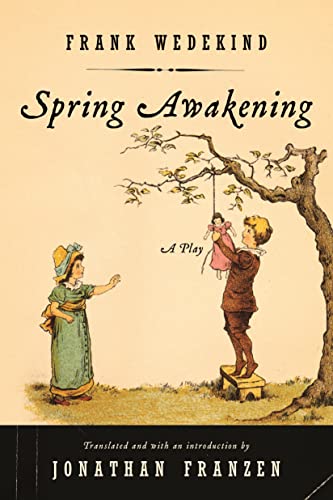
From Jonathan Franzen, bestselling author of The Corrections and Crossroads, comes his razor-sharp translation of Frank Wedekind's major modern play, Spring Awakening.
Featuring an introduction by Franzen. First performed in Germany in 1906, Frank Wedekind's controversial play Spring Awakening closed after one night in New York in 1917 amid charges of obscenity and public outrage. For the better part of the twentieth century Wedekind's intense body of work was largely unpublished and rarely performed. Yet the play's subject matter--teenage desire, suicide, abortion, and homosexuality--is as explosive and important today as it was a century ago. Spring Awakening follows the lives of three teenagers, Melchior, Moritz, and Wendl, as they navigate their entry into sexual awareness. Unlike so many works that claim to tell the truth of adolescence, Spring Awakening offers no easy answers or redemption. Today, more than a hundred years after the play's first performance, a new musical version of this essential modern masterpiece is being hailed as the "best new musical . . . in a generation" (John Heilpern, The New York Observer). Franzen's rendition of the text--for so long poorly served in English--is unique in capturing the bizarre and inimitable comic spirit that animates almost every line of this unrelentingly tragic play. There couldn't be a better time for this thrilling, definitive new translation.Die Inhaltsangabe kann sich auf eine andere Ausgabe dieses Titels beziehen.
Über die Autorinnen und Autoren
Frank Wedekind (1864-1918) had a seminal effect on the development of twentieth-centruy German drama. His plays portray a society riven by the demands of lust and greed, and his powerful writing continues to disturb and shock; his plays were still being refused a performing licence in Britain in the 1960s.
Jonathan Franzen is the author of five novels, including The Corrections, Freedom, and Crossroads, and five works of nonfiction, including Farther Away and The End of the End of the Earth, all published by Farrar, Straus and Giroux. He lives in Santa Cruz, California.
Von der hinteren Coverseite
Spring's Awakening is a tragi-comedy of teenage sex. Its fourteen-year-old heroine, Wendla, is killed by abortion pills. The young Moritz, terrorized by the world around him, and especially by his teachers, shoots himself. The ending seems likely to be the suicide of Moritz's friend, Melchior, but in a confrontation with a mysterious stranger (the famous Masked Man) he finally manages to shed his illusions and face the consequences.
Auszug. © Genehmigter Nachdruck. Alle Rechte vorbehalten.
Spring Awakening
A Children's Tragedy
By Frank Wedekind, Jonathan FranzenFaber and Faber, Inc.
Copyright © 2013 Frank Wedekind
All rights reserved.
ISBN: 978-0-86547-978-4All rights reserved.
CHAPTER 1
ACT ONE
SCENE ONE
A living room.
WENDLA: Why did you make me such a long dress, Mother?
MRS. BERGMANN: It's your fourteenth birthday!
WENDLA: If I'd known you'd make my dress so long, I wouldn't have wanted to be fourteen.
MRS. BERGMANN: This dress is not too long, Wendla. What do you want me to do? Can I help it if my baby is two inches taller every spring? Now that you're a grown-up girl, you can't expect to go out in a pinafore.
WENDLA: At least my pinafore looks better on me than this bathrobe. — Please let me keep wearing it! Just for the summer. This sackcloth is going to fit me the same whether I'm fourteen or fifteen. — Let's put it away till my next birthday; I'd only be stepping on the hem and tearing it.
MRS. BERGMANN: I don't know what to say to you. I'd love to keep you just the way you are, baby. Other girls your age are skinny and gawky. You're the opposite. — Who knows what you'll be like when the others are fully developed.
WENDLA: Who knows — maybe I won't be around anymore.
MRS. BERGMANN: Baby, baby, where do you get these ideas?
WENDLA: Don't, Mommy; don't be sad!
MRS. BERGMANN: (kissing her) My dearest darling!
WENDLA: I get them at night when I can't fall asleep. I don't feel sad at all, and I know I'll sleep all the better then. — Mother, is it sinful to think about things like that?
MRS. BERGMANN: Go and hang the sackcloth in the closet! Put your pinafore back on, for heaven's sake! — When I have a chance, I'll sew a ruffle on the bottom.
WENDLA: (hanging the dress in the closet) No, in that case I'd rather go ahead and be twenty ...!
MRS. BERGMANN: Just as long as you don't get too cold! — That little dress used to be plenty long for you; but ...
WENDLA: Now, when it's almost summer? — Oh, Mother, even children don't get diphtheria in the back of their knees! You're such a worrier. A person doesn't get cold at my age — your legs least of all. Would it be better if I got too hot, Mother? — You can thank the good Lord if your dearest darling doesn't cut her sleeves off one of these mornings and run into you some evening in the twilight without any shoes and socks on! — When I wear my sackcloth, I'm going to be dressed like a fairy queen underneath ... Don't be angry, Mommy! No one will ever know it then.
SCENE TWO
Sunday evening.
MELCHIOR: This is too boring. I'm going to quit.
OTTO: Then the rest of us will have to stop too. — Have you done the homework, Melchior?
MELCHIOR: Just keep playing!
MORITZ: Where are you going?
MELCHIOR: For a walk.
GEORGE: It's getting awfully dark.
ROBERT: Have you done the homework already?
MELCHIOR: Why shouldn't I go for a walk in the dark?
ERNST: Central America! — Louis the Fifteenth! — Sixty lines of Homer! — Seven equations!
MELCHIOR: Damn this homework!
GEORGE: If only the Latin paper wasn't due tomorrow, too!
MORITZ: There's nothing you can think about without homework getting in the way!
OTTO: I'm going home.
GEORGE: Me too, I've got homework.
ERNST: Me too, me too.
ROBERT: Good night, Melchior.
MELCHIOR: Sleep well!
(All except MORITZ and MELCHIOR leave.)
MELCHIOR: What I'd like to know is what are we doing in this world, anyway?
MORITZ: As far as school is concerned, I'd rather be a cab horse! — What do we go to school for? — We go to school so they can give us exams! — And what do they give us exams for? — So we can flunk. — Seven of us have to flunk, if only because the upstairs classroom doesn't hold more than sixty. — I've felt so peculiar since Christmas ... I swear to God, if it weren't for my dad I'd pack a bag tonight and go to Altona Harbor!
MELCHIOR: Let's talk about something else. —
(They go for a walk.)
MORITZ: You see that black cat there with its tail in the air?
MELCHIOR: Do you believe in omens?
MORITZ: I'm not sure. — It came from over there. It doesn't mean anything.
MELCHIOR: This is a Charybdis that I think everyone falls into if they've managed to escape the Scylla of religious superstition. — Let's sit down here under the beech tree. There's a warm spring wind blowing over the mountains. I'd like to be a young dryad now and spend the whole long night up there in the woods, swinging and rocking in the highest treetops ...
MORITZ: Unbutton your vest, Melchior!
MELCHIOR: Ha — the way it makes your clothes puff out!
MORITZ: God, it's getting so pitch-dark you can't even see your hand in front of your face. In fact, where are you? — Don't you agree, Melchior, that a human being's sense of shame is merely a product of his upbringing?
MELCHIOR: I was giving this some thought just the day before yesterday. No matter what, the feeling does seem to be deeply rooted in human nature. Imagine that you're supposed to take off all your clothes in front of your best friend. You wouldn't do it unless he was doing it himself at the same time. — I guess it's also more or less a fashion thing.
MORITZ: I've been thinking that when I have children, little boys and girls, I'm going to start them out sleeping in the same room, if possible in the very same bed, and have them help each other get dressed and undressed every morning and every night, and when the weather's hot both the girls and the boys are not going to wear anything all day except short white woolen tunics with leather belts. — It seems to me that, if they grow up like this, then later on they're bound to be more relaxed than we are, as a rule.
MELCHIOR: That's definitely my opinion, Moritz! — The only question is, what happens when the girls start having babies?
MORITZ: What do you mean having babies?
MELCHIOR: Well, in this regard, I believe in certain instincts. I believe, for example, that if you take a male cat and a female cat and you shut them up together when they're still young, and you keep the two of them isolated from all contact with the outside world — that is, if you leave them entirely to their own inclinations — that sooner or later the female is going to get pregnant, even though neither she nor the male had anyone whose example they could follow.
MORITZ: I guess with animals it eventually just happens.
MELCHIOR: All the more so with people, is what I think! Listen, Moritz, if your boys are sleeping in the very same bed with the girls, and all of a sudden they feel their first masculine stirrings — I'll bet you anything ...
MORITZ: You may be right about that. — But still ...
MELCHIOR: And when your girls reached the proper age it would be exactly the same with them! Not that a girl is quite ... there's obviously no telling exactly what ... still, it's reasonable to assume ... and you can count on curiosity to play its part as well!
MORITZ: One question, by the way —
MELCHIOR: Yes?
MORITZ: You sure you'll answer?
MECHIOR: Of course!
MORITZ: Promise?!
MELCHIOR: Cross my heart. — — Yes, Moritz?
MORITZ: Have you done the essay yet??
MELCHIOR: Come on, spit it out! —...
„Über diesen Titel“ kann sich auf eine andere Ausgabe dieses Titels beziehen.
Suchergebnisse für Spring Awakening: A Play

Beispielbild für diese ISBN
Spring Awakening: A Play
Verlag:
Farrar, Straus and Giroux, 2007
ISBN 10: 086547978X
ISBN 13: 9780865479784
Gebraucht
Softcover
Anbieter: Wonder Book, Frederick, MD, USA
Verkäuferbewertung 5 von 5 Sternen

Zustand: Good. Good condition. A copy that has been read but remains intact. May contain markings such as bookplates, stamps, limited notes and highlighting, or a few light stains. Bestandsnummer des Verkäufers P07Q-00540
Gebraucht kaufen
EUR 6,27
Versand gratis
Versand innerhalb von USA
Versand innerhalb von USA
Anzahl: 2 verfügbar
Beispielbild für diese ISBN
Spring Awakening: A Play
Anbieter: Half Price Books Inc., Dallas, TX, USA
Verkäuferbewertung 5 von 5 Sternen
Paperback. Zustand: Very Good. Connecting readers with great books since 1972! Used books may not include companion materials, and may have some shelf wear or limited writing. We ship orders daily and Customer Service is our top priority! Bestandsnummer des Verkäufers S_462171864
Gebraucht kaufen
EUR 3,18
EUR 3,27 Versand
Versand innerhalb von USA
Versand innerhalb von USA
Anzahl: 1 verfügbar
Beispielbild für diese ISBN
Spring Awakening: A Play
Verlag:
Farrar, Straus and Giroux, 2007
ISBN 10: 086547978X
ISBN 13: 9780865479784
Gebraucht
Paperback
Anbieter: HPB-Ruby, Dallas, TX, USA
Verkäuferbewertung 5 von 5 Sternen
Paperback. Zustand: Very Good. Connecting readers with great books since 1972! Used books may not include companion materials, and may have some shelf wear or limited writing. We ship orders daily and Customer Service is our top priority! Bestandsnummer des Verkäufers S_468496682
Gebraucht kaufen
EUR 3,18
EUR 3,27 Versand
Versand innerhalb von USA
Versand innerhalb von USA
Anzahl: 1 verfügbar
Foto des Verkäufers
Spring Awakening: A Play
Verlag:
Farrar, Straus and Giroux, 2007
ISBN 10: 086547978X
ISBN 13: 9780865479784
Gebraucht
Softcover
Anbieter: Goodwill, Brooklyn Park, MN, USA
Verkäuferbewertung 4 von 5 Sternen

Zustand: good. All pages and cover are intact including the dust cover, if applicable . Spine may show signs of wear. Pages may include limited notes and highlighting. May include "From the library of" labels. Shrink wrap, dust covers, or boxed set case may be missing. Item may be missing bundled media. Bestandsnummer des Verkäufers MINV.086547978X.G
Gebraucht kaufen
EUR 3,28
EUR 3,48 Versand
Versand innerhalb von USA
Versand innerhalb von USA
Anzahl: 1 verfügbar
Beispielbild für diese ISBN
Spring Awakening: A Play
Verlag:
Farrar, Straus and Giroux, 2007
ISBN 10: 086547978X
ISBN 13: 9780865479784
Gebraucht
Paperback
Anbieter: ThriftBooks-Dallas, Dallas, TX, USA
Verkäuferbewertung 5 von 5 Sternen
Paperback. Zustand: Fair. No Jacket. Readable copy. Pages may have considerable notes/highlighting. ~ ThriftBooks: Read More, Spend Less. Bestandsnummer des Verkäufers G086547978XI5N00
Gebraucht kaufen
EUR 6,76
Versand gratis
Versand innerhalb von USA
Versand innerhalb von USA
Anzahl: 1 verfügbar
Beispielbild für diese ISBN
Spring Awakening: A Play
Verlag:
Farrar, Straus and Giroux, 2007
ISBN 10: 086547978X
ISBN 13: 9780865479784
Gebraucht
Paperback
Anbieter: ThriftBooks-Phoenix, Phoenix, AZ, USA
Verkäuferbewertung 5 von 5 Sternen
Paperback. Zustand: Fair. No Jacket. Readable copy. Pages may have considerable notes/highlighting. ~ ThriftBooks: Read More, Spend Less. Bestandsnummer des Verkäufers G086547978XI5N00
Gebraucht kaufen
EUR 6,76
Versand gratis
Versand innerhalb von USA
Versand innerhalb von USA
Anzahl: 1 verfügbar
Beispielbild für diese ISBN
Spring Awakening: A Play
Verlag:
Farrar, Straus and Giroux, 2007
ISBN 10: 086547978X
ISBN 13: 9780865479784
Gebraucht
Paperback
Anbieter: ThriftBooks-Atlanta, AUSTELL, GA, USA
Verkäuferbewertung 5 von 5 Sternen
Paperback. Zustand: Fair. No Jacket. Readable copy. Pages may have considerable notes/highlighting. ~ ThriftBooks: Read More, Spend Less. Bestandsnummer des Verkäufers G086547978XI5N00
Gebraucht kaufen
EUR 6,76
Versand gratis
Versand innerhalb von USA
Versand innerhalb von USA
Anzahl: 1 verfügbar
Beispielbild für diese ISBN
Spring Awakening: A Play
Verlag:
Farrar, Straus and Giroux, 2007
ISBN 10: 086547978X
ISBN 13: 9780865479784
Gebraucht
Paperback
Anbieter: ThriftBooks-Atlanta, AUSTELL, GA, USA
Verkäuferbewertung 5 von 5 Sternen
Paperback. Zustand: Good. No Jacket. Pages can have notes/highlighting. Spine may show signs of wear. ~ ThriftBooks: Read More, Spend Less. Bestandsnummer des Verkäufers G086547978XI3N00
Gebraucht kaufen
EUR 6,76
Versand gratis
Versand innerhalb von USA
Versand innerhalb von USA
Anzahl: 1 verfügbar
Beispielbild für diese ISBN
Spring Awakening: A Play
Verlag:
Farrar, Straus and Giroux, 2007
ISBN 10: 086547978X
ISBN 13: 9780865479784
Gebraucht
Paperback
Anbieter: ThriftBooks-Dallas, Dallas, TX, USA
Verkäuferbewertung 5 von 5 Sternen
Paperback. Zustand: Very Good. No Jacket. May have limited writing in cover pages. Pages are unmarked. ~ ThriftBooks: Read More, Spend Less. Bestandsnummer des Verkäufers G086547978XI4N00
Gebraucht kaufen
EUR 6,76
Versand gratis
Versand innerhalb von USA
Versand innerhalb von USA
Anzahl: 1 verfügbar
Beispielbild für diese ISBN
Spring Awakening: A Play
Verlag:
Farrar, Straus and Giroux, 2007
ISBN 10: 086547978X
ISBN 13: 9780865479784
Gebraucht
Paperback
Anbieter: ThriftBooks-Reno, Reno, NV, USA
Verkäuferbewertung 5 von 5 Sternen
Paperback. Zustand: Good. No Jacket. Pages can have notes/highlighting. Spine may show signs of wear. ~ ThriftBooks: Read More, Spend Less. Bestandsnummer des Verkäufers G086547978XI3N00
Gebraucht kaufen
EUR 6,76
Versand gratis
Versand innerhalb von USA
Versand innerhalb von USA
Anzahl: 1 verfügbar