
Verwandte Artikel zu White Protestant Nation: The Rise of the American Conservati...
Inhaltsangabe
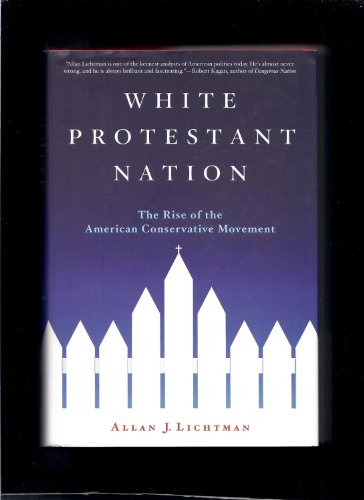
Spanning nearly one hundred years of American political history, and abounding with outsize characters--from Lindbergh to Goldwater to Gingrich to Abramoff-- White Protestant Nation offers a penetrating look at the origins, evolution, and triumph (at times) of modern conservatism. Lichtman is both a professor of political history at American University and a veteran journalist, and after ten years of prodigious research, he has produced what may be the definitive history of the modern conservative movement in America. He brings to life a gallery of dynamic right-wing personalities, from luminaries such as Strom Thurmond, Phyllis Schlafly, and Bill Kristol to indispensable inside operators like financiers Frank Gannett and J. Howard Pew. He explodes the conventional wisdom that modern conservative politics began with Goldwater and instead traces the roots of today’s movement to the 1920s. And he lays bare the tactics that conservatives have used for generations to put their slant on policy and culture; to choke the growth of the liberal state; and to build the most powerful media, fundraising, and intellectual network in the history of representative government. White Protestant Nation is entertaining, provocative, enlightening, and essential reading for anyone who cares about modern American politics and its history.
Die Inhaltsangabe kann sich auf eine andere Ausgabe dieses Titels beziehen.
Auszug. © Genehmigter Nachdruck. Alle Rechte vorbehalten.
WHITE PROTESTANT NATION
The Rise of the American Conservative MovementBy Allan J. LichtmanAtlantic Monthly Press
Copyright © 2008 Allan J. LichtmanAll right reserved.
ISBN: 978-0-87113-984-9
Contents
INTRODUCTION....................................................................11 THE BIRTH OF THE MODERN RIGHT, 1920-1928......................................82 CRYING IN THE WILDERNESS, 1929-1936...........................................503 UP FROM THE ASHES, 1936-1945..................................................934 THE BEST AND THE WORST YEARS FOR CONSERVATIVES, 1945-1952.....................1365 STRANGERS IN A MODERN REPUBLICAN LAND, 1952-1960..............................1846 CONSERVATIVES FALL, RISE, AND FALL AGAIN, 1960-1968...........................2327 THE RIGHT REBUILDS IN ADVERSITY, 1969-1976....................................2818 THE REAGAN REVOLUTION, 1977-1984..............................................3309 RESTORING THE CONSERVATIVE CONSENSUS, 1985-2000...............................379EPILOGUE: A CONSERVATIVE IMPLOSION?.............................................436ACKNOWLEDGMENTS.................................................................457APPENDIX........................................................................459NOTES...........................................................................461BIBLIOGRAPHY....................................................................527INDEX...........................................................................561
Chapter One
THE BIRTH OF THE MODERN RIGHT, 1920-1928
In 1920 the three leading Republican candidates for president, U.S. Army General Leonard Wood, Governor Frank Lowden of Illinois, and Senator Hiram Johnson of California, had hopelessly deadlocked the Republican nominating convention that convened in Chicago. Party leaders, purportedly after meeting in a smoke-filled room at the Blackstone Hotel, then turned to an unlikely compromise nominee, Senator Warren Harding of Ohio. In six undistinguished years in the Senate, the reliably conservative Harding had devoted far more energy to golf, poker, and womanizing than to matters of state. His speaking style, said journalist H. L. Mencken, "reminds me of a string of wet sponges." After Harding's nomination on the tenth ballot, the Republican National Committee paid to send his mistress on a world tour. The Republican-leaning New York Times said, "We must go back to Franklin Pierce if we would seek a president who measures down to his [Harding's] stature."
Yet Harding quickly came to embody the sentiments of a conservative electorate in 1920. He promised a "return to normalcy" for Americans tired of liberal reform, war, and waves of Catholic and Jewish immigrants from southern and eastern Europe. He pledged to end "ineffective meddling" by government in business affairs and to govern as an "America First" president, who, mindful of "racial differences" among people, would open the nation's golden door to "only the immigrant who can be assimilated and thoroughly imbued with the American spirit."
The incumbent Democratic president Woodrow Wilson was everything that Harding was not. Wilson was learned and erudite. He was a brilliant writer, an inspiring orator, and a master of statecraft. He had big ideas for leaving his mark on world history. But the future of America in the 1920s belonged to Harding's Republicans, not Wilson's Democrats.
In April 1917, a month after his second inauguration, Wilson led the nation into World War I. The president worried that war would imperil civil liberties and domestic reform and empower reactionary men of business. But he also nurtured plans for shaping a postwar international order based on self-determination, free trade, and collective security as alternatives to "atavistic imperialism and revolutionary socialism." If Wilson achieved these ambitious goals, he would likely become the first American president elected to a third term and establish his Democrats as America's enduring majority party. It didn't work out as planned for the president, the Democratic Party, the nation, or the world.
Modern conservativism took flight in response to the crisis that followed a brutal war and a failed peace. The war unleashed a wave of nationalism at home that brought on the government's repression of dissent and spread civil and racial strife across the nation. America sacrificed 118,000 young men to a savage war that annulled all standards of morality and restraint. Wilson's Democratic coalition first cracked in 1918, when Republicans recaptured the U.S. House and Senate, a week before Armistice Day, and congressional voting moved to the right. Then Wilson's peace plans collapsed amid the base ambitions of Europe's rulers, and bomb-throwing Bolsheviks replaced club-wielding Huns as the shadow falling on civilization. Although the president salvaged his plan for a League of Nations, the Senate rejected the treaty that established the League and Wilson suffered a debilitating stroke, which dashed his hopes for another presidential run. No matter. Failure abroad, social unrest and fears of radical subversion at home, and a postwar recession made 1920 a bad year for any Democratic candidate for president. On Election Day, voters cast their ballots overwhelmingly for a return to peacetime normalcy. Harding won the most decisive popular-vote victory in American history, with 60 percent of the poplar vote to 34 percent for Ohio governor James Cox, whom Democrats had nominated after forty-four ballots at their San Francisco convention.
By the 1920s a gulf had opened between Americans still devoted to a national identity defined by late-nineteenth-century Victorian values and those tied to the increasingly pluralistic cultural forces of the twentieth century. Anti-pluralists joined with leaders of business to forge a new conservative consensus in the 1920s that locked together support for private enterprise and white Protestant cultural values. The conservatives who dominated American politics in the 1920s established most of the enduring ideas and institutions that would ground the modern political right. Taken together, the prohibition of vice, anticommunism, conservative maternalism, evangelical Protestantism, business conservatism, racial science and containment, and the grassroots organizing of the Ku Klux Klan formed a stout defense of America's white Protestant, free enterprise civilization.
PROHIBITION POLITICS
For Wayne B. Wheeler of the Anti-Saloon League, the dark clouds of World War I had the silver lining of encouraging moral reform. "America has just two gigantic foes, kaiserism and the liquor traffic," Wheeler said, and he predicted victory over both these evils. Wheeler was right. In January 1919, two months after the war ended, the states ratified the Eighteenth Amendment prohibiting the manufacture, transport, and sale of alcohol. The successful campaign for prohibition showed that white Protestants, often led by women reformers, could successfully wage a bottom-up battle for their vision of moral conduct and a just society. Anti-alcohol campaigns had for many decades targeted working-class immigrants, most often Catholic, who patronized saloons and vice dens. In the South, prohibitionists argued that rum and whiskey had become symbols of freedom for blacks that led to social disharmony, crime, and the sexual violation of white women by black men.
The Eighteenth Amendment was...
„Über diesen Titel“ kann sich auf eine andere Ausgabe dieses Titels beziehen.
Suchergebnisse für White Protestant Nation: The Rise of the American Conservati...

Beispielbild für diese ISBN
White Protestant Nation: The Rise of the American Conservative Movement
Anbieter: Orion Tech, Kingwood, TX, USA
Verkäuferbewertung 5 von 5 Sternen

hardcover. Zustand: Good. Bestandsnummer des Verkäufers 0871139847-3-32238060
Gebraucht kaufen
EUR 4,78
Versand gratis
Versand innerhalb von USA
Versand innerhalb von USA
Anzahl: 1 verfügbar
Beispielbild für diese ISBN
White Protestant Nation: The Rise of the American Conservative Movement
Anbieter: World of Books (was SecondSale), Montgomery, IL, USA
Verkäuferbewertung 5 von 5 Sternen
Zustand: Very Good. Item in very good condition! Textbooks may not include supplemental items i.e. CDs, access codes etc. Bestandsnummer des Verkäufers 00105437517
Gebraucht kaufen
EUR 4,78
Versand gratis
Versand innerhalb von USA
Versand innerhalb von USA
Anzahl: 2 verfügbar
Beispielbild für diese ISBN
White Protestant Nation: The Rise of the American Conservative Movement
Anbieter: World of Books (was SecondSale), Montgomery, IL, USA
Verkäuferbewertung 5 von 5 Sternen
Zustand: Acceptable. Item in acceptable condition! Textbooks may not include supplemental items i.e. CDs, access codes etc. Bestandsnummer des Verkäufers 00100839672
Gebraucht kaufen
EUR 4,78
Versand gratis
Versand innerhalb von USA
Versand innerhalb von USA
Anzahl: 1 verfügbar
Foto des Verkäufers
White Protestant Nation: The Rise of the American Conservative Movement
Anbieter: Greenworld Books, Arlington, TX, USA
Verkäuferbewertung 5 von 5 Sternen
Zustand: acceptable. Fast Free Shipping â" A well-loved copy with text fully readable and cover pages intact. May display wear such as writing, highlighting, bends, folds or library marks. Still a complete and usable book. Bestandsnummer des Verkäufers GWV.0871139847.A
Gebraucht kaufen
EUR 5,01
Versand gratis
Versand innerhalb von USA
Versand innerhalb von USA
Anzahl: 1 verfügbar
Beispielbild für diese ISBN
White Protestant Nation: The Rise of the American Conservative Movement
Verlag:
Atlantic Monthly Press (edition First Edition), 2008
ISBN 10: 0871139847
ISBN 13: 9780871139849
Gebraucht
Hardcover
Erstausgabe
Anbieter: BooksRun, Philadelphia, PA, USA
Verkäuferbewertung 5 von 5 Sternen
Hardcover. Zustand: Very Good. First Edition. With dust jacket. It's a well-cared-for item that has seen limited use. The item may show minor signs of wear. All the text is legible, with all pages included. It may have slight markings and/or highlighting. Bestandsnummer des Verkäufers 0871139847-11-1-29
Gebraucht kaufen
EUR 5,45
Versand gratis
Versand innerhalb von USA
Versand innerhalb von USA
Anzahl: 1 verfügbar
Beispielbild für diese ISBN
White Protestant Nation: The Rise of the American Conservative Movement
Anbieter: ThriftBooks-Dallas, Dallas, TX, USA
Verkäuferbewertung 5 von 5 Sternen
Hardcover. Zustand: Very Good. No Jacket. May have limited writing in cover pages. Pages are unmarked. ~ ThriftBooks: Read More, Spend Less. Bestandsnummer des Verkäufers G0871139847I4N00
Gebraucht kaufen
EUR 5,87
Versand gratis
Versand innerhalb von USA
Versand innerhalb von USA
Anzahl: 1 verfügbar
Beispielbild für diese ISBN
White Protestant Nation: The Rise of the American Conservative Movement
Anbieter: ThriftBooks-Atlanta, AUSTELL, GA, USA
Verkäuferbewertung 5 von 5 Sternen
Hardcover. Zustand: Good. No Jacket. Pages can have notes/highlighting. Spine may show signs of wear. ~ ThriftBooks: Read More, Spend Less. Bestandsnummer des Verkäufers G0871139847I3N00
Gebraucht kaufen
EUR 5,87
Versand gratis
Versand innerhalb von USA
Versand innerhalb von USA
Anzahl: 1 verfügbar
Beispielbild für diese ISBN
White Protestant Nation: The Rise of the American Conservative Movement
Anbieter: ThriftBooks-Reno, Reno, NV, USA
Verkäuferbewertung 5 von 5 Sternen
Hardcover. Zustand: Very Good. No Jacket. May have limited writing in cover pages. Pages are unmarked. ~ ThriftBooks: Read More, Spend Less. Bestandsnummer des Verkäufers G0871139847I4N00
Gebraucht kaufen
EUR 5,87
Versand gratis
Versand innerhalb von USA
Versand innerhalb von USA
Anzahl: 1 verfügbar
Beispielbild für diese ISBN
White Protestant Nation: The Rise of the American Conservative Movement
Anbieter: ThriftBooks-Atlanta, AUSTELL, GA, USA
Verkäuferbewertung 5 von 5 Sternen
Hardcover. Zustand: Very Good. No Jacket. May have limited writing in cover pages. Pages are unmarked. ~ ThriftBooks: Read More, Spend Less. Bestandsnummer des Verkäufers G0871139847I4N00
Gebraucht kaufen
EUR 5,87
Versand gratis
Versand innerhalb von USA
Versand innerhalb von USA
Anzahl: 1 verfügbar
Beispielbild für diese ISBN
White Protestant Nation: The Rise of the American Conservative Movement
Anbieter: ThriftBooks-Dallas, Dallas, TX, USA
Verkäuferbewertung 5 von 5 Sternen
Hardcover. Zustand: Good. No Jacket. Pages can have notes/highlighting. Spine may show signs of wear. ~ ThriftBooks: Read More, Spend Less. Bestandsnummer des Verkäufers G0871139847I3N00
Gebraucht kaufen
EUR 5,87
Versand gratis
Versand innerhalb von USA
Versand innerhalb von USA
Anzahl: 1 verfügbar