
Verwandte Artikel zu Real Estate Development: Principles and Process
Inhaltsangabe
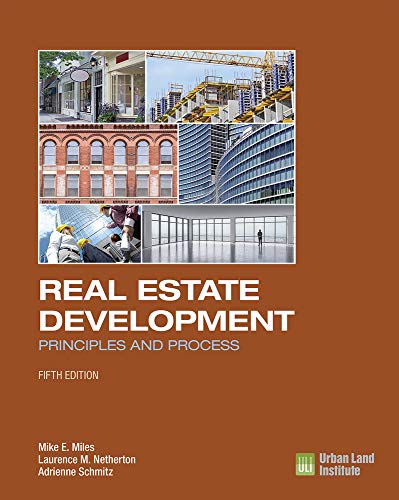
This comprehensive book covers each stage of the real estate development process, explaining the basics of idea conception, feasibility, planning, financing, market analysis, contract negotiation, construction, marketing, and asset management. Widely used by professionals and in universities, this book should be on the shelf of anyone involved in architecture, planning, development, investment, or related fields.
Die Inhaltsangabe kann sich auf eine andere Ausgabe dieses Titels beziehen.
Über die Autorin bzw. den Autor
Mike E. Miles is a portfolio manager for Guggenheim Real Estate and is a former professor of real estate and the dean of the business school at University of North Carolina–Chapel Hill. Laurence M. Netherton is a 40 year veteran of real estate investment and development. He is a former professor of land planning at the University of California–Irvine. Adrienne Schmitz is the former senior director of publications at the Urban Land Institute.
Auszug. © Genehmigter Nachdruck. Alle Rechte vorbehalten.
Real Estate Development
Principles and Process
By Mike E. Miles, Gayle Berens, Mark J. Eppli, Marc A. WeissUrban Land Institute
Copyright © 2007 ULI–the Urban Land Institute
All rights reserved.
ISBN: 978-0-87420-343-1All rights reserved.
Contents
PART I. INTRODUCTION,
Chapter 1. The Real Estate Development Process,
Chapter 2. The Raw Material: Land and Demographics in the United States,
Chapter 3. Developers and Their Partners,
PART II. THE HISTORY OF REAL ESTATE DEVELOPMENT IN THE UNITED STATES,
Chapter 4. The Colonial Period to the Late 1800s,
Chapter 5. The Late 1800s to World War II,
Chapter 6. Post–World War II to the Present,
PART III. FINANCE,
Chapter 7. Real Estate Finance: Background,
Chapter 8. Real Estate Finance: The Logic behind Real Estate Financing Decisions,
Chapter 9. Discounted Cash Flow: The Equity Perspective in More Detail,
PART IV. IDEAS,
Chapter 10. Stage One: Inception of an Idea,
Chapter 11. Market Research: A Tool for Generating Ideas,
Chapter 12. Stage Two: Refinement of the Idea,
PART V. PLANNING AND ANALYSIS: THE PUBLIC ROLES,
Chapter 13. The Roles of the Public Sector,
Chapter 14. Meshing Public and Private Roles in the Development Process,
Chapter 15. Affordable Housing,
PART VI. PLANNING AND ANALYSIS: THE MARKET PERSPECTIVE,
Chapter 16. Stage Three: The Feasibility Study,
Chapter 17. Market Analysis: Collecting, Validating, and Understanding Market Data,
Chapter 18. Data Sources Supporting Market Studies,
PART VII. MAKING IT HAPPEN,
Chapter 19. Stages Four and Five: Contract Negotiation and Formal Commitment,
Chapter 20. Stages Six and Seven: Construction, Completion, and Formal Opening,
PART VIII. MAKING IT WORK,
Chapter 21. Stage Eight: Property, Asset, and Portfolio Management,
Chapter 22. The Challenge of Marketing and Sales,
Chapter 23. Some Closing Thoughts and a Note about the Future,
Appendix A. Europa Center Case Study,
Appendix B. Gateway Business Center Offering Memorandum,
Appendix C. The Real Estate Game: Level One and Level Two,
Appendix D. Glossary,
Bibliography,
Index,
CHAPTER 1
The Real Estate Development Process
Real estate development is the continual reconfiguration of the built environment to meet society's needs. Roads, sewer systems, housing, office buildings, and lifestyle centers do not just happen. Someone must initiate and manage the creation, maintenance, and eventual re-creation of the spaces in which we live, work, and play.
The need for development is constant, because population, technology, and taste never stop changing. New generations, new lifestyle choices, and revolving immigrant groups, coupled with the evolution of technology, drive economic changes in consumer tastes and individual preferences.
Whether current consumer, new citizen, or real estate professional, all of us inhabit the built environment. Further, through the legislative/political process, we collectively continue to alter the rules of the development process. Therefore, we should all understand the development process. The development process creates the houses we live in, the mixed-use development down the street, the 25-story office tower downtown, the warehouse that stored the paper this book was printed on, and the convenient (but to some tastes terribly unattractive) fast-food restaurant on the commercial strip.
Both public and private participants in real estate development share compelling reasons for understanding the development process. The goals of private sector participants are to minimize risk while maximizing personal and/or institutional objectives — usually profit (wealth maximization) but often nonmonetary objectives as well. Few business ventures are as heavily leveraged as traditional real estate development projects, magnifying the risk of ruin but also increasing the potential for high returns to equity. Large fortunes have been and continue to be made and lost in real estate development.
The public sector's goal is to promote sound and smart development, ensuring that construction is attractive and safe and that new developments are located and designed to enhance the community, provide needed space, and boost the economy. Sound development means balancing the public's need for both constructed space and economic growth against the public responsibility to provide services and improve the quality of life without harming the environment.
The public and private sectors are involved as partners in every real estate development project. A key tenet of this book is that all participants enjoy a higher probability of achieving their goals and objectives if they understand how the development process works, who the other players are, how their objectives are interwoven, and the need to achieve consensus.
This book was written for people who need to understand real estate development from the perspectives of both the public and private sectors. Its aim is to be useful to present and future developers, city planners, legislators, regulators, corporate real estate officers, land planners, lawyers specializing in real estate or municipal law, architects, engineers, building contractors, lenders, market analysts, and leasing agents/brokers. Readers are assumed to have already acquired the fundamentals of real estate and/or city planning. This book summarizes but does not repeat in great detail basic information about real estate law and finance, urban economics, and land planning and design. Although the focus of our book is the individual entrepreneurial developer, it is important to note that developers can also be financial institutions, corporations, universities, medical centers, private investors, cities, municipalities, and others. The process laid out in this book remains essentially the same — no matter who the developer is. Market decisions still have to be made, pro form as still need integrity, designers have to be consulted, and so on. The process might be layered by various institutional procedures and committees and boards of trustees, but the product is achieved by going through the same steps. In fact, many institutions and cities are hiring entrepreneurial developers on a fee basis to manage a project's development within the larger organizational framework.
Throughout, the book includes profiles of developers and the diverse set of professionals who work with developers. Their career paths are always interesting and often surprising. Their perspectives on development are especially valuable because these individuals have lived the process we are describing. Development decision making has become more difficult as the world has grown more complex, and developers' and professionals' insights help frame the development process in human terms.
In addition to the various profiles, the book focuses on three developers and three projects. One profile is of Russell Katz, a young developer who was originally trained as an architect. An ardent supporter of green buildings, one of his goals in developing Elevation 314, a four-story, 52-unit apartment complex, is to demonstrate the potential of environmentally friendly architecture.
The other project involves two residential towers developed in Cambridge, Massachusetts, by Dean Stratouly of Congress Group Ventures. Museum Towers is the story of a development in a pioneering location.
In addition to Katz's and Stratouly's experiences, Appendix A of...
„Über diesen Titel“ kann sich auf eine andere Ausgabe dieses Titels beziehen.
Suchergebnisse für Real Estate Development: Principles and Process

Beispielbild für diese ISBN
Real Estate Development - 5th Edition: Principles and Process
Verlag:
Urban Land Institute (edition Fifth Edition, Fifth), 2015
ISBN 10: 0874203430
ISBN 13: 9780874203431
Gebraucht
Hardcover
Anbieter: BooksRun, Philadelphia, PA, USA
Verkäuferbewertung 5 von 5 Sternen

Hardcover. Zustand: Very Good. Fifth Edition, Fifth. It's a well-cared-for item that has seen limited use. The item may show minor signs of wear. All the text is legible, with all pages included. It may have slight markings and/or highlighting. Bestandsnummer des Verkäufers 0874203430-11-1
Gebraucht kaufen
EUR 49,56
Versand gratis
Versand innerhalb von USA
Versand innerhalb von USA
Anzahl: 4 verfügbar
Beispielbild für diese ISBN
Real Estate Development - 5th Edition: Principles and Process
Verlag:
Urban Land Institute (edition Fifth Edition, Fifth), 2015
ISBN 10: 0874203430
ISBN 13: 9780874203431
Gebraucht
Hardcover
Anbieter: BooksRun, Philadelphia, PA, USA
Verkäuferbewertung 5 von 5 Sternen
Hardcover. Zustand: Very Good. Fifth Edition, Fifth. It's a well-cared-for item that has seen limited use. The item may show minor signs of wear. All the text is legible, with all pages included. It may have slight markings and/or highlighting. Bestandsnummer des Verkäufers 0874203430-11-12
Gebraucht kaufen
EUR 49,82
Versand gratis
Versand innerhalb von USA
Versand innerhalb von USA
Anzahl: 6 verfügbar
Beispielbild für diese ISBN
Real Estate Development - 5th Edition: Principles and Process
Verlag:
Urban Land Institute (edition Fifth Edition, Fifth), 2015
ISBN 10: 0874203430
ISBN 13: 9780874203431
Gebraucht
Hardcover
Anbieter: BooksRun, Philadelphia, PA, USA
Verkäuferbewertung 5 von 5 Sternen
Hardcover. Zustand: Very Good. Fifth Edition, Fifth. It's a well-cared-for item that has seen limited use. The item may show minor signs of wear. All the text is legible, with all pages included. It may have slight markings and/or highlighting. Bestandsnummer des Verkäufers 0874203430-8-1
Gebraucht kaufen
EUR 49,82
Versand gratis
Versand innerhalb von USA
Versand innerhalb von USA
Anzahl: 1 verfügbar
Foto des Verkäufers
Real Estate Development - 5th Edition: Principles and Process
Anbieter: Goodwill Southern California, Los Angeles, CA, USA
Verkäuferbewertung 5 von 5 Sternen
Zustand: good. Hardcover Book. Bestandsnummer des Verkäufers 4CJULU001VZB
Gebraucht kaufen
EUR 47,26
EUR 2,59 Versand
Versand innerhalb von USA
Versand innerhalb von USA
Anzahl: 1 verfügbar
Foto des Verkäufers
Real Estate Development - 5th Edition: Principles and Process
Anbieter: Greenworld Books, Arlington, TX, USA
Verkäuferbewertung 5 von 5 Sternen
Zustand: like_new. Fast Free Shipping â" Excellent condition book with clean cover and pages. Barely handled, with minimal wear. An outstanding copy, close to enjoy! Bestandsnummer des Verkäufers GWV.0874203430.LN
Gebraucht kaufen
EUR 50,14
Versand gratis
Versand innerhalb von USA
Versand innerhalb von USA
Anzahl: 5 verfügbar
Beispielbild für diese ISBN
Real Estate Development - 5th Edition: Principles and Process
Anbieter: ThriftBooks-Atlanta, AUSTELL, GA, USA
Verkäuferbewertung 5 von 5 Sternen
Hardcover. Zustand: Good. No Jacket. Pages can have notes/highlighting. Spine may show signs of wear. ~ ThriftBooks: Read More, Spend Less. Bestandsnummer des Verkäufers G0874203430I3N00
Gebraucht kaufen
EUR 50,68
Versand gratis
Versand innerhalb von USA
Versand innerhalb von USA
Anzahl: 1 verfügbar
Beispielbild für diese ISBN
Real Estate Development - 5th Edition: Principles and Process
Anbieter: ThriftBooks-Dallas, Dallas, TX, USA
Verkäuferbewertung 5 von 5 Sternen
Hardcover. Zustand: Good. No Jacket. Pages can have notes/highlighting. Spine may show signs of wear. ~ ThriftBooks: Read More, Spend Less. Bestandsnummer des Verkäufers G0874203430I3N00
Gebraucht kaufen
EUR 50,68
Versand gratis
Versand innerhalb von USA
Versand innerhalb von USA
Anzahl: 1 verfügbar
Beispielbild für diese ISBN
Real Estate Development - 5th Edition: Principles and Process
Anbieter: ThriftBooks-Dallas, Dallas, TX, USA
Verkäuferbewertung 5 von 5 Sternen
Hardcover. Zustand: Very Good. No Jacket. May have limited writing in cover pages. Pages are unmarked. ~ ThriftBooks: Read More, Spend Less. Bestandsnummer des Verkäufers G0874203430I4N00
Gebraucht kaufen
EUR 50,68
Versand gratis
Versand innerhalb von USA
Versand innerhalb von USA
Anzahl: 1 verfügbar
Beispielbild für diese ISBN
Real Estate Development - 5th Edition: Principles and Process
Anbieter: HPB-Red, Dallas, TX, USA
Verkäuferbewertung 5 von 5 Sternen
Hardcover. Zustand: Acceptable. Connecting readers with great books since 1972. Used textbooks may not include companion materials such as access codes, etc. May have condition issues including wear and notes/highlighting. We ship orders daily and Customer Service is our top priority! Bestandsnummer des Verkäufers S_480723491
Gebraucht kaufen
EUR 48,42
EUR 3,24 Versand
Versand innerhalb von USA
Versand innerhalb von USA
Anzahl: 1 verfügbar
Beispielbild für diese ISBN
Real Estate Development - 5th Edition: Principles and Process
Anbieter: HPB-Red, Dallas, TX, USA
Verkäuferbewertung 5 von 5 Sternen
Hardcover. Zustand: Good. Connecting readers with great books since 1972! Used textbooks may not include companion materials such as access codes, etc. May have some wear or writing/highlighting. We ship orders daily and Customer Service is our top priority! Bestandsnummer des Verkäufers S_479852905
Gebraucht kaufen
EUR 48,56
EUR 3,24 Versand
Versand innerhalb von USA
Versand innerhalb von USA
Anzahl: 1 verfügbar