
Verwandte Artikel zu Cattle, Capitalism, Class: Ilparakuyo Maasai Transformations
Inhaltsangabe
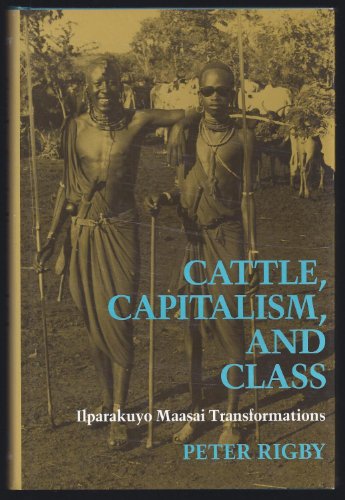
Focusing on the Ilparakuyo Maasai of Kenya and Tanzania, Peter Rigby discusses why third world development policies with regard to pastoral societies are inappropriate and likely to fail. A political economy of development, maintains Rigby, must incorporate historical, cultural, linguistic, and even aesthetic dimensions of the peoples involved. Using ethnography and other research materials, the author illuminates the culture and explores the prospects of a distinct section of pastoral Maasai (the Ilparakuyo). In addition, he attempts to develop a historical materialist theory of language in relation to a specific East African culture.
While rural development is a priority in many recently independent third world countries, it is often not designed for the benefit of the producer, as when food products are exported rather than used for domestic consumption. Although much information is available about pastoral societies - herd size, grazing areas, livestock holdings between families - the cultures, languages, and aspirations of such societies are often overlooked by development planners. Rigby describes how government expectations should be based on such social conditions.
Adopting an African perspective derived from a dialogue with African philosophical discourse, Rigby analyzes the language customs of the people he lived with to chronicle the changes forced upon the Maasai by both colonial and post-colonial governments. The book features more than a dozen photos that portray a juxtaposition of tradition and modern development in local communities. The Maasai have been victims of land expropriation, unnatural division by international boundaries, forcible interference with their customs and rituals, and marginalization by developing governments. Despite this incessant onslaught and the formation of classes in a hitherto classless society, the Maasai have managed to a great degree to preserve their culture and way of thinking. Rigby urges a revolution in planning priorities that respects the Maasai way of life.
Die Inhaltsangabe kann sich auf eine andere Ausgabe dieses Titels beziehen.
Suchergebnisse für Cattle, Capitalism, Class: Ilparakuyo Maasai Transformations

Beispielbild für diese ISBN
Cattle, Capitalism, and Class: Ilparakuyo Maasai Transformations
Verlag:
Temple University Press, 1992
ISBN 10: 0877229546
ISBN 13: 9780877229544
Gebraucht
Soft cover
Anbieter: N. Fagin Books, Chicago, IL, USA
Verkäuferbewertung 5 von 5 Sternen

Soft cover. Zustand: Near Fine. 1992. Africa. Temple University Press. 247p.,very good -fine paperback. 4/23 and 10/23. Bestandsnummer des Verkäufers -1091690848
Gebraucht kaufen
EUR 7,11
EUR 5,18 Versand
Versand innerhalb von USA
Versand innerhalb von USA
Anzahl: 1 verfügbar
Beispielbild für diese ISBN
Cattle, Capitalism, Class
Verlag:
Temple University Press, 1992
ISBN 10: 0877229546
ISBN 13: 9780877229544
Gebraucht
Hardcover
Anbieter: Better World Books, Mishawaka, IN, USA
Verkäuferbewertung 5 von 5 Sternen
Zustand: Very Good. Former library copy. Pages intact with possible writing/highlighting. Binding strong with minor wear. Dust jackets/supplements may not be included. Includes library markings. Stock photo provided. Product includes identifying sticker. Better World Books: Buy Books. Do Good. Bestandsnummer des Verkäufers 39617548-6
Gebraucht kaufen
EUR 14,76
Versand gratis
Versand innerhalb von USA
Versand innerhalb von USA
Anzahl: 1 verfügbar
Beispielbild für diese ISBN
Cattle, Capitalism, and Class: Ilparakuyo Maasai Transformations
ISBN 10: 0877229546
ISBN 13: 9780877229544
Gebraucht
Hardcover
Erstausgabe
Anbieter: Granada Bookstore, IOBA, Woodlawn, IL, USA
Verkäuferbewertung 5 von 5 Sternen
Hardcover. Zustand: Fine. Zustand des Schutzumschlags: Good. First Edition. First Edition (Nap - No Additional Printing Stated, Thus First). Bibliographical References And Index. The Jacket Front Has Many Scratches. Bestandsnummer des Verkäufers 002581
Gebraucht kaufen
EUR 11,55
EUR 6,03 Versand
Versand innerhalb von USA
Versand innerhalb von USA
Anzahl: 1 verfügbar
Beispielbild für diese ISBN
Cattle, capitalism, and class: Ilparakuyo Maasai transformations.
Verlag:
Temple University Press, 1992
ISBN 10: 0877229546
ISBN 13: 9780877229544
Gebraucht
Hardcover
Anbieter: Kloof Booksellers & Scientia Verlag, Amsterdam, Niederlande
Verkäuferbewertung 4 von 5 Sternen

Zustand: as new. Philadelphia,1992. Orig. cloth binding. Dustjacket. xviii,247p.,ills. Index. Bibliography. Condition : as new copy. ISBN 9780877229544. Keywords : , Africa. Bestandsnummer des Verkäufers 77683
Gebraucht kaufen
EUR 20,95
EUR 30,00 Versand
Versand von Niederlande nach USA
Versand von Niederlande nach USA
Anzahl: 1 verfügbar