
Verwandte Artikel zu Astrology for Initates: Astrological Secrets of the...
Inhaltsangabe
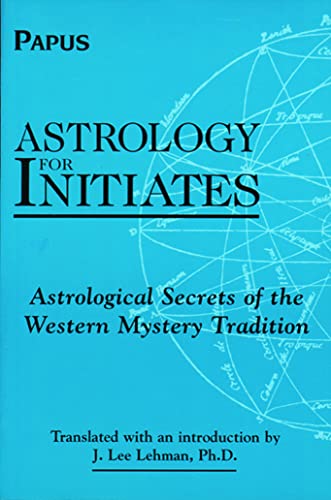
By borrowing from Burgoyne and the Continental astrological tradition, Papus produced a work that provides fresh insights to the English speaking astrological tradition. Lehman's introduction places Papus in an historical perspective and explains his influence in late 19th and early 20th century France. In translating this work from the French, she has given English speaking students of astrology and the Western Mystery Tradition an important source work.
Die Inhaltsangabe kann sich auf eine andere Ausgabe dieses Titels beziehen.
Auszug. © Genehmigter Nachdruck. Alle Rechte vorbehalten.
Astrology for Initiates
Astrological Secrets of the Western Mystery Tradition
By J. Lee LehmanSamuel Weiser, Inc.
Copyright © 1996 Samuel Weiser, Inc.
All rights reserved.
ISBN: 978-0-87728-894-7All rights reserved.
Contents
| Translator's Introduction | |
| A Word to the Reader | |
| Chapter 1. The Celestial Sphere | |
| Chapter 2. The Planets | |
| Chapter 3. The Twelve Signs | |
| Chapter 4. Applications of Astrology | |
| Appendix. Astrology and the Calendar | |
| Tables | |
| Translator's References | |
| Index | |
| About the Translator |
CHAPTER 1
The Celestial Sphere
In the night if we direct our regard toward the starry sky, we can see, if theweather is clear, an enormous quantity of stars, more or less brilliant, and sooverwhelming that it seems impossible to even recognize anything at first. Whileobserving all these brilliant points in the sky more closely, we begin to noticethat some of them form distinct groups of stars separate from one another.
How to Recognize these in the Mass of Stars
In antiquity, people formed these groups of stars, figures to which theimagination of the wise ones assigned some shapes. Some are merely geometric,but most often people used the shapes of animals, of people, or of objects. Onegave the name of constellations to these clumps of stars, and there are someunique constellations in the Northern Hemisphere which are directly overhead inEurope, and some others unique to the Southern Hemisphere, on the other side theequator.
The Starry Route
One should also note, that besides some stationary stars that appear studded inthe sky like so many lights, there are also mobile bodies that promenade throughthe constellations. These stars are first the Sun, then the Moon. Of the rest,the planets, we will speak later. Let us hold on, for the moment, to theexterior sensations that they produce on the Earth. We will see that a lot ofobvious movements are actually due to the movement of the Earth, but we willignore this at present, because it would interfere with the clarity of ourdescriptions. Therefore, in observing the sky, people realized that in itscourse the Sun traversed the constellations, always the same; they noted thatthe Moon followed the same course, as well as all the other wandering stars, orplanets.
The Zodiac
This pathway followed by the celestial wanderers through the sky was called theway of the celestial animals, or the divine starry way or zodiac. This zodiac iscomposed of twelve constellations, and this study is most important for theastronomer, as much as for the astrologer. We will return to it for more detaillater.
Divisions of Sky
All the bodies in the sky therefore divide in two major types; first thestationary stars forming the constellations, then the wandering stars movingthrough the twelve constellations of the zodiac.
Stationary Stars
The word "fixed" applied to the stars is relative; these stars indeed don'tdisplace individually, this is what differentiates them from the wanderingstars. But the sky displaces around the Celestial Pole; behold why the ancientsconsidered the sky like a large ocean, within which the constellations rose orset.
The Celestial Sphere
A set of astronomical observations ancient and modern based on the rising andsetting of the constellations.
The Celestial Sphere (According to the Ancient System of Ptolemy)
In order to navigate, people divided the celestial sphere in a very simple andanalogous way to the division of the Earth. The celestial sphere has two Poles;a North or Arctic Pole, and a South or Antarctic Pole. Between these two Polesand in the middle of the sphere is the celestial Equator, parallel to the Poles;the zodiac, acting in the sky like the ecliptic on the Earth; cuts the Equatorin two places, in such a way that six signs of zodiac are above the Equator,toward the North or Arctic Pole, and six beneath the Equator, toward the Southor Antarctic Pole. The accompanying figure will clarify this situation of zodiacand Equator. (See figure 2 on page 4.)
The sign that is the most northern point of the zodiac is Cancer; the sign that
is the most southern, closest to the Antarctic Pole, is Capricorn.In addition to the equator and to the parallel circles in the celestial sphere,there is another circle that passes through Capricorn and is called the Tropicof Capricorn. (See figure 3 on page 6.)
The two signs of zodiac of which we have just spoken, Cancer and Capricorn,forming the extreme northerly point and the extreme southerly point of thezodiac, constitute the line of the solstices; two other signs, the eastern point(Aries), and the western point (Libra), constitute the line of the equinoxes.
These last two signs are exactly placed at the two points where the zodiac cutsthe equator. In the starry way, one finds, therefore, the grand celestial cross,defined by the line of the equinoxes and solstices, and constituted by foursigns, North-South, and East-West; Cancer-Capricorn, and Aries-Libra.
The astrologers call these four signs, the angular houses, because they occupythe four angles of sky, or the four cardinal points. (See figure 4 on page 6.)
These four angles indicate the beginning of the four seasons. It is necessarynow to memorize in order the names of the twelve zodiacal signs. These signs arethe following, with the corresponding months, because the astrologers' yearbegins in March:
These dates indicate the entrance of the Sun in the different signs in 1916.
In order to learn the signs of zodiac in sequence by heart, you may use thefollowing mnemonic:
In small doses, you will manage to memorize the succession of the signs of thezodiac, which is indispensable to memorize for astrological studies.
Each one of the twelve signs of zodiac is composed of groups of stars, which,united together, comprise geometrical figures. All of antiquity assigned to thezodiacal signs the symbolic figures of animals, personages, or objects whoresemble their name. Finally, each one of the zodiacal signs is also given aglyph (see figure 4), and we enlist the reader to combine the glyph and themnemonic formula above.
We will proceed, for the moment, but let's retain what we have learnedconcerning the zodiac, which will give us the opportunity to discuss it ingreater detail later.
CHAPTER 2
The Planets
The zodiac is the road followed by the planets or mobile stars. All the planetstraverse successively through the twelve signs of the zodiac, but each one witha different speed. Let us take as our first example the march of the Sun, whichserved as the basis for the establishment of a mass of allegorical stories inancient mythology.
We will give some elements of plain astronomy first, and it is only in afollowing chapter that we will bring back the astrological point of view ininterpreting the physical data of the astronomers.
First Hierarchy of the Plants
For the astronomer, the Sun is at the center of our planetary world. (See figure5, page 10.) If we move away from the position of the Sun, we have the planetsin the following sequence:
1) Sun
2) Mercury
3)...
„Über diesen Titel“ kann sich auf eine andere Ausgabe dieses Titels beziehen.
Suchergebnisse für Astrology for Initates: Astrological Secrets of the...

Beispielbild für diese ISBN
Astrology for Initiates: Astrological Secrets of the Western Mystery Tradition
Verlag:
Weiser Books (edition ), 1996
ISBN 10: 0877288941
ISBN 13: 9780877288947
Gebraucht
Paperback
Anbieter: BooksRun, Philadelphia, PA, USA
Verkäuferbewertung 5 von 5 Sternen

Paperback. Zustand: Fair. The item might be beaten up but readable. May contain markings or highlighting, as well as stains, bent corners, or any other major defect, but the text is not obscured in any way. Bestandsnummer des Verkäufers 0877288941-7-1
Gebraucht kaufen
EUR 6,59
Versand gratis
Versand innerhalb von USA
Versand innerhalb von USA
Anzahl: 1 verfügbar
Beispielbild für diese ISBN
Astrology for Initiates: Astrological Secrets of the Western Mystery Tradition
Anbieter: New Legacy Books, Annandale, NJ, USA
Verkäuferbewertung 5 von 5 Sternen
paperback. Zustand: Good. Fast shipping and order satisfaction guaranteed. A portion of your purchase benefits Non-Profit Organizations, First Aid and Fire Stations! Bestandsnummer des Verkäufers mon0000108279
Gebraucht kaufen
EUR 8,22
EUR 2,21 Versand
Versand innerhalb von USA
Versand innerhalb von USA
Anzahl: 1 verfügbar
Beispielbild für diese ISBN
Astrology for Initiates: Astrological Secrets of the Western Mystery Tradition
Anbieter: Half Price Books Inc., Dallas, TX, USA
Verkäuferbewertung 5 von 5 Sternen
paperback. Zustand: Very Good. Connecting readers with great books since 1972! Used books may not include companion materials, and may have some shelf wear or limited writing. We ship orders daily and Customer Service is our top priority! Bestandsnummer des Verkäufers S_487067048
Gebraucht kaufen
EUR 7,31
EUR 3,33 Versand
Versand innerhalb von USA
Versand innerhalb von USA
Anzahl: 1 verfügbar
Foto des Verkäufers
Astrology for Initiates
Anbieter: Rarewaves.com USA, London, LONDO, Vereinigtes Königreich
Verkäuferbewertung 5 von 5 Sternen
Paperback. Zustand: New. Bestandsnummer des Verkäufers LU-9780877288947
Neu kaufen
EUR 16,72
Versand gratis
Versand von Vereinigtes Königreich nach USA
Versand von Vereinigtes Königreich nach USA
Anzahl: 1 verfügbar
Foto des Verkäufers
Astrology for Initiates (Paperback)
Anbieter: Grand Eagle Retail, Bensenville, IL, USA
Verkäuferbewertung 5 von 5 Sternen
Paperback. Zustand: new. Paperback. By borrowing from Burgoyne and the Continental astrological tradition, Papus produced a work that provides fresh insights to the English speaking astrological tradition. Lehman's introduction places Papus in an historical perspective and explains his influence in late 19th and early 20th century France. In translating this work from the French, she has given English speaking students of astrology and the Western Mystery Tradition an important source work. Papus (1865-1916), lived during a period when an interest in mystery traditions peaked in Europe. This work is a translation of his resulting writings with an introduction that places Papus in a historical perspective. It also includes explanatory notes and supplementary material. Shipping may be from multiple locations in the US or from the UK, depending on stock availability. Bestandsnummer des Verkäufers 9780877288947
Beispielbild für diese ISBN
Astrology for Initiates: Astrological Secrets of the Western Mystery Tradition
Anbieter: Revaluation Books, Exeter, Vereinigtes Königreich
Verkäuferbewertung 5 von 5 Sternen
Paperback. Zustand: Brand New. 160 pages. 8.75x5.50x0.75 inches. In Stock. Bestandsnummer des Verkäufers __0877288941
Neu kaufen
EUR 16,07
EUR 11,77 Versand
Versand von Vereinigtes Königreich nach USA
Versand von Vereinigtes Königreich nach USA
Anzahl: 2 verfügbar
Beispielbild für diese ISBN
Astrology for Initiates
Anbieter: Kennys Bookshop and Art Galleries Ltd., Galway, GY, Irland
Verkäuferbewertung 5 von 5 Sternen
Zustand: New. Translator(s): Lehman, J.Lee. Num Pages: 160 pages. BIC Classification: 2ADF; DSBF; DSBH; VXFA. Category: (G) General (US: Trade). Dimension: 208 x 143 x 13. Weight in Grams: 190. . 1996. Paperback. . . . . Bestandsnummer des Verkäufers V9780877288947
Neu kaufen
EUR 19,16
EUR 9,50 Versand
Versand von Irland nach USA
Versand von Irland nach USA
Anzahl: 19 verfügbar
Foto des Verkäufers
Astrology For Initiates : Astrological Secrets of the Western Mystery TraditionAstrology For Initiates : Astrological Secrets of the Western Mystery Tradition
Verlag:
Samuel Weiser, Inc., York Beach, Maine, 1996
ISBN 10: 0877288941
ISBN 13: 9780877288947
Neu
Soft cover
Erstausgabe
Anbieter: Gates Past Books Inc., NY, NY, USA
Verkäuferbewertung 5 von 5 Sternen
Soft cover. Zustand: New. 1st Edition. York Beach, Maine: Samuel Weiser, Inc., 1996. FIRST PRINTING - NEW / Unread old stock (see scan). First Edition/First Printing. Soft Cover. New. Illus. by Frontispiece, Plates, Figures, Line Drawings, Diagrams, Charts, Tables, etc. 8vo size - over 8" tall. Bestandsnummer des Verkäufers 932489
Neu kaufen
EUR 22,88
EUR 7,99 Versand
Versand innerhalb von USA
Versand innerhalb von USA
Anzahl: 1 verfügbar
Beispielbild für diese ISBN
Astrology for Initiates
Anbieter: Kennys Bookstore, Olney, MD, USA
Verkäuferbewertung 5 von 5 Sternen
Zustand: New. Translator(s): Lehman, J.Lee. Num Pages: 160 pages. BIC Classification: 2ADF; DSBF; DSBH; VXFA. Category: (G) General (US: Trade). Dimension: 208 x 143 x 13. Weight in Grams: 190. . 1996. Paperback. . . . . Books ship from the US and Ireland. Bestandsnummer des Verkäufers V9780877288947
Neu kaufen
EUR 22,79
EUR 9,33 Versand
Versand innerhalb von USA
Versand innerhalb von USA
Anzahl: 19 verfügbar
Foto des Verkäufers
Astrology for Initiates : Astrological Secrets of the Western Mystery Tradition
Anbieter: AHA-BUCH GmbH, Einbeck, Deutschland
Verkäuferbewertung 5 von 5 Sternen
Taschenbuch. Zustand: Neu. Neuware - By borrowing from Burgoyne and the Continental astrological tradition, Papus produced a work that provides fresh insights to the English speaking astrological tradition. Lehman's introduction places Papus in an historical perspective and explains his influence in late 19th and early 20th century France. In translating this work from the French, she has given English speaking students of astrology and the Western Mystery Tradition an important source work. Bestandsnummer des Verkäufers 9780877288947
Neu kaufen
EUR 24,60
EUR 35,00 Versand
Versand von Deutschland nach USA
Versand von Deutschland nach USA
Anzahl: 2 verfügbar