
Verwandte Artikel zu Building Wealth: The New Rules for Individuals, Companies,...
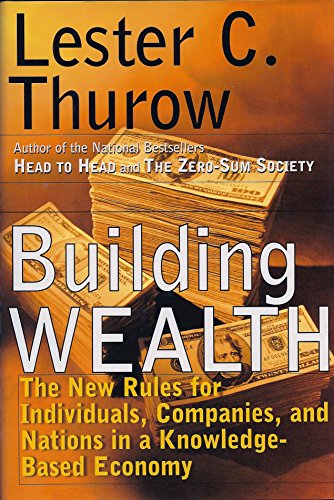
Building Wealth: The New Rules for Individuals, Companies, and Nations in a Knowledge Based Economy - Hardcover
Inhaltsangabe
As we stand on the brink of the new millennium, MIT economist Lester Thurow addresses the critical issue of wealth creation. The result is an essential road map for how individuals, companies, and nations can and must build wealth in a knowledge-based global economy.
There is no doubt that we are in the middle of a transition to a knowledge-based economy; breakthrough technologies in microelectronics, biotechnology, new materials, telecommunications, robotics, and computers are fundamentally changing the game of creating wealth. Thanks to the impact of these technologies, new industries (software, gene therapy) are growing explosively and existing industries (banking, retail) are being transformed beyond recognition.
Out of these transformations, a new global economy is emerging to replace existing national economies. Almost alone, the American economy seems to be enjoying a period of unprecedented growth. Is this growth sustainable? Is global integration a boon or a threat to this trend? Will the forces that sparked the Asian meltdown--a crisis that is meticulously evaluated in these pages--provoke a more persistent era of stagnation or worse? Should global integration be slowed? Can it be slowed? What lies ahead in the near future?
What skills are needed to succeed in this new economy? What new rules must apply to the creation and protection of new ideas? How are environmental problems such as global warming going to affect wealth creation? How can marketable wealth be rising at ever-faster rates while productivity growth is slowing? How can nations create a social system in which the entrepreneurial spirit can flourish without also creating income and wealth inequalities that threaten the system?
In the groundbreaking final chapters of Building Wealth, Professor Thurow turns his attention to the three current major economic sectors of the world: America, East Asia, and Europe. He provides a trenchant analysis of each as a significant competitor in the coming decades, and predicts the likely outcome of the complex forces that are presently shaping global society.
Die Inhaltsangabe kann sich auf eine andere Ausgabe dieses Titels beziehen.
Über die Autorin bzw. den Autor
Lester C. Thurow is the Lemelson Professor of Management and Economics at the Massachusetts Institute of Technology, where he has taught since 1968. From 1987 through 1993 he was dean of MIT's Sloan School of Management. His previous books include the New York Times bestsellers The Zero-Sum Society and The Future of Capitalism.
Von der hinteren Coverseite
As we stand on the brink of the new millennium, MIT economist Lester Thurow addresses the critical issue of wealth creation. The result is an essential road map for how individuals, companies, and nations can and must build wealth in a knowledge-based global economy.
There is no doubt that we are in the middle of a transition to a knowledge-based economy; breakthrough technologies in microelectronics, biotechnology, new materials, telecommunications, robotics, and computers are fundamentally changing the game of creating wealth. Thanks to the impact of these technologies, new industries (software, gene therapy) are growing explosively and existing industries (banking, retail) are being transformed beyond recognition.
Out of these transformations, a new global economy is emerging to replace existing national economies. Almost alone, the American economy seems to be enjoying a period of unprecedented growth. Is this growth sustainable? Is global integration a boon or a threat to this trend? Will the forces that sparked the Asian meltdown--a crisis that is meticulously evaluated in these pages--provoke a more persistent era of stagnation or worse? Should global integration be slowed? Can it be slowed? What lies ahead in the near future?
What skills are needed to succeed in this new economy? What new rules must apply to the creation and protection of new ideas? How are environmental problems such as global warming going to affect wealth creation? How can marketable wealth be rising at ever-faster rates while productivity growth is slowing? How can nations create a social system in which the entrepreneurial spirit can flourish without also creating income and wealth inequalities that threaten the system?
In the groundbreaking final chapters of Building Wealth, Professor Thurow turns his attention to the three current major economic sectors of the world: America, East Asia, and Europe. He provides a trenchant analysis of each as a significant competitor in the coming decades, and predicts the likely outcome of the complex forces that are presently shaping global society.
„Über diesen Titel“ kann sich auf eine andere Ausgabe dieses Titels beziehen.
Suchergebnisse für Building Wealth: The New Rules for Individuals, Companies,...

Beispielbild für diese ISBN
Building Wealth: The New Rules for Individuals, Companies and Nations
Anbieter: Gulf Coast Books, Cypress, TX, USA
Verkäuferbewertung 5 von 5 Sternen

hardcover. Zustand: As New. Bestandsnummer des Verkäufers 0887309518-1-34715121
Gebraucht kaufen
EUR 4,61
Versand gratis
Versand innerhalb von USA
Versand innerhalb von USA
Anzahl: 1 verfügbar
Beispielbild für diese ISBN
Building Wealth: The New Rules for Individuals, Companies and Nations
Anbieter: Gulf Coast Books, Cypress, TX, USA
Verkäuferbewertung 5 von 5 Sternen
hardcover. Zustand: Fair. Bestandsnummer des Verkäufers 0887309518-4-36381353
Gebraucht kaufen
EUR 4,61
Versand gratis
Versand innerhalb von USA
Versand innerhalb von USA
Anzahl: 1 verfügbar
Beispielbild für diese ISBN
Building Wealth: The New Rules for Individuals, Companies and Nations
Anbieter: Your Online Bookstore, Houston, TX, USA
Verkäuferbewertung 5 von 5 Sternen
hardcover. Zustand: Very Good. Bestandsnummer des Verkäufers 0887309518-2-37219849
Gebraucht kaufen
EUR 4,61
Versand gratis
Versand innerhalb von USA
Versand innerhalb von USA
Anzahl: 1 verfügbar
Beispielbild für diese ISBN
Building Wealth: The New Rules for Individuals, Companies and Nations in a Knowledge Based Economy
Verlag:
HarperCollins Publishers Inc, 1999
ISBN 10: 0887309518
ISBN 13: 9780887309519
Gebraucht
Hardcover
Anbieter: World of Books (was SecondSale), Montgomery, IL, USA
Verkäuferbewertung 5 von 5 Sternen
Hardback. Zustand: Fair. As we stand on the brink of the new millennium, MIT economist Lester Thurow addresses the critical issue of wealth creation. The result is an essential road map for how individuals, companies, and nations can and must build wealth in a knowledge-based global economy. There is no doubt that we are in the middle of a transition to a knowledge-based economy; breakthrough technologies in microelectronics, biotechnology, new materials, telecommunications, robotics, and computers are fundamentally changing the game of creating wealth. Thanks to the impact of these technologies, new industries (software, gene therapy) are growing explosively and existing industries (banking, retail) are being transformed beyond recognition. Out of these transformations, a new global economy is emerging to replace existing national economies. Almost alone, the American economy seems to be enjoying a period of unprecedented growth. Is this growth sustainable? Is global integration a boon or a threat to this trend? Will the forces that sparked the Asian meltdown--a crisis that is meticulously evaluated in these pages--provoke a more persistent era of stagnation or worse? Should global integration be slowed? Can it be slowed? What lies ahead in the near future? What skills are needed to succeed in this new economy? What new rules must apply to the creation and protection of new ideas? How are environmental problems such as global warming going to affect wealth creation? How can marketable wealth be rising at ever-faster rates while productivity growth is slowing? How can nations create a social system in which the entrepreneurial spirit can flourish without also creating income and wealth inequalities that threaten the system? In the groundbreaking final chapters of Building Wealth, Professor Thurow turns his attention to the three current major economic sectors of the world: America, East Asia, and Europe. He provides a trenchant analysis of each as a significant competitor in the coming decades, and predicts the likely outcome of the complex forces that are presently shaping global society. Bestandsnummer des Verkäufers 00104514206
Gebraucht kaufen
EUR 4,62
Versand gratis
Versand innerhalb von USA
Versand innerhalb von USA
Anzahl: 2 verfügbar
Beispielbild für diese ISBN
Building Wealth: The New Rules for Individuals, Companies and Nations in a Knowledge Based Economy
Verlag:
HarperCollins Publishers Inc, 1999
ISBN 10: 0887309518
ISBN 13: 9780887309519
Gebraucht
Hardcover
Anbieter: World of Books (was SecondSale), Montgomery, IL, USA
Verkäuferbewertung 5 von 5 Sternen
Hardback. Zustand: Very Good. As we stand on the brink of the new millennium, MIT economist Lester Thurow addresses the critical issue of wealth creation. The result is an essential road map for how individuals, companies, and nations can and must build wealth in a knowledge-based global economy. There is no doubt that we are in the middle of a transition to a knowledge-based economy; breakthrough technologies in microelectronics, biotechnology, new materials, telecommunications, robotics, and computers are fundamentally changing the game of creating wealth. Thanks to the impact of these technologies, new industries (software, gene therapy) are growing explosively and existing industries (banking, retail) are being transformed beyond recognition. Out of these transformations, a new global economy is emerging to replace existing national economies. Almost alone, the American economy seems to be enjoying a period of unprecedented growth. Is this growth sustainable? Is global integration a boon or a threat to this trend? Will the forces that sparked the Asian meltdown--a crisis that is meticulously evaluated in these pages--provoke a more persistent era of stagnation or worse? Should global integration be slowed? Can it be slowed? What lies ahead in the near future? What skills are needed to succeed in this new economy? What new rules must apply to the creation and protection of new ideas? How are environmental problems such as global warming going to affect wealth creation? How can marketable wealth be rising at ever-faster rates while productivity growth is slowing? How can nations create a social system in which the entrepreneurial spirit can flourish without also creating income and wealth inequalities that threaten the system? In the groundbreaking final chapters of Building Wealth, Professor Thurow turns his attention to the three current major economic sectors of the world: America, East Asia, and Europe. He provides a trenchant analysis of each as a significant competitor in the coming decades, and predicts the likely outcome of the complex forces that are presently shaping global society. Bestandsnummer des Verkäufers 00105235914
Gebraucht kaufen
EUR 4,62
Versand gratis
Versand innerhalb von USA
Versand innerhalb von USA
Anzahl: 1 verfügbar
Beispielbild für diese ISBN
Building Wealth: The New Rules for Individuals, Companies and Nations in a Knowledge Based Economy
Verlag:
HarperCollins Publishers Inc, 1999
ISBN 10: 0887309518
ISBN 13: 9780887309519
Gebraucht
Hardcover
Anbieter: World of Books (was SecondSale), Montgomery, IL, USA
Verkäuferbewertung 5 von 5 Sternen
Hardback. Zustand: Good. As we stand on the brink of the new millennium, MIT economist Lester Thurow addresses the critical issue of wealth creation. The result is an essential road map for how individuals, companies, and nations can and must build wealth in a knowledge-based global economy. There is no doubt that we are in the middle of a transition to a knowledge-based economy; breakthrough technologies in microelectronics, biotechnology, new materials, telecommunications, robotics, and computers are fundamentally changing the game of creating wealth. Thanks to the impact of these technologies, new industries (software, gene therapy) are growing explosively and existing industries (banking, retail) are being transformed beyond recognition. Out of these transformations, a new global economy is emerging to replace existing national economies. Almost alone, the American economy seems to be enjoying a period of unprecedented growth. Is this growth sustainable? Is global integration a boon or a threat to this trend? Will the forces that sparked the Asian meltdown--a crisis that is meticulously evaluated in these pages--provoke a more persistent era of stagnation or worse? Should global integration be slowed? Can it be slowed? What lies ahead in the near future? What skills are needed to succeed in this new economy? What new rules must apply to the creation and protection of new ideas? How are environmental problems such as global warming going to affect wealth creation? How can marketable wealth be rising at ever-faster rates while productivity growth is slowing? How can nations create a social system in which the entrepreneurial spirit can flourish without also creating income and wealth inequalities that threaten the system? In the groundbreaking final chapters of Building Wealth, Professor Thurow turns his attention to the three current major economic sectors of the world: America, East Asia, and Europe. He provides a trenchant analysis of each as a significant competitor in the coming decades, and predicts the likely outcome of the complex forces that are presently shaping global society. Bestandsnummer des Verkäufers 00107140237
Gebraucht kaufen
EUR 4,62
Versand gratis
Versand innerhalb von USA
Versand innerhalb von USA
Anzahl: 3 verfügbar
Foto des Verkäufers
Building Wealth: The New Rules for Individuals, Companies and Nations
Anbieter: Greenworld Books, Arlington, TX, USA
Verkäuferbewertung 5 von 5 Sternen
Zustand: good. Fast Free Shipping â" Good condition. It may show normal signs of use, such as light writing, highlighting, or library markings, but all pages are intact and the book is fully readable. A solid, complete copy that's ready to enjoy. Bestandsnummer des Verkäufers GWV.0887309518.G
Gebraucht kaufen
EUR 4,73
Versand gratis
Versand innerhalb von USA
Versand innerhalb von USA
Anzahl: 1 verfügbar
Beispielbild für diese ISBN
Building Wealth: The New Rules for Individuals, Companies and Nations
Verlag:
Harper Business (edition 1), 1999
ISBN 10: 0887309518
ISBN 13: 9780887309519
Gebraucht
Hardcover
Anbieter: BooksRun, Philadelphia, PA, USA
Verkäuferbewertung 5 von 5 Sternen
Hardcover. Zustand: Very Good. 1. With dust jacket. It's a well-cared-for item that has seen limited use. The item may show minor signs of wear. All the text is legible, with all pages included. It may have slight markings and/or highlighting. Bestandsnummer des Verkäufers 0887309518-11-1-29
Gebraucht kaufen
EUR 5,74
Versand gratis
Versand innerhalb von USA
Versand innerhalb von USA
Anzahl: 1 verfügbar
Beispielbild für diese ISBN
Building Wealth: The New Rules for Individuals, Companies and Nations
Anbieter: ThriftBooks-Atlanta, AUSTELL, GA, USA
Verkäuferbewertung 5 von 5 Sternen
Hardcover. Zustand: As New. No Jacket. Pages are clean and are not marred by notes or folds of any kind. ~ ThriftBooks: Read More, Spend Less. Bestandsnummer des Verkäufers G0887309518I2N00
Gebraucht kaufen
EUR 6,08
Versand gratis
Versand innerhalb von USA
Versand innerhalb von USA
Anzahl: 1 verfügbar
Beispielbild für diese ISBN
Building Wealth: The New Rules for Individuals, Companies and Nations
Anbieter: ThriftBooks-Dallas, Dallas, TX, USA
Verkäuferbewertung 5 von 5 Sternen
Hardcover. Zustand: Very Good. No Jacket. May have limited writing in cover pages. Pages are unmarked. ~ ThriftBooks: Read More, Spend Less. Bestandsnummer des Verkäufers G0887309518I4N00
Gebraucht kaufen
EUR 6,08
Versand gratis
Versand innerhalb von USA
Versand innerhalb von USA
Anzahl: 1 verfügbar