
Verwandte Artikel zu In the Cards: Murder and Magic in the Librarya Frances...
Inhaltsangabe
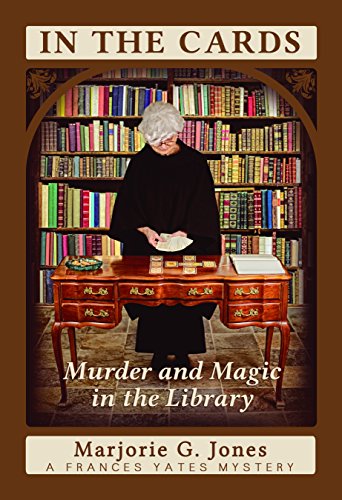
In collaboration with a Scotland Yard detective, who is, also, a Freemason, Frances Yates, eminent historian of Renaissance spirituality and proponent of martyred priest, Giordano Bruno, employs her unique scholarship to solve a murder and the theftof a rare volume in the renowned musty library of ancient philosophical traditions, where she has long been a resident scholar. While immersed in an article regarding the significance of mysterious tarot cards, Yates comes to realise that the recurring images of the cards illustrate universal life stages and character traits that may provide clues to the identity of the murderer. Along the way, she encounters more recent scholarship regarding feminist theology that, together with the tarot,prompts Yates to reconsider her own patriarchal spiritual worldview.
Die Inhaltsangabe kann sich auf eine andere Ausgabe dieses Titels beziehen.
Über die Autorin bzw. den Autor
Marjorie G. Jones, author of Frances Yates and the Hermetic Tradition and The Life and Times of Mary Vaux Walcott, is a graduate of Wheaton College, the Rutgers School of Law, and the Graduate Faculty of the New School in NYC, where she wrote her thesis on the unpublished papers of Frances Yates. For 20 years she taught history and government at Mercy College, including courses for its degree program at Sing Sing prison. Currently she resides with her husband in Center City, Philadelphia.
Auszug. © Genehmigter Nachdruck. Alle Rechte vorbehalten.
In the Cards
Murder and Magic in the Library
By Marjorie G. JonesIbis Press
Copyright © 2018 Marjorie G. Jones
All rights reserved.
ISBN: 978-0-89254-185-0All rights reserved.
CHAPTER 1
Working late one early fall evening in her small cluttered office on the third floor at the Warburg Institute on Woburn Square, Dame Frances Yates, writing by hand in the lined Boot's notebook she used for drafting, beavered away at her article. In between puffs on her Woodbine cigarette, she nibbled on some butter thins from Fortnum's. These were always kept in her top right-hand desk drawer. The cold remains of a cup of stale Earl Gray tea sat at her elbow.
Her reading glasses, attached to a frayed black ribbon around her doubling chins, were perched on the end of her wide fleshy nose. Cigarette butts piled up in the overflowing heavy glass ashtray at her elbow. Since more than once Frances had been known to set papers on her desk on fire, the fire extinguisher hanging just outside her office was especially handy and reassuring. Several years ago, patiently as always, her research assistant Billy Howard had spent a remarkable amount of time instructing her how to disengage the apparatus from the wall, pull the pin from the canister, and put it to good use when needed. Her unruly nest of white hair was held in place by hairpins. Frances' disheveled appearance was complimented by a somewhat tattered white blouse, patterned with faded blue flowers, held together by a safety pin and blotted with tea stains. Crumbs and ashes accumulated on her generous bosom before making their way onto her worn gray woolen skirt. With her bushy untended white eyebrows arched above her glasses, Frances was lost in thought.
The drab green walls of her office were covered with black and white photographs, taken on her many trips abroad. Yates' desk, along with every available shelf, was piled high with books and papers that tended to spill onto the frayed Oriental rug covering most of the cracked linoleum floor. Whenever she did glance up, the photographs of past adventures with her family and colleagues gave her pleasure and prompted her to reminisce. She especially liked the one of her and Perkin Walker, taken a few years ago while they were sitting on the steps of a temple in the Roman forum. Although some visitors to the office wondered if she ever noticed that with her legs akimbo, the trim on her knickers was showing and that her stockings were laced with runners. A more recent snapshot, taken with Rudolf and Margot Wittkower in front of Columbia University library in New York City, reminded her of her first whirlwind trip to the States the year before. Still, her favorite was the photo of her standing beneath the looming brooding statue of the martyred Bruno at the Campo de' Fiori in Rome.
Tattered thin beige cotton curtains that could use a wash hung limply at the only window overlooking tiny Woburn Square, where shadows played among the early autumn leaves. The leaves were just beginning to turn as the sun set over the great city. A few hours earlier, perched on the wooden benches, workers from nearby university offices and libraries had enjoyed lunch al fresco. A bouquet of wilted peonies from her garden at Claygate perched in a glass jelly jar at the corner of her chaotic desk.
For a few days, Frances was staying in town at the University Women's Club so that she could finish her article on time and not have to travel back and forth to the charming suburb of Claygate. She lived there with her older sister Ruby and their little black cat Hermes, who, to their great delight one day several years ago, had wandered into the garden looking for a home. Per usual, she was working under a deadline — this time for Bob Silvers, editor at The New York Review of Books. He was waiting for still another of the many articles she had written over the past several years for the erudite literary magazine, published in New York since the 1960s. Her many accolades notwithstanding, Frances always was flattered to be invited to contribute to the renowned publication. Finally meeting Silvers in person was a highlight of her trip last year to the States.
This time Silvers had asked her to review a book on Tarot by Michael Dummett. Although, at first, she thought the topic inane, Frances was growing increasingly intrigued, if not for the reasons Dummett had intended. Surprisingly even to her, Frances was wrestling with an intriguing new subject — the mysterious images of the Major Arcana of the Tarot.
Leafing through the very large book, which purported to be a history of Tarot, with its array of reproductions of various decks of cards produced throughout Europe between the thirteenth through the eighteenth centuries, she noted quickly — as she would write in her article — that the same images, in varying versions, recurred constantly and always in the same order in the so-called Major Arcana, the first twenty-two cards of the Tarot. Since these images specifically had been banned by the Church in the 1600s, modern decks of playing cards contained only the fifty-two of the four suits. So the first question Frances considered was her favorite: Why? Why had the first twenty-two images been eliminated and what about the Major Arcana was distasteful to the medieval Church? If, as Dummett maintained in his book, the Tarot were "just playing cards," it didn't make sense that they were so terribly troubling to the Inquisition. So perhaps something else going on ...
She contemplated the sketchy but colorful images of the early seventeenth century Tarot de Paris deck — created not long after Bruno's terrible death — when religious conflict ravaged Europe. The sequence she observed and the scattered illusions to Christianity triggered new thoughts in Yates's fertile imagination and stimulated her investigative juices. Indeed, in the context of Renaissance thought and the Hermetic Tradition, she began to suspect that the cards might mean something more. Of course, if she was right, it wouldn't be the first time Frances Yates would be accused of seeing the Hermetic Tradition everywhere — even if in her heart of hearts, she thought it was.
By now it was 8:00 P.M. Most students and staff left the premises by 7:00, so the Institute had quieted down; but, as her pen filled the pages of her notebook, Frances' brain was racing. How she relished that sensation! Although she was soon to celebrate her 75th birthday, her brilliant mind was as sharp and probing as ever; and while sometimes she hesitated before coming up with just the word she was searching for, Frances also knew she had become more discerning and perceptive. Indeed, she smiled to herself as she gazed at the cards, she even thought of an appropriate pun: It could be said that she was at the top of her game!
At long last, Giordano Bruno and the Hermetic Tradition, followed quickly by The Art of Memory, had made her a celebrity-scholar and recent DBE, Dame of the British Empire, and she was deluged with invitations to speak and travel throughout Europe and America.
Wondering if she might be onto something, it became apparent that she'd need to look at other variations of the Tarot images. After more than four decades at the Warburg, she knew more or less where to find them in the library's convoluted stacks. Organized according to the intellectual meanderings of Aby Warburg's brilliant mind and his own unique methodology, the system was known to stump many a first-time and even second- and third-time visitor. Instead of traditional categories (history, literature, biography, etc.), the library's five floors were each dedicated to a theme: ACTION (social and political history, magic and science); ORIENTATION (religion and philosophy); WORD (literature) and IMAGE (art history).
"How interesting," Frances pondered. Rather than walk the concrete stairs, she took the creaky elevator, which really was not much larger than a closet, to the fourth floor. "Tarot is catalogued under Orientation here rather than at Image. Yet if, as Dummett claims, it is 'just a game ...'"
Once daylight receded, the crammed stacks were dark and gloomy. To save money, the fluorescent lights in the stacks were turned on and off with pull strings. Light switches were an extravagance the cash-strapped library could not afford — if, that is, it continued to acquire and add rare books to its remarkable collection. So even for someone as familiar as she was with the archaic ways of her beloved and longtime intellectual home, Frances always found it dreadfully annoying to have to wave her arms about like a pigeon, trying to feel her way in the dim light toward an elusive string; furthermore her sight wasn't what it used to be. Yet she too always opted for more books over light, and, besides, she thought, too much modernity would detract from the library's Old World ambience and sense of mystery.
Since she knew the illustrated books of Tarot were kept on wide low shelves along the wall to the right of the elevator, when the doors opened, she turned in that direction and felt her way along the shelves. But as she edged along with her right hand tracing the edge of the top shelf where the oversized art books were kept, Frances stumbled over something lumpy and bulky on the floor and fell rudely to her knees, skinning her shins, while flailing with outstretched arms to brace her tumble. Momentarily stunned, she sat up dazed, and although far from sylph-like, awkwardly managed to pull herself up by holding onto the bookshelf.
Acutely aware of the sharp pain in her legs already stiff with arthritis, somehow she managed to find a pull string and tugged on it hard. After waiting a few seconds, while the light flickered and finally brightened, renowned scholar of the Renaissance Dame Frances Yates found herself staring down at the dead body of Warburg archivist, Richard Pratt.
CHAPTER 2Lying on his back in a pool of dark blood that had begun to seep onto some of the oversized rare books scattered in disarray on the floor, Pratt's arms were crossed over his chest, as if he were clutching something. His head was still bleeding from a terrible gash above his left temple. One lifeless blue eye was open and seemed to be glaring at Frances, but the other was hideous, swollen shut, black and blue, and also oozing blood.
Frances drew back in horror and wanted to scream, but when she tried, no sound came out. So instead — with the back of her right hand against her mouth — she backed away from the corpse, feeling her way around the corner toward the elevator door and pushed the large round alarm button. This set off a loud clanging that she fervently prayed would bring receptionist Gerald Clewes upstairs as quickly as possible.
Later, recalling the nightmare, she realized she didn't remember when or how Clewes arrived. Surely London's most scholarly receptionist and night watchman, Clewes habitually poured over and was engrossed in rare books from the library's collection. She desperately hoped his studies wouldn't delay his departure from the reception desk. Clewes was never one to engage in anything beyond polite conversation with her or anyone else at the Institute. Finally he arrived on the creaky elevator after what seemed like hours. It didn't help Frances's growing horror that Clewes always reminded her of a skeleton. When, trembling and white-faced, he felt Pratt's neck for a pulse and concluded, "Certainly Professor Pratt is dead, Dame Frances. What should we do?"
"Good God, man," Frances croaked at the cowering sentry, "Call Scotland Yard!"
CHAPTER 3As Frances Yates and Gerald Clewes with arms awkwardly entwined struggled to make their way back to the third floor in the creaky lumbering elevator, Harry Slater crept down the staircase and out the front door of the Institute — that now had no night watchman. Clutched under his raincoat was an oversized book. Stashed in the pocket of his dirty raincoat was the white pair of thin cotton gloves that he wore — per Warburg procedure — when examining old documents and ... stealing rare books.
A graduate student, supposedly working his way to a Master's degree in curating, Harry had been studying Renaissance iconography in Pre-Raphaelite art with Dame Frances for the past year. Accordingly, he knew his way around the library.
When he unlocked the door to his room at Fellowship House at nearby Mecklenburgh Square, Harry was trembling and bathed in sweat. His dash through Russell Square and along the iron fence encircling Coram Fields — trying to walk as quickly as he could without drawing attention, trying to appear calm while picking up the key to his room at the front desk — had left him an even worse bundle of nerves after the grisly scene in the library.
Collapsing on the narrow hard bed, he gasped: "My God, what have I done?" Certainly he hadn't intended to harm dreadful Pratt, but the nosey old goat had wandered through the stacks unexpectedly just as Harry was removing the Tarot book from the shelf and had tried to stop him. As they tussled, the corner of the book Harry was clutching hit Pratt in the eye, blinding him. When, as a result, he lurched backward, he hit his head on the edge of the bookshelves and fell dead on the floor. "What a disaster!" he moaned with the heels of his hands pressing into his eyes.
More like a prison cell, Harry's room was small and dank, furnished only with a wooden desk, cluttered with papers and half-eaten bags of chips and candy. His thin worn mattress on a wired frame with exposed springs was uncomfortable, as was his dilapidated, unpleasantly stained arm chair. The room's small sink didn't drain properly. As always, his quarters smelled vaguely male, a legacy of the long line of unwashed temporary residents who had lived there over the years.
Since the end of World War II, Fellowship House, constructed on the site of a row of stately Georgian townhouses destroyed during the Blitz, had offered academics from around the world affordable subsidized temporary housing and decent inexpensive meals. In the heart of Bloomsbury, where the literary spirits of Virginia Woolf, Charlotte Mews, T. S. Eliot and Dorothy Sayers, among others, haunted the neighborhood, Fellowship House was only a short walk to the British Museum, the Russell Square tube station, the University of London and the Warburg Institute.
Managing to get to his feet, Harry flung open the window that overlooked the park. He took in great gulps of air and tried to calm down. It was a lovely early fall evening in London and at eight o'clock still somewhat light. The fresh air helped, but the sounds of children laughing and the ping of tennis balls being returned over the nets of the courts in the park, which usually gave him pleasure, tonight were annoying. He tried to process what had happened and what he should do next.
Incredibly, he realized he was ravenously hungry! So after splashing some cold water on his face and stubbly beard, he headed downstairs to the spacious dining room with high vaulted ceilings and bountiful cafeteria. Tonight, unlike most other evenings, he hoped he could avoid the cluster of gregarious students from various institutions of higher learning who met there to discuss their classes, theses, debate world affairs and flirt. He needed to think. Usually he lurked on the periphery, but no such luck tonight.
The usual coven of students from around the world was gathered at one of the long wooden tables. So when Harry arrived — his tray piled high with a cup of thick pasty white bean soup, fried fish and chips and a colossal piece of marble cake smothered with chocolate frosting (nothing green ever passed his lips) — it would be awkward, he thought, to sit apart. Thus, in spite of his terrible preoccupation, Harry found himself drawn into the chatter about the day's activities and academic escapades.
Usually he actually looked forward to the nightly gabfests because, for the first time in his life, it almost resembled a social life. While he was sure none of the assertive confident young women at the table would ever consider spending any extended period of time alone with him, they seemed at least not to mind his presence, and even occasionally asked what he had done that day or how his thesis was progressing.
(Continues...)
Excerpted from In the Cards by Marjorie G. Jones. Copyright © 2018 Marjorie G. Jones. Excerpted by permission of Ibis Press.
All rights reserved. No part of this excerpt may be reproduced or reprinted without permission in writing from the publisher.
Excerpts are provided by Dial-A-Book Inc. solely for the personal use of visitors to this web site.
„Über diesen Titel“ kann sich auf eine andere Ausgabe dieses Titels beziehen.
Suchergebnisse für In the Cards: Murder and Magic in the Librarya Frances...

Beispielbild für diese ISBN
In the Cards : Murder and Magic in the Library
Anbieter: GreatBookPrices, Columbia, MD, USA
Verkäuferbewertung 5 von 5 Sternen

Zustand: As New. Unread book in perfect condition. Bestandsnummer des Verkäufers 33194294
Gebraucht kaufen
EUR 16,21
EUR 2,36 Versand
Versand innerhalb von USA
Versand innerhalb von USA
Anzahl: Mehr als 20 verfügbar
Foto des Verkäufers
In the Cards : Murder and Magic in the Library
Anbieter: GreatBookPrices, Columbia, MD, USA
Verkäuferbewertung 5 von 5 Sternen
Zustand: New. Bestandsnummer des Verkäufers 33194294-n
Neu kaufen
EUR 17,22
EUR 2,36 Versand
Versand innerhalb von USA
Versand innerhalb von USA
Anzahl: Mehr als 20 verfügbar
Foto des Verkäufers
In the Cards
Anbieter: Rarewaves USA, HEBRON, KY, USA
Verkäuferbewertung 5 von 5 Sternen
Paperback. Zustand: New. Bestandsnummer des Verkäufers LU-9780892541850
Neu kaufen
EUR 19,65
Versand gratis
Versand innerhalb von USA
Versand innerhalb von USA
Anzahl: Mehr als 20 verfügbar
Foto des Verkäufers
In the Cards
Anbieter: Rarewaves.com USA, London, LONDO, Vereinigtes Königreich
Verkäuferbewertung 5 von 5 Sternen
Paperback. Zustand: New. Bestandsnummer des Verkäufers LU-9780892541850
Neu kaufen
EUR 22,38
Versand gratis
Versand von Vereinigtes Königreich nach USA
Versand von Vereinigtes Königreich nach USA
Anzahl: 1 verfügbar
Beispielbild für diese ISBN
In the Cards (Paperback)
Anbieter: Grand Eagle Retail, Bensenville, IL, USA
Verkäuferbewertung 5 von 5 Sternen
Paperback. Zustand: new. Paperback. In collaboration with a Scotland Yard detective, who is also a Freemason, Frances Yates, eminent historian of Renaissance spirituality and proponent of martyred priest Giordano Bruno, employs her unique scholarship to solve a murder and the theft of a rare volume in the renowned musty library of ancient philosophical traditions, where she has long been a resident scholar.While immersed in an article regarding the significance of mysterious tarot cards, Yates comes to realize that the recurring images of the cards illustrate universal life stages and character traits that may provide clues to the identity of the murderer. Along the way, she encounters more recent scholarship regarding feminist theology that, together with the tarot, prompts her to reconsider her own patriarchal spiritual worldview. Shipping may be from multiple locations in the US or from the UK, depending on stock availability. Bestandsnummer des Verkäufers 9780892541850
Beispielbild für diese ISBN
In the Cards: Murder and Magic in the Library (A Frances Yates Mystery)
Anbieter: Kennys Bookshop and Art Galleries Ltd., Galway, GY, Irland
Verkäuferbewertung 5 von 5 Sternen
Zustand: New. 2018. Paperback. . . . . . Bestandsnummer des Verkäufers V9780892541850
Neu kaufen
EUR 22,84
EUR 9,50 Versand
Versand von Irland nach USA
Versand von Irland nach USA
Anzahl: Mehr als 20 verfügbar
Beispielbild für diese ISBN
In the Cards: Murder and Magic in the Library
Anbieter: Revaluation Books, Exeter, Vereinigtes Königreich
Verkäuferbewertung 5 von 5 Sternen
Paperback. Zustand: Brand New. 251 pages. 8.75x5.75x0.75 inches. In Stock. Bestandsnummer des Verkäufers __0892541857
Neu kaufen
EUR 22,89
EUR 11,82 Versand
Versand von Vereinigtes Königreich nach USA
Versand von Vereinigtes Königreich nach USA
Anzahl: 2 verfügbar
Beispielbild für diese ISBN
In the Cards: Murder and Magic in the Library (A Frances Yates Mystery)
Anbieter: Kennys Bookstore, Olney, MD, USA
Verkäuferbewertung 5 von 5 Sternen
Zustand: New. 2018. Paperback. . . . . . Books ship from the US and Ireland. Bestandsnummer des Verkäufers V9780892541850
Neu kaufen
EUR 28,54
EUR 9,37 Versand
Versand innerhalb von USA
Versand innerhalb von USA
Anzahl: Mehr als 20 verfügbar
Beispielbild für diese ISBN
In the Cards
Anbieter: Russell Books, Victoria, BC, Kanada
Verkäuferbewertung 5 von 5 Sternen
Zustand: New. Special order item direct from the distributor. Bestandsnummer des Verkäufers R9780892541850
Neu kaufen
EUR 28,04
EUR 17,84 Versand
Versand von Kanada nach USA
Versand von Kanada nach USA
Anzahl: 1 verfügbar
Foto des Verkäufers
In the Cards : Murder and Magic in the Library
Anbieter: AHA-BUCH GmbH, Einbeck, Deutschland
Verkäuferbewertung 5 von 5 Sternen
Taschenbuch. Zustand: Neu. Neuware - In collaboration with a Scotland Yard detective, who is also a Freemason, Frances Yates, eminent historian of Renaissance spirituality and proponent of martyred priest Giordano Bruno, employs her unique scholarship to solve a murder and the theft of a rare volume in the renowned musty library of ancient philosophical traditions, where she has long been a resident scholar.While immersed in an article regarding the significance of mysterious tarot cards, Yates comes to realize that the recurring images of the cards illustrate universal life stages and character traits that may provide clues to the identity of the murderer. Along the way, she encounters more recent scholarship regarding feminist theology that, together with the tarot, prompts her to reconsider her own patriarchal spiritual worldview. Bestandsnummer des Verkäufers 9780892541850
Neu kaufen
EUR 35,88
EUR 35,00 Versand
Versand von Deutschland nach USA
Versand von Deutschland nach USA
Anzahl: 2 verfügbar