
Verwandte Artikel zu All That the Rain Promises and More: A Hip Pocket Guide...
Inhaltsangabe
“[All That the Rain Promises and More] is certainly the best guide to fungi, and may in fact be a long lasting masterpiece in guide writing for all subjects.”—Roger McKnight, The New York Times
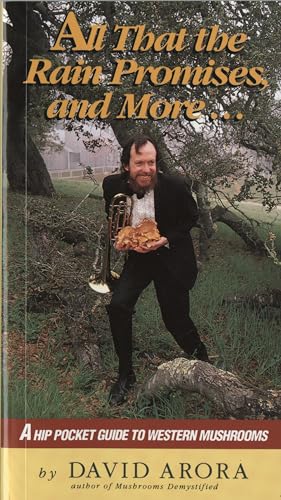
Mushrooms appeal to all kinds of people—and so will this handy pocket guide, which includes key information for more than 200 Western mushrooms
Over 200 edible and poisonous mushrooms are depicted with simple checklists of their identifying features, as David Arora celebrates the fun in fungi with the same engaging bend of wit and wisdom, fact and fancy, that has made his comprehensive guide, Mushrooms Demystified, the mushroom hunter’s bible.
“The best guide for the beginner. I’d buy it no matter where I lived in North America.”—Whole Earth Catalog
Die Inhaltsangabe kann sich auf eine andere Ausgabe dieses Titels beziehen.
Über die Autorin bzw. den Autor
David Arora is an American naturalist, writer, and a biologist who specializes in the study of fungi. The author of two popular books on the identification of wild fungi—Mushrooms Demystified and All That the Rain Promises and More—Arora has also written about conservation issues relating to recreational and commercial mushroom cultivation.
Auszug. © Genehmigter Nachdruck. Alle Rechte vorbehalten.
Introduction
Mushrooms are the reproductive structures or "fruit" of certain fungi. The most familiar kind of mushroom has a cap with gills (radiating blades) on its underside. Millions of microscopic reproductive units called spores are discharged from the gills and dispersed by air currents. Only a small percentage of spores land in a favorable environment, where they germinate to form new fungi.
Fungi do not manufacture their own food like plants. In this respect they are like animals: they must obtain food from outside sources. The part of the mushroom fungus that digests nutrients is an intricate web of fine threads collectively called the mycelium (plural: mycelia). The mycelium may live anywhere from a few days (in perishable substrates like dung) to several hundred years, periodically producing mushrooms when enough moisture is available.
Mushrooms, or more exactly the fungi that produce them, are a vital and omnipresent part of our environment. Despite their bad press, the overwhelming majority are beneficial. A few are parasitic, feeding on living organisms, usually trees. The rest are either saprophytic or mycorrhizal. Saprophytic fungi are nature's recyclers. They replenish the soil by breaking down complex organic matter (wood, dung, humus, etc.) into simpler, reusable compounds. Mycorrhizal fungi form a mutually beneficial relationship with the rootlets of plants in which nutrients are exchanged. They are critical to the health of our forests, as many trees will not grow without them. (Since some mycorrhizal mushrooms are associated with certain kinds of trees, make a habit of noting the different trees growing in the vicinity of any mushroom you wish to identify.)
Despite the many benefits and uses of mushrooms, most North Americans are markedly fungophobic, a trait inherited from the British. Fungophobia can be defined as the belief that mushrooms are actively hostile at worst and worthless at best. It is only in the last few years that large numbers of North Americans have begun to discover what the mushroom-loving peoples of Japan, China, Russia, and Europe have known for centuries: that these "forbidden fruit" are delicious and nutritious, vital and valuable, potent and beautiful, and that mushroom hunting is a challenging, enlightening, and uplifting activity.
How To Use This Book
Simple. Once you've collected a distinctive mushroom, consult the quick key to mushroom groups on the inside front and back covers, and go to the section of the book indicated. Flip through the pictures in that section until you find one that looks similar to your mushroom. Then carefully go through the numbered list of "Key Features" on that page, checking them off as you go so you don't inadvertently miss one. If your mushroom has all of the key features, then you have identified it! To verify your identification, check the details listed under "Other Features," "Where," etc.
If your mushroom does not agree with one of the "Key Features," assume it is different. First consult the section called "Note" at the bottom of the page for a possible explanation of the discrepancy or a listing of similar species, then continue searching the pictures for another likely candidate. If you can't find a photograph and set of key features that match your mushroom, there are two possible explanations.
The first is that your mushroom is a "freak"—an untypical example of an illustrated species, for instance one that has faded badly or lost its ring. By collecting several examples of each kind of mushroom you wish to identify, in different stages of development if possible, you are much more likely to gather at least a few typical, identifiable ones; then you can discard those that lack one or more of the key features unless you are experienced enough to recognize them. (Note: different kinds of mushrooms often mingle with one another; unless they are obviously the same, assume that they are different until you discover otherwise.)
The second, and more likely, explanation is that your mushroom is not in this book. After all, less than 10 percent of the known species from western North America are. You can return unidentified mushrooms to their place of origin, relegate them to the compost pile, or, if you are determined to know their identity, consult a more comprehensive guide such as Mushrooms Demystified, 2d ed. (1986).
„Über diesen Titel“ kann sich auf eine andere Ausgabe dieses Titels beziehen.
Suchergebnisse für All That the Rain Promises and More: A Hip Pocket Guide...

Beispielbild für diese ISBN
All That the Rain Promises and More: A Hip Pocket Guide to Western Mushrooms
Anbieter: HPB Inc., Dallas, TX, USA
Verkäuferbewertung 5 von 5 Sternen

Paperback. Zustand: Very Good. Connecting readers with great books since 1972! Used books may not include companion materials, and may have some shelf wear or limited writing. We ship orders daily and Customer Service is our top priority! Bestandsnummer des Verkäufers S_482919475
Gebraucht kaufen
EUR 8,07
EUR 3,27 Versand
Versand innerhalb von USA
Versand innerhalb von USA
Anzahl: 1 verfügbar
Foto des Verkäufers
All That the Rain Promises and More: A Hip Pocket Guide to Western Mushrooms
Anbieter: Zoom Books Company, Lynden, WA, USA
Verkäuferbewertung 5 von 5 Sternen
Zustand: very_good. Book is in very good condition and may include minimal underlining highlighting. The book can also include "From the library of" labels. May not contain miscellaneous items toys, dvds, etc. . We offer 100% money back guarantee and 24 7 customer service. Bestandsnummer des Verkäufers ZBV.0898153883.VG
Gebraucht kaufen
EUR 11,56
Versand gratis
Versand innerhalb von USA
Versand innerhalb von USA
Anzahl: 1 verfügbar
Beispielbild für diese ISBN
All That the Rain Promises and More: A Hip Pocket Guide to Western Mushrooms
Anbieter: Else Fine Booksellers, Tacoma, WA, USA
Verkäuferbewertung 5 von 5 Sternen
Soft cover. Zustand: Very Good. Just a bit of wear along the edges. Perfect pocket-sized field guide to western mushrooms, compiled by a real live human expert. Bestandsnummer des Verkäufers 010381
Gebraucht kaufen
EUR 8,98
EUR 4,79 Versand
Versand innerhalb von USA
Versand innerhalb von USA
Anzahl: 1 verfügbar
Beispielbild für diese ISBN
All That the Rain Promises and More: A Hip Pocket Guide to Western Mushrooms
Anbieter: The Book Corner, Beaverton, OR, USA
Verkäuferbewertung 5 von 5 Sternen
Paperback. Zustand: New. Brand new. Ships from Friends bookstore to benefit Beaverton (Oregon) library. Bestandsnummer des Verkäufers mon0000089971
Beispielbild für diese ISBN
All That the Rain Promises, and More . : A Hip Pocket Guide to Western Mushrooms
Anbieter: GreatBookPrices, Columbia, MD, USA
Verkäuferbewertung 5 von 5 Sternen
Zustand: New. Bestandsnummer des Verkäufers 109185-n
Neu kaufen
EUR 11,71
EUR 2,30 Versand
Versand innerhalb von USA
Versand innerhalb von USA
Anzahl: Mehr als 20 verfügbar
Beispielbild für diese ISBN
All That the Rain Promises and More: A Hip Pocket Guide to Western Mushrooms
Anbieter: HPB-Emerald, Dallas, TX, USA
Verkäuferbewertung 5 von 5 Sternen
Paperback. Zustand: Very Good. Connecting readers with great books since 1972! Used books may not include companion materials, and may have some shelf wear or limited writing. We ship orders daily and Customer Service is our top priority! Bestandsnummer des Verkäufers S_484976333
Gebraucht kaufen
EUR 10,77
EUR 3,27 Versand
Versand innerhalb von USA
Versand innerhalb von USA
Anzahl: 1 verfügbar
Beispielbild für diese ISBN
All That the Rain Promises and More: A Hip Pocket Guide to Western Mushrooms
Anbieter: GCCebooks, Salinas, CA, USA
Verkäuferbewertung 4 von 5 Sternen

Paperback. Zustand: Good. Later printing. Bestandsnummer des Verkäufers mon-ug-0898153883
Gebraucht kaufen
EUR 10,56
EUR 3,48 Versand
Versand innerhalb von USA
Versand innerhalb von USA
Anzahl: 1 verfügbar
Beispielbild für diese ISBN
All That the Rain Promises and More: A Hip Pocket Guide to Western Mushrooms
Anbieter: Lakeside Books, Benton Harbor, MI, USA
Verkäuferbewertung 5 von 5 Sternen
Zustand: New. Brand New! Not Overstocks or Low Quality Book Club Editions! Direct From the Publisher! We're not a giant, faceless warehouse organization! We're a small town bookstore that loves books and loves it's customers! Buy from Lakeside Books! Bestandsnummer des Verkäufers OTF-S-9780898153880
Neu kaufen
EUR 10,90
EUR 3,48 Versand
Versand innerhalb von USA
Versand innerhalb von USA
Anzahl: Mehr als 20 verfügbar
Foto des Verkäufers
All That the Rain Promises and More
Anbieter: Rarewaves USA, HEBRON, KY, USA
Verkäuferbewertung 5 von 5 Sternen
Paperback. Zustand: New. Bestandsnummer des Verkäufers LU-9780898153880
Neu kaufen
EUR 14,47
Versand gratis
Versand innerhalb von USA
Versand innerhalb von USA
Anzahl: Mehr als 20 verfügbar
Foto des Verkäufers
All That the Rain Promises and More: A Hip Pocket Guide to Western Mushrooms (Paperback or Softback)
Verlag:
Ten Speed Press 2/1/1991, 1991
ISBN 10: 0898153883
ISBN 13: 9780898153880
Neu
Paperback or Softback
Anbieter: BargainBookStores, Grand Rapids, MI, USA
Verkäuferbewertung 5 von 5 Sternen
Paperback or Softback. Zustand: New. All That the Rain Promises and More: A Hip Pocket Guide to Western Mushrooms. Book. Bestandsnummer des Verkäufers BBS-9780898153880