
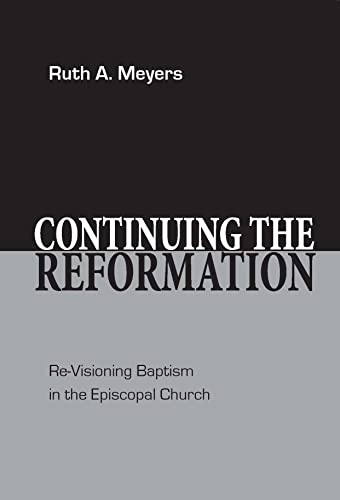
Verwandte Artikel zu Continuing the Reformation: Re-Visioning Baptism in...
Inhaltsangabe
This book documents the Episcopal Church's developing focus on baptism within the context of the liturgical movement, the emerging understanding of the eucharist, prayer book revision, and the confirmation dilemma. Drawing on historical and contemporary sources, the author presents a credible case in support of her belief that a baptismal ecclesiology is emerging from these events that have enabled people to accept a radically different initiatory pattern in the church. This book exhibits clarity on the issues discussed with the support of solid scholarship and lucid writing.
Die Inhaltsangabe kann sich auf eine andere Ausgabe dieses Titels beziehen.
Über die Autorin bzw. den Autor
Ruth A. Meyers is Dean of Academic Affairs and Hodges-Haynes Professor of Liturgics at Church Divinity School of the Pacific. She served as chair of The Episcopal Churchs Standing Commission on Liturgy and Music through the conclusion of the 2012–2015 triennium and teaches throughout the Anglican Communion. She lives outside Berkeley CA.
Auszug. © Genehmigter Nachdruck. Alle Rechte vorbehalten.
CONTINUING THE REFORMATION
Re-Visioning Baptism in the Episcopal Church
By Ruth A. MeyersChurch Publishing Incorporated
Copyright © 1997 Ruth A. Meyers
All rights reserved.
ISBN: 978-0-89869-195-5All rights reserved.
Contents
| Abbreviations | |
| Acknowledgments | |
| Foreword | |
| Introduction | |
| 1 The Traditional Anglican Pattern: Baptism, Confirmation, Admission to Communion | |
| 2 The Emergence of A Eucharistic Ecclesiology | |
| 3 The Renewal of Baptism | |
| 4 The Dilemma of Confirmation | |
| 5 Admission to Communion | |
| 6 Turning Points: Toward Prayer Book Revision | |
| 7 Toward a New Pattern of Christian Initiation: Communion of All the Baptized | |
| 8 Toward a New Pattern of Christian Initiation: Redefining Confirmation | |
| 9 The 1979 Baptismal Rite: Foundation for a Baptismal Ecclesiology | |
| 10 Enriching the Prayer Book: | |
| 11 Baptism and Reaffirmation of Faith: A Continuing Agenda for the Episcopal Church 225 | |
| Continuing the Reformation | |
| Appendices | |
| Bibliography | |
| Index |
CHAPTER 1
The Traditional Anglican Pattern: Baptism, Confirmation, Admission to Communion
I am what is sometimes known as a "cradle Episcopalian." The child of activeEpiscopalians, I was baptized at the rather tender age of one month, confirmedwhen I was in the ninth grade after a full school year of confirmation classes,and admitted to communion at the time of my confirmation. My experience reflectsthe traditional Anglican pattern of Christian initiation, a pattern establishedby the first Anglican prayer books at the time of the Reformation in thesixteenth century and essentially unchanged until the 1979 Book of CommonPrayer. But this pattern was the product of the rather complex evolution ofbaptism and confirmation in the life of the Church, an evolution that has beenwidely studied and discussed during the twentieth century. To understand theradical changes introduced in the 1979 Book of Common Prayer, it is necessary tobegin with a brief survey of this history.
The New Testament and the Early Church: A Single Initiatory Rite
Numerous references and allusions to baptism can be found in the New Testament,but nowhere is there a full description or text of a baptismal rite. The book ofActs includes several reports of baptisms as part of its story of the missionaryspread of the Gospel, beginning with the baptism of three thousand converts inresponse to Peter's Pentecost sermon following the descent of the Spirit on thedisciples (Acts 2). From these descriptions and from other New Testamentreferences to baptism, we can conclude that baptism followed conversion and wasadministered with water in the name of Jesus or in the name of the Father, Sonand Holy Spirit.
While in several places the New Testament associates the gift of the Holy Spiritwith baptism, there is no evidence for the regular administration of a ritebestowing the Spirit separate from baptism. Acts 8:14-17 tells of the journey ofPeter and John to Samaria in order to lay hands on converts who had beenbaptized but had not received the Spirit, and Acts 19:1-6 relates Paul'sencounter at Ephesus with disciples who had been baptized into John's baptismbut did not know of the Holy Spirit. In each of these tales, the Holy Spirit isbestowed through laying on of hands by the apostles. But in Acts 10:44-48, theSpirit descends upon a group of Gentiles while Peter is preaching to them, andin response the converts are baptized. Elsewhere in Acts, baptisms are reportedwithout any mention of the bestowal of the Spirit. The primary intent of each ofthese stories is not to provide an accurate description of the sacramentalpractice of the nascent church, but to bear witness to the missionary spread ofthe church, empowered by the Holy Spirit.
What can be learned from these reports of baptism and other New Testamentreferences to baptism is that converts were initiated into Christian life bybaptism with water in the name of Jesus or in the triune name. Baptism wasinterpreted as incorporation into the Christian community, cleansing from sin,rebirth, participation in Christ's death and resurrection, entrance into thereign of God, sealing with the Spirit, being clothed with Christ. Some of thesemetaphors suggest ritual actions, for example, anointing or putting on newgarments. However, there is no conclusive evidence that such actions werecustomarily part of the baptismal rite during the first century.
As the Church grew and ritual practices developed, the multifaceted dimensionsof baptism gradually came to be expressed symbolically through variousinterpretive gestures and actions, including anointing and the laying on ofhands. The normative candidate was an adult, although from at least as early asthe end of the second century, the children of believers, including infants,were incorporated into the Christian community by the same rite. Baptismculminated in the celebration of the eucharist, at which the newly baptized,including infants, were present and received communion for the first time. Thebishop customarily presided at the initiatory rite, and by the fourth century,baptism was usually administered at the Easter vigil. No additional rite, foradults or for children, was considered necessary to complete Christianinitiation.
The Middle Ages: Adaptation and Division of the Rite
The official recognition of the Church after the peace of Constantine (313) hada number of consequences for the Church's initiatory practice. Throughout thefourth century, large numbers of adults were initiated through an elaborateprocess that included several months or years of preparation (the"catechumenate"), culminating in the celebration of the initiatory rites at theEaster vigil. But as the empire came to be predominantly Christian, thereremained few adult converts to be baptized, and the normative candidates wereinfants. The catechumenate was shortened and adjustments made to the preliminaryrites. Baptism continued to be administered at the vigils of Easter andPentecost, with exceptions permitted for those in danger of death. However, inthe later Middle Ages, owing to concern about infants dying suddenly, withoutwarning, baptism came to be allowed to infants at any time. By the fourteenthcentury, several synods required that baptism be administered within eight daysof birth.
In the early Middle Ages, outside of Rome and central Italy, where dioceses werelarge and travel difficult, bishops could not be present at most celebrations ofbaptism. Instead, a priest administered the entire rite, including a singlepostbaptismal anointing and the concluding eucharist, and this was viewed asfull Christian initiation. This continues to be the initiatory pattern ofEastern Orthodox churches today. But in Rome and the dioceses of central Italy,in addition to a postbaptismal anointing on the head by a priest, the bishopadministered a second anointing on the forehead. In cases where a bishop wasunable to be present for the rite, this final anointing could be readilysupplied within a short period of time, effectively preserving a role for thebishop in Christian initiation.
When in the eighth century the rites of Rome were imposed by the emperorCharlemagne throughout the West,...
„Über diesen Titel“ kann sich auf eine andere Ausgabe dieses Titels beziehen.
Suchergebnisse für Continuing the Reformation: Re-Visioning Baptism in...

Beispielbild für diese ISBN
Continuing the Reformation: Re-Visioning Baptism in the Episcopal Church
Anbieter: World of Books (was SecondSale), Montgomery, IL, USA
Verkäuferbewertung 5 von 5 Sternen

Zustand: Good. Good condition ex-library book with usual library markings and stickers. Bestandsnummer des Verkäufers 00105468824
Gebraucht kaufen
EUR 5,81
Versand gratis
Versand innerhalb von USA
Versand innerhalb von USA
Anzahl: 1 verfügbar
Beispielbild für diese ISBN
Continuing the Reformation: Re-Visioning Baptism in the Episcopal Church
Anbieter: World of Books (was SecondSale), Montgomery, IL, USA
Verkäuferbewertung 5 von 5 Sternen
Zustand: Very Good. Item in very good condition! Textbooks may not include supplemental items i.e. CDs, access codes etc. Bestandsnummer des Verkäufers 00102614488
Gebraucht kaufen
EUR 5,81
Versand gratis
Versand innerhalb von USA
Versand innerhalb von USA
Anzahl: 1 verfügbar
Beispielbild für diese ISBN
Continuing the Reformation: Re-Visioning Baptism in the Episcopal Church
Verlag:
Church Publishing (edition large type edition), 2000
ISBN 10: 0898691958
ISBN 13: 9780898691955
Gebraucht
Hardcover
Anbieter: BooksRun, Philadelphia, PA, USA
Verkäuferbewertung 5 von 5 Sternen
Hardcover. Zustand: Very Good. large type edition. With dust jacket. It's a well-cared-for item that has seen limited use. The item may show minor signs of wear. All the text is legible, with all pages included. It may have slight markings and/or highlighting. Bestandsnummer des Verkäufers 0898691958-11-1-29
Gebraucht kaufen
EUR 5,82
Versand gratis
Versand innerhalb von USA
Versand innerhalb von USA
Anzahl: 1 verfügbar
Beispielbild für diese ISBN
Continuing the Reformation: Re-Visioning Baptism in the Episcopal
Anbieter: Hawking Books, Edgewood, TX, USA
Verkäuferbewertung 4 von 5 Sternen

Zustand: Very Good. Very Good Condition. Has some wear. Five star seller - Buy with confidence! Bestandsnummer des Verkäufers X0898691958X2
Gebraucht kaufen
EUR 6,60
Versand gratis
Versand innerhalb von USA
Versand innerhalb von USA
Anzahl: 1 verfügbar
Beispielbild für diese ISBN
Continuing the Reformation: Re-Visioning Baptism in the Episcopal Church
Anbieter: ThriftBooks-Atlanta, AUSTELL, GA, USA
Verkäuferbewertung 5 von 5 Sternen
Hardcover. Zustand: Very Good. No Jacket. May have limited writing in cover pages. Pages are unmarked. ~ ThriftBooks: Read More, Spend Less. Bestandsnummer des Verkäufers G0898691958I4N00
Gebraucht kaufen
EUR 6,77
Versand gratis
Versand innerhalb von USA
Versand innerhalb von USA
Anzahl: 1 verfügbar
Beispielbild für diese ISBN
Continuing the Reformation: Re-Visioning Baptism in the Episcopal Church
Anbieter: ThriftBooks-Dallas, Dallas, TX, USA
Verkäuferbewertung 5 von 5 Sternen
Hardcover. Zustand: Good. No Jacket. Pages can have notes/highlighting. Spine may show signs of wear. ~ ThriftBooks: Read More, Spend Less. Bestandsnummer des Verkäufers G0898691958I3N00
Gebraucht kaufen
EUR 6,77
Versand gratis
Versand innerhalb von USA
Versand innerhalb von USA
Anzahl: 1 verfügbar
Beispielbild für diese ISBN
Continuing the Reformation: Re-Visioning Baptism in the Episcopal Church
Anbieter: ThriftBooks-Atlanta, AUSTELL, GA, USA
Verkäuferbewertung 5 von 5 Sternen
Hardcover. Zustand: Good. No Jacket. Pages can have notes/highlighting. Spine may show signs of wear. ~ ThriftBooks: Read More, Spend Less. Bestandsnummer des Verkäufers G0898691958I3N00
Gebraucht kaufen
EUR 6,77
Versand gratis
Versand innerhalb von USA
Versand innerhalb von USA
Anzahl: 1 verfügbar
Beispielbild für diese ISBN
Continuing the Reformation: Re-Visioning Baptism in the Episcopal Church
Anbieter: RiLaoghaire, Knoxville, TN, USA
Verkäuferbewertung 5 von 5 Sternen
Hardcover. Zustand: Good. Zustand des Schutzumschlags: Good. 294 numbered pages; minor tan to text; name and date on first free page; several minor marks to edges of closed pages; light wear to corners and edges of dustjacket; minor rub to dj; a few minor dings to dj; weighs 1 pound and 5 ounces; measures 8.5 by 6.2 by 1.2 inches; 012623; This book documents the Episcopal Church's developing focus on baptism within the context of the liturgical movement, the emerging understanding of the Eucharist, prayer book revision, and the confirmation dilemma. Bestandsnummer des Verkäufers 19470
Gebraucht kaufen
EUR 2,53
EUR 4,31 Versand
Versand innerhalb von USA
Versand innerhalb von USA
Anzahl: 1 verfügbar
Beispielbild für diese ISBN
Continuing the Reformation : Re-Visioning Baptism in the Episcopal Church
Verlag:
Church Publishing Incorporated, 2000
ISBN 10: 0898691958
ISBN 13: 9780898691955
Gebraucht
Hardcover
Anbieter: Better World Books: West, Reno, NV, USA
Verkäuferbewertung 5 von 5 Sternen
Zustand: Very Good. Pages intact with possible writing/highlighting. Binding strong with minor wear. Dust jackets/supplements may not be included. Stock photo provided. Product includes identifying sticker. Better World Books: Buy Books. Do Good. Bestandsnummer des Verkäufers 14025851-6
Gebraucht kaufen
EUR 7,10
Versand gratis
Versand innerhalb von USA
Versand innerhalb von USA
Anzahl: 2 verfügbar
Beispielbild für diese ISBN
Continuing the Reformation: Re-Visioning Baptism in the Episcopal Church
Anbieter: World of Books Inc, Montgomery, IL, USA
Verkäuferbewertung 4 von 5 Sternen
Hardback. Zustand: Good. This book documents the Episcopal Church's developing focus on baptism within the context of the liturgical movement, the emerging understanding of the eucharist, prayer book revision, and the confirmation dilemma. Drawing on historical and contemporary sources, the author presents a credible case in support of her belief that a baptismal ecclesiology is emerging from these events that have enabled people to accept a radically different initiatory pattern in the church. This book exhibits clarity on the issues discussed with the support of solid scholarship and lucid writing. Bestandsnummer des Verkäufers CIN0898691958G
Gebraucht kaufen
EUR 7,62
Versand gratis
Versand innerhalb von USA
Versand innerhalb von USA
Anzahl: 1 verfügbar