
Inhaltsangabe
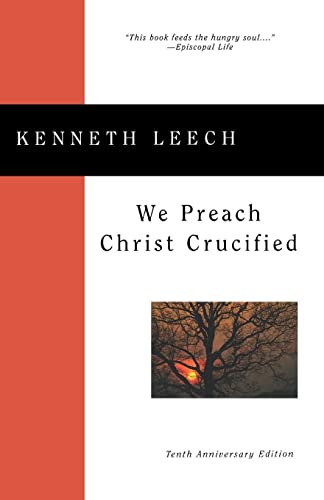
Through hymns, poems, and the lens of personal experience, a leading spiritual director and author takes a thoughtful, in-depth look at the Cross as a focal point for theology, spirituality, Christian symbolism, and discipleship, providing a probing and disturbing resource for group study during Lent.
Die Inhaltsangabe kann sich auf eine andere Ausgabe dieses Titels beziehen.
Über die Autorin bzw. den Autor
Kenneth Leech (1939-2015) was the founder of Centrepoint, one of the biggest programs for homeless youth in Europe, and former field officer for racial justice for the Church of England and community theologian at St Botolph's Church in Aldgate, London. He is the author of many highly regarded books, including Soul Friend, The Eye of the Storm, True Prayer, and the award-winning Care and Conflict.
Auszug. © Genehmigter Nachdruck. Alle Rechte vorbehalten.
WE PREACH CHRIST CRUCIFIED
By Kenneth LeechChurch Publishing Incorporated
Copyright © 2005 Kenneth Leech
All rights reserved.
ISBN: 978-0-89869-499-4All rights reserved.
Contents
| Preface.................................................................... | vii |
| 1. Foolishness to the Greeks............................................... | 1 |
| 2. Healed by His Wounds.................................................... | 20 |
| 3. A Kingdom not of This World............................................. | 39 |
| 4. The Love of God Poured Out.............................................. | 53 |
| 5. The Darkness where God Dwells........................................... | 69 |
| 6. Christ Our Passover..................................................... | 84 |
| References................................................................. | 99 |
CHAPTER 1
Foolishnessto the Greeks
For Jews demand signs and Greeks desire wisdom,but we proclaim Christ crucified, a stumbling blockto Jews and foolishness to Gentiles, but to thosewho are the called, both Jews and Greeks, Christthe power of God and the wisdom of God,
(1 Corinthians 1:22–24)
STRANGE MEMORY
Thousands of people were crucified during the sixty-fiveyears from the time that Judea became a Romanprovince until the end of the Jewish War. Almost all ofthem are now forgotten: they have become part of theimmense historical mass of the anonymous dead. Sucha loss of identity is hardly surprising in the aftermathof this most degrading and dehumanising form of punishmentin which, according to Cicero, even the nameof the victim should be removed. The rotting corpseswere often left for vultures and animals to devour. It isthis form of punishment, reserved mainly for the lowerclasses, particularly for slaves, violent criminals andinstigators of revolt, which provides the location forthese reflections on the work of our salvation.
Among the crucified people, Jesus of Nazarath aloneis remembered. But he is not only remembered, he isremembered by his followers as the crucified God. Theaccounts of his death in the gospels are the longest andmost detailed accounts of crucifixion in the whole ofancient literature, and the event itself is supported byevidence which is better than that for any similar eventin the ancient world. Within the gospels themselvesthe accounts of the passion (suffering) and death ofJesus take up the largest single sections: indeed thegospels have been described as passion narratives withextended introductions. Clearly this crucifixion is seenas being exceptionally important, at least by somepeople.
Within the community of his followers, Jesus isremembered – in the most literal sense, re-membered.Week by week, day by day, in the eucharistic offering,in the exposition of the word and in other ways, thereis a ritual re-enactment, an anamnesis, of the dyingand rising of Jesus. It is the Eucharist or Mass – thatregular act in which Christians claim to 'eat the flesh'and 'drink the blood' of Christ – which most dramaticallymanifests and makes present the mystery of thecross and resurrection. This ritual or liturgy is centralto Christian consciousness and to the nurturing andsustaining of Christian identity. 'Do this in remembranceof me' stands at the heart of Christian worship.Yet it is a strange act and seems to the outsider to bea foolish one. For here Christians not only retell theancient stories, they claim to re-enact the Last Supper,relive the sacrifice of Calvary and of heaven, andremember their own broken body through solidaritywith the broken and glorious body of Jesus Christ. This'unbloody sacrifice' of the Mass is strange, mysterious,fascinating and impenetrable, and, for all the attemptsto dispense with its mystery and reduce it to a crudeone-dimensional fellowship meal, the complexity of themystery keeps returning. In the mystery of the Masswe are, as it were, present at Calvary and at the resurrection.It is a strange event rooted in a strangememory.
While most Anglican eucharistic prayers use 'remembrance',the English versions of the Roman Mass usethe weaker word 'memory'. However, while memory isoften seen as a looking back to past and finished events,in recent years there has been a renewed emphasis oncorporate memory, the memory which recovers losttraditions and suppressed histories, the memory whichnourishes and strengthens movements and struggles.Memory is of the greatest importance in the lives ofChristians. Without memory there can be no forgiveness,no healing of the hurts and pain of the past.And forgiveness and healing are central to Christianexistence. The trouble is that our memory is oftenblocked. Past hurts and sufferings are too painful toremember, so we blot them out of consciousness. Weoften justify this organised amnesia by saying that we'live for the present'. But living for the present caneasily be an evasion of the reality of our past. It isthis evasion which must be undermined, lovingly yetdeliberately, by the Christian community. For to livewithin a community of faith is to live within a communityof memory, and the Christian community isshaped by what J. B. Metz calls 'the dangerous memoryof the passion of Christ'. It is a community with ahistory. T. S. Eliot in 'Little Gidding' tells us thata people without history is not redeemed from time,and, in Christian thought, redemption takes place bothwithin time and from the captivity of time.
However, the word 'remember* brings out the presentdynamic in the past events. To re-member is to puttogether again. And this is what happens among thedisciples of Jesus. Week by week, day by day, the Christiancommunity celebrates the mystery of his dying,breaking bread in his memory, and in that fragmentation,that brokenriess, celebrates its own unity as 'onebody in Christ'. The term 'body of Christ' is used inPaul to mean both the Eucharist and the people. Thiscontinual memorial or anamnesis is more than an actof nostalgia. It is a putting together again of the body ofChrist which was broken and given for the life of theworld. There is something immensely powerful andenergising about this movement, and yet we mustadmit that it is very odd, very strange – indeed, on thesurface, utterly absurd. For one would have thoughtthat the event of Calvary would have marked the endof what we call 'Christology', thinking about Jesus asthe Christ, the Messiah: it would seem to mark thedisastrous failure of a project. Yet this seems not to beso. Christ was broken and crushed, and yet it is whenwe are broken and crushed that we know him. Christwas a failure and it is in the midst of our failure thatwe know him, not as another failure but as a source oflife and power.
In fact the original Calvary experience was, for thedisciples, one of failure. It was later, on the road toEmmaus, and on similar subsequent encounters, thatthe reality of the cross and of the crucified one becamea living reality. It was on the first Pentecost after thedeath of Jesus that, as a result of Peter's preaching,they were 'cut to the heart' (Acts 2:37). It was as aresult of the preaching of the gospel of the crucifiedChrist that people were brought to faith and discipleship.
And so it has been through all the succeeding centuries.Although evidence suggests that friendship andthe witness and examples of friends is the most importantsingle factor in leading people to Christian faith,there is a power in preaching which is not dependenton...
„Über diesen Titel“ kann sich auf eine andere Ausgabe dieses Titels beziehen.
Weitere beliebte Ausgaben desselben Titels

Suchergebnisse für We Preach Christ Crucified

Beispielbild für diese ISBN
We Preach Christ Crucified
Anbieter: Orion Tech, Kingwood, TX, USA
Verkäuferbewertung 5 von 5 Sternen

paperback. Zustand: Very Good. Bestandsnummer des Verkäufers 089869499X-2-35591014
Gebraucht kaufen
EUR 5,48
Versand gratis
Versand innerhalb von USA
Versand innerhalb von USA
Anzahl: 1 verfügbar
Beispielbild für diese ISBN
We Preach Christ Crucified
Anbieter: World of Books (was SecondSale), Montgomery, IL, USA
Verkäuferbewertung 5 von 5 Sternen
Zustand: Good. Item in good condition. Textbooks may not include supplemental items i.e. CDs, access codes etc. Bestandsnummer des Verkäufers 00088526596
Gebraucht kaufen
EUR 5,49
Versand gratis
Versand innerhalb von USA
Versand innerhalb von USA
Anzahl: 1 verfügbar
Beispielbild für diese ISBN
We Preach Christ Crucified
Anbieter: ThriftBooks-Reno, Reno, NV, USA
Verkäuferbewertung 5 von 5 Sternen
Paperback. Zustand: Good. No Jacket. Pages can have notes/highlighting. Spine may show signs of wear. ~ ThriftBooks: Read More, Spend Less. Bestandsnummer des Verkäufers G089869499XI3N00
Gebraucht kaufen
EUR 7,33
Versand gratis
Versand innerhalb von USA
Versand innerhalb von USA
Anzahl: 1 verfügbar
Beispielbild für diese ISBN
We Preach Christ Crucified
Anbieter: ThriftBooks-Dallas, Dallas, TX, USA
Verkäuferbewertung 5 von 5 Sternen
Paperback. Zustand: Good. No Jacket. Pages can have notes/highlighting. Spine may show signs of wear. ~ ThriftBooks: Read More, Spend Less. Bestandsnummer des Verkäufers G089869499XI3N00
Gebraucht kaufen
EUR 7,35
Versand gratis
Versand innerhalb von USA
Versand innerhalb von USA
Anzahl: 1 verfügbar
Beispielbild für diese ISBN
We Preach Christ Crucified
Anbieter: ThriftBooks-Dallas, Dallas, TX, USA
Verkäuferbewertung 5 von 5 Sternen
Paperback. Zustand: Very Good. No Jacket. May have limited writing in cover pages. Pages are unmarked. ~ ThriftBooks: Read More, Spend Less. Bestandsnummer des Verkäufers G089869499XI4N00
Gebraucht kaufen
EUR 7,35
Versand gratis
Versand innerhalb von USA
Versand innerhalb von USA
Anzahl: 1 verfügbar
Beispielbild für diese ISBN
We Preach Christ Crucified
Anbieter: ThriftBooks-Atlanta, AUSTELL, GA, USA
Verkäuferbewertung 5 von 5 Sternen
Paperback. Zustand: Good. No Jacket. Pages can have notes/highlighting. Spine may show signs of wear. ~ ThriftBooks: Read More, Spend Less. Bestandsnummer des Verkäufers G089869499XI3N00
Gebraucht kaufen
EUR 7,35
Versand gratis
Versand innerhalb von USA
Versand innerhalb von USA
Anzahl: 1 verfügbar
Beispielbild für diese ISBN
We Preach Christ Crucified
Verlag:
Church Publishing Incorporated, 2005
ISBN 10: 089869499X
ISBN 13: 9780898694994
Gebraucht
Softcover
Anbieter: Better World Books, Mishawaka, IN, USA
Verkäuferbewertung 5 von 5 Sternen
Zustand: Good. Pages intact with minimal writing/highlighting. The binding may be loose and creased. Dust jackets/supplements are not included. Stock photo provided. Product includes identifying sticker. Better World Books: Buy Books. Do Good. Bestandsnummer des Verkäufers 14909780-6
Gebraucht kaufen
EUR 9,47
Versand gratis
Versand innerhalb von USA
Versand innerhalb von USA
Anzahl: 1 verfügbar
Foto des Verkäufers
We Preach Christ Crucified
Anbieter: Coas Books, Las Cruces, NM, USA
Verkäuferbewertung 5 von 5 Sternen
Zustand: acceptable. Item has staining. Cover is worn. Paperback. 10th Anniversary Edition. Bestandsnummer des Verkäufers 55GSJ1001J08_ns
Gebraucht kaufen
EUR 8,81
EUR 3,44 Versand
Versand innerhalb von USA
Versand innerhalb von USA
Anzahl: 1 verfügbar
Beispielbild für diese ISBN
We Preach Christ Crucified
Anbieter: GreatBookPrices, Columbia, MD, USA
Verkäuferbewertung 5 von 5 Sternen
Zustand: New. Bestandsnummer des Verkäufers 3477600-n
Neu kaufen
EUR 12,70
EUR 2,27 Versand
Versand innerhalb von USA
Versand innerhalb von USA
Anzahl: Mehr als 20 verfügbar
Foto des Verkäufers
We Preach Christ Crucified
Anbieter: Rarewaves.com USA, London, LONDO, Vereinigtes Königreich
Verkäuferbewertung 5 von 5 Sternen
Paperback. Zustand: New. Through hymns, poems, and the lens of personal experience, a leading spiritual director and author takes a thoughtful, in-depth look at the Cross as a focal point for theology, spirituality, Christian symbolism, and discipleship, providing a probing and disturbing resource for group study during Lent. Bestandsnummer des Verkäufers LU-9780898694994
Neu kaufen
EUR 15,04
Versand gratis
Versand von Vereinigtes Königreich nach USA
Versand von Vereinigtes Königreich nach USA
Anzahl: 10 verfügbar