
Verwandte Artikel zu Chile: The Pinochet Decade : The Rise and Fall of the...
Inhaltsangabe
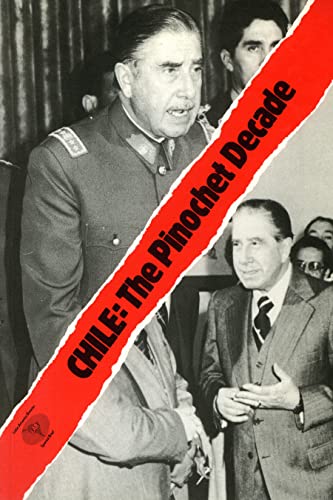
Chile: The Pinochet Decade tells the story of the rise and fall of the laissez-faire economic technocrats known as the Chicago Boys, who masterminded the experiment and analyses the nature of their alliance with General Pinochet.
Die Inhaltsangabe kann sich auf eine andere Ausgabe dieses Titels beziehen.
Auszug. © Genehmigter Nachdruck. Alle Rechte vorbehalten.
Chile: The Pinochet Decade
The Rise and Fall of the Chicago Boys
By Phil O'Brien, Jackie RoddickPractical Action Publishing
Copyright © 1983 Latin America Bureau (Research and Action) Ltd
All rights reserved.
ISBN: 978-0-906156-18-6All rights reserved.
Contents
Map of Chile, iv,
1. Chile in Brief, 1,
2. New and Old Extremisms, 14,
3. Popular Unity 1970-1973, 23,
4. The Making of the Coup 1970-1973, 30,
5. The Transition 1973-1974, 42,
6. The Shock 1975-1976, 54,
7. Fool's Gold and Fool's Democracy, 67,
8. The Roots of Resistance, 88,
9. The End of the Dream, 97,
10. The Model in Retrospect, 106,
Appendix: Human Rights and the Pinochet Decade, 110,
Bibliography, 118,
CHAPTER 1
Chile in Brief
Chronology
1541 Foundation of Santiago by Pedro de Valdivia.
1818 Chile achieves independence from Spain under leadership of Bernardo O'Higgins and Argentinian San Martin. O'Higgins becomes first president (Director Supremo) of Chile.
1833 New constitution, introduced by Diego Portales, establishes strongly-centralized and authoritarian state.
1879-1883 Bolivia and Peru defeated by Chile in the War of the Pacific. Bolivia loses access to the sea, and Chile gains possession of the Atacama desert, main source of the world's supply of nitrates.
1891 Defeat of President Jose Manuel Balmaceda in brief civil war.
1907 Massacre of 3,000 miners by troops after demonstration in nitrate port of Iquique.
1920 Arturo Alessandri elected as president.
1922 Communist Party of Chile officially formed.
1927-1931 Military dictatorship of Colonel Carlos Ibañez.
1932 12-day 'Socialist Republic' of Colonel Marmaduke Grove. Arturo Alessandri elected as president for second time.
1933 Foundation of Chilean Socialist Party.
1938 Election of Popular Front government, with a programme of state investment and state protection for national industry, under joint banner of Radical, Communist and Socialist Parties.
1948Ley Maldita, or the 'Evil Law', bans the Communist Party.
1952-1958 Second administration of Carlos Ibañez.
1958 Salvador Allende, presidential candidate for the Popular Action Front (FRAP), loses to National Party candidate, Jorge Alessandri, by 33,000 votes.
1964 Eduardo Frei, Christian Democrat candidate, wins election with 56 per cent of the vote, offering 'revolution in liberty' as an alternative to Marxist socialism.
1970 Salvador Allende, candidate for Popular Unity, wins presidential elections with 36 per cent of the vote, and becomes first ever elected Marxist president.
1973 Military coup. Military junta composed of Leigh, Merino, Pinochet and Mendoza takes power; Popular Unity parties banned; others suspended. National trade union confederation CUT dissolved. Congress dissolved; Comité Pro Paz created by Catholic and Lutheran Churches to deal with victims of repression. Junta organizes legislative committees: army controls defence and Leniz named minister of economy.
1974 DINA, Chile's secret police, created, solely responsible to Pinochet, who now becomes officially head of junta; El Mercurio outlines two alternative measures to reduce inflation: gradualism or economic 'shock treatment'; Christian Democrat advisers leave government; ban on union elections. Wage freeze continues, but old law of contract reinstated against employers' opposition; General Prats murdered in Buenos Aires. Miguel Enriquez, leader of MIR, killed in Santiago; El Mercurio comes out in favour of shock treatment in November. Privatization of banks announced; Pinochet becomes president of Chile in December.
1975 General Bonilla killed in air crash. Friedman and Harberger visit Chile to support 'shock treatment' to reduce inflation; cabinet reshuffle, consolidating 'Chicago' hold on government. Minister of finance Cauas announces introduction of 'shock treatment'; Movement of National Unity created by Declaration of Codegua, in face of growing economic emergency and world hostility to Chile; arrest of trade unionists from El Salvador copper mine. Ministry of interior (responsible to Pinochet) takes over control of trade union affairs from General Diaz and air force; Academy for National Security created; Leigh declares social cost of Chicago Plan too high; assassination attempt on left-wing Christian Democrat exile Bernardo Leighton in Rome; Comité: Pro Paz dissolved, Vicaria de Solidaridad created; withdrawal of British ambassador after torture of Sheila Cassidy, a British doctor.
1976 Cabinet reshuffle: air force General Diaz replaced by Chicago supporter Sergio Fernandez at ministry of labour; El Mercurio reports 20 minute strike attempt at Chuquicamata copper mine; Group of Ten right-wing Christian Democrat trade union leaders emerge into open with public letter to Fernandez; Letelier murdered in Washington; CNS made up of Marxists and leftwing Christian Democrats makes its first public appearance with another open letter to Fernandez; pro-government union confederation UNTRACH formed; Chile withdraws from Andean Pact.
1977 All political parties made illegal; British mediation awards Chile legal title to three disputed islands in Beagle Channel; DINA disbanded in wake of Letelier scandal, replaced by CNI; Bardon (Chicago supporter) president of central bank, says Chile will increase its foreign debt to speed up battle against inflation; Friedrich Von Hayek, father of free-market 'Chicago model' visits Chile; economics minister De Castro announces reduction of virtually all tariffs to 10 per cent.
1978 State of siege changed to state of emergency; Fernandez becomes minister of interior. Hernan Cubillos becomes minister of foreign relations with mandate to end Chile's diplomatic isolation; members of US AFL-CIO visit Chile at the invitation of the Group of Ten; Leigh and eight other air force chiefs retired. Matthei becomes chief of air force and new member of junta; Pinochet holds fourth mass meeting with trade union leaders organized by Secretario de los Gremios; Manuel Contreras indicted for murder of Letelier. Argentina calls up reserves and sends troops to Chilean border. Pinochet gives in to demands for union elections, and allows them in private sector. CNS federations dissolved; Vatican's offer to mediate the Beagle issue is accepted, after church in Chile and Argentina organizes protest demonstrations against war; US unions announce plan to organize a transport boycott of Chilean goods; first public discussion of the 'disappeared' of 1973 after bodies are found at Lonquen. Cabinet reshuffle: Fernandez's deputy at the labour ministry is replaced by Chicago Boy Jose Piñera, completing the Chicago revolution.
1979 Piñera promises restoration of trade union rights, an end to police surveillance of trade unions. Proposed US union boycott is lifted; collective bargaining begins for first time since the coup; size of US Embassy in Santiago cut as protest over government's failure to extradite Contreras.
1980 Government wins strike at El Teniente copper mine, seen as a victory for Chicago-style Labour Plan; protest march by student doctors unable to get jobs; Pinochet's trip to Philippines cancelled hours before his arrival; Cubillos is sacked as foreign minister; in first free university elections, opposition students win...
„Über diesen Titel“ kann sich auf eine andere Ausgabe dieses Titels beziehen.
Suchergebnisse für Chile: The Pinochet Decade : The Rise and Fall of the...

Foto des Verkäufers
Chile: The Pinochet Decade
Anbieter: Rarewaves.com USA, London, LONDO, Vereinigtes Königreich
Verkäuferbewertung 5 von 5 Sternen

Paperback. Zustand: New. Bestandsnummer des Verkäufers LU-9780906156186
Neu kaufen
EUR 22,33
Versand gratis
Versand von Vereinigtes Königreich nach USA
Versand von Vereinigtes Königreich nach USA
Anzahl: Mehr als 20 verfügbar
Beispielbild für diese ISBN
Chile: The Pinochet Decade
Anbieter: PBShop.store US, Wood Dale, IL, USA
Verkäuferbewertung 5 von 5 Sternen
PAP. Zustand: New. New Book. Shipped from UK. Established seller since 2000. Bestandsnummer des Verkäufers CX-9780906156186
Beispielbild für diese ISBN
Chile: The Pinochet Decade: The Rise and Fall of the Chicago Boys (Latin American Bureau Special Brief)
Verlag:
Latin America Bureau (LAB), 1983
ISBN 10: 0906156181
ISBN 13: 9780906156186
Gebraucht
Soft cover
Anbieter: The Book Escape, Baltimore, MD, USA
Verkäuferbewertung 5 von 5 Sternen
Soft cover. Zustand: Good. A couple pages have pencil underlining. Binding is tight and secure. ***Shipped within 24 hours from the beautiful Baltimore inner harbor area. First class service; accurate descriptions. Most items packed in boxes, not envelopes.***. Bestandsnummer des Verkäufers 004166
Gebraucht kaufen
EUR 20,23
EUR 3,53 Versand
Versand innerhalb von USA
Versand innerhalb von USA
Anzahl: 1 verfügbar
Beispielbild für diese ISBN
Chile: The Pinochet Decade
Anbieter: PBShop.store UK, Fairford, GLOS, Vereinigtes Königreich
Verkäuferbewertung 5 von 5 Sternen
PAP. Zustand: New. New Book. Shipped from UK. Established seller since 2000. Bestandsnummer des Verkäufers CX-9780906156186
Neu kaufen
EUR 20,77
EUR 4,91 Versand
Versand von Vereinigtes Königreich nach USA
Versand von Vereinigtes Königreich nach USA
Anzahl: 15 verfügbar
Foto des Verkäufers
Chile: The Pinochet Decade
Anbieter: Rarewaves USA, HEBRON, KY, USA
Verkäuferbewertung 5 von 5 Sternen
Paperback. Zustand: New. Bestandsnummer des Verkäufers LU-9780906156186
Neu kaufen
EUR 27,69
Versand gratis
Versand innerhalb von USA
Versand innerhalb von USA
Anzahl: Mehr als 20 verfügbar
Beispielbild für diese ISBN
Chile: The Pinochet Decade: The Rise and Fall of the Chicago Boys (Latin American Bureau Special Brief)
Anbieter: California Books, Miami, FL, USA
Verkäuferbewertung 5 von 5 Sternen
Zustand: New. Bestandsnummer des Verkäufers I-9780906156186
Neu kaufen
EUR 28,50
Versand gratis
Versand innerhalb von USA
Versand innerhalb von USA
Anzahl: Mehr als 20 verfügbar
Beispielbild für diese ISBN
Chile: The Pinochet Decade: The Rise and Fall of the Chicago Boys (Latin American Bureau Special Brief)
Anbieter: Ria Christie Collections, Uxbridge, Vereinigtes Königreich
Verkäuferbewertung 5 von 5 Sternen
Zustand: New. In English. Bestandsnummer des Verkäufers ria9780906156186_new
Neu kaufen
EUR 22,34
EUR 11,07 Versand
Versand von Vereinigtes Königreich nach USA
Versand von Vereinigtes Königreich nach USA
Anzahl: Mehr als 20 verfügbar
Beispielbild für diese ISBN
Chile: The Pinochet Decade: The Rise and Fall of the Chicago Boys (Latin American Bureau Special Brief)
Anbieter: Anybook.com, Lincoln, Vereinigtes Königreich
Verkäuferbewertung 5 von 5 Sternen
Zustand: Good. This is an ex-library book and may have the usual library/used-book markings inside.This book has soft covers. In good all round condition. Please note the Image in this listing is a stock photo and may not match the covers of the actual item,250grams, ISBN:0906156181. Bestandsnummer des Verkäufers 5772216
Gebraucht kaufen
EUR 31,75
EUR 15,41 Versand
Versand von Vereinigtes Königreich nach USA
Versand von Vereinigtes Königreich nach USA
Anzahl: 1 verfügbar
Beispielbild für diese ISBN
Chile: The Pinochet Decade : The Rise and Fall of the.
Anbieter: Books Puddle, Woodside, NY, USA
Verkäuferbewertung 4 von 5 Sternen

Zustand: New. pp. 124. Bestandsnummer des Verkäufers 26133916564
Neu kaufen
EUR 51,15
EUR 3,56 Versand
Versand innerhalb von USA
Versand innerhalb von USA
Anzahl: 4 verfügbar
Beispielbild für diese ISBN
Chile: The Pinochet Decade : The Rise and Fall of the.
Print-on-DemandAnbieter: Majestic Books, Hounslow, Vereinigtes Königreich
Verkäuferbewertung 4 von 5 Sternen
Zustand: New. Print on Demand pp. 124. Bestandsnummer des Verkäufers 126670923
Neu kaufen
EUR 49,20
EUR 7,68 Versand
Versand von Vereinigtes Königreich nach USA
Versand von Vereinigtes Königreich nach USA
Anzahl: 4 verfügbar