
Verwandte Artikel zu A History of the Concerto (Amadeus)
Inhaltsangabe
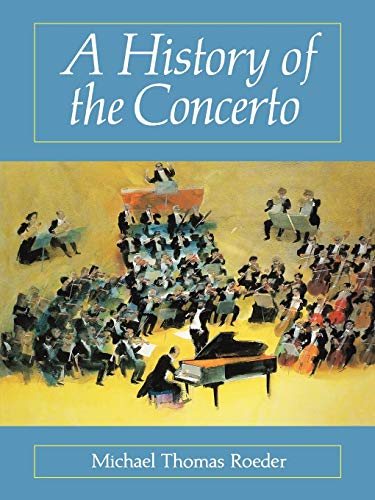
This lucid guide traces the concerto's evolution over the major periods of music: baroque, classical, romantic, and 20th century. The compositions of each important composer are discussed in detail, making this a useful companion to the form.
Die Inhaltsangabe kann sich auf eine andere Ausgabe dieses Titels beziehen.
Über die Autorin bzw. den Autor
Michael Thomas Roeder is a professor at the University of Alberta, where he recently received the A. C. Rutherford Award for Excellence in Undergraduate Teaching. His articles have appeared in the Canadian Association of University Schools of Music Journal and The Music Review. He has written and spoken extensively on the concerto, specifically on the baroque concerto, Alban Berg's Violin Concerto, the keyboard concertos of J. C. Bach and Mozart, and the influence of jazz on concert music. Dr. Roeder lives in Edmonton, Alberta, Canada.
Von der hinteren Coverseite
Michael Roeder's A History of the Concerto traces the concerto from its origins in the sixteenth and seventeenth centuries to its incarnation in the present. Basic to the concerto idea is the division of the performance group into two parts - one solo and the other orchestral - but the relationships between these two have undergone fundamental changes over the centuries. In many of the more familiar works from the nineteenth century, the composer frequently juxtaposes a dazzling soloist against a more conservative orchestral voice, but this has not always been the case. The developing concerto form, while always maintaining the dramatic opposition of solo and orchestral forces, evolved many rich variations specific to time, place, and composer. Whether in Vivaldi's The Four Seasons, Beethoven's "Emperor", or Calandrelli's Concerto for Jazz Clarinet, the dual elements of cooperation and contention come into play. The changing role of the soloist; the development of instruments; the evolution of music's function in society; the influence of local, regional, and international culture; and the composer's individual story are all part of Roeder's documentation of concerto history. The book is divided into four sections corresponding to the major historical-stylistic periods of Western music and of concerto development - Baroque, Classical, Romantic, and Twentieth Century. Within these sections, attention is given to geographical regions where strikingly different approaches to concerto style are found. Roeder explores major works as well as the pieces of lesser-known composers whose contributions were important to the changing character of the concerto. A History of the Concerto may be readfrom cover to cover, but readers may also use the extensive index to focus on specific concertos and their composers. Numerous musical examples illuminate critical points. While some readers may want to study the more detailed analyses with scores in hand, this is not essential for an understanding of the text. Michael Roeder's lucid and detailed historical study of the concerto will inform and delight those interested in understanding this popular and dynamic musical form.
„Über diesen Titel“ kann sich auf eine andere Ausgabe dieses Titels beziehen.
Suchergebnisse für A History of the Concerto (Amadeus)

Beispielbild für diese ISBN
A History of the Concerto (Amadeus)
Anbieter: World of Books (was SecondSale), Montgomery, IL, USA
Verkäuferbewertung 5 von 5 Sternen

Zustand: Good. Item in good condition. Textbooks may not include supplemental items i.e. CDs, access codes etc. Bestandsnummer des Verkäufers 00094541661
Gebraucht kaufen
EUR 6,25
Versand gratis
Versand innerhalb von USA
Versand innerhalb von USA
Anzahl: 1 verfügbar
Beispielbild für diese ISBN
A History of the Concerto
Anbieter: ThriftBooks-Dallas, Dallas, TX, USA
Verkäuferbewertung 5 von 5 Sternen
Paperback. Zustand: Fair. No Jacket. Readable copy. Pages may have considerable notes/highlighting. ~ ThriftBooks: Read More, Spend Less. Bestandsnummer des Verkäufers G0931340616I5N00
Gebraucht kaufen
EUR 6,27
Versand gratis
Versand innerhalb von USA
Versand innerhalb von USA
Anzahl: 1 verfügbar
Beispielbild für diese ISBN
History of the Concerto
Anbieter: ThriftBooks-Atlanta, AUSTELL, GA, USA
Verkäuferbewertung 5 von 5 Sternen
Paperback. Zustand: Good. No Jacket. Pages can have notes/highlighting. Spine may show signs of wear. ~ ThriftBooks: Read More, Spend Less. Bestandsnummer des Verkäufers G0931340616I3N00
Gebraucht kaufen
EUR 6,27
Versand gratis
Versand innerhalb von USA
Versand innerhalb von USA
Anzahl: 1 verfügbar
Beispielbild für diese ISBN
A History of the Concerto
Verlag:
Bloomsbury Publishing USA, 2003
ISBN 10: 0931340616
ISBN 13: 9780931340611
Gebraucht
Softcover
Anbieter: Better World Books: West, Reno, NV, USA
Verkäuferbewertung 5 von 5 Sternen
Zustand: Good. Former library copy. Pages intact with minimal writing/highlighting. The binding may be loose and creased. Dust jackets/supplements are not included. Includes library markings. Stock photo provided. Product includes identifying sticker. Better World Books: Buy Books. Do Good. Bestandsnummer des Verkäufers GRP17189203
Gebraucht kaufen
EUR 7,07
Versand gratis
Versand innerhalb von USA
Versand innerhalb von USA
Anzahl: 1 verfügbar
Beispielbild für diese ISBN
A History of the Concerto
Verlag:
Bloomsbury Publishing USA, 2003
ISBN 10: 0931340616
ISBN 13: 9780931340611
Gebraucht
Softcover
Anbieter: Better World Books, Mishawaka, IN, USA
Verkäuferbewertung 5 von 5 Sternen
Zustand: Good. Pages intact with minimal writing/highlighting. The binding may be loose and creased. Dust jackets/supplements are not included. Stock photo provided. Product includes identifying sticker. Better World Books: Buy Books. Do Good. Bestandsnummer des Verkäufers 8214158-6
Gebraucht kaufen
EUR 7,07
Versand gratis
Versand innerhalb von USA
Versand innerhalb von USA
Anzahl: 1 verfügbar
Beispielbild für diese ISBN
A History of the Concerto (Amadeus)
Anbieter: HPB-Red, Dallas, TX, USA
Verkäuferbewertung 5 von 5 Sternen
paperback. Zustand: Good. Connecting readers with great books since 1972! Used textbooks may not include companion materials such as access codes, etc. May have some wear or writing/highlighting. We ship orders daily and Customer Service is our top priority! Bestandsnummer des Verkäufers S_434971995
Gebraucht kaufen
EUR 4,58
EUR 3,33 Versand
Versand innerhalb von USA
Versand innerhalb von USA
Anzahl: 1 verfügbar
Beispielbild für diese ISBN
A History of the Concerto
Verlag:
Hal Leonard Corporation, 2003
ISBN 10: 0931340616
ISBN 13: 9780931340611
Gebraucht
Paperback
Anbieter: World of Books Inc, Montgomery, IL, USA
Verkäuferbewertung 4 von 5 Sternen

Paperback. Zustand: Good. This lucid guide traces the concerto's evolution over the major periods of music: baroque, classical, romantic, and 20th century. The compositions of each important composer are discussed in detail, making this a useful companion to the form. Bestandsnummer des Verkäufers CIN0931340616G
Gebraucht kaufen
EUR 8,08
Versand gratis
Versand innerhalb von USA
Versand innerhalb von USA
Anzahl: 1 verfügbar
Beispielbild für diese ISBN
A History of the Concerto (Amadeus)
Anbieter: Hilltop Book Shop, Marshfield, WI, USA
Verkäuferbewertung 5 von 5 Sternen
paperback. Zustand: Good. Hardcover in good condition. Light edge wear to dust jacket, and front flap is price clipped. Cover will have a few dings to edges along with some rubbing. Clean pages free of writing, marks or tears. Binding is secure. We package our items carefully, so you receive them in the advertised condition. Bestandsnummer des Verkäufers 2501200004
Gebraucht kaufen
EUR 14,78
EUR 4,67 Versand
Versand innerhalb von USA
Versand innerhalb von USA
Anzahl: 1 verfügbar
Beispielbild für diese ISBN
A History of the Concerto
Anbieter: Anybook.com, Lincoln, Vereinigtes Königreich
Verkäuferbewertung 5 von 5 Sternen
Zustand: Poor. This is an ex-library book and may have the usual library/used-book markings inside.This book has hardback covers. Book contains pencil markings. In poor condition, suitable as a reading copy. No dust jacket. Please note the Image in this listing is a stock photo and may not match the covers of the actual item,1450grams, ISBN:0931340616. Bestandsnummer des Verkäufers 3723325
Gebraucht kaufen
EUR 7,27
EUR 15,49 Versand
Versand von Vereinigtes Königreich nach USA
Versand von Vereinigtes Königreich nach USA
Anzahl: 1 verfügbar
Beispielbild für diese ISBN
A History of the Concerto
Anbieter: Anybook.com, Lincoln, Vereinigtes Königreich
Verkäuferbewertung 5 von 5 Sternen
Zustand: Poor. This is an ex-library book and may have the usual library/used-book markings inside.This book has hardback covers. Clean from markings. In poor condition, suitable as a reading copy. Dust jacket in fair condition. Please note the Image in this listing is a stock photo and may not match the covers of the actual item,1550grams, ISBN:9780931340611. Bestandsnummer des Verkäufers 7070916
Gebraucht kaufen
EUR 5,71
EUR 17,91 Versand
Versand von Vereinigtes Königreich nach USA
Versand von Vereinigtes Königreich nach USA
Anzahl: 1 verfügbar