
Verwandte Artikel zu Covered Call Writing with Qs and Diamonds: Double-Digit...
Inhaltsangabe
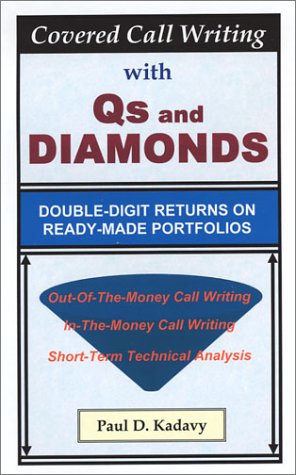
"Covered Call Writing With Qs And Diamonds: Double-Digit Returns on Ready-Made Portfolios" is not just another new book about covered call writing. It is a highly focused and readily understandable educational tool with a unique easy-to-follow implementation program. It is designed for investors who either do not have the time or the desire to research individual stocks and administer such a portfolio, yet who seek an opportunity to achieve double-digit investment returns by using covered call writing.
Ownership of the ready-made portfolios available to you with the Qs (ticker symbol QQQ: the 100 largest companies on the Nasdaq) and Diamonds (ticker symbol DIA: the stocks composing the Dow Jones Industrial Average) eliminate the need for stock research. And, the call writing choices you have available to you with them are far broader than any individual stocks, making them the perfect equity investment to use in conjunction with covered call writing. The book delves deeply into the subject of how to obtain double-digit returns from both out-of-the-money calls and in-the-money calls. It also provides short-term technical analysis tools to assist in guiding market forecasts and making appropriate call writing decisions.
On May 3, 2003 after the annual meeting of his company, Warren Buffett (Chairman of Berkshire Hathaway) said to Maria Bartiromo of CNBC: "If you own equities, over the next twenty or thirty years you’ll get a reasonable return...maybe its 6%, maybe its 7%. People who expect 15% a year are doomed to disappointment." If you believe that "The Oracle of Omaha" is right about a slow-growth market for decades to come, then everything that you need as an investor is here for you in this book to develop and implement a covered call writing program using two of the world’s most liquid, highly diversified equity portfolios.
THE BOOK PROVIDES:
* The case for using the Nasdaq-100 Index Tracking Stock (tracks the top 100 Nasdaq stocks in market capitalization), also known as the "Qs" or "Cubes," and the Diamonds Trust Series 1 (tracks the Dow Jones Industrial Average), known simply as Diamonds, for total or substantial portfolio composition. This allows investors to achieve significantly more equity ownership diversification than from shares in individual stocks. * Details on the unique features of these two highly liquid and popular Exchange Traded Funds (ETFs) that make them ideally suitable for no hassle, easy decision covered call writing to assist in reaching consistent double-digit investment returns in a more conservative way than a buy-and-hold equity strategy.
* A detailed turnkey implementation program for call writing with the QQQ and DIA, including "out-of-the-money" calls and "in-the-money" calls, both of which can yield solid double-digit returns, when and how to effectively use them.
* Discussion on call expiration date selection to fit your needs, including the advantages of shorter-term and longer-term expirations.
* A presentation of technical analysis tools to assist investors in making short-term decisions on when to write calls, and which type of call to write.
* Use of Microsoft® Excel spreadsheets to assist in reviewing covered call writing selection alternatives and tracking your results so that the best decisions for you are reached to achieve your investment return goal.
* Use of margin, if appropriate for you, to potentially almost double the returns from covered call writing on these ready-made portfolios.
* Details about brokerage accounts, with special emphasis on the use of online discount brokerages for quick, very low cost execution of trades. Web sites for brokerages, charting sources and other technical information are provided.
* Presentation of the tax information you need to understand and administer the income tax aspects of covered call writing. This includes deferring taxation of income until a later tax year while enjoying the use of the income now.
With interest rates so low and a scarcity of acceptable investment alternatives available to investors, covered call writing on diversified portfolios such as the Qs and Diamonds may offer one of the best possible opportunities to achieve double-digit investment returns in the slow-growth market we seem sure to encounter ahead.
Die Inhaltsangabe kann sich auf eine andere Ausgabe dieses Titels beziehen.
Über die Autorin bzw. den Autor
As a thirty-year career banker and trust officer for Norwest Corporation, now Wells Fargo & Co., one of the nation’s largest financial institutions, Paul D. Kadavy was president of numerous banks in three states. He also headed a multi-billion dollar trust department, managed a team of investment professionals, and was a trusted advisor to many of the banks' individual clients. He is now retired from banking and is a writer, teacher and public speaker.
Kadavy has served on the faculty of the National Graduate Trust School at Northwestern University, The Schools of Banking, Inc., the American Institute of Banking and numerous community colleges in several states. He has been a lecturer on trust, investment and banking subjects to FDIC and Federal Reserve Bank examiners in Washington, D.C. He has been a public speaker for the past twenty-five years.
Kadavy is also the author of "Covered Call Writing Demystified," "Covered Call Writing With Exchange Traded Funds (ETFs)" and "The Book of World-Class Quotations: The Best of the Best Quotations on Earth," which includes guides for writing affirmations and for personal goal setting. All of his books are available on Amazon.com. In addition to writing books, he is the author of banking, trust and investment articles for such national publications as "Financial Review," "Trusts & Estates," "Pension World," "The Collector/Investor," "Cases & Comment" and "American Bankers Association Trust Management."
He has developed and successfully used the principles in his books for over twenty years.
Auszug. © Genehmigter Nachdruck. Alle Rechte vorbehalten.
CHAPTER 1 INVESTMENT RETURNS: THE FUTURE ISN T WHAT IT USED TO BE
When the enormous Internet and telecommunications bubble eventually burst, many of the investment "experts" people had come to trust either lost their jobs, or at the very least lost their credibility. Some have been heavily fined, and the dust likely won t completely settle for years to come.
Yet through it all, we find that there are still real experts out there who can be trusted and should have always been trusted. Among them are Warren Buffett (Chairman of Berkshire Hathaway), John Templeton (a pioneer in the mutual fund industry and founder of the Templeton Funds), Jeremy Siegel (professor of finance at the Wharton School of the University of Pennsylvania), and Peter Lynch (Vice Chairman of Fidelity Investments, and former manager of the top ranked Fidelity Magellan Fund).
Many of these true experts have been warning us that the generous stock market returns of the past should not be expected in the future. Warren Buffett, "The Oracle of Omaha," is arguably the most successful investor in modern times, with average annual returns to his investors exceeding 25% annually since the late 1960s. In 1999 Buffett, who had always been silent about his beliefs on the stock market, began to publicly express his concerns about the expectations that investors have for market returns in the future. He suggested in Fortune that, perhaps for decades, stock market returns would average about 6% per year after brokerage costs, but before taxes. Then the markets, particularly the Nasdaq, began their substantial fall.
He has not warmed up much to the market since that time. In the most recent annual report for his company, Buffett commented:
"Despite three years of falling prices, which have significantly improved the attractiveness of common stocks, we still find VERY few that even mildly interest us. That dismal fact is testimony to the insanity of valuations reached during The Great Bubble. Unfortunately, the hangover may prove to be proportional to the binge." ("Chairman s Letter," Berkshire Hathaway 2002 Annual Report: 15-16)
And, following the annual meeting of his shareholders attended by 15,000 loyal believers, Buffett had the following to say in an exclusive interview with Maria Bartiromo of CNBC in which he seems to have lengthened his time horizon for slow growth in the market:
"If you own equities, over the next twenty or thirty years you ll get a reasonable return maybe its 6%, maybe its 7%. People who expect 15% a year are doomed to disappointment." (Interview with Maria Bartiromo, CNBC TV, May 3, 2003)
While it is possible that these experts could be wrong, history has certainly been on the side of those who have believed in Mr. Buffett.
There are many other individuals with acknowledged expertise in investments as well as economics who believe that stock market returns in the future will be significantly less than they have been in the past. They offer several themes to support their conclusions:
WHY WILL MARKET GROWTH LIKELY BE SLOWER IN THE FUTURE?
* Despite market corrections in the major averages--the Dow Jones Industrial Average, the Standard & Poors 500, and most especially the Nasdaq--stocks are still selling at heftier prices now than even a historical midpoint of a range of values for these averages.
* A bubble was created in the Internet and telecommunications sectors through unprecedented access by startup companies to the capital markets, resulting in unsustainable levels of capital spending. This has been unwinding for some time as the bubble broke. Many believe that such a bursting has long-term implications that will slow future economic growth and affect other industries as well.
* Corporate profits would have to grow at an abnormally high rate in the future as a percentage of Gross Domestic Product (national output) to support much higher stock prices. Since this is very unlikely, the relatively high level of current stock prices will increase more slowly as corporate earnings growth works to catch up with these prices.
* Interest rates are now at lows not seen since the Eisenhower Administration in the late 1950s. Inflation is very low. Both of these factors certainly support relatively high stock prices. Yet to support even higher stock prices, both interest rates and inflation would need to decline even more. The problem is that there is almost no additional room for either to decline much further.
These are the primary schools of thought regarding why stock prices are highly likely to grow at a slower pace in the future than they have in the past.
For owners of stocks and Exchange Traded Funds (ETFs), a simple strategy unknown to the vast majority of individual investors--writing covered call options--may be the best opportunity to achieve double-digit returns in this projected future. And two of the most liquid and noteworthy ETFs available to us, the Qs and Diamonds, are as we shall see also the two most attractive for writing covered calls.
We do not need a fast rising market to earn such returns. All we need is for the market to stop going down and either stabilize or begin going up slowly--the best possible market environment for covered call writing.
„Über diesen Titel“ kann sich auf eine andere Ausgabe dieses Titels beziehen.
Suchergebnisse für Covered Call Writing with Qs and Diamonds: Double-Digit...

Beispielbild für diese ISBN
Covered Call Writing with Qs and Diamonds: Double-Digit Returns on Ready-Made Portfolios
Anbieter: ThriftBooks-Dallas, Dallas, TX, USA
Verkäuferbewertung 5 von 5 Sternen

Plastic Comb. Zustand: Good. No Jacket. Pages can have notes/highlighting. Spine may show signs of wear. ~ ThriftBooks: Read More, Spend Less. Bestandsnummer des Verkäufers G097155143XI3N00
Gebraucht kaufen
EUR 7,95
Versand gratis
Versand innerhalb von USA
Versand innerhalb von USA
Anzahl: 1 verfügbar
Beispielbild für diese ISBN
Covered Call Writing with Qs and Diamonds: Double-Digit Returns on Ready-Made Portfolios
Anbieter: ThriftBooks-Atlanta, AUSTELL, GA, USA
Verkäuferbewertung 5 von 5 Sternen
Plastic Comb. Zustand: Fair. No Jacket. Readable copy. Pages may have considerable notes/highlighting. ~ ThriftBooks: Read More, Spend Less. Bestandsnummer des Verkäufers G097155143XI5N00
Gebraucht kaufen
EUR 7,95
Versand gratis
Versand innerhalb von USA
Versand innerhalb von USA
Anzahl: 1 verfügbar