
Verwandte Artikel zu The Yamas & Niyamas: Exploring Yoga's Ethical Practice
Inhaltsangabe
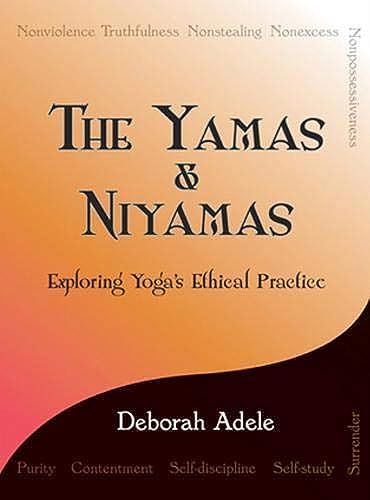
The first two limbs of the eight-fold path of yoga sutras—the basic text for classical yoga—are examined in this spiritual guide to the practice of yoga. Foundational to all yogic thought, they are considered to be the guidelines to the yoga way of living that free individuals to take ownership of their lives, direct them toward the fulfillment they seek, and gain the skills to choose attitude, thought, and action. The first five guidelines are referred to as the yamas—a Sanskrit word that translates to "restraints"—and encompass nonviolence, truthfulness, not stealing, nonexcess, and nonpossessiveness. The last five are referred to as the niyamas, or observances—purity, contentment, self-discipline, self-study, and surrender. A self-study section at the end of each chapter may also be used by instructors for group discussion.
Die Inhaltsangabe kann sich auf eine andere Ausgabe dieses Titels beziehen.
Über die Autorin bzw. den Autor
Deborah Adele holds master’s degrees in both Liberal Studies and Theology & Religious Studies. An ERYT500, she carries yoga certifications in Kundalini yoga, Hatha yoga, Yoga Therapy, and Meditation. She is also trained as a Gestalt practitioner and a Somatic Educator. For over 14 years, Deborah brought her combined knowledge of business and her in-depth knowledge of yoga philosophy to build Yoga North, now a thriving yoga center. Currently she is writing, teaching, consulting, and engaging her own personal practice.
Deborah worked for three years as a consultant with a firm out of Boulder, Colorado, where she combined the concept of body and breath with organizational development skills to improve leadership and management in various businesses around the country. She wrote a regular wellness column for the Duluth News Tribune and has authored two CD’s, The Art of Relaxation and The Practice of Meditation. Deborah currently owns Adele & Associates, a company whose goal is to increase clarity, productivity, and right-living in individuals and systems. Deborah is a keen and innovative thinker, and, in whatever venue she finds herself, consistently uses her knowledge and training to support others in living a life imbued with balance, clarity, and well-being.
In addition to her business and yoga experience, Deborah has made several trips to India for study and exploration. She feels it is important to continually ask ourselves the question, “What does it mean to be human?” by putting ourselves in places we can be challenged and changed, by telling ourselves the truth, and by sitting in some form of prayer, meditation, or reflection daily.
Deborah currently resides in Duluth with her husband Doug, a Lutheran minister, where their conversations around spirituality remain lively. Her life is enriched by their two sons and four grandchildren.
To learn more about Deborah visit her website: www.DeborahAdele.com.
Auszug. © Genehmigter Nachdruck. Alle Rechte vorbehalten.
The Yamas & Niyamas: Exploring Yoga's Ethical Practice
By Deborah AdeleOn-Word Bound Books
Copyright © 2009 Deborah Adele
All rights reserved.
ISBN: 978-0-9744706-4-1All rights reserved.
CHAPTER 1
Ahimsa
Storms rage about me. I calm my heart and send out ribbons of peace ~ peace.
~ C.L.
Nonviolence
Ahimsa
In the Karate Kid movies, Mr. Miyagi at first appears to be a silly, rather harmless little old man to seventeen year old Daniel. Mr. Miyagi is humble and unpretentious; he sits around for hours trying to catch flies with chopsticks, tends his bonsai trees, and doesn't even seem to bat an eye when provoked. But as the movie progresses and bullies threaten both Daniel and Mr. Miyagi, Mr. Miyagi springs into defensive action. Daniel's eyes are opened to the incredible ability of this old man who skillfully takes on a team of karate opponents larger and younger than he is. From that point on, Mr. Miyagi becomes Daniel's mentor in the art of skillful defense, true friendship, and the art of living.
Nonviolence may appear to us like Mr. Miyagi first appeared to Daniel. It can look so passive and unimportant that we can easily ignore its presence and the subtleties of its power, wondering what the fuss is all about. And yet, in Eastern thought, nonviolence is so valued that it stands as the very core and foundation of all yoga philosophy and practice. It is as if the yogis are saying that if we don't ground our lives and actions in nonviolence, everything else we attempt will be precarious. All of our achievements and successes, hopes and joys stand on faulty ground if they do not stand on the foundation built by nonviolence.
Killing and doing physical harm are grosser forms of violence that are easily seen and understood. However, nonviolence has many subtle implications as well. When we feel hurried, afraid, powerless, out of balance, and harsh with ourselves, we may find ourselves speaking words of unkindness or even exploding with a violent outburst. As our awareness of these nuances grows, we learn that our ability to be nonviolent to others is directly related to our ability to be nonviolent within ourselves. Our inner strength and character determine our ability to be a person of peace at home and in the world.
In the Karate Kid movies, Daniel did not go to karate school to study. Instead, he became skilled at karate by learning how to move through the daily chores of waxing cars, sanding wood, and painting fences. In much the same way, we grow our capacity to be nonviolent by learning how to move through the everyday challenges of life and by addressing the things that precipitate our tendencies toward violence. Ahimsa, or nonviolence, literally to do "no harm," calls forth from us our most brilliant and best self. Our capacity to be nonviolent depends on our proactive practice of courage, balance, love of self, and compassion for others.
Finding our Courage
We only have to look around us to see that fear abounds. It abounds in cowardly faces that turn away, in violent attacks, in walls of protection, in bins of possessions, in numerous unkind words and gestures. In an abundant world, hoarders take more than their share leaving others lacking. Wars are started and fought to seize the goods and keep the power. All around the world, children's innocence is destroyed by abuse and horror. If we look closely, we can trace all of these acts of greed, control, and insecurity back to their root: fear. Fear creates violence.
If we are to begin to address these fears, we need to know the difference between the fears that keep us alive and the fears that keep us from living. The first kind of fear is instinctual and built in us for survival. The second kind of fear is fear of the unfamiliar. The unfamiliar can become an abundant place for our exploration once we realize this fear lives only in our imagination. It is only our minds that have created the turmoil in our gut and kept us hostage to the possibility of our own lives.
An example of fear that lives only in the imagination, might be sky diving. For me, the thought of jumping out of a plane at a high altitude and remembering to open my parachute somewhere along the way, sends cold shivers down my spine and giant rumblings of fear in my gut. All of this is happening in my body in this very moment, and yet I have never experienced this activity. For me to walk into this fear, I would first imagine a different scenario for myself, something that looks like adventure and fun; something where I am competent and collected as I jump from heaven to earth. And then, were I really to step into my courage, I would call a pilot.
Seeking out people and experiences we would normally avoid provides a fertile place to learn new things about ourselves and about life. Even those we might call enemies have much to teach us. People we have previously avoided will open up new ways of thinking and will give us pieces of ourselves. As we walk into our fears with both people and experiences, we will find that our sense of self has grown. Our view has expanded; the world suddenly looks like a bigger place, and we are more competent to navigate in it. As we expand ourselves into these new places, our minds and hearts grow more open and we have less need to be violent. Thus, to create a life and a world free of violence is first and foremost to find our own courage.
Courage is not the absence of fear, but the ability to be afraid without being paralyzed. Courage is found by facing our fears – the small ones, the fat ones, the embarrassing ones, and the really big, scary ones. To live the fullness that our own life is inviting us into, we often have to let ourselves be afraid and do it anyway. If we keep ourselves safe, how will our courage grow? One of the reasons for Gandhi's unmatched power was that he continued to stay with life; he didn't run when life got too confusing or difficult. He stayed and learned from the moment, and in the process he became a skillful leader no one could match and a force that no one could stop. For Gandhi, fear became a stimulus to develop his courage.
Creating Balance
Courage demands our best self and that is a self in balance. Think about the times you were "short" with others because of too much work to do, or too much caffeine and sugar, or a restless night of sleep. Imbalance in our systems is almost a certainty for violence, as the "disease" we feel within finds its way to expression outwards. Balance creates harmony within us, and harmony within naturally expresses itself in external actions that are harmonious. Dr. Phil Nuernberger emphasizes the importance of balance when he says, "The deep harmony of balance is my most precious commodity and I guard it fiercely."
Creating balance in our lives is not an easy thing. We are a hungry, noisy people, bombarded with stimulation and advertisements that promise to grant us our deepest desires. If we are not on purpose with creating balance for ourselves, we can easily fall victim to false promises and fill every breathable space with appointments and activities and all the responsibilities that go with a full agenda. It is anti-cultural to claim any space that is simply space, or to move with any kind of lingering, or to take time for closure. We are bombarded and we bombard ourselves. And if we have any doubts, our calendars will reveal the truth of our craziness. The repercussions are inescapable, immeasurable violence to ourselves and those around us.
Like the body, the mind and soul need time to digest and assimilate. Like the body, the mind and soul need time to rest. We create this rest by allowing space that we can breathe in. Not more clutter, but more space, space to reflect, space to journal, space for closure, space for imagination, and space to feel the calling of the life force within us.
Balance does not look a certain way because it isn't a set standard to impose upon ourselves; it's not something we can plan or schedule. Balance instead comes from listening to the guidance and wisdom of the inner voice. Balance will look different in each of us and even different in each of us at different times. To be in tune with ourselves, we must get quiet and listen and then heed this inner voice. This voice does not push or bombard or make promises. This inner wisdom simply knows what we need to be vital, healthy, and in deep harmony.
My sons and their children love the board game Risk. It is a game where all the players begin with armies, which they strategically place on various countries around the world, and then try to conquer the world with their armies. It is a game of strategy and skill and can be played into the wee hours of the night. What is interesting to me is that my grandchildren, in playing this game, have learned something important about balance. One of my grandchildren put it this way, "When you see someone's army spread all over the world, it looks so impressive. Dad always starts by putting all his armies on four countries in a corner. It looks like no one will ever have to worry about him. But as the game gets played, the person who has spread their armies too thin is always the first to lose, and Dad always wins."
Balance is like this. Spreading ourselves thin looks impressive, but in the end, we are the first to lose. The health and well-being of our body, mind, and spirit is a powerful resource and by keeping ourselves in balance, we can stride through life with greater competence and ease. We are primed to "win" as we meet life from an inner place of harmony. When we are in balance, we automatically live in nonviolence.
Dealing with Powerlessness
One of the biggest challenges to maintaining balance is feeling powerless. Feeling powerless leads to outward aggression in the form of frustration and anger, or withdrawal inward into depression and victimization. We fear our own power and we often feel trapped at our sense of powerlessness. By powerless, I mean those times we feel like we've run out of choices. We've run out of options and we are feeling totally incompetent to deal with the challenge at hand. At these times, we may feel like a caged animal, trapped and ready to spring. Whether we respond with anger, withdrawal, frustration, or resignation, there is a way in which our mind shuts down, as if we are riding a train through a dark tunnel and we can't see anything but darkness and anxiety.
Ahimsa, or nonviolence, invites us to question the feeling of powerlessness rather than accept it. When we feel powerless, we have forgotten how much choice we really have. We have a choice to take action and we have a choice to change the story we are telling ourselves about our powerlessness. Instead of sulking in the feeling of powerlessness, we can ask, "What do I need to do right now to feel competent to handle this situation?" During these times, we can also jumpstart ourselves by remembering past times when we successfully handled a challenging situation while remaining loving and whole and then trying to find that feeling again.
I have found three ways of thinking that shift me out of a feeling of powerlessness: practicing gratitude, trust in the moment, and thinking about others. When I change my approach, I am out of the dark tunnel of powerlessness. Suddenly, in the light, I see many options. For instance, if my car breaks down at an inconvenient time, I can choose to be grateful that I am safe and have my cell phone; I can choose one of many options for support for towing and fixing my car; I can turn the whole situation into an adventure by perhaps riding the bus for the first time in years or calling an old friend for a lift, and trusting that somehow, all is well.
Often we carry a sense of powerlessness from a childhood story. Perhaps at one time in our lives, the story was true, but it probably isn't true anymore. I do many private consultations with people who are feeling powerlessness from believing an old story that they have continued to accept as true. I have come to believe that any sense of powerlessness we are feeling can be traced back to the story we are telling ourselves in the moment about the situation. We all have the choice to tell a different story and grow ourselves up to take responsibility for our lives in a new and fresh way.
Situations where we feel powerless can also be opportunities to grow our skill level with life. I find my powerless issues arise with technology and mechanics. When things break down, my feelings of powerlessness can become a violent outburst or an opportunity to learn something new. I often ponder the words of Yogiraj Achala, "I excite myself with my incompetencies." With this attitude, feelings of powerlessness become opportunities to become competent rather than violent.
Self-Love
Our ability to stay balanced and courageous has much to do with how we feel about ourselves. The following two stories illustrate this point. Pandit Rajmani Tigunait, spiritual head of the Himalayan Institute, tells of an incident with his young son. The family had just returned from India and the child began behaving strangely. He was biting and pinching his parents and playmates. Rajmani was beside himself with this strange behavior from his sweet son, until he realized that in India his son had gotten worms and the worms were pinching and biting his little insides. The son was only displaying outwardly the experience of his insides.
Yoga instructor and mentor Ann Maxwell tells of the abrupt turbulence in her home when her three year old son, Brooks, suddenly began holding his stools. Holding his stools caused him great discomfort and in turn the whole household was affected to the extent that the day was shaped for the whole family by whether Brooks was releasing or holding his stools. The days he held it in were the days that the whole family suffered from the oppressive misery of a little three year old boy. Brooks was displaying outwardly the experience of his insides.
These stories show that how we treat ourselves is in truth how we treat those around us. If you are a taskmaster with yourself, others will feel your whip. If you are critical of yourself, others will feel your high expectations of themselves as well. If you are light hearted and forgiving with yourself, others will feel the ease and joy of being with you. If you find laughter and delight in yourself, others will be healed in your presence.
We would never purchase a can of red paint and expect it to be the color blue when we apply it to our walls. And yet we can be so harsh and demanding with ourselves and then expect to be loving with others. It just doesn't work that way. The color of the paint inside the can is the color that whatever we paint becomes. The "color" of how we treat ourselves is the "color" of how we treat others. If we can't be safe with ourselves, others can never be safe with us, and the world can never be a safe place to be.
I spent three years consulting with a firm out of Boulder, Colorado. The work itself was stimulating and rewarding, but I was on such a fast-paced track that one day I realized I had not even taken time in those three years for one of my most delicious pleasures, a long, hot bubble bath. When I finally took a pause to look at the whirlwind life I had created, I also realized I had not played with my grandchildren or checked in with my friends, and I was becoming quite demanding of those around me. Others were feeling my bite. I had created a violent inner world of pushing, overdoing, and under-sleeping that had seeped into all my relationships. When I quit the work and began to bring some ease and pleasure back into my life, all my relationships became more enjoyable and ease filled.
One experiment I did as I began to make this huge change was to practice falling in love with myself. I say experiment because I was curious what affect this would have on others as well as on me. Falling in love is such a delightful place. The other can do no wrong. The loved one is always beautiful and delightful to be with, and you want to be with them all the time. Falling in love leaves no room for the violence of expectations and judgments; it is free for delight and joy and spontaneity. Everyone around the lover also feels the love. Love creates a spontaneous combustion that includes all in its path. Have I succeeded in my experiment? Not entirely, but those who know me report that I am easy and delightful to be with.
We can have hearts that are full of love for others, and intentions to love that are pure. But the truth is, we will express that love for others by treating them the same way we treat ourselves. Love lies at the core of nonviolence and begins with our love of self. Not a love that is ego-centric but a love that is forgiving and lenient; a love that sees the humor in the imperfections and accepts the fullness of the human expression. Only when we find this love for all the parts of ourselves, can we begin to express fully the love that wells up inside of us for others. Finding this love for all the parts of ourselves means we have to forgive ourselves. Without forgiveness, we carry guilt like a heavy burden around our hearts. Guilt holds our love for self and others hostage and keeps us bound to a one-sided expectation of the human experience.
(Continues...)
Excerpted from The Yamas & Niyamas: Exploring Yoga's Ethical Practice by Deborah Adele. Copyright © 2009 Deborah Adele. Excerpted by permission of On-Word Bound Books.
All rights reserved. No part of this excerpt may be reproduced or reprinted without permission in writing from the publisher.
Excerpts are provided by Dial-A-Book Inc. solely for the personal use of visitors to this web site.
„Über diesen Titel“ kann sich auf eine andere Ausgabe dieses Titels beziehen.
Suchergebnisse für The Yamas & Niyamas: Exploring Yoga's Ethical Practice

Beispielbild für diese ISBN
The Yamas & Niyamas: Exploring Yoga's Ethical Practice
Verlag:
On-Word Bound Books (edition 40081st), 2009
ISBN 10: 0974470643
ISBN 13: 9780974470641
Gebraucht
Paperback
Anbieter: BooksRun, Philadelphia, PA, USA
Verkäuferbewertung 5 von 5 Sternen

Paperback. Zustand: Very Good. 40081st. It's a well-cared-for item that has seen limited use. The item may show minor signs of wear. All the text is legible, with all pages included. It may have slight markings and/or highlighting. Bestandsnummer des Verkäufers 0974470643-11-1
Gebraucht kaufen
EUR 5,65
Versand gratis
Versand innerhalb von USA
Versand innerhalb von USA
Anzahl: 1 verfügbar
Foto des Verkäufers
The Yamas & Niyamas: Exploring Yoga's Ethical Practice
Anbieter: Zoom Books Company, Lynden, WA, USA
Verkäuferbewertung 5 von 5 Sternen
Zustand: very_good. Book is in very good condition and may include minimal underlining highlighting. The book can also include "From the library of" labels. May not contain miscellaneous items toys, dvds, etc. . We offer 100% money back guarantee and 24 7 customer service. Bestandsnummer des Verkäufers ZBV.0974470643.VG
Gebraucht kaufen
EUR 6,68
Versand gratis
Versand innerhalb von USA
Versand innerhalb von USA
Anzahl: 1 verfügbar
Foto des Verkäufers
The Yamas & Niyamas: Exploring Yoga's Ethical Practice
Anbieter: Dream Books Co., Denver, CO, USA
Verkäuferbewertung 5 von 5 Sternen
Zustand: good. Gently used with minimal wear on the corners and cover. A few pages may contain light highlighting or writing, but the text remains fully legible. Dust jacket may be missing, and supplemental materials like CDs or codes may not be included. May be ex-library with library markings. Ships promptly! Bestandsnummer des Verkäufers DBV.0974470643.G
Gebraucht kaufen
EUR 7,19
Versand gratis
Versand innerhalb von USA
Versand innerhalb von USA
Anzahl: 1 verfügbar
Beispielbild für diese ISBN
The Yamas & Niyamas: Exploring Yoga's Ethical Practice
Anbieter: Half Price Books Inc., Dallas, TX, USA
Verkäuferbewertung 5 von 5 Sternen
Paperback. Zustand: Very Good. Connecting readers with great books since 1972! Used books may not include companion materials, and may have some shelf wear or limited writing. We ship orders daily and Customer Service is our top priority! Bestandsnummer des Verkäufers S_484923848
Gebraucht kaufen
EUR 4,06
EUR 3,30 Versand
Versand innerhalb von USA
Versand innerhalb von USA
Anzahl: 1 verfügbar
Foto des Verkäufers
The Yamas & Niyamas: Exploring Yoga's Ethical Practice
Anbieter: Goodwill Books, Hillsboro, OR, USA
Verkäuferbewertung 5 von 5 Sternen
Zustand: acceptable. Fairly worn, but readable and intact. If applicable: Dust jacket, disc or access code may not be included. Bestandsnummer des Verkäufers GICWV.0974470643.A
Gebraucht kaufen
EUR 4,02
EUR 3,51 Versand
Versand innerhalb von USA
Versand innerhalb von USA
Anzahl: 1 verfügbar
Foto des Verkäufers
The Yamas & Niyamas: Exploring Yoga's Ethical Practice
Anbieter: Goodwill, Brooklyn Park, MN, USA
Verkäuferbewertung 4 von 5 Sternen

Zustand: good. The item has tabs sticky notes throughout. Bestandsnummer des Verkäufers MINV.0974470643.G
Gebraucht kaufen
EUR 4,02
EUR 3,51 Versand
Versand innerhalb von USA
Versand innerhalb von USA
Anzahl: 2 verfügbar
Foto des Verkäufers
The Yamas & Niyamas: Exploring Yoga's Ethical Practice
Anbieter: Greenworld Books, Arlington, TX, USA
Verkäuferbewertung 5 von 5 Sternen
Zustand: good. Fast Free Shipping â" Good condition. It may show normal signs of use, such as light writing, highlighting, or library markings, but all pages are intact and the book is fully readable. A solid, complete copy that's ready to enjoy. Bestandsnummer des Verkäufers GWV.0974470643.G
Gebraucht kaufen
EUR 7,63
Versand gratis
Versand innerhalb von USA
Versand innerhalb von USA
Anzahl: 1 verfügbar
Beispielbild für diese ISBN
The Yamas & Niyamas: Exploring Yoga's Ethical Practice
Anbieter: Books From California, Simi Valley, CA, USA
Verkäuferbewertung 4 von 5 Sternen
Paperback. Zustand: Good. Book shows minimal shelf & handling wear. Pages are minimally worn on their external edges. Interiors are intact & crisp with unmarked text/pictures. Good reading copy! Bestandsnummer des Verkäufers mon0004216230
Gebraucht kaufen
EUR 3,95
EUR 4,39 Versand
Versand innerhalb von USA
Versand innerhalb von USA
Anzahl: 1 verfügbar
Beispielbild für diese ISBN
The Yamas & Niyamas: Exploring Yoga's Ethical Practice
Anbieter: St Vincent de Paul of Lane County, Eugene, OR, USA
Verkäuferbewertung 5 von 5 Sternen
Zustand: Good. paperback 100% of proceeds go to charity! Good condition with all pages in tact. Item shows signs of use and may have cosmetic defects. Bestandsnummer des Verkäufers 2EE-03-3158
Gebraucht kaufen
EUR 5,87
EUR 3,51 Versand
Versand innerhalb von USA
Versand innerhalb von USA
Anzahl: 1 verfügbar
Beispielbild für diese ISBN
The Yamas & Niyamas: Exploring Yoga's Ethical Practice
Anbieter: HPB-Emerald, Dallas, TX, USA
Verkäuferbewertung 5 von 5 Sternen
Paperback. Zustand: Very Good. Connecting readers with great books since 1972! Used books may not include companion materials, and may have some shelf wear or limited writing. We ship orders daily and Customer Service is our top priority! Bestandsnummer des Verkäufers S_478300306
Gebraucht kaufen
EUR 6,78
EUR 3,30 Versand
Versand innerhalb von USA
Versand innerhalb von USA
Anzahl: 1 verfügbar