
Verwandte Artikel zu The Children's Day
Inhaltsangabe
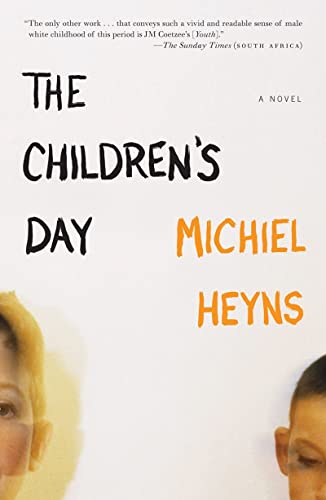
The Children's Day is the shocking, funny, and tender chronicle of a boy's coming of age in the Free State village of Verkeerdespruit during the apartheid years of the sixties.
The tender chronicle of a boy's coming of age in South Africa during the apartheid years of the sixties, The Children's Day captures the essence of growing up in a world fraught with the strange and sometimes violent contradictions of class, race, gender, and language. The widening world of adolescence, in all its allure and confusion, is explored through the eyes of Simon, who struggles to make sense of the adults around him—torn between scorn for his surroundings and a desire to belong.
This debut novel is peopled with poignant, vulnerable, and sometimes eccentric characters, and it is through their lives that Simon comes to understand the complexities of love.
Die Inhaltsangabe kann sich auf eine andere Ausgabe dieses Titels beziehen.
Über die Autorinnen und Autoren
Michiel Heyns is an award-winning literary translator and author of nine novels: The Children’s Day, The Reluctant Passenger, The Typewriter’s Tale, Bodies Politic, Invisible Furies, Lost Ground, A Sportful Malice, I am Pandarus, and A Poor Season for Whales. He was previously professor of English at the University of Stellenbosch.
Michiel Heyns grew up all over South Africa Thaba Nchu, Kimberley, Grahamstown, Cape Town - and was educated at the Universities of Stellenbosch and Cambridge. For much of his adult life he was an academic, lecturing in English at the University of Stellenbosch, but after publication of his first novel, The Children’s Day, he took to writing full-time, publishingThe Reluctant Passenger in 2003 and The Typewriter’s Tale in 2005. His latest novel,Bodies Politic, was recently published by Jonathan Ball. In 2006 he translated two works by Marlene van Niekerk,Agaat and Memorandum. Agaat was awarded the Sunday Times Fiction Prize for 2006; published asThe Way of the Women in the UK in November 2007, it was short-listed for the Independent Foerign Fiction Prize. He has recently translatedEquatoria by Tom Dreyer, to be published by Aflame Books (UK) in 2008. He reviews regularly for theSunday Independent, for which he was awarded the English Academy's Pringle Prize for Reviewing for 2006.
A.L. Kennedy is one of the most distinguished and acclaimed writers of her generation. She is the author of four collections of stories, most recentlyIndelible Acts, and four novels, including Paradise and Day, winner of the 2008 Costa Book Prize. She is the winner of the John Llewellyn Rhys Prize and the Somerset Maugham Award and was chosen as one of the twenty Best of Young British Novelists in 1993 and again in 2003. Her work of non-fiction, On Bullfighting, is already regarded as a modern classic. She has been commissioned to write a play for the Royal Shakespeare Company and has embarked on a successful career in stand-up comedy.
A.L. Kennedy is one of the most distinguished and acclaimed writers of her generation. She is the author of four collections of stories, most recentlyIndelible Acts, and four novels, including Paradise and Day, winner of the 2008 Costa Book Prize. She is the winner of the John Llewellyn Rhys Prize and the Somerset Maugham Award and was chosen as one of the twenty Best of Young British Novelists in 1993 and again in 2003. Her work of non-fiction, On Bullfighting, is already regarded as a modern classic. She has been commissioned to write a play for the Royal Shakespeare Company and has embarked on a successful career in stand-up comedy.
Auszug. © Genehmigter Nachdruck. Alle Rechte vorbehalten.
The Children's Day
By Michiel HeynsTin House Books
Copyright © 2009 Michiel HeynsAll right reserved.
ISBN: 978-0-9802436-6-6
Chapter One
1962 Children naturally take an interest in any newcomer, whether as object of their charity or as victim of their persecution. Thus even Fanie van den Bergh created a little hush of attention when he was brought into the classroom by the principal, Mr. Viljoen, and assigned a desk by Miss Jordaan in the front of the class, across the aisle from mine. On a first frankly exploratory stare, he seemed candidate for neither charity nor persecution - that is, he seemed just ordinary. He was very thin, but then so were many of the children in the class; he was poorly dressed in slightly grubby clothes, but again that was hardly noteworthy in Verkeerdespruit. He was wearing a pair of scuffed shoes, which did set him apart from the predominantly barefooted class, but that was understood as a concession to his first day at school. Verkeerdespruit people, my mother used to say, had to prove that they possessed shoes. I never wore shoes, not even on the last day of term when everybody else did. In the course of the morning Miss Jordaan asked her new pupil a few questions, partly to make him feel at home and partly, I suppose, because she also felt a certain curiosity: she hadn't been in Verkeerdespruit long enough to have ceased hoping for an exception. Fanie certainly was not it: her questions elicited only the usual dour silence of ignorance or shyness or both. She and the twenty-five members of the Standards One and Two class settled down again to their routine, and Fanie van den Bergh took his unremarkable place in the unexacting primary educational system of the Orange Free State. At first break what curiosity remained was soon satisfied: Fanie was willing to join in games of kennetjie, which suggested an acceptable combination of conformity and defiance of authority; kennetjie, a somewhat rudimentary game in which the bat was a long stick and the ball was a short stick, was officially outlawed since Marius Venter had received a cut on his forehead while trying to field one of Louis van Niekerk's more vigorous efforts. Fanie was uncommunicative about his origins, though he admitted to coming from Ficksburg, which was neither near enough to make him one of us nor far enough to be exotic. He was nine years old, which was the standard age in our class, except for Tjaart Bothma, whose father had taken him out of school for a year because he had found a reference to evolution in our Nature Studies book. It was generally believed that Tjaart's father, who was known as Bobbejaan-Bakkies Bothma, Baboon-face Bothma, felt as strongly as he did about the theory of evolution because it accounted so unflatteringly for his own appearance; but we did not generally refer to baboons in Tjaart's company, because his year's advantage in age gave him a disproportionate advantage in size. The only slightly unusual thing about Fanie was that he had neither brothers nor sisters: one-child families were not common in Verkeerdespruit in 1962. Although I myself was in fact an only child, this did not seem to require explanation, since I was used to our family being slightly different from the rest of the village. But Fanie was in every other respect so ordinary that even this slight deviation from the four-child norm of the time and place seemed an anomaly. His father was the new barman at Loubser's Hotel, replacing Schalk Redelinghuis, who, rumor ran, had drunk up all the profits. From this we deduced that his father was a man of sober habits, and Louis van Niekerk stated with knowing emphasis, "Then that's why he's an only child." "Why?" I asked reluctantly, unwilling to give Louis an opening to show off his powers of deduction. "Because his father's a barman, of course," he said smugly. "That means he comes home too late." I wanted to ask too late for what, but since that was clearly what Louis van Niekerk wanted me to do, I simply said, "Oh," and pretended to take a thorn out of my foot. So Fanie van den Bergh, having been explained and categorized, ceased to occupy our minds. Nobody was nasty to him, and some were friendly: those with no particular friend who thought that perhaps Fanie might be it, and others like myself who had been taught that one should be kind to strangers. I can't remember that I was ever given a reason for this precept, but I accepted it as I accepted that one should not wipe one's nose on one's sleeve or talk of kaffirs - a sign of our difference from the rest of Verkeerdespruit. My father was the magistrate, and we lived in the secondbiggest house in Verkeerdespruit after the pastorie-the third-biggest in fact - but the biggest of all belonged to Dr. Mazwai in the location and thus did not count. Nor did the pastorie really, because that belonged to the church, which meant that we paid for it with the sixpences we put in the collection plate. So it was possible to believe that we owned the biggest house in Verkeerdespruit, and I believed it. Apart from this, my father was English-speaking, which was if not unique then relatively rare in Verkeerdespruit; my name, Simon, was supposed to be pronounced in the English way, though this was regarded as an affectation by my peers. My parents came from the Cape, which was bigger even than Bloemfontein and generally accepted to be considerably more advanced. As for Verkeerdespruit ... Verkeerdespruit had no claims to the regard of the rest of the world. It featured in our school history book only as the home of a minor "friendly" native tribe - which meant that they had not put up any resistance to the occupation of their land by the Voortrekkers - and as the place where two Voortrekker leaders, having no enemy against which to unite, had quarreled with each other, causing one group to trek on in a huff to meet obliteration at the hands of a less docile indigenous community in Natal and leaving the other to settle what became, not very spectacularly, the white village of Verkeerdespruit. Even the name Verkeerdespruit, the wrong creek, had something depressed about it, as if the founders had recognized their mistake but lacked the initiative to do anything about it. The heroic group that had set off to annihilation elsewhere was commemorated annually in a lugubrious ceremony around the square of cement imprinted with the tracks of the ox wagon that had visited Verkeerdespruit during the centennial ox wagon trek of 1938. The square of cement also bore the distinct imprint of a high-heeled shoe, according to popular legend belonging to the mayor's wife, who had a drinking problem. All in all, my ambitions were larger than my environment. I knew, in any case, that I was going to be sent to Free State College in Bloemfontein after Standard Five. My mother said that after a certain age you needed more from school than what she called The Basics; Verkeerdespruit, she said, was probably as Basic as you could get without severe mental deprivation. So in being nice to Fanie van den Bergh I was simply demonstrating a standard of behavior more exacting than that of the rest of Verkeerdespruit. I told my mother about the new boy, and she went to visit his mother, as she visited all newcomers to the village, partly as her social duty, partly in her capacity as secretary of the Oranje Vrouevereniging, or OVV, a women's charitable organization that looked after poor white people. She reported that the Van den Berghs were indeed very poor and that she would have to make regular visits, which she...„Über diesen Titel“ kann sich auf eine andere Ausgabe dieses Titels beziehen.
Suchergebnisse für The Children's Day

Foto des Verkäufers
The Children's Day
Anbieter: -OnTimeBooks-, Phoenix, AZ, USA
Verkäuferbewertung 5 von 5 Sternen

Zustand: good. A copy that has been read, remains in good condition. All pages are intact, and the cover is intact. The spine and cover show signs of wear. Pages can include notes and highlighting and show signs of wear, and the copy can include "From the library of" labels or previous owner inscriptions. 100% GUARANTEE! Shipped with delivery confirmation, if you're not satisfied with purchase please return item! Ships via media mail. Bestandsnummer des Verkäufers OTV.0980243661.G
Gebraucht kaufen
EUR 6,20
Versand gratis
Versand innerhalb von USA
Versand innerhalb von USA
Anzahl: 1 verfügbar
Beispielbild für diese ISBN
The Children's Day
Anbieter: St Vincent de Paul of Lane County, Eugene, OR, USA
Verkäuferbewertung 5 von 5 Sternen
Zustand: Acceptable. paperback 100% of proceeds go to charity! Acceptable reading copy with obvious signs of use, wear, and/or cosmetic issues. Item is complete and remains readable despite notable condition issues. Bestandsnummer des Verkäufers 2EE-06-2558
Gebraucht kaufen
EUR 3,61
EUR 3,51 Versand
Versand innerhalb von USA
Versand innerhalb von USA
Anzahl: 1 verfügbar
Beispielbild für diese ISBN
The Children's Day
Anbieter: Better World Books, Mishawaka, IN, USA
Verkäuferbewertung 5 von 5 Sternen
Zustand: Good. Pages intact with minimal writing/highlighting. The binding may be loose and creased. Dust jackets/supplements are not included. Stock photo provided. Product includes identifying sticker. Better World Books: Buy Books. Do Good. Bestandsnummer des Verkäufers 67951953-6
Gebraucht kaufen
EUR 9,96
Versand gratis
Versand innerhalb von USA
Versand innerhalb von USA
Anzahl: 1 verfügbar
Beispielbild für diese ISBN
The Children's Day
Anbieter: Powell's Bookstores Chicago, ABAA, Chicago, IL, USA
Verkäuferbewertung 5 von 5 Sternen
Paperback. Zustand: Used-Very Good. Original. Pap. Slight shelf-wear. Bestandsnummer des Verkäufers 1843401
Gebraucht kaufen
EUR 7,25
EUR 4,40 Versand
Versand innerhalb von USA
Versand innerhalb von USA
Anzahl: 1 verfügbar
Foto des Verkäufers
Children's Day
Anbieter: GreatBookPrices, Columbia, MD, USA
Verkäuferbewertung 5 von 5 Sternen
Zustand: New. Bestandsnummer des Verkäufers 6299166-n
Neu kaufen
EUR 10,90
EUR 2,32 Versand
Versand innerhalb von USA
Versand innerhalb von USA
Anzahl: 15 verfügbar
Beispielbild für diese ISBN
The Children's Day Format: Paperback
Anbieter: INDOO, Avenel, NJ, USA
Verkäuferbewertung 5 von 5 Sternen
Zustand: New. Bestandsnummer des Verkäufers 9780980243666
Neu kaufen
EUR 13,30
Versand gratis
Versand innerhalb von USA
Versand innerhalb von USA
Anzahl: Mehr als 20 verfügbar
Foto des Verkäufers
The Children's Day
Anbieter: Rarewaves USA, HEBRON, KY, USA
Verkäuferbewertung 5 von 5 Sternen
Paperback. Zustand: New. Bestandsnummer des Verkäufers LU-9780980243666
Foto des Verkäufers
Children's Day
Anbieter: GreatBookPrices, Columbia, MD, USA
Verkäuferbewertung 5 von 5 Sternen
Zustand: As New. Unread book in perfect condition. Bestandsnummer des Verkäufers 6299166
Gebraucht kaufen
EUR 11,51
EUR 2,32 Versand
Versand innerhalb von USA
Versand innerhalb von USA
Anzahl: 15 verfügbar
Beispielbild für diese ISBN
The Children's Day Format: Paperback
Anbieter: INDOO, Avenel, NJ, USA
Verkäuferbewertung 5 von 5 Sternen
Zustand: As New. Unread copy in mint condition. Bestandsnummer des Verkäufers RH9780980243666
Gebraucht kaufen
EUR 13,91
Versand gratis
Versand innerhalb von USA
Versand innerhalb von USA
Anzahl: Mehr als 20 verfügbar
Foto des Verkäufers
The Children's Day
Anbieter: Goodwill of Greater Milwaukee and Chicago, Racine, WI, USA
Verkäuferbewertung 5 von 5 Sternen
Zustand: good. Book is considered to be in good or better condition. The actual cover image may not match the stock photo. Hard cover books may show signs of wear on the spine, cover or dust jacket. Paperback book may show signs of wear on spine or cover as well as having a slight bend, curve or creasing to it. Book should have minimal to no writing inside and no highlighting. Pages should be free of tears or creasing. Stickers should not be present on cover or elsewhere, and any CD or DVD expected with the book is included. Book is not a former library copy. Bestandsnummer des Verkäufers SEWV.0980243661.G
Gebraucht kaufen
EUR 11,49
EUR 2,64 Versand
Versand innerhalb von USA
Versand innerhalb von USA
Anzahl: 1 verfügbar