
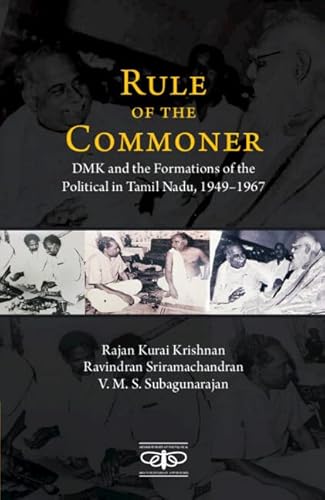
Rule of the Commoner: Dmk and Formations of the Political in Tamil Nadu, 1949-1967 (Metamorphoses of the Political: Multidisciplinary Approaches) - Hardcover
Inhaltsangabe
A conceptually framed narrative of how the construction of a people as Dravidian-Tamil was achieved by the DMK between 1949-1967.
Die Inhaltsangabe kann sich auf eine andere Ausgabe dieses Titels beziehen.
Über die Autorinnen und Autoren
Rajan Kurai Krishnan is Associate Professor at the School of Culture and Creative Expressions, Dr B R Ambedkar University, Delhi. He regularly publishes articles on political theory, philosophy, global affairs, climate change and film theory.
Ravindran Sriramachandran is Assistant Professor of Sociology and Anthropology at Ashoka University. His research interests include semiotics, environment and development, South Asian politics, and film studies.
VMS Subagunarajan is an independent researcher in Chennai. He has written extensively on the Dravidian movement, especially on Periyar.
„Über diesen Titel“ kann sich auf eine andere Ausgabe dieses Titels beziehen.
Suchergebnisse für Rule of the Commoner: Dmk and Formations of the Political...

Internationale Ausgabe
Rule of the Commoner: DMK and the Formations of the Political in Tamil Nadu, 1949-1967
Verlag:
Cambridge University Press (Manohar), 2022
ISBN 10: 1009197177
ISBN 13: 9781009197175
Neu
Hardcover
Anbieter: UK BOOKS STORE, London, LONDO, Vereinigtes Königreich
Verkäuferbewertung 5 von 5 Sternen

Hardcover. Zustand: New. Brand New! Fast Delivery This is an International Edition and ship within 24-48 hours. Deliver by FedEx and Dhl, & Aramex, UPS, & USPS and we do accept APO and PO BOX Addresses. Order can be delivered worldwide within 6-10 days and we do have flat rate for up to 2LB. Extra shipping charges will be requested if the Book weight is more than 5 LB. This Item May be shipped from India, United states & United Kingdom. Depending on your location and availability. Bestandsnummer des Verkäufers MA 9781009197175
Neu kaufen
EUR 41,89
Versand gratis
Versand von Vereinigtes Königreich nach USA
Versand von Vereinigtes Königreich nach USA
Anzahl: 5 verfügbar

Beispielbild für diese ISBN
Rule of the Commoner
Anbieter: PBShop.store US, Wood Dale, IL, USA
Verkäuferbewertung 5 von 5 Sternen
HRD. Zustand: New. New Book. Shipped from UK. Established seller since 2000. Bestandsnummer des Verkäufers FM-9781009197175
Beispielbild für diese ISBN
Rule of the Commoner : Dmk and Formations of the Political in Tamil Nadu, 1949-1967
Anbieter: GreatBookPrices, Columbia, MD, USA
Verkäuferbewertung 5 von 5 Sternen
Zustand: New. Bestandsnummer des Verkäufers 44261846-n
Neu kaufen
EUR 100,29
EUR 2,31 Versand
Versand innerhalb von USA
Versand innerhalb von USA
Anzahl: 20 verfügbar
Beispielbild für diese ISBN
Rule of the Commoner (Hardcover)
Verlag:
Cambridge University Press, Cambridge, 2022
ISBN 10: 1009197177
ISBN 13: 9781009197175
Neu
Hardcover
Anbieter: Grand Eagle Retail, Bensenville, IL, USA
Verkäuferbewertung 5 von 5 Sternen
Hardcover. Zustand: new. Hardcover. The Dravida Munnetra Kazhagam (DMK) has been singular in heralding and establishing a firm regional polity among the Indian states after the Indian Union was inaugurated as a republic. Academic scholarship has often treated the DMK as a Tamil nationalist or ethno-nationalist formation without conceptual clarity or critical insight. Rule of the Commoner demonstrates with persuasive evidence that the DMK appealed to a federalist and not nationalist imagination. The DMK's combining of the non-Brahmin Dravidian identity and allegiance to Tamil language led to a counter hegemonic formation of the plebes and left populism. Drawing on Ernesto Laclau, the book argues that the DMK achieved the construction of a people as Dravidian-Tamil, with Tamil being the empty signifier of the social whole, Brahmin vs. non-Brahmin divide functioning as the internal frontier leading to the formations of the political. It elaborates the conceptual scheme under the three rubrics of Ideation, Imagination and Mobilization. The plebian democratic mobilization effected by the DMK in Tamil Nadu was unique in many ways. In eighteen years, it managed to establish the Dravidian rule in Tamil Nadu. The book conceptually recaptures the party's growth under the twin rubrics of 'construction of a people' and 'formations of the political'. Shipping may be from multiple locations in the US or from the UK, depending on stock availability. Bestandsnummer des Verkäufers 9781009197175
Beispielbild für diese ISBN
Rule of the Commoner
Anbieter: PBShop.store UK, Fairford, GLOS, Vereinigtes Königreich
Verkäuferbewertung 5 von 5 Sternen
HRD. Zustand: New. New Book. Shipped from UK. Established seller since 2000. Bestandsnummer des Verkäufers FM-9781009197175
Neu kaufen
EUR 104,06
EUR 5,90 Versand
Versand von Vereinigtes Königreich nach USA
Versand von Vereinigtes Königreich nach USA
Anzahl: 6 verfügbar
Foto des Verkäufers
Rule of the Commoner : Dmk and Formations of the Political in Tamil Nadu, 1949-1967
Verlag:
Cambridge University Press, 2023
ISBN 10: 1009197177
ISBN 13: 9781009197175
Gebraucht
Hardcover
Anbieter: GreatBookPrices, Columbia, MD, USA
Verkäuferbewertung 5 von 5 Sternen
Zustand: As New. Unread book in perfect condition. Bestandsnummer des Verkäufers 44261846
Gebraucht kaufen
EUR 110,79
EUR 2,31 Versand
Versand innerhalb von USA
Versand innerhalb von USA
Anzahl: 20 verfügbar
Beispielbild für diese ISBN
Rule of the Commoner: DMK and Formations of the Political in Tamil Nadu, 1949-1967 (Metamorphoses of the Political: Multidisciplinary Approaches)
Anbieter: California Books, Miami, FL, USA
Verkäuferbewertung 4 von 5 Sternen

Zustand: New. Bestandsnummer des Verkäufers I-9781009197175
Neu kaufen
EUR 113,45
Versand gratis
Versand innerhalb von USA
Versand innerhalb von USA
Anzahl: Mehr als 20 verfügbar
Beispielbild für diese ISBN
Rule of the Commoner: Dmk and Formations of the Political in Tamil Nadu, 1949-1967
Anbieter: Revaluation Books, Exeter, Vereinigtes Königreich
Verkäuferbewertung 5 von 5 Sternen
Hardcover. Zustand: Brand New. 280 pages. 9.33x6.34x0.94 inches. In Stock. Bestandsnummer des Verkäufers __1009197177
Neu kaufen
EUR 109,66
EUR 14,70 Versand
Versand von Vereinigtes Königreich nach USA
Versand von Vereinigtes Königreich nach USA
Anzahl: 1 verfügbar
Beispielbild für diese ISBN
Rule of the Commoner Rule of the Commoner: DMK and Formations of the Political in Tamil Nadu, 1949-1967
Anbieter: THE SAINT BOOKSTORE, Southport, Vereinigtes Königreich
Verkäuferbewertung 5 von 5 Sternen
Hardback. Zustand: New. New copy - Usually dispatched within 4 working days. Bestandsnummer des Verkäufers B9781009197175
Neu kaufen
EUR 109,41
EUR 18,64 Versand
Versand von Vereinigtes Königreich nach USA
Versand von Vereinigtes Königreich nach USA
Anzahl: Mehr als 20 verfügbar
Foto des Verkäufers
Rule of the Commoner (Hardcover)
Verlag:
Cambridge University Press, Cambridge, 2022
ISBN 10: 1009197177
ISBN 13: 9781009197175
Neu
Hardcover
Anbieter: CitiRetail, Stevenage, Vereinigtes Königreich
Verkäuferbewertung 5 von 5 Sternen
Hardcover. Zustand: new. Hardcover. The Dravida Munnetra Kazhagam (DMK) has been singular in heralding and establishing a firm regional polity among the Indian states after the Indian Union was inaugurated as a republic. Academic scholarship has often treated the DMK as a Tamil nationalist or ethno-nationalist formation without conceptual clarity or critical insight. Rule of the Commoner demonstrates with persuasive evidence that the DMK appealed to a federalist and not nationalist imagination. The DMK's combining of the non-Brahmin Dravidian identity and allegiance to Tamil language led to a counter hegemonic formation of the plebes and left populism. Drawing on Ernesto Laclau, the book argues that the DMK achieved the construction of a people as Dravidian-Tamil, with Tamil being the empty signifier of the social whole, Brahmin vs. non-Brahmin divide functioning as the internal frontier leading to the formations of the political. It elaborates the conceptual scheme under the three rubrics of Ideation, Imagination and Mobilization. The plebian democratic mobilization effected by the DMK in Tamil Nadu was unique in many ways. In eighteen years, it managed to establish the Dravidian rule in Tamil Nadu. The book conceptually recaptures the party's growth under the twin rubrics of 'construction of a people' and 'formations of the political'. Shipping may be from our UK warehouse or from our Australian or US warehouses, depending on stock availability. Bestandsnummer des Verkäufers 9781009197175
Neu kaufen
EUR 98,09
EUR 43,51 Versand
Versand von Vereinigtes Königreich nach USA
Versand von Vereinigtes Königreich nach USA
Anzahl: 1 verfügbar