
Verwandte Artikel zu The Duke's Children: The Only Complete Edition;...
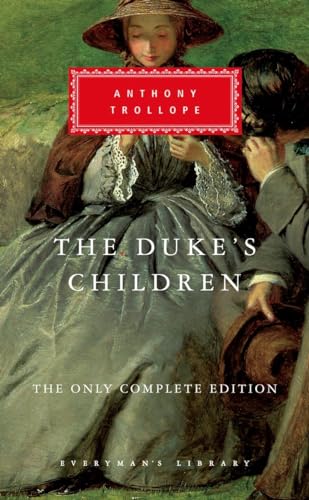
The Duke's Children: The Only Complete Edition; Introduction by Max Egremont (Everyman's Library Classics Series, Band 378) - Hardcover
Inhaltsangabe
Newly restored from the original manuscript and more than a quarter longer than existing editions: one of the finest novels from one of the greatest English novelists is finally available in the form he intended.
Trollope wrote The Duke’s Children, his final Palliser novel, as a four-volume work but was required by his publisher to reduce it to three, necessitating the loss of nearly sixty-five thousand words. A team of researchers led by Steven Amarnick has worked with the manuscript at Yale’s Beinecke Library to restore the novel to its original form. The result is richer and more complex, with a subtly different ending, a clearly superior book to the one that has always been published.
Plantagenet Palliser, the Duke of Omnium, has lost both his vivacious wife, Lady Glencora, and his position as prime minister of Great Britain. The bereft duke is left to try to manage his three grown children, whose rebellions take the various forms of gambling debts, university pranks, and unsuitable romantic attachments. But though he fails to understand his offspring, Palliser truly cares for them, and he navigates the clash of generations with a growing awareness of the necessity of compromises, both political and personal. Insightful, entertaining, and compassionate—and now restored to its full glory—The Duke’s Children is a fitting conclusion to the epic Palliser series, one of the most remarkable achievements of British fiction.
Die Inhaltsangabe kann sich auf eine andere Ausgabe dieses Titels beziehen.
Über die Autorin bzw. den Autor
ANTHONY TROLLOPE (1815-1882) was born in London to a bankrupt barrister father and a mother who, as a well-known writer, supported the family. Trollope enjoyed considerable success both as a novelist and as a senior civil servant in the post office. He published more than forty novels and many short stories that are regarded as among the greatest of nineteenth-century fiction.
MAX EGREMONT is the author of numerous biographies and novels. His biography of the poet Siegfried Sassoon was short-listed for the James Tait Black Memorial Prize. He is a Fellow of the Royal Society of Literature, and lives in Sussex, England.
Auszug. © Genehmigter Nachdruck. Alle Rechte vorbehalten.
from the Introduction by Max Egremont
Anthony Trollope arouses strong feelings for a writer sometimes thought of as soothing. His admirers have been accused of smugness, middle-brow taste, nostalgia, catatonic escapism, intellectual laziness and fear of the avant garde. His fictional worlds have been described as very English, not always in praise, and his prose compared to hunks of roast beef. Thomas Carlyle, echoing many other intellectuals (for Trollope is not a novelist of ideas), thought him “irredeemably embedded in the commonplace, and grown fat upon it.”
His critics are often ambivalent, giving but also taking away. Patronised by Henry James for writing too much and for blandness, Trollope had the American’s admiration for a “complete appreciation of the usual” and “extreme interest in character”. Virginia Woolf liked the “sober reality”, thought The Small House at Allington as perfect a novel as Pride and Prejudice yet decried his “hale and hearty common-sense” and the chronicle-like, flat style. W.H. Auden called him “the poet of the ordinary”.
Yet Trollope has brought much pleasure. He can still make us laugh and many of his characters - Mrs Proudie, Slope, Glencora and Plantagenet Palliser, Lizzie Eustace, Phineas Finn, Augustus Melmotte, Archdeacon Grantly – still live, perhaps rivalled only among 19th century novelists by some creations of Jane Austen and Charles Dickens. Then there’s his evocation of a period in history. Plantagenet Palliser, the Duke of Omnium and the central figure in The Duke’s Children, seems what a Victorian Duke should be. Palliser’s measured Whig creed and his unquestioned place at the top of society are quite different in atmosphere from the revolutions that exploded in the mid nineteenth century throughout continental Europe. His ideology favours gradualism and is pragmatic - or English. It is also, on the whole, successful.
Trollope wished to avoid obscurity or abstract theory. He believed that “of all the needs a book has, the chief need is that it be readable” for “the primary object of a novel is to please”. Giving life to his characters is one way that he does this, displaying them at length, as if to show life’s longueurs, unrolling his plots slowly although he wrote at immense speed, scarcely revising at all. Trollope thought that anyone might be trained to be a novelist for it is a craft similar to carpentry, which shocked Henry James to whom the House of Fiction was a sacred place. He suggests in his Autobiography that foxhunting is a better, even more worthwhile, way of passing time, giving the impression that he flung his pen down on completion of his requisite number of daily words and leapt joyfully upon a waiting horse.
Of the many characters that he created, Trollope most valued Plantagenet Palliser, putting him alongside only the Reverend Josiah Crawley in the Last Chronicle of Barset. For his creator, Palliser stands “firmly on the ground”. As Duke of Omnium (since the death of his uncle in an earlier novel Phineas Redux) he dominates The Duke’s Children, not only by what he does but through the insoluble regret of his past.
The Duke’s Children shows Trollope’s effectiveness. It is not too long, has no sub-plots that drag or are too facetious such as the rivalry between the farmer Cheesacre and Captain Bellfield in Can You Forgive Her? or the romantic carousel of the Reverend Thomas Gibson, the French sisters and Dorothea Stanby in He Knew He Was Right. A late work, it was published in 1880, when Trollope had passed his time of greatest success and only two years before his death. By then, his books were appearing first in serial form in magazines, this one in All The Year Round from October 1879 until July 1880. Other titles considered for it were Lord Silverbridge (the name of the Duke’s eldest son), The Duke and His Children or The Ex-Prime Minister. I think that he (or his publisher) made the right choice.
The novel is the last in the series beginning with Can You Forgive Her? - published in 1865 (and Trollope’s best seller) – that features Plantagenet Palliser and his wife Glencora. The Pallisers ascend to high places, partly through birth, partly through merit. Palliser, after the death of his unmarried, uncle, becomes Duke of Omnium and, later, Prime Minister. Glencora is vastly rich in her own right.
Palliser appears first in A Small House at Allington, published in 1864, as a minor character: an awkward young man of twenty five, staying at Courcy Castle, in a Trollopian setting of a grand house party, and fumbling towards a flirtation with the stupid, beautiful Lady Dumbello. One of the first things that we read him saying is a brusque protest against Lord De Courcy’s unpleasant amusement at Lord De Guest’s discomfiture on having been attacked by a bull; “I don’t see anything to laugh at.” Here - in the challenge to his older host – comes a flash of strength from someone who had not seemed capable of it.
Different from his rakish, spoilt uncle the old Duke of Omnium, whose vast possessions and houses he will inherit, Palliser dislikes the aristocratic pursuits of racing or field sports. He is bored by luxury and grandeur, preferring work, especially his scheme to introduce decimal coinage. Unusually for a politician, he is “a man altogether without guile and entirely devoted to his country”. Most important, “no one could mistake him for other than a gentleman”. He is also virtuous. Alongside the need to entertain, Trollope had views on what was a desirable life: “I have ever thought of myself as a preacher of sermons,” he writes in the Autobiography.
Palliser had become when young, and through family influence, what the novelist believed should be “the highest object of every educated Englishmen”: a Member of Parliament. Trollope saw the British parliament, presumably both the House of Lords and the House of Commons, as “the greatest in the world”, admiring its combination of fierce and competitive debate and restrained behaviour. “There is nothing like it,” he writes in Phineas Finn, the second novel in the Palliser series, or “nothing as yet. Nowhere else is there the same good-humoured, affectionate, prize-fighting ferocity in politics….”
He knew, however (and had seen first-hand while trying to be elected as Member of Parliament for Beverly) that there was dishonesty in the political world, connived at by both sides. In Phineas Finn a Conservative candidate Browborough is charged with bribery and gets off very lightly, to the relief of the Conservatives and the Liberals. Reform was in the air but in the novel political hacks from both parties – Roby and Rattler – admit to each other that the old corrupt ways are still useful. In The Duke’s Children, Sir Timothy Beeswax represents the less admirable side of politics.
Trollope had failed at Beverly. However, he knew the House of Commons, often attending its debates and learning its procedures from politicians who wished to...
„Über diesen Titel“ kann sich auf eine andere Ausgabe dieses Titels beziehen.
Suchergebnisse für The Duke's Children: The Only Complete Edition;...

Foto des Verkäufers
Duke's Children : The Complete Text
Anbieter: GreatBookPrices, Columbia, MD, USA
Verkäuferbewertung 5 von 5 Sternen

Zustand: New. Bestandsnummer des Verkäufers 26947693-n
Neu kaufen
EUR 18,74
EUR 2,35 Versand
Versand innerhalb von USA
Versand innerhalb von USA
Anzahl: Mehr als 20 verfügbar
Beispielbild für diese ISBN
The Duke's Children Format: Hardcover
Anbieter: INDOO, Avenel, NJ, USA
Verkäuferbewertung 5 von 5 Sternen
Zustand: New. Bestandsnummer des Verkäufers 9781101907818
Neu kaufen
EUR 21,17
Versand gratis
Versand innerhalb von USA
Versand innerhalb von USA
Anzahl: Mehr als 20 verfügbar
Beispielbild für diese ISBN
The Duke's Children : The Only Complete Edition; Introduction by Max Egremont
Verlag:
Knopf Doubleday Publishing Group, 2017
ISBN 10: 1101907819
ISBN 13: 9781101907818
Gebraucht
Hardcover
Anbieter: Better World Books, Mishawaka, IN, USA
Verkäuferbewertung 5 von 5 Sternen
Zustand: Good. Former library copy. Pages intact with minimal writing/highlighting. The binding may be loose and creased. Dust jackets/supplements are not included. Includes library markings. Stock photo provided. Product includes identifying sticker. Better World Books: Buy Books. Do Good. Bestandsnummer des Verkäufers 18773466-75
Gebraucht kaufen
EUR 21,19
Versand gratis
Versand innerhalb von USA
Versand innerhalb von USA
Anzahl: 1 verfügbar
Foto des Verkäufers
The Duke's Children (Hardcover)
Verlag:
Random House USA Inc, New York, 2017
ISBN 10: 1101907819
ISBN 13: 9781101907818
Neu
Hardcover
Anbieter: Grand Eagle Retail, Bensenville, IL, USA
Verkäuferbewertung 5 von 5 Sternen
Hardcover. Zustand: new. Hardcover. Newly restored from the original manuscript and more than a quarter longer than existing editions: one of the finest novels from one of the greatest English novelists is finally available in the form he intended. Trollope wrote The Dukes Children, his final Palliser novel, as a four-volume work but was required by his publisher to reduce it to three, necessitating the loss of nearly sixty-five thousand words. A team of researchers led by Steven Amarnick has worked with the manuscript at Yales Beinecke Library to restore the novel to its original form. The result is richer and more complex, with a subtly different ending, a clearly superior book to the one that has always been published. Plantagenet Palliser, the Duke of Omnium, has lost both his vivacious wife, Lady Glencora, and his position as prime minister of Great Britain. The bereft duke is left to try to manage his three grown children, whose rebellions take the various forms of gambling debts, university pranks, and unsuitable romantic attachments. But though he fails to understand his offspring, Palliser truly cares for them, and he navigates the clash of generations with a growing awareness of the necessity of compromises, both political and personal. Insightful, entertaining, and compassionateand now restored to its full gloryThe Dukes Children is a fitting conclusion to the epic Palliser series, one of the most remarkable achievements of British fiction. "This is a Borzoi book"--Title page verso. Shipping may be from multiple locations in the US or from the UK, depending on stock availability. Bestandsnummer des Verkäufers 9781101907818
Beispielbild für diese ISBN
The Duke's Children: The Only Complete Edition; Introduction by Max Egremont (Everyman's Library Classics)
Anbieter: Bookensteins, Las Vegas, NV, USA
Verkäuferbewertung 5 von 5 Sternen
Hardcover. Zustand: Fine. Zustand des Schutzumschlags: Near Fine. Dust jacket is in Near Fine condition being lightly bumped at the top of the spine. Cover image: Lovers by William Powell Frith. Book is in Fine condition with clean pages and no page folds. Burgundy ribbon marker. Bestandsnummer des Verkäufers 017272
Gebraucht kaufen
EUR 16,50
EUR 4,89 Versand
Versand innerhalb von USA
Versand innerhalb von USA
Anzahl: 1 verfügbar
Beispielbild für diese ISBN
Duke's Children : The Complete Text
Anbieter: GreatBookPrices, Columbia, MD, USA
Verkäuferbewertung 5 von 5 Sternen
Zustand: As New. Unread book in perfect condition. Bestandsnummer des Verkäufers 26947693
Gebraucht kaufen
EUR 19,36
EUR 2,35 Versand
Versand innerhalb von USA
Versand innerhalb von USA
Anzahl: Mehr als 20 verfügbar
Beispielbild für diese ISBN
The Duke's Children Format: Hardcover
Anbieter: INDOO, Avenel, NJ, USA
Verkäuferbewertung 5 von 5 Sternen
Zustand: As New. Unread copy in mint condition. Bestandsnummer des Verkäufers RH9781101907818
Gebraucht kaufen
EUR 21,79
Versand gratis
Versand innerhalb von USA
Versand innerhalb von USA
Anzahl: Mehr als 20 verfügbar
Foto des Verkäufers
The Duke's Children
Anbieter: Rarewaves USA, HEBRON, KY, USA
Verkäuferbewertung 5 von 5 Sternen
Hardback. Zustand: New. Bestandsnummer des Verkäufers LU-9781101907818
Beispielbild für diese ISBN
The Duke's Children: The Only Complete Edition; Introduction by Max Egremont
Anbieter: Massive Bookshop, Erving, MA, USA
Verkäuferbewertung 4 von 5 Sternen

Hardcover. Zustand: New. Bestandsnummer des Verkäufers 9781101907818
Neu kaufen
EUR 25,21
EUR 4,23 Versand
Versand innerhalb von USA
Versand innerhalb von USA
Anzahl: 10 verfügbar
Beispielbild für diese ISBN
The Duke's Children: The Only Complete Edition (Everyman's Library)
Verlag:
Everyman's Library April 2017, 2017
ISBN 10: 1101907819
ISBN 13: 9781101907818
Neu
Hardcover
Anbieter: Eighth Day Books, LLC, Wichita, KS, USA
Verkäuferbewertung 4 von 5 Sternen
Hardcover. Zustand: New. Bestandsnummer des Verkäufers 156687
Neu kaufen
EUR 25,21
EUR 5,29 Versand
Versand innerhalb von USA
Versand innerhalb von USA
Anzahl: 1 verfügbar