
Verwandte Artikel zu Introduction to Mixed Modelling: Beyond Regression...
Inhaltsangabe
Mixed modelling is very useful, and easier than you think!
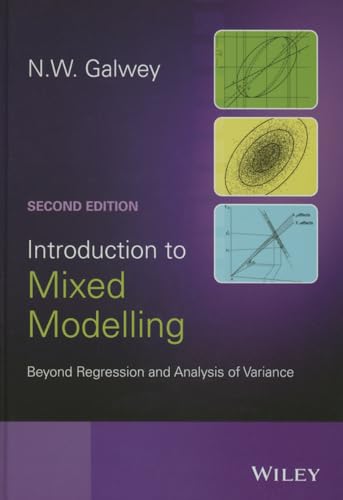
Mixed modelling is now well established as a powerful approach to statistical data analysis. It is based on the recognition of random-effect terms in statistical models, leading to inferences and estimates that have much wider applicability and are more realistic than those otherwise obtained.
Introduction to Mixed Modelling leads the reader into mixed modelling as a natural extension of two more familiar methods, regression analysis and analysis of variance. It provides practical guidance combined with a clear explanation of the underlying concepts.
Like the first edition, this new edition shows diverse applications of mixed models, provides guidance on the identification of random-effect terms, and explains how to obtain and interpret best linear unbiased predictors (BLUPs). It also introduces several important new topics, including the following:
- Use of the software SAS, in addition to GenStat and R.
- Meta-analysis and the multiple testing problem.
- The Bayesian interpretation of mixed models.
Including numerous practical exercises with solutions, this book provides an ideal introduction to mixed modelling for final year undergraduate students, postgraduate students and professional researchers. It will appeal to readers from a wide range of scientific disciplines including statistics, biology, bioinformatics, medicine, agriculture, engineering, economics, archaeology and geography.
Praise for the first edition:
"One of the main strengths of the text is the bridge it provides between traditional analysis of variance and regression models and the more recently developed class of mixed models...Each chapter is well-motivated by at least one carefully chosen example...demonstrating the broad applicability of mixed models in many different disciplines...most readers will likely learn something new, and those previously unfamiliar with mixed models will obtain a solid foundation on this topic."
―Kerrie Nelson, University of South Carolina, in American Statistician, 2007
Die Inhaltsangabe kann sich auf eine andere Ausgabe dieses Titels beziehen.
Über die Autorin bzw. den Autor
Nicholas W. Galwey, Statistical Consultant, GlaxoSmithKline, Harlow, Essex, UK.
Von der hinteren Coverseite
Mixed modelling is very useful, and easier than you think!
Mixed modelling is now well established as a powerful approach to statistical data analysis. It is based on the recognition of random-effect terms in statistical models, leading to inferences and estimates that have much wider applicability and are more realistic than those otherwise obtained.
Introduction to Mixed Modelling leads the reader into mixed modelling as a natural extension of two more familiar methods, regression analysis and analysis of variance. It provides practical guidance combined with a clear explanation of the underlying concepts.
Like the first edition, this new edition shows diverse applications of mixed models, provides guidance on the identification of random-effect terms, and explains how to obtain and interpret best linear unbiased predictors (BLUPs). It also introduces several important new topics, including the following:
- Use of the software SAS, in addition to GenStat and R.
- Meta-analysis and the multiple testing problem.
- The Bayesian interpretation of mixed models.
Including numerous practical exercises with solutions, this book provides an ideal introduction to mixed modelling for final year undergraduate students, postgraduate students and professional researchers. It will appeal to readers from a wide range of scientific disciplines including statistics, biology, bioinformatics, medicine, agriculture, engineering, economics, archaeology and geography.
Praise for the first edition:
“One of the main strengths of the text is the bridge it provides between traditional analysis of variance and regression models and the more recently developed class of mixed models...Each chapter is well-motivated by at least one carefully chosen example...demonstrating the broad applicability of mixed models in many different disciplines...most readers will likely learn something new, and those previously unfamiliar with mixed models will obtain a solid foundation on this topic.”―Kerrie Nelson University of South Carolina, in American Statistician, 2007
Aus dem Klappentext
Mixed modelling is very useful, and easier than you think!
Mixed modelling is now well established as a powerful approach to statistical data analysis. It is based on the recognition of random-effect terms in statistical models, leading to inferences and estimates that have much wider applicability and are more realistic than those otherwise obtained.
Introduction to Mixed Modelling leads the reader into mixed modelling as a natural extension of two more familiar methods, regression analysis and analysis of variance. It provides practical guidance combined with a clear explanation of the underlying concepts.
Like the first edition, this new edition shows diverse applications of mixed models, provides guidance on the identification of random-effect terms, and explains how to obtain and interpret best linear unbiased predictors (BLUPs). It also introduces several important new topics, including the following:
- Use of the software SAS, in addition to GenStat and R.
- Meta-analysis and the multiple testing problem.
- The Bayesian interpretation of mixed models.
Including numerous practical exercises with solutions, this book provides an ideal introduction to mixed modelling for final year undergraduate students, postgraduate students and professional researchers. It will appeal to readers from a wide range of scientific disciplines including statistics, biology, bioinformatics, medicine, agriculture, engineering, economics, archaeology and geography.
Praise for the first edition:
“One of the main strengths of the text is the bridge it provides between traditional analysis of variance and regression models and the more recently developed class of mixed models...Each chapter is well-motivated by at least one carefully chosen example...demonstrating the broad applicability of mixed models in many different disciplines...most readers will likely learn something new, and those previously unfamiliar with mixed models will obtain a solid foundation on this topic.”—Kerrie Nelson University of South Carolina, in American Statistician, 2007
„Über diesen Titel“ kann sich auf eine andere Ausgabe dieses Titels beziehen.
Suchergebnisse für Introduction to Mixed Modelling: Beyond Regression...

Beispielbild für diese ISBN
Introduction to Mixed Modelling: Beyond Regression and Analysis of Variance
Anbieter: SN Books Ltd, Thetford, Vereinigtes Königreich
Verkäuferbewertung 5 von 5 Sternen

hardcover. Zustand: Very Good. Orders shipped daily from the UK. Professional seller. Bestandsnummer des Verkäufers mon0000476609
Gebraucht kaufen
EUR 44,20
EUR 17,79 Versand
Versand von Vereinigtes Königreich nach USA
Versand von Vereinigtes Königreich nach USA
Anzahl: 1 verfügbar
Beispielbild für diese ISBN
Introduction to Mixed Modelling
Anbieter: PBShop.store UK, Fairford, GLOS, Vereinigtes Königreich
Verkäuferbewertung 5 von 5 Sternen
HRD. Zustand: New. New Book. Shipped from UK. Established seller since 2000. Bestandsnummer des Verkäufers FW-9781119945499
Neu kaufen
EUR 86,71
EUR 6,96 Versand
Versand von Vereinigtes Königreich nach USA
Versand von Vereinigtes Königreich nach USA
Anzahl: 15 verfügbar
Beispielbild für diese ISBN
Introduction to Mixed Modelling: Beyond Regression and Analysis of Variance (eng)
Anbieter: Brook Bookstore On Demand, Napoli, NA, Italien
Verkäuferbewertung 5 von 5 Sternen
Zustand: new. Bestandsnummer des Verkäufers 36570bf4d6f8ae20a8efedc9b4f6e61e
Neu kaufen
EUR 85,94
EUR 8,00 Versand
Versand von Italien nach USA
Versand von Italien nach USA
Anzahl: Mehr als 20 verfügbar
Foto des Verkäufers
Introduction to Mixed Modelling : Beyond Regression and Analysis of Variance
Anbieter: GreatBookPrices, Columbia, MD, USA
Verkäuferbewertung 5 von 5 Sternen
Zustand: New. Bestandsnummer des Verkäufers 13308907-n
Neu kaufen
EUR 94,08
EUR 2,35 Versand
Versand innerhalb von USA
Versand innerhalb von USA
Anzahl: 6 verfügbar
Foto des Verkäufers
Introduction to Mixed Modelling : Beyond Regression and Analysis of Variance
Anbieter: GreatBookPricesUK, Woodford Green, Vereinigtes Königreich
Verkäuferbewertung 5 von 5 Sternen
Zustand: New. Bestandsnummer des Verkäufers 13308907-n
Neu kaufen
EUR 86,69
EUR 17,79 Versand
Versand von Vereinigtes Königreich nach USA
Versand von Vereinigtes Königreich nach USA
Anzahl: Mehr als 20 verfügbar
Beispielbild für diese ISBN
Introduction to Mixed Modelling: Beyond Regression and Analysis of Variance
Anbieter: Chiron Media, Wallingford, Vereinigtes Königreich
Verkäuferbewertung 5 von 5 Sternen
Hardcover. Zustand: New. Brand new book, sourced directly from publisher. Dispatch time is 3-4 days from our warehouse. Book will be sent in robust, secure packaging to ensure it reaches you securely. Bestandsnummer des Verkäufers 6666-WLY-9781119945499
Neu kaufen
EUR 102,11
EUR 7,70 Versand
Versand von Vereinigtes Königreich nach USA
Versand von Vereinigtes Königreich nach USA
Anzahl: 20 verfügbar
Beispielbild für diese ISBN
Introduction to Mixed Modelling: Beyond Regression and Analysis of Variance
Anbieter: Kennys Bookshop and Art Galleries Ltd., Galway, GY, Irland
Verkäuferbewertung 5 von 5 Sternen
Zustand: New. Mixed modelling is very useful, and easier than you think! Mixed modelling is now well established as a powerful approach to statistical data analysis. Num Pages: 504 pages, illustrations. BIC Classification: PBWH. Category: (P) Professional & Vocational. Dimension: 251 x 174 x 29. Weight in Grams: 902. . 2014. 2nd Edition. Hardcover. . . . . Bestandsnummer des Verkäufers V9781119945499
Neu kaufen
EUR 109,69
EUR 9,50 Versand
Versand von Irland nach USA
Versand von Irland nach USA
Anzahl: Mehr als 20 verfügbar
Beispielbild für diese ISBN
Introduction to Mixed Modelling
Anbieter: Majestic Books, Hounslow, Vereinigtes Königreich
Verkäuferbewertung 4 von 5 Sternen

Zustand: New. pp. 512. Bestandsnummer des Verkäufers 322545620
Neu kaufen
EUR 114,60
EUR 7,71 Versand
Versand von Vereinigtes Königreich nach USA
Versand von Vereinigtes Königreich nach USA
Anzahl: 3 verfügbar
Beispielbild für diese ISBN
Introduction to Mixed Modelling: Beyond Regression and Analysis of Variance
Anbieter: Ubiquity Trade, Miami, FL, USA
Verkäuferbewertung 5 von 5 Sternen
Zustand: New. Brand new! Please provide a physical shipping address. Bestandsnummer des Verkäufers 9781119945499
Neu kaufen
EUR 122,70
EUR 2,67 Versand
Versand innerhalb von USA
Versand innerhalb von USA
Anzahl: Mehr als 20 verfügbar
Beispielbild für diese ISBN
Introduction to Mixed Modelling: Beyond Regression and Analysis of Variance
Anbieter: THE SAINT BOOKSTORE, Southport, Vereinigtes Königreich
Verkäuferbewertung 5 von 5 Sternen
Hardback. Zustand: New. New copy - Usually dispatched within 4 working days. Bestandsnummer des Verkäufers B9781119945499
Neu kaufen
EUR 103,69
EUR 23,93 Versand
Versand von Vereinigtes Königreich nach USA
Versand von Vereinigtes Königreich nach USA
Anzahl: Mehr als 20 verfügbar