
Verwandte Artikel zu Lexus and the Olive Tree: Understanding Globalization
Inhaltsangabe
"A brilliant guide for the here and now."---The New York Times Book Review
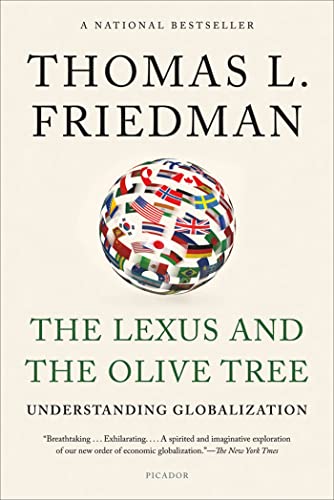
In this vivid portrait of the new business world, Thomas L. Friedman shows how technology, capital, and information are transforming the global marketplace, leveling old geographic and geopolitical boundaries. With bold reporting and acute analysis, Friedman dramatizes the conflict between globalizing forces and local cultures, and he shows why a balance between progress and the preservation of ancient traditions will ensure a better future for all. The Lexus and the Olive Tree is an indispensable look at power and big change in the age of globalization.
Die Inhaltsangabe kann sich auf eine andere Ausgabe dieses Titels beziehen.
Über die Autorin bzw. den Autor
Thomas L. Friedman
Auszug. © Genehmigter Nachdruck. Alle Rechte vorbehalten.
The Lexus and the Olive Tree
Understanding GlobalizationBy Thomas L. FriedmanPicador
Copyright © 2012 Thomas L. FriedmanAll right reserved.
ISBN: 9781250013743
1
The New System
What was it that Forrest Gump’s mama liked to say? Life is like a box of chocolates: you never know what you’re going to get inside. For me, an inveterate traveler and foreign correspondent, life is like room service—you never know what you’re going to find outside your door.
Take for instance the evening of December 31, 1994, when I began my assignment as the foreign affairs columnist for The New York Times. I started the column by writing from Tokyo, and when I arrived at the Okura Hotel after a long transpacific flight, I called room service with one simple request: “Could you please send me up four oranges.” I am addicted to citrus and I needed a fix. It seemed to me a simple enough order when I telephoned it in, and the person on the other end seemed to understand. About twenty minutes later there was a knock at my door. A room service waiter was standing there in his perfectly creased uniform. In front of him was a cart covered by a starched white tablecloth. On the tablecloth were four tall glasses of fresh-squeezed orange juice, each glass set regally in a small silver bowl of ice.
“No, no,” I said to the waiter, “I want oranges, oranges—not orange juice.” I then pretended to bite into something like an orange.
“Ahhhh,” the waiter said, nodding his head. “O-ranges, o-ranges.”
I retreated into my room and went back to work. Twenty minutes later there was another knock at my door. Same waiter. Same linen-covered room service trolley. But this time, on it were four plates and on each plate was an orange that had been peeled and diced into perfect little sections that were fanned out on a plate like sushi, as only the Japanese can do.
“No, no,” I said, shaking my head again. “I want the whole orange.” I made a ball shape with my hands. “I want to keep them in my room and eat them for snacks. I can’t eat four oranges all cut up like that. I can’t store them in my mini-bar. I want the whole orange.”
Again, I did my best exaggerated imitation of someone eating an orange.
“Ahhhh,” the waiter said, nodding his head. “O-range, o-range. You want whole o-range.”
Another twenty minutes went by. Again there was a knock on my door. Same waiter. Same trolley, only this time he had four bright oranges, each one on its own dinner plate, with a fork, knife and linen napkin next to it. That was progress.
“That’s right,” I said, signing the bill. “That’s just what I wanted.”
As he left the room, I looked down at the room service bill. The four oranges were $22. How am I going to explain that to my publisher?
But my citrus adventures were not over. Two weeks later I was in Hanoi, having dinner by myself in the dining room of the Metropole Hotel. It was the tangerine season in Vietnam, and vendors were selling pyramids of the most delicious, bright orange tangerines on every street corner. Each morning I had a few tangerines for breakfast. When the waiter came to get my dessert order I told him all I wanted was a tangerine.
He went away and came back a few minutes later.
“Sorry,” he said, “no tangerines.”
“But how can that be?” I asked in exasperation. “You have a table full of them at breakfast every morning! Surely there must be a tangerine somewhere back in the kitchen?”
“Sorry.” He shook his head. “Maybe you like watermelon?”
“O.K.,” I said, “bring me some watermelon.”
Five minutes later the waiter returned with a plate bearing three peeled tangerines on it.
“I found the tangerines,” he said. “No watermelon.”
Had I known then what I know now I would have taken it all as a harbinger. For I too would find a lot of things on my plate and outside my door that I wasn’t planning to find as I traveled the globe for the Times.
Being the foreign affairs columnist for The New York Times is actually the best job in the world. I mean, someone has to have the best job, right? Well, I’ve got it. The reason it is such a great job is that I get to be a tourist with an attitude. I get to go anywhere, anytime, and have attitudes about what I see and hear. But the question for me as I embarked on this odyssey was: Which attitudes? What would be the lens, the perspective, the organizing system—the superstory—through which I would look at the world, make sense of events, prioritize them, opine upon them and help readers understand them?
In some ways my predecessors had it a little easier. They each had a very obvious superstory and international system in place when they were writing. I am the fifth foreign affairs columnist in the history of the Times. “Foreign Affairs” is actually the paper’s oldest column. It was begun in 1937 by a remarkable woman, Anne O’Hare McCormick, and was originally called “In Europe,” because in those days, “in Europe” was foreign affairs for most Americans, and it seemed perfectly natural that the paper’s one overseas columnist would be located on the European continent. Mrs. McCormick’s 1954 obituary in the Times said she got her start in foreign reporting “as the wife of Mr. McCormick, a Dayton engineer whom she accompanied on frequent buying trips to Europe.” (New York Times obits have become considerably more politically correct since then.) The international system which she covered was the disintegration of balance-of-power Versailles Europe and the beginnings of World War II.
As America emerged from World War II, standing astride the world as the preeminent superpower, with global responsibilities and engaged in a global power struggle with the Soviet Union, the title of the column changed in 1954 to “Foreign Affairs.” Suddenly the whole world was America’s playing field and the whole world mattered, because every corner was being contested with the Soviet Union. The Cold War international system, with its competition for influence and supremacy between the capitalist West and the communist East, between Washington, Moscow and Beijing, became the superstory within which the next three foreign affairs columnists organized their opinions.
By the time I started the column at the beginning of 1995, though, the Cold War was over. The Berlin Wall had crumbled and the Soviet Union was history. I had the good fortune to witness, in the Kremlin, one of the last gasps of the Soviet Union. The day was December 16, 1991. Secretary of State James A. Baker III was visiting Moscow, just as Boris Yeltsin was easing Mikhail Gorbachev out of power. Whenever Baker had met Gorbachev previously, they had held their talks in the Kremlin’s gold-gilded St. Catherine Hall. There was always a very orchestrated entry scene for the press. Mr. Baker and his entourage would wait behind two huge wooden double doors on one end of the long Kremlin hall, with Gorbachev and his team behind the doors on the other end. And then, by some signal, the doors would simultaneously open and each man would stride out and they would shake hands in front of the cameras in the middle of the room. Well, on this day Baker arrived for his...
The New System
What was it that Forrest Gump’s mama liked to say? Life is like a box of chocolates: you never know what you’re going to get inside. For me, an inveterate traveler and foreign correspondent, life is like room service—you never know what you’re going to find outside your door.
Take for instance the evening of December 31, 1994, when I began my assignment as the foreign affairs columnist for The New York Times. I started the column by writing from Tokyo, and when I arrived at the Okura Hotel after a long transpacific flight, I called room service with one simple request: “Could you please send me up four oranges.” I am addicted to citrus and I needed a fix. It seemed to me a simple enough order when I telephoned it in, and the person on the other end seemed to understand. About twenty minutes later there was a knock at my door. A room service waiter was standing there in his perfectly creased uniform. In front of him was a cart covered by a starched white tablecloth. On the tablecloth were four tall glasses of fresh-squeezed orange juice, each glass set regally in a small silver bowl of ice.
“No, no,” I said to the waiter, “I want oranges, oranges—not orange juice.” I then pretended to bite into something like an orange.
“Ahhhh,” the waiter said, nodding his head. “O-ranges, o-ranges.”
I retreated into my room and went back to work. Twenty minutes later there was another knock at my door. Same waiter. Same linen-covered room service trolley. But this time, on it were four plates and on each plate was an orange that had been peeled and diced into perfect little sections that were fanned out on a plate like sushi, as only the Japanese can do.
“No, no,” I said, shaking my head again. “I want the whole orange.” I made a ball shape with my hands. “I want to keep them in my room and eat them for snacks. I can’t eat four oranges all cut up like that. I can’t store them in my mini-bar. I want the whole orange.”
Again, I did my best exaggerated imitation of someone eating an orange.
“Ahhhh,” the waiter said, nodding his head. “O-range, o-range. You want whole o-range.”
Another twenty minutes went by. Again there was a knock on my door. Same waiter. Same trolley, only this time he had four bright oranges, each one on its own dinner plate, with a fork, knife and linen napkin next to it. That was progress.
“That’s right,” I said, signing the bill. “That’s just what I wanted.”
As he left the room, I looked down at the room service bill. The four oranges were $22. How am I going to explain that to my publisher?
But my citrus adventures were not over. Two weeks later I was in Hanoi, having dinner by myself in the dining room of the Metropole Hotel. It was the tangerine season in Vietnam, and vendors were selling pyramids of the most delicious, bright orange tangerines on every street corner. Each morning I had a few tangerines for breakfast. When the waiter came to get my dessert order I told him all I wanted was a tangerine.
He went away and came back a few minutes later.
“Sorry,” he said, “no tangerines.”
“But how can that be?” I asked in exasperation. “You have a table full of them at breakfast every morning! Surely there must be a tangerine somewhere back in the kitchen?”
“Sorry.” He shook his head. “Maybe you like watermelon?”
“O.K.,” I said, “bring me some watermelon.”
Five minutes later the waiter returned with a plate bearing three peeled tangerines on it.
“I found the tangerines,” he said. “No watermelon.”
Had I known then what I know now I would have taken it all as a harbinger. For I too would find a lot of things on my plate and outside my door that I wasn’t planning to find as I traveled the globe for the Times.
Being the foreign affairs columnist for The New York Times is actually the best job in the world. I mean, someone has to have the best job, right? Well, I’ve got it. The reason it is such a great job is that I get to be a tourist with an attitude. I get to go anywhere, anytime, and have attitudes about what I see and hear. But the question for me as I embarked on this odyssey was: Which attitudes? What would be the lens, the perspective, the organizing system—the superstory—through which I would look at the world, make sense of events, prioritize them, opine upon them and help readers understand them?
In some ways my predecessors had it a little easier. They each had a very obvious superstory and international system in place when they were writing. I am the fifth foreign affairs columnist in the history of the Times. “Foreign Affairs” is actually the paper’s oldest column. It was begun in 1937 by a remarkable woman, Anne O’Hare McCormick, and was originally called “In Europe,” because in those days, “in Europe” was foreign affairs for most Americans, and it seemed perfectly natural that the paper’s one overseas columnist would be located on the European continent. Mrs. McCormick’s 1954 obituary in the Times said she got her start in foreign reporting “as the wife of Mr. McCormick, a Dayton engineer whom she accompanied on frequent buying trips to Europe.” (New York Times obits have become considerably more politically correct since then.) The international system which she covered was the disintegration of balance-of-power Versailles Europe and the beginnings of World War II.
As America emerged from World War II, standing astride the world as the preeminent superpower, with global responsibilities and engaged in a global power struggle with the Soviet Union, the title of the column changed in 1954 to “Foreign Affairs.” Suddenly the whole world was America’s playing field and the whole world mattered, because every corner was being contested with the Soviet Union. The Cold War international system, with its competition for influence and supremacy between the capitalist West and the communist East, between Washington, Moscow and Beijing, became the superstory within which the next three foreign affairs columnists organized their opinions.
By the time I started the column at the beginning of 1995, though, the Cold War was over. The Berlin Wall had crumbled and the Soviet Union was history. I had the good fortune to witness, in the Kremlin, one of the last gasps of the Soviet Union. The day was December 16, 1991. Secretary of State James A. Baker III was visiting Moscow, just as Boris Yeltsin was easing Mikhail Gorbachev out of power. Whenever Baker had met Gorbachev previously, they had held their talks in the Kremlin’s gold-gilded St. Catherine Hall. There was always a very orchestrated entry scene for the press. Mr. Baker and his entourage would wait behind two huge wooden double doors on one end of the long Kremlin hall, with Gorbachev and his team behind the doors on the other end. And then, by some signal, the doors would simultaneously open and each man would stride out and they would shake hands in front of the cameras in the middle of the room. Well, on this day Baker arrived for his...
„Über diesen Titel“ kann sich auf eine andere Ausgabe dieses Titels beziehen.
Suchergebnisse für Lexus and the Olive Tree: Understanding Globalization

Beispielbild für diese ISBN
The Lexus and the Olive Tree: Understanding Globalization
Anbieter: Gulf Coast Books, Cypress, TX, USA
Verkäuferbewertung 5 von 5 Sternen

paperback. Zustand: Fair. Bestandsnummer des Verkäufers 1250013747-4-37041973
Gebraucht kaufen
EUR 4,00
Versand gratis
Versand innerhalb von USA
Versand innerhalb von USA
Anzahl: 1 verfügbar
Beispielbild für diese ISBN
The Lexus and the Olive Tree
Anbieter: World of Books (was SecondSale), Montgomery, IL, USA
Verkäuferbewertung 5 von 5 Sternen
Paperback. Zustand: Good. "A brilliant guide for the here and now."---The New York Times Book Review In this vivid portrait of the new business world, Thomas L. Friedman shows how technology, capital, and information are transforming the global marketplace, leveling old geographic and geopolitical boundaries. With bold reporting and acute analysis, Friedman dramatizes the conflict between globalizing forces and local cultures, and he shows why a balance between progress and the preservation of ancient traditions will ensure a better future for all. The Lexus and the Olive Tree is an indispensable look at power and big change in the age of globalization. Bestandsnummer des Verkäufers 00096495285
Gebraucht kaufen
EUR 4,00
Versand gratis
Versand innerhalb von USA
Versand innerhalb von USA
Anzahl: 8 verfügbar
Beispielbild für diese ISBN
The Lexus and the Olive Tree
Anbieter: World of Books (was SecondSale), Montgomery, IL, USA
Verkäuferbewertung 5 von 5 Sternen
Paperback. Zustand: Very Good. "A brilliant guide for the here and now."---The New York Times Book Review In this vivid portrait of the new business world, Thomas L. Friedman shows how technology, capital, and information are transforming the global marketplace, leveling old geographic and geopolitical boundaries. With bold reporting and acute analysis, Friedman dramatizes the conflict between globalizing forces and local cultures, and he shows why a balance between progress and the preservation of ancient traditions will ensure a better future for all. The Lexus and the Olive Tree is an indispensable look at power and big change in the age of globalization. Bestandsnummer des Verkäufers 00108973057
Gebraucht kaufen
EUR 4,00
Versand gratis
Versand innerhalb von USA
Versand innerhalb von USA
Anzahl: 2 verfügbar
Foto des Verkäufers
The Lexus and the Olive Tree: Understanding Globalization
Anbieter: Zoom Books East, Glendale Heights, IL, USA
Verkäuferbewertung 5 von 5 Sternen
Zustand: acceptable. Book is in acceptable condition and shows signs of wear. Book may also include underlining highlighting. The book can also include "From the library of" labels. May not contain miscellaneous items toys, dvds, etc. . We offer 100% money back guarantee and 24 7 customer service. Bestandsnummer des Verkäufers ZEV.1250013747.A
Gebraucht kaufen
EUR 4,06
Versand gratis
Versand innerhalb von USA
Versand innerhalb von USA
Anzahl: 1 verfügbar
Foto des Verkäufers
The Lexus and the Olive Tree: Understanding Globalization
Anbieter: ZBK Books, Carlstadt, NJ, USA
Verkäuferbewertung 5 von 5 Sternen
Zustand: good. Fast & Free Shipping â" Good condition. It may show normal signs of use, such as light writing, highlighting, or library markings, but all pages are intact and the book is fully readable. A solid, complete copy that's ready to enjoy. Bestandsnummer des Verkäufers ZWV.1250013747.G
Gebraucht kaufen
EUR 4,92
Versand gratis
Versand innerhalb von USA
Versand innerhalb von USA
Anzahl: 1 verfügbar
Foto des Verkäufers
The Lexus and the Olive Tree: Understanding Globalization
Anbieter: Greenworld Books, Arlington, TX, USA
Verkäuferbewertung 5 von 5 Sternen
Zustand: good. Fast Free Shipping â" Good condition. It may show normal signs of use, such as light writing, highlighting, or library markings, but all pages are intact and the book is fully readable. A solid, complete copy that's ready to enjoy. Bestandsnummer des Verkäufers GWV.1250013747.G
Gebraucht kaufen
EUR 4,92
Versand gratis
Versand innerhalb von USA
Versand innerhalb von USA
Anzahl: 3 verfügbar
Beispielbild für diese ISBN
The Lexus and the Olive Tree
Anbieter: World of Books Inc, Montgomery, IL, USA
Verkäuferbewertung 4 von 5 Sternen

Paperback. Zustand: Good. "A brilliant guide for the here and now."---The New York Times Book Review In this vivid portrait of the new business world, Thomas L. Friedman shows how technology, capital, and information are transforming the global marketplace, leveling old geographic and geopolitical boundaries. With bold reporting and acute analysis, Friedman dramatizes the conflict between globalizing forces and local cultures, and he shows why a balance between progress and the preservation of ancient traditions will ensure a better future for all. The Lexus and the Olive Tree is an indispensable look at power and big change in the age of globalization. Bestandsnummer des Verkäufers CIN1250013747G
Gebraucht kaufen
EUR 5,84
Versand gratis
Versand innerhalb von USA
Versand innerhalb von USA
Anzahl: 8 verfügbar
Beispielbild für diese ISBN
The Lexus and the Olive Tree
Anbieter: World of Books Inc, Montgomery, IL, USA
Verkäuferbewertung 4 von 5 Sternen
Paperback. Zustand: Very Good. "A brilliant guide for the here and now."---The New York Times Book Review In this vivid portrait of the new business world, Thomas L. Friedman shows how technology, capital, and information are transforming the global marketplace, leveling old geographic and geopolitical boundaries. With bold reporting and acute analysis, Friedman dramatizes the conflict between globalizing forces and local cultures, and he shows why a balance between progress and the preservation of ancient traditions will ensure a better future for all. The Lexus and the Olive Tree is an indispensable look at power and big change in the age of globalization. Bestandsnummer des Verkäufers CIN1250013747VG
Gebraucht kaufen
EUR 5,84
Versand gratis
Versand innerhalb von USA
Versand innerhalb von USA
Anzahl: 2 verfügbar
Beispielbild für diese ISBN
The Lexus and the Olive Tree
Anbieter: ThriftBooks-Phoenix, Phoenix, AZ, USA
Verkäuferbewertung 5 von 5 Sternen
Paperback. Zustand: Very Good. No Jacket. May have limited writing in cover pages. Pages are unmarked. ~ ThriftBooks: Read More, Spend Less. Bestandsnummer des Verkäufers G1250013747I4N00
Gebraucht kaufen
EUR 5,96
Versand gratis
Versand innerhalb von USA
Versand innerhalb von USA
Anzahl: 1 verfügbar
Beispielbild für diese ISBN
The Lexus and the Olive Tree
Anbieter: ThriftBooks-Atlanta, AUSTELL, GA, USA
Verkäuferbewertung 5 von 5 Sternen
Paperback. Zustand: Very Good. No Jacket. May have limited writing in cover pages. Pages are unmarked. ~ ThriftBooks: Read More, Spend Less. Bestandsnummer des Verkäufers G1250013747I4N00
Gebraucht kaufen
EUR 5,96
Versand gratis
Versand innerhalb von USA
Versand innerhalb von USA
Anzahl: 1 verfügbar