
Verwandte Artikel zu You Are Not Your Pain: Using Mindfulness to Relieve...
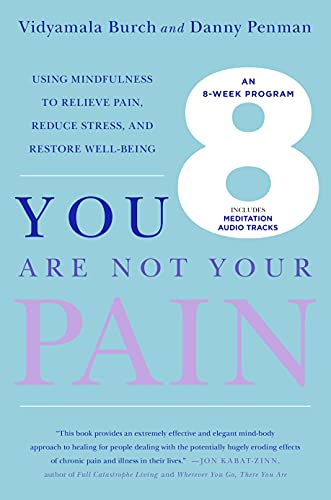
You Are Not Your Pain: Using Mindfulness to Relieve Pain, Reduce Stress, and Restore Well-Being---An Eight-Week Program - Softcover
Inhaltsangabe
Developed by two authors, Vidyamala Burch and Danny Penman who themselves have struggled with severe pain after sustaining serious injuries, You Are Not Your Pain reveals a simple eight-week program of mindfulness-based practices that will melt away your suffering.
The eight meditations in this book take just ten to twenty minutes per day and have been shown to be as effective as prescription painkillers to soothe some of the most common causes of pain. These mindfulness-based practices soothe the brain's pain networks, while also significantly reducing the anxiety, stress, exhaustion, irritability, and depression that often accompanies chronic pain and illness.
Whether you experience back pain, arthritis, or migraines, are suffering from fibromyalgia, celiac disease, or undergoing chemotherapy, you will quickly learn to manage your pain and live life fully once again.
Die Inhaltsangabe kann sich auf eine andere Ausgabe dieses Titels beziehen.
Über die Autorin bzw. den Autor
VIDYAMALA BURCH is founder and codirector of Breathworks, an organization offering mindfulness-based and compassion-based approaches to living well with chronic pain, illness, and stress. There are Breathworks teachers in over 15 countries. She is the author of Living Well with Pain and Illness which is based on her acclaimed Breathworks program.
DANNY PENMAN, PhD, is an award-winning journalist and author who has worked for the BBC, The Independent, and writes for the London Daily Mail. He is coauthor of the bestselling Mindfulness: An Eight-Week Plan for Finding Peace in a Frantic World.
Auszug. © Genehmigter Nachdruck. Alle Rechte vorbehalten.
You are Not Your Pain
Using Mindfulness to Relieve Pain, Reduce Stress, and Restore Well-Being—an Eight-Week Program
By Vidyamala Burch, Danny PenmanFlatiron Books
Copyright © 2013 Vidyamala Burch and Danny Penman
All rights reserved.
ISBN: 978-1-250-05267-4All rights reserved.
Contents
Title Page,
Copyright Notice,
Reader's Note,
Dedication,
Audio Contents,
Acknowledgments,
Foreword by Mark Williams,
1. Every Moment Is a New Chance,
2. What You Resist Persists,
3. Introducing the Mindfulness Program,
4. Week One: Wild Horses,
5. Week Two: You Are Not Your Thoughts,
6. Week Three: Learning to Respond, Rather Than React,
7. Week Four: Watching Your Suffering and Stress Dissolve,
8. Week Five: The Pleasure of Small Things,
9. Week Six: "The Tender Gravity of Kindness",
10. Week Seven: You Are Not Alone,
11. Week Eight: Life Lives Through You,
Notes,
Resources,
Further Reading,
Appendix,
Index,
About the Authors,
Copyright,
CHAPTER 1
Every Moment Is a New Chance
Pain always seems worse at night. Something about the silence amplifies the suffering. Even after you've taken the maximum dose of painkillers, the aching soon returns with a vengeance. You want to do something, anything, to stop the pain, but whatever you try seems to fail. Moving hurts. Doing nothing hurts. Ignoring it hurts. But it's not just the pain that hurts; your mind can start to suffer as you desperately try to find a way of escaping. Pointed and bitter questions can begin nagging at your soul: What will happen if I don't recover? What if it gets worse? I can't cope with this. Please, I just want it to stop. ...
We wrote this book to help you cope with pain, illness, and stress in times such as these. It will teach you how to reduce your suffering progressively, so that you can begin living life to the fullest once again. It may not completely eliminate your suffering, but it will ensure that it no longer dominates your life. You'll discover that it is possible to be at peace, even if illness and pain are unavoidable, and to enjoy a fulfilling life.
We know this to be true because we have both experienced terrible injuries and used an ancient form of meditation known as mindfulness to ease our suffering. The techniques in this book have been proven to work by doctors and scientists in universities around the world. Mindfulness is so effective that doctors and specialist pain clinics now refer their patients to our Breathworks center in Manchester, UK, and to courses run by our affiliated trainers around the world. Every day we help people find peace amid their suffering.
This book and the accompanying CD reveal a series of simple practices that you can incorporate into daily life to significantly reduce your pain, anguish, and stress. They are built on Mindfulness-Based Pain Management (MBPM), which has its roots in the groundbreaking work of Dr. Jon Kabat-Zinn of the University of Massachusetts Medical Center. The MBPM program itself was developed by Vidyamala Burch (coauthor of this book) as a means of coping with the aftereffects of two serious accidents. Although originally designed to reduce physical pain and suffering, it has proven to be an effective stress-reduction technique as well. The core mindfulness meditation techniques have been shown in many clinical trials to be at least as effective as drugs or counseling for relieving anxiety, stress, and depression. When it comes to pain, clinical trials show that mindfulness can be as effective as the most commonly prescribed painkillers, and some studies have shown it to be as powerful as morphine. Imaging studies show that it soothes the brain patterns underlying pain, and over time, these changes take root and alter the structure of the brain itself so that you no longer feel pain with the same intensity. And when it does arise, the pain no longer dominates your life. Many people report that their pain declines to such a degree that they barely notice it at all.
Many hospital pain clinics now prescribe mindfulness meditation to help patients cope with the suffering arising from a wide range of diseases, such as cancer (and the side effects of chemotherapy), heart disease, diabetes, and arthritis. It is also used for back problems, migraines, fibromyalgia, celiac disease, and a range of autoimmune diseases such as lupus and multiple sclerosis, as well as for such long-term conditions as chronic fatigue syndrome and irritable bowel syndrome. It's also useful for coping with labor pain. In addition to all these uses, clinical trials also show that mindfulness significantly reduces the anxiety, stress, depression, irritability, and insomnia that can arise from chronic pain and illness. Researchers are continually finding new conditions that can be eased with mindfulness.
MINDFULNESS DISSOLVES PAIN AND SUFFERING
Mindfulness-Based Pain Management uses ancient meditations that were largely unknown in the West until recently. In one typical meditation, you focus on the breath as it flows into and out of the body (see box here). This allows you to see your mind and body in action, to observe painful sensations as they arise, and to let go of struggling with them. Mindfulness teaches you that pain naturally waxes and wanes. You learn to gently observe it, rather than be caught up in it, and when you do so, something remarkable happens: it begins to melt away of its own accord. After a while, you come to the profound realization that pain comes in two forms: primary and secondary. Each of these has very different causes—and understanding this gives you far greater control over your suffering.
Primary pain tends to arise from illness, injury, or damage to the body or nervous system. You could see it as raw information being sent by the body to the brain. Secondary pain follows close behind, but is often far more powerful and distressing. Secondary pain can be seen as the mind's reaction to primary pain.
Pain's Volume Control
The mind has tremendous control over the sensations of pain that you consciously feel and how unpleasant they are. It has a "volume" control that governs both the intensity and the duration of the sensations of pain. This is because your mind does not simply feel pain, it also processes the information that it contains. It teases apart all of the different sensations to try to find their underlying causes so that you can avoid further pain or damage to the body. In effect, your mind zooms in on your pain for a closer look as it tries to find a solution to your suffering. This zooming-in amplifies your pain. As your mind analyzes the pain, it also sifts through your memories for occasions when you have suffered similarly. It is searching for a pattern, some clues, that will lead to a solution. Trouble is, if you have suffered from pain or illness for months or years, then the mind will have a rich tapestry of painful memories on which to draw—but few solutions. So before you know it, your mind can become flooded with unsettling memories. You can become enmeshed in thoughts about your suffering. It can seem as if you've always been ill and in pain, that you've never found a solution and that you never will. So you can end up being consumed by anxieties, stresses, and worries about the future as well as physical pain: What will happen if I can't stop this pain? Am I going to spend my life suffering like this? Is it going to keep on getting...
„Über diesen Titel“ kann sich auf eine andere Ausgabe dieses Titels beziehen.
Suchergebnisse für You Are Not Your Pain: Using Mindfulness to Relieve...

Beispielbild für diese ISBN
You Are Not Your Pain: Using M
Anbieter: World of Books (was SecondSale), Montgomery, IL, USA
Verkäuferbewertung 5 von 5 Sternen

Zustand: Acceptable. Item in acceptable condition! Textbooks may not include supplemental items i.e. CDs, access codes etc. Bestandsnummer des Verkäufers 00103031378
Gebraucht kaufen
EUR 3,92
Versand gratis
Versand innerhalb von USA
Versand innerhalb von USA
Anzahl: 1 verfügbar
Beispielbild für diese ISBN
You Are Not Your Pain: Using M
Anbieter: World of Books (was SecondSale), Montgomery, IL, USA
Verkäuferbewertung 5 von 5 Sternen
Zustand: Good. Item in good condition. Textbooks may not include supplemental items i.e. CDs, access codes etc. Bestandsnummer des Verkäufers 00105241421
Gebraucht kaufen
EUR 3,92
Versand gratis
Versand innerhalb von USA
Versand innerhalb von USA
Anzahl: 5 verfügbar
Foto des Verkäufers
You Are Not Your Pain
Anbieter: Zoom Books East, Glendale Heights, IL, USA
Verkäuferbewertung 5 von 5 Sternen
Zustand: acceptable. Book is in acceptable condition and shows signs of wear. Book may also include underlining highlighting. The book can also include "From the library of" labels. May not contain miscellaneous items toys, dvds, etc. . We offer 100% money back guarantee and 24 7 customer service. Bestandsnummer des Verkäufers ZEV.125005267X.A
Gebraucht kaufen
EUR 3,93
Versand gratis
Versand innerhalb von USA
Versand innerhalb von USA
Anzahl: 1 verfügbar
Foto des Verkäufers
You Are Not Your Pain
Anbieter: Zoom Books Company, Lynden, WA, USA
Verkäuferbewertung 5 von 5 Sternen
Zustand: very_good. Book is in very good condition and may include minimal underlining highlighting. The book can also include "From the library of" labels. May not contain miscellaneous items toys, dvds, etc. . We offer 100% money back guarantee and 24 7 customer service. Bestandsnummer des Verkäufers ZBV.125005267X.VG
Gebraucht kaufen
EUR 4,15
Versand gratis
Versand innerhalb von USA
Versand innerhalb von USA
Anzahl: 4 verfügbar
Foto des Verkäufers
You Are Not Your Pain
Anbieter: ZBK Books, Carlstadt, NJ, USA
Verkäuferbewertung 5 von 5 Sternen
Zustand: good. Fast & Free Shipping â" Good condition. It may show normal signs of use, such as light writing, highlighting, or library markings, but all pages are intact and the book is fully readable. A solid, complete copy that's ready to enjoy. Bestandsnummer des Verkäufers ZWV.125005267X.G
Gebraucht kaufen
EUR 4,52
Versand gratis
Versand innerhalb von USA
Versand innerhalb von USA
Anzahl: 1 verfügbar
Foto des Verkäufers
You Are Not Your Pain
Anbieter: Greenworld Books, Arlington, TX, USA
Verkäuferbewertung 5 von 5 Sternen
Zustand: good. Fast Free Shipping â" Good condition. It may show normal signs of use, such as light writing, highlighting, or library markings, but all pages are intact and the book is fully readable. A solid, complete copy that's ready to enjoy. Bestandsnummer des Verkäufers GWV.125005267X.G
Gebraucht kaufen
EUR 4,52
Versand gratis
Versand innerhalb von USA
Versand innerhalb von USA
Anzahl: 4 verfügbar
Foto des Verkäufers
You Are Not Your Pain
Anbieter: Greenworld Books, Arlington, TX, USA
Verkäuferbewertung 5 von 5 Sternen
Zustand: acceptable. Fast Free Shipping â" A well-loved copy with text fully readable and cover pages intact. May display wear such as writing, highlighting, bends, folds or library marks. Still a complete and usable book. Bestandsnummer des Verkäufers GWV.125005267X.A
Gebraucht kaufen
EUR 4,52
Versand gratis
Versand innerhalb von USA
Versand innerhalb von USA
Anzahl: 1 verfügbar
Foto des Verkäufers
You Are Not Your Pain
Anbieter: ZBK Books, Carlstadt, NJ, USA
Verkäuferbewertung 5 von 5 Sternen
Zustand: very_good. Fast & Free Shipping â" Very Good condition book with a firm cover and clean pages. Shows normal use and some light wear or limited notes markings. A solid, nice copy to enjoy. Bestandsnummer des Verkäufers ZWV.125005267X.VG
Gebraucht kaufen
EUR 5,10
Versand gratis
Versand innerhalb von USA
Versand innerhalb von USA
Anzahl: 1 verfügbar
Beispielbild für diese ISBN
You Are Not Your Pain
Anbieter: World of Books Inc, Montgomery, IL, USA
Verkäuferbewertung 2 von 5 Sternen

Paperback. Zustand: Fair. Developed by two authors, Vidyamala Burch and Danny Penman who themselves have struggled with severe pain after sustaining serious injuries, You Are Not Your Pain reveals a simple eight-week program of mindfulness-based practices that will melt away your suffering. The eight meditations in this book take just ten to twenty minutes per day and have been shown to be as effective as prescription painkillers to soothe some of the most common causes of pain. These mindfulness-based practices soothe the brain's pain networks, while also significantly reducing the anxiety, stress, exhaustion, irritability, and depression that often accompanies chronic pain and illness. Whether you experience back pain, arthritis, or migraines, are suffering from fibromyalgia, celiac disease, or undergoing chemotherapy, you will quickly learn to manage your pain and live life fully once again. Bestandsnummer des Verkäufers CIN125005267XA
Gebraucht kaufen
EUR 5,70
Versand gratis
Versand innerhalb von USA
Versand innerhalb von USA
Anzahl: 1 verfügbar
Beispielbild für diese ISBN
You Are Not Your Pain
Anbieter: World of Books Inc, Montgomery, IL, USA
Verkäuferbewertung 2 von 5 Sternen
Paperback. Zustand: Good. Developed by two authors, Vidyamala Burch and Danny Penman who themselves have struggled with severe pain after sustaining serious injuries, You Are Not Your Pain reveals a simple eight-week program of mindfulness-based practices that will melt away your suffering. The eight meditations in this book take just ten to twenty minutes per day and have been shown to be as effective as prescription painkillers to soothe some of the most common causes of pain. These mindfulness-based practices soothe the brain's pain networks, while also significantly reducing the anxiety, stress, exhaustion, irritability, and depression that often accompanies chronic pain and illness. Whether you experience back pain, arthritis, or migraines, are suffering from fibromyalgia, celiac disease, or undergoing chemotherapy, you will quickly learn to manage your pain and live life fully once again. Bestandsnummer des Verkäufers CIN125005267XG
Gebraucht kaufen
EUR 5,70
Versand gratis
Versand innerhalb von USA
Versand innerhalb von USA
Anzahl: 6 verfügbar