
Verwandte Artikel zu Welcome, Wombat (True Tales of Rescue)
Inhaltsangabe
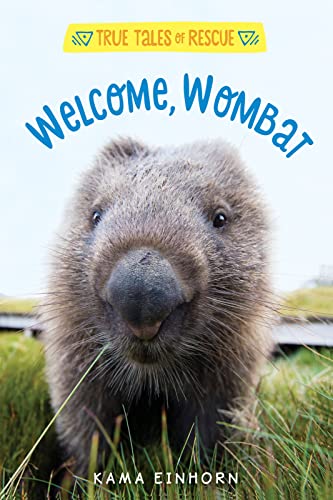
Photo-packed series explores the stories and science behind animal sanctuaries. An up-close look at what life is like at a real wombat sanctuary in Australia—straight from a wombat herself in a nonfiction chapter book for elementary-aged readers. Includes full-color photos, graphics, and maps.
When a new baby wombat shows up at Sleepy Burrows Sanctuary in Australia, Chance, the veteran wombat, is excited to show the new gal the ropes. Before any animal can be successfully released, many things have to happen. After rescue comes recovery, then rehabilitation, and finally, release. Those are animal-sanctuary tenets—an animal will remain safe until release or until it dies. For Chance and the new wombat, Panzer, this means learning how to find food, dig, and find a lifelong companion. Readers will love Chance, Panzer, and the crew of wombats. Other books in the photo-packed Sanctuary Stories series include Sweet Senior Pups.
Die Inhaltsangabe kann sich auf eine andere Ausgabe dieses Titels beziehen.
Über die Autorin bzw. den Autor
Kama Einhorn is Brooklyn-based writer and editor of children’s media. She has master’s degree in literacy education from U.C. Berkeley has been an editor at Scholastic, before becoming a content creator at Sesame Street. She's written more than 40 books for kids, published by Scholastic, Random House, Simon & Schuster, and HarperCollins and also authored magazine articles, outreach materials, and web content for Sesame Street, Nickelodeon, The New York Times Learning Network, Best Friends Animal Society, and The Humane Society of the United States.
Auszug. © Genehmigter Nachdruck. Alle Rechte vorbehalten.
PINKY WITH A PROBLEM
Oh, hi, tiny thing. Welcome to Sleepy Burrows Wombat Sanctuary. I'm Chance. I'm a wombat, too. I'm two years old, and I've been living here for more than a year.
Don't worry. I'll explain everything about being a wombat, and I think you'll be pleased to learn how totally awesome we are. But first, here's what's going on.
The two humans who brought you here are Donna and Phil. I knew you were coming because soon after sunset, the phone rang and Donna called out that there was a joey who needed help. It was almost my feeding time when she and Phil rushed out, but I didn't mind waiting, as long as I got my carrots soon. No worries. I've been snacking all day anyway.
I know you must be scared, little mate. I was scared when I arrived, too. I'll tell you more about that later. Right now it's all about you.
From all the human yapping, I've pieced your story together. You probably don't remember much. See, your mum was crossing the road to go find more grass to munch, and she got hit by a car that was going too fast. Then your mum . . . well, your mum died right away. I'm sorry, buddy. Maybe you didn't realize.
The truth is, lots of us wombats and other wildlife get hit by cars. We don't see very well. Our sense of smell is excellent'we can smell the difference between twenty different kinds of grass. But we can't smell cars coming, now can we?
The couple in the car was so upset. They got out, looked at your mum's belly, and saw her pouch. They could tell you were wiggling around in there. It's a good thing they checked, because even after our mums die, we can stay alive in their pouch for five days.
We start our lives in our mum's pouch, like koalas and kangaroos. This makes us a special kind of mammal called a marsupial.
The couple searched for 'wildlife rescue' on their phone and found Sleepy Burrows. Donna jotted down your exact location on the back of an unopened envelope on her desk. It was an hour's drive, and when they arrived, Donna pulled you carefully out of your mum's pouch with a piece of clean cloth. She knew the cloth would get your mum's smell on it and keep you calm when you were swaddled in it. Then they wrapped you again in one of Phil's flannel shirts. Phil carried your mum's body to the back of their truck, so he could bury her later. He gently set her down and covered her in an old blanket.
The couple thanked Phil and Donna and hugged them. "Is she going to be okay?' the woman asked, her voice trembling. "I hope I didn't cause two deaths!"
'We'll take good care of this little one," Donna said. 'thank you for checking the pouch, and for calling us. There are never any guarantees, but call us in a year's time, and hopefully you can visit us, to see how she's grown.' Phil put you, all bundled up, inside his own shirt, close to his skin, to keep you warm as Donna drove home.
And here you are. If all goes well, you could live for five years in the wild. It could be a good life out there. Donna tries to make it happen for all of us. Some of us don't return to the wild, but lots of us do. Those of us who stay might live until age fifteen, which tells you just how dangerous the wild can be.
'Wombat' comes from an Aboriginal word, 'wambad.' Sometimes Donna and Phil give us native Aboriginal names, like Dakara ('hard ground') or Yhi ('goddess of light'). Aboriginals are the native people who were here long before European settlers came here hundreds of years ago.
Our habitat is grassy, hilly, and full of eucalyptus forests. The land can be dusty or muddy, depending on the season. There are cool trees around us called ghost-gums, with smooth white'or even pinkish!'bark. They're called ghost-gums because you can see them in the dark. The bark feels a little powdery, and the long light green leaves smell sweet and minty. I hope you'll smell them someday.
All you have to know now is that you're in good hands. Donna's been doing this since 2004. Running the sanctuary is her full-time job (it's Phil's job, too, but he has another job fixing heaters and air conditioners). Donna and Phil are wildlife rehabilitators, with special training and a license from the government. They've learned from other caregivers, and they've really learned by watching us closely and trying different things. They often wind up teaching our vet, Dr. Joseph, about us!
Donna and Phil take care of about thirty of us at a time. Some are little pinkies like you; some are bigger; some are fully grown. Some live inside; some live outside. When our mums aren't here to show us how to live in the wild, Donna and Phil help us learn to be 'normal' wombats so we can live in the bush, where we belong.
We share our habitat with kangaroos, wallabies, koalas, wallaroos, echidnas, platypuses, quolls, emus, and even more native Australian creatures. Strange thing, most Australians never get to see even one of us wombats in the wild. We're good hiders.
THE SONGLINES
Aborigines believe in songlines, or dreaming tracks'invisible paths that stretch and crisscross all over Australia.
They believe that before there were people, giant beings wandered Australia, singing the name of everything that crossed their paths. These story-songs are like maps with every detail of the landscape and animals. If people know the songs, they can navigate thousands of miles without getting lost.
Aborigines believe that children inherit traits from the songline running through their birthplace. For example, if you are born on a wombat songline, you may have some characteristics of the wombat, like a habit of pushing your way through obstacles and never giving up.
Donna thinks that wombat songlines run through Sleepy Burrows and that wombats follow the wombat dreaming tracks of their ancestors till they get here, knowing they'll be safe.
Donna and Phil help kangaroo joeys and birds, too. And when they see shingle-back lizards on the roads, they pull over, pick them up, and bring them back to the sanctuary so they won't get hit by cars. But mostly, they help us.
Our closest relatives are koalas, which is weird because koalas are all about being up, up, up in trees and we're all about being down, down, down in the earth.
We're called 'bare-nosed wombats' or 'common wombats," but there are two other species: the northern hairy-nosed, which are almost extinct, and the southern hairy-nosed, which are also having a pretty rough go of it. Both have very hairy noses, obviously. To tell you the truth, us bare-nosed wombats aren't doing much better'there aren't as many of us as before, because of more roads and human buildings in our habitats.
Some wombats at Sleepy Burrows were once kept as pets. As you grow, you will understand what a truly terrible idea this is. Humans want us to walk on leashes and visit the supermarket and hang out with their friends, and they expect us to stay up during the day and sleep at night, just like them. That's torture for us, because we're nocturnal'we sleep all day and are up at night.
Since we'd stay with our mums for almost two years in the wild, and because we need bottles every two hours when we're pinkies, we enjoy...
„Über diesen Titel“ kann sich auf eine andere Ausgabe dieses Titels beziehen.
Suchergebnisse für Welcome, Wombat (True Tales of Rescue)

Beispielbild für diese ISBN
Welcome, Wombat (True Tales of Rescue)
Anbieter: Orion Tech, Kingwood, TX, USA
Verkäuferbewertung 5 von 5 Sternen

hardcover. Zustand: Good. Bestandsnummer des Verkäufers 1328767027-3-37019886
Gebraucht kaufen
EUR 4,51
Versand gratis
Versand innerhalb von USA
Versand innerhalb von USA
Anzahl: 1 verfügbar
Beispielbild für diese ISBN
Welcome, Wombat (True Tales of Rescue, 1)
Verlag:
Clarion Books (edition Illustrated), 2018
ISBN 10: 1328767027
ISBN 13: 9781328767028
Gebraucht
Hardcover
Anbieter: BooksRun, Philadelphia, PA, USA
Verkäuferbewertung 5 von 5 Sternen
Hardcover. Zustand: Very Good. Illustrated. It's a well-cared-for item that has seen limited use. The item may show minor signs of wear. All the text is legible, with all pages included. It may have slight markings and/or highlighting. Bestandsnummer des Verkäufers 1328767027-11-1
Gebraucht kaufen
EUR 4,52
Versand gratis
Versand innerhalb von USA
Versand innerhalb von USA
Anzahl: 1 verfügbar
Foto des Verkäufers
Welcome, Wombat (True Tales of Rescue)
Anbieter: Greenworld Books, Arlington, TX, USA
Verkäuferbewertung 5 von 5 Sternen
Zustand: good. Fast Free Shipping â" Good condition. It may show normal signs of use, such as light writing, highlighting, or library markings, but all pages are intact and the book is fully readable. A solid, complete copy that's ready to enjoy. Bestandsnummer des Verkäufers GWV.1328767027.G
Gebraucht kaufen
EUR 4,76
Versand gratis
Versand innerhalb von USA
Versand innerhalb von USA
Anzahl: 1 verfügbar
Beispielbild für diese ISBN
Welcome, Wombat
Verlag:
HarperCollins Publishers, 2018
ISBN 10: 1328767027
ISBN 13: 9781328767028
Gebraucht
Hardcover
Anbieter: Better World Books, Mishawaka, IN, USA
Verkäuferbewertung 5 von 5 Sternen
Zustand: Good. Former library copy. Pages intact with minimal writing/highlighting. The binding may be loose and creased. Dust jackets/supplements are not included. Includes library markings. Stock photo provided. Product includes identifying sticker. Better World Books: Buy Books. Do Good. Bestandsnummer des Verkäufers 18049088-6
Gebraucht kaufen
EUR 5,99
Versand gratis
Versand innerhalb von USA
Versand innerhalb von USA
Anzahl: 2 verfügbar
Beispielbild für diese ISBN
Welcome, Wombat
Verlag:
HarperCollins Publishers, 2018
ISBN 10: 1328767027
ISBN 13: 9781328767028
Gebraucht
Hardcover
Anbieter: Better World Books: West, Reno, NV, USA
Verkäuferbewertung 5 von 5 Sternen
Zustand: Good. Former library copy. Pages intact with minimal writing/highlighting. The binding may be loose and creased. Dust jackets/supplements are not included. Includes library markings. Stock photo provided. Product includes identifying sticker. Better World Books: Buy Books. Do Good. Bestandsnummer des Verkäufers 18049088-6
Gebraucht kaufen
EUR 5,99
Versand gratis
Versand innerhalb von USA
Versand innerhalb von USA
Anzahl: 1 verfügbar
Beispielbild für diese ISBN
Welcome, Wombat
Anbieter: ThriftBooks-Dallas, Dallas, TX, USA
Verkäuferbewertung 5 von 5 Sternen
Hardcover. Zustand: Very Good. No Jacket. May have limited writing in cover pages. Pages are unmarked. ~ ThriftBooks: Read More, Spend Less. Bestandsnummer des Verkäufers G1328767027I4N00
Gebraucht kaufen
EUR 6,45
Versand gratis
Versand innerhalb von USA
Versand innerhalb von USA
Anzahl: 1 verfügbar
Beispielbild für diese ISBN
Welcome, Wombat
Anbieter: ThriftBooks-Dallas, Dallas, TX, USA
Verkäuferbewertung 5 von 5 Sternen
Hardcover. Zustand: Very Good. No Jacket. Former library book; May have limited writing in cover pages. Pages are unmarked. ~ ThriftBooks: Read More, Spend Less. Bestandsnummer des Verkäufers G1328767027I4N10
Gebraucht kaufen
EUR 6,45
Versand gratis
Versand innerhalb von USA
Versand innerhalb von USA
Anzahl: 1 verfügbar
Beispielbild für diese ISBN
Welcome, Wombat
Anbieter: ThriftBooks-Atlanta, AUSTELL, GA, USA
Verkäuferbewertung 5 von 5 Sternen
Hardcover. Zustand: Very Good. No Jacket. Former library book; May have limited writing in cover pages. Pages are unmarked. ~ ThriftBooks: Read More, Spend Less. Bestandsnummer des Verkäufers G1328767027I4N10
Gebraucht kaufen
EUR 6,45
Versand gratis
Versand innerhalb von USA
Versand innerhalb von USA
Anzahl: 1 verfügbar
Foto des Verkäufers
Welcome, Wombat (True Tales of Rescue)
Anbieter: Goodwill of Greater Milwaukee and Chicago, Racine, WI, USA
Verkäuferbewertung 5 von 5 Sternen
Zustand: good. Book is considered to be in good or better condition. The actual cover image may not match the stock photo. Hard cover books may show signs of wear on the spine, cover or dust jacket. Paperback book may show signs of wear on spine or cover as well as having a slight bend, curve or creasing to it. Book should have minimal to no writing inside and no highlighting. Pages should be free of tears or creasing. Stickers should not be present on cover or elsewhere, and any CD or DVD expected with the book is included. Book is not a former library copy. Bestandsnummer des Verkäufers SEWV.1328767027.G
Gebraucht kaufen
EUR 5,42
EUR 2,59 Versand
Versand innerhalb von USA
Versand innerhalb von USA
Anzahl: 1 verfügbar
Beispielbild für diese ISBN
Welcome, Wombat (True Tales of Rescue)
Anbieter: BookOutlet, Jefferson City, TN, USA
Verkäuferbewertung 5 von 5 Sternen
Hardcover. Zustand: New. Hardcover. Publisher overstock, may contain remainder mark on edge. Bestandsnummer des Verkäufers 9781328767028B