
Verwandte Artikel zu Sketch of Capitular Masonry: From Its Introduction...
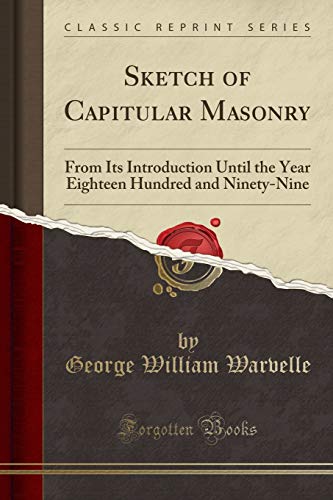
Sketch of Capitular Masonry: From Its Introduction Until the Year Eighteen Hundred and Ninety-Nine (Classic Reprint) - Softcover
Inhaltsangabe
Excerpt from Sketch of Capitular Masonry: From Its Introduction Until the Year Eighteen Hundred and Ninety-Nine
The symbolism was crude and undeveloped and the philosophical teach ings scarcely more than a suggestion. The fifty years that next ensued were marked by a restless and ever increasing activity. The schism of 1738 produced a keen rivalry that soon begat competition. The Scottish lodges abandoning their operative character entered the speculative field; Ireland did the same; and soon five grand lodges struggled for su premacy in the British Islands. Then it/was that the simple legends that formed the basis of the early ceremonial were eagerly seized upon by the enthusiast, the visionary, and, not infrequently, by the schemer. Allegory and symbol pieced out the fragmentary traditions of the Ancient Craft, and imagination furnished historical evidence where the facts were wanting. Beyond the seas rites and systems arose like the exhalations of magic, and the fundamental ideas of primitive Masonry were expanded to the last stage of attenuation through the extended scale of degrees which in many cases were adopted. These years may well be called the period of the Masonic renaissance. A new impulse was imparted to the fraternity by the development and expansion of its old legends; an im pulse that in many cases was made to serve the purposes of the charlatan and trickster, but in the end was productive of the highest good, and from the confused and ill-digested mass that marked this epoch have been evolved the great rites that now dominate the Masonic world.
With the exception of the three primary degrees of the Symbolic Lodge no degree in Masonry is so well known or widely diffused as that of the Royal Arch. When, where or how it originated is not definitely known, but the favorite theory of the students is, that it was fabricated by one Lawrence Dermott at or about the time of the so - called schism of the fraternity in England. This latter event occurred in the year 1738, and the first mention of the Royal Arch, so far as known, was in the year 1743. It was employed as an adjunct by both of the rival Grand Lodges of England and by them was introduced into the American Col onies, where it continued to be practiced in connection with craft lodges, the lodge warrant serving as a full authority for its conference upon candidates.' Until the latter part of the eighteenth century its govern ment was that of the lodge, but about 1790 a separation commenced to take place. The convocations in which it was conferred were called Chap ters, and certain detached degrees as well as new fabrications were about this time added to and included in the chapter jurisdiction. This was largely accomplished through the labors of Thomas Smith Webb, who may with propriety be styled the founder of the American Masonic system. From the fact that the Royal Arch and its subsidiary degrees are con ferred in bodies called Chapters they have now come to be generally styled the Capitular Degrees.
About the Publisher
Forgotten Books publishes hundreds of thousands of rare and classic books. Find more at www.forgottenbooks.com
This book is a reproduction of an important historical work. Forgotten Books uses state-of-the-art technology to digitally reconstruct the work, preserving the original format whilst repairing imperfections present in the aged copy. In rare cases, an imperfection in the original, such as a blemish or missing page, may be replicated in our edition. We do, however, repair the vast majority of imperfections successfully; any imperfections that remain are intentionally left to preserve the state of such historical works.
Die Inhaltsangabe kann sich auf eine andere Ausgabe dieses Titels beziehen.
Suchergebnisse für Sketch of Capitular Masonry: From Its Introduction...

Foto des Verkäufers
Sketch of Capitular Masonry (Classic Reprint)
Print-on-DemandAnbieter: Forgotten Books, London, Vereinigtes Königreich
Verkäuferbewertung 5 von 5 Sternen

Paperback. Zustand: New. Print on Demand. This book delves into the history of Capitular Freemasonry in Illinois, a significant branch of Freemasonry that emerged in the mid-18th century and practiced in conjunction with Craft lodges. The author traces the origins of the Royal Arch degree and its subsequent spread throughout the United States, focusing on the establishment and development of the Grand Chapter of Royal Arch Masons in Illinois from 1850 onwards. The book sheds light on the challenges faced by early chapters and the decisions that shaped the organization's growth, including the temporary embargo against Grand Chapter of Pennsylvania and the controversy over the control of Cryptic degrees. Through detailed accounts of annual convocations and profiles of prominent members, the author provides a rich tapestry of the people and events that have shaped Capitular Masonry in the state. This book serves as a valuable resource for Masonic historians and enthusiasts, offering insights into the evolution of Capitular Masonry in Illinois and its impact on the broader Masonic landscape. This book is a reproduction of an important historical work, digitally reconstructed using state-of-the-art technology to preserve the original format. In rare cases, an imperfection in the original, such as a blemish or missing page, may be replicated in the book. print-on-demand item. Bestandsnummer des Verkäufers 9781330059616_0
Neu kaufen
EUR 16,13
Versand gratis
Versand von Vereinigtes Königreich nach USA
Versand von Vereinigtes Königreich nach USA
Anzahl: Mehr als 20 verfügbar
Beispielbild für diese ISBN
Sketch of Capitular Masonry From Its Introduction Until the Year Eighteen Hundred and NinetyNine Classic Reprint
Anbieter: PBShop.store US, Wood Dale, IL, USA
Verkäuferbewertung 5 von 5 Sternen
PAP. Zustand: New. New Book. Shipped from UK. Established seller since 2000. Bestandsnummer des Verkäufers LW-9781330059616
Beispielbild für diese ISBN
Sketch of Capitular Masonry From Its Introduction Until the Year Eighteen Hundred and NinetyNine Classic Reprint
Anbieter: PBShop.store UK, Fairford, GLOS, Vereinigtes Königreich
Verkäuferbewertung 5 von 5 Sternen
PAP. Zustand: New. New Book. Shipped from UK. Established seller since 2000. Bestandsnummer des Verkäufers LW-9781330059616
Neu kaufen
EUR 24,88
EUR 3,89 Versand
Versand von Vereinigtes Königreich nach USA
Versand von Vereinigtes Königreich nach USA
Anzahl: 15 verfügbar