
Verwandte Artikel zu A Fine Balance (Vintage International)
Inhaltsangabe
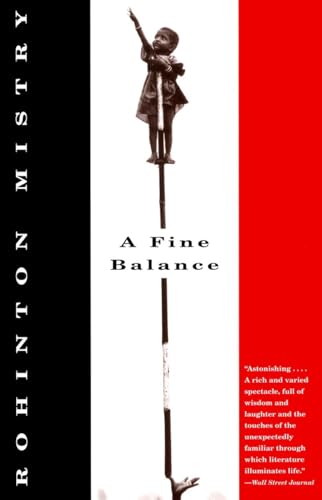
With a compassionate realism and narrative sweep that recall the work of Charles Dickens, this magnificent novel captures all the cruelty and corruption, dignity and heroism, of India. The time is 1975. The place is an unnamed city by the sea. The government has just declared a State of Emergency, in whose upheavals four strangers--a spirited widow, a young student uprooted from his idyllic hill station, and two tailors who have fled the caste violence of their native village--will be thrust together, forced to share one cramped apartment and an uncertain future.
As the characters move from distrust to friendship and from friendship to love, A Fine Balance creates an enduring panorama of the human spirit in an inhuman state.
Die Inhaltsangabe kann sich auf eine andere Ausgabe dieses Titels beziehen.
Über die Autorin bzw. den Autor
Rohinton Mistry was born in Bombay and now lives near Toronto. His first novel, Such a Long Journey, was shortlisted for the Booker Prize and received, among other awards, the Governor General's Award and the Commonwealth Writers Prize for Best Book of the Year. A Fine Balance is his second novel, winner of the Los Angeles Times Book Prize in Fiction, the Giller Prize, and the Commonwealth Writers Prize as well as a Booker Prize finalist. Mistry is also the author of Swimming Lessons, a collection of short stories.
Von der hinteren Coverseite
With a compassionate realism and narrative sweep that recall the work of Charles Dickens, this magnificent novel captures all the cruelty and corruption, dignity and heroism, of India. The time is 1975. The place is an unnamed city by the sea. The government has just declared a State of Emergency, in whose upheavals four strangers--a spirited widow, a young student uprooted from his idyllic hill station, and two tailors who have fled the caste violence of their native village--will be thrust together, forced to share one cramped apartment and an uncertain future.
As the characters move from distrust to friendship and from friendship to love, A Fine Balance creates an enduring panorama of the human spirit in an inhuman state.
Auszug. © Genehmigter Nachdruck. Alle Rechte vorbehalten.
One: City By the Sea
Dina Dalal seldom indulged in looking back at her life with regret or bitterness, or questioning why things had turned out the way they had, cheating her of the bright future everyone had predicted for her when she was in school, when her name was still Dina Shroff. And if she did sink into one of these rare moods, she quickly swam out of it. What was the point of repeating the story over and over and over, she asked herself--it always ended the same way; whichever corridor she took, she wound up in the same room.
Dina's father had been a doctor, a GP with a modest practice who followed the Hippocratic oath somewhat more passionately than others of his profession. During the early years of Dr. Shroff's career, his devotion to his work was diagnosed, by peers, family members, and senior physicians, as typical of youthful zeal and vigour. "How refreshing, this enthusiasm of the young," they smiled, nodding sagely, confident that time would douse the fires of idealism with a healthy dose of cynicism and family responsibilities.
But marriage, and the arrival of a son, followed eleven years later by a daughter, changed nothing for Dr. Shroff. Time only sharpened the imbalance between his fervour to ease suffering and his desire to earn a comfortable income.
"How disappointing," said friends and relatives, shaking their heads. "Such high hopes we had for him. And he keeps slaving like a clerk, like a fanatic, refusing to enjoy life. Poor Mrs. Shroff. Never a vacation, never a party--no fun at all in her existence."
At fifty-one, when Most GPS would have begun considering options like working half-time, hiring an inexpensive junior, or even selling the practice in favour of early retirement, Dr. Shroff had neither the bank balance nor the temperament to permit such indulgences. Instead, he volunteered to lead a campaign of medical graduates bound for districts in the interior. There, where typhoid and cholera, unchallenged by science or technology, were still reaping their routine harvest of villagers, Dr. Shroff would try to seize the deadly sickles or, at the very least, to blunt them.
But Mrs. Shroff undertook a different sort of campaign: to dissuade her husband from going into what she felt were the jaws of certain death. She attempted to coach Dina with words to sway her father. After all, Dina, at twelve, was Daddy's darling. Mrs. Shroff knew that her son, Nusswan, could be of no help in this enterprise. Enlisting him would have ruined any chance of changing her husband's mind.
The turning point in the father-and-son relationship had come seven years ago, on Nusswan's sixteenth birthday. Uncles and aunts had been invited to dinner, and someone said, "Well, Nusswan, you will soon be studying to become a doctor, just like your father."
"I don't want to be a doctor," Nusswan answered. "I'll be going into business-import and export."
Some of the uncles and aunts nodded approvingly. Others recoiled in mock horror, turning to Dr. Shroff. "Is this true? No father-son partnership?"
"Of course it's true," he said. "My children are free to do whatever they please."
But five-year-old Dina had seen the hurt on her father's face before he could hide it. She ran to him and clambered onto his lap. "Daddy, I want to be a doctor, just like you, when I grow up."
Everyone laughed and applauded, and said, Smart little girl, knows how to get what she wants. Later, they whispered that the son was obviously not made of the same solid stuff as the father-no ambition, wouldn't amount to much.
Dina had repeated her wish in the years to come, continuing to regard her father as some kind of god who gave people good health, who struggled against illness, and who, sometimes, succeeded in temporarily thwarting death. And Dr. Shroff was delighted with his bright child. On parents' night at the convent school, the principal and teachers always had the highest praise for her. She would succeed if she wanted to, Dr. Shroff knew it for certain.
Mrs. Shroff also knew, for certain, that her daughter was the one to recruit in the campaign against Dr. Shroff's foolish philanthropic plan of working in remote, Godforsaken villages. But Dina refused to cooperate; she did not approve of devious means to keep her beloved father home.
Then Mrs. Shroff resorted to other methods, using not money or his personal safety or his family to persuade him, for she knew these would fail hopelessly. Instead, she invoked his patients, claiming he was abandoning them, old and frail and helpless. "What will they do if you go so far away? They trust you and rely on you. How can you be so cruel? You have no idea how much you mean to them."
"No, that is not the point," said Dr. Shroff. He was familiar with the anfractuous arguments that her love for him could prompt her to wield. Patiently he explained there were GPS galore in the city who could take care of the assorted aches and pains-where he was going, the people had no one. He comforted her that it was only a temporary assignment, hugging and kissing her much more than was usual for him. "I promise to be back soon," he said. "Before you even grow used to my absence."
But Dr. Shroff could not keep his promise. Three weeks into the medical campaign he was dead, not from typhoid or cholera, but from a cobra's bite, far from the lifesaving reach of antivenins.
Mrs. Shroff received the news calmly. People said it was because she was a doctor's wife, more familiar with death than other mortals. They reasoned that Dr. Shroff must have often carried such tidings to her regarding his own patients, thus preparing her for the inevitable.
When she took brisk charge of the funeral arrangements, managing everything with superb efficiency, people wondered if there was not something a little abnormal about her behaviour. Between disbursing funds from her handbag for the various expenses, she accepted condolences, comforted grieving relatives, tended the oil lamp at the head of Dr. Shroff's bed, washed and ironed her white sari, and made sure there was a supply of incense and sandalwood in the house. She personally instructed the cook about the special vegetarian meal for the next day.
After the full four days of death ceremonies, Dina was still crying. Mrs. Shroff, who was busy tallying the prayer-bungalow charges from the Towers of Silence, said briskly, "Come, my daughter, be sensible now. Daddy would not like this." So Dina did her best to control herself.
Then Mrs. Shroff continued absentmindedly, writing out the cheque. "You could have stopped him if you wanted. He would have listened to you," she said.
Dina's sobs burst out with renewed intensity. In addition to the grief for her father, her tears now included anger towards her mother, even hatred. It would take her a few months to understand that there was no malice or accusation contained in what had been said, just a sad and simple statement of fact as seen by her mother.
Six months after Dr. Shroff's death, after being the pillar that everyone could lean on, Mrs. Shroff gradually began to crumble. Retreating from daily life, she took very little interest in the running of her household or in her own person.
It made little difference to Nusswan, who was twenty-three and busy planning his own future. But Dina, at twelve, could have done with a parent for a few more years. She missed her father dreadfully. Her mother's withdrawal made it much worse.
Nusswan Shroff had earned his own living as a businessman for two years prior to his father's death. He was still single, living at home, saving his money while searching for a suitable flat and a suitable...
„Über diesen Titel“ kann sich auf eine andere Ausgabe dieses Titels beziehen.
Suchergebnisse für A Fine Balance (Vintage International)

Foto des Verkäufers
A Fine Balance
Anbieter: Dream Books Co., Denver, CO, USA
Verkäuferbewertung 5 von 5 Sternen

Zustand: acceptable. This copy has clearly been enjoyedâ"expect noticeable shelf wear and some minor creases to the cover. Binding is strong, and all pages are legible. May contain previous library markings or stamps. Bestandsnummer des Verkäufers 4EKGY3008MAB_ns
Gebraucht kaufen
EUR 3,79
Versand gratis
Versand innerhalb von USA
Versand innerhalb von USA
Anzahl: 6 verfügbar
Beispielbild für diese ISBN
A Fine Balance: A Novel
Anbieter: World of Books (was SecondSale), Montgomery, IL, USA
Verkäuferbewertung 5 von 5 Sternen
Paperback. Zustand: Good. BOOKER PRIZE FINALIST * "Monumental . . . Few have caught the real sorrow and inexplicable strength of India, the unaccountable crookedness and sweetness, as well as Mistry."--Pico Iyer, Time WINNER OF THE LOS ANGELES TIMES BOOK PRIZE, COMMONWEALTH WRITERS PRIZE, AND GILLER PRIZE With a compassionate realism and narrative sweep that recall the work of Charles Dickens, this magnificent novel captures all the cruelty and corruption, dignity and heroism, of India. The time is 1975. The place is an unnamed city by the sea. The government has just declared a State of Emergency, in whose upheavals four strangers--a spirited widow, a young student uprooted from his idyllic hill station, and two tailors who have fled the caste violence of their native village--will be thrust together, forced to share one cramped apartment and an uncertain future. As the characters move from distrust to friendship and from friendship to love, A Fine Balance creates an enduring panorama of the human spirit in an inhuman state. Bestandsnummer des Verkäufers 00100864766
Gebraucht kaufen
EUR 3,81
Versand gratis
Versand innerhalb von USA
Versand innerhalb von USA
Anzahl: Mehr als 20 verfügbar
Beispielbild für diese ISBN
A Fine Balance: A Novel
Anbieter: World of Books (was SecondSale), Montgomery, IL, USA
Verkäuferbewertung 5 von 5 Sternen
Paperback. Zustand: Fair. BOOKER PRIZE FINALIST * "Monumental . . . Few have caught the real sorrow and inexplicable strength of India, the unaccountable crookedness and sweetness, as well as Mistry."--Pico Iyer, Time WINNER OF THE LOS ANGELES TIMES BOOK PRIZE, COMMONWEALTH WRITERS PRIZE, AND GILLER PRIZE With a compassionate realism and narrative sweep that recall the work of Charles Dickens, this magnificent novel captures all the cruelty and corruption, dignity and heroism, of India. The time is 1975. The place is an unnamed city by the sea. The government has just declared a State of Emergency, in whose upheavals four strangers--a spirited widow, a young student uprooted from his idyllic hill station, and two tailors who have fled the caste violence of their native village--will be thrust together, forced to share one cramped apartment and an uncertain future. As the characters move from distrust to friendship and from friendship to love, A Fine Balance creates an enduring panorama of the human spirit in an inhuman state. Bestandsnummer des Verkäufers 00078974145
Gebraucht kaufen
EUR 3,81
Versand gratis
Versand innerhalb von USA
Versand innerhalb von USA
Anzahl: Mehr als 20 verfügbar
Beispielbild für diese ISBN
A Fine Balance: A Novel
Anbieter: World of Books (was SecondSale), Montgomery, IL, USA
Verkäuferbewertung 5 von 5 Sternen
Paperback. Zustand: Very Good. BOOKER PRIZE FINALIST * "Monumental . . . Few have caught the real sorrow and inexplicable strength of India, the unaccountable crookedness and sweetness, as well as Mistry."--Pico Iyer, Time WINNER OF THE LOS ANGELES TIMES BOOK PRIZE, COMMONWEALTH WRITERS PRIZE, AND GILLER PRIZE With a compassionate realism and narrative sweep that recall the work of Charles Dickens, this magnificent novel captures all the cruelty and corruption, dignity and heroism, of India. The time is 1975. The place is an unnamed city by the sea. The government has just declared a State of Emergency, in whose upheavals four strangers--a spirited widow, a young student uprooted from his idyllic hill station, and two tailors who have fled the caste violence of their native village--will be thrust together, forced to share one cramped apartment and an uncertain future. As the characters move from distrust to friendship and from friendship to love, A Fine Balance creates an enduring panorama of the human spirit in an inhuman state. Bestandsnummer des Verkäufers 00110287426
Gebraucht kaufen
EUR 3,81
Versand gratis
Versand innerhalb von USA
Versand innerhalb von USA
Anzahl: 1 verfügbar
Beispielbild für diese ISBN
A Fine Balance
Anbieter: Your Online Bookstore, Houston, TX, USA
Verkäuferbewertung 5 von 5 Sternen
Paperback. Zustand: Very Good. Bestandsnummer des Verkäufers 140003065X-2-18988300
Gebraucht kaufen
EUR 3,90
Versand gratis
Versand innerhalb von USA
Versand innerhalb von USA
Anzahl: 2 verfügbar
Beispielbild für diese ISBN
A Fine Balance
Anbieter: Orion Tech, Kingwood, TX, USA
Verkäuferbewertung 5 von 5 Sternen
Paperback. Zustand: Very Good. Bestandsnummer des Verkäufers 140003065X-2-18440659
Gebraucht kaufen
EUR 3,90
Versand gratis
Versand innerhalb von USA
Versand innerhalb von USA
Anzahl: 1 verfügbar
Beispielbild für diese ISBN
A Fine Balance
Anbieter: Gulf Coast Books, Cypress, TX, USA
Verkäuferbewertung 5 von 5 Sternen
Paperback. Zustand: Fair. Bestandsnummer des Verkäufers 140003065X-4-18982707
Gebraucht kaufen
EUR 3,90
Versand gratis
Versand innerhalb von USA
Versand innerhalb von USA
Anzahl: 2 verfügbar
Foto des Verkäufers
A Fine Balance
Anbieter: 3Brothers Bookstore, Egg harbor township, NJ, USA
Verkäuferbewertung 5 von 5 Sternen
Zustand: acceptable. Books may contain multiple pages with notes and highlighting. Supplements such as Access Codes, Cd's, etc. are not guaranteed with used book purchases. Bestandsnummer des Verkäufers EVV.140003065X.A
Gebraucht kaufen
EUR 3,91
Versand gratis
Versand innerhalb von USA
Versand innerhalb von USA
Anzahl: 1 verfügbar
Foto des Verkäufers
A Fine Balance
Anbieter: Used Book Company, Egg Harbor Township, NJ, USA
Verkäuferbewertung 5 von 5 Sternen
Zustand: Good. Former library copy. Shows moderate signs of wear and previous use. Can include notes/highlighting. A portion of your purchase benefits nonprofits! - Note: Edition & format may differ from what is shown in stock photo & item details. May not include supplementary material (toys, access code, dvds, etc). Bestandsnummer des Verkäufers UBCV.140003065X.G
Gebraucht kaufen
EUR 3,91
Versand gratis
Versand innerhalb von USA
Versand innerhalb von USA
Anzahl: 1 verfügbar
Foto des Verkäufers
A Fine Balance
Anbieter: Zoom Books East, Glendale Heights, IL, USA
Verkäuferbewertung 5 von 5 Sternen
Zustand: good. Book is in good condition and may include underlining highlighting and minimal wear. The book can also include "From the library of" labels. May not contain miscellaneous items toys, dvds, etc. . We offer 100% money back guarantee and 24 7 customer service. Bestandsnummer des Verkäufers ZEV.140003065X.G
Gebraucht kaufen
EUR 4,05
Versand gratis
Versand innerhalb von USA
Versand innerhalb von USA
Anzahl: 3 verfügbar