
Verwandte Artikel zu A Year at the Races: Reflections on Horses, Humans,...
Inhaltsangabe
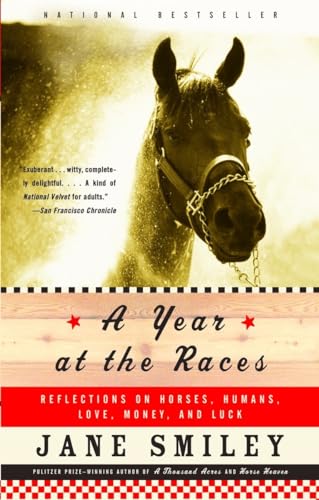
NATIONAL BESTSELLER • From the Pulitzer Prize-winning author of A Thousand Acres comes an irresistibly smart, witty, and engaging chronicle of a novelist's lifelong obsession with horses. • "Exuberant...witty, completely delightful.... A kind of National Velvet for adults." —San Francisco Chronicle
“Every horse story is a love story,” writes Jane Smiley, who has loved horses for most of her life and owned and bred them for a good part of it. To love something is to observe it with more than usual attention, and that is precisely what Smiley does in this
In particular she follows a sexy filly named Waterwheel and a grey named Wowie (he “tells” a horse communicator that he wants it changed from Hornblower) as they begin careers at the racetrack. Filled with humor and suspense, and with discourses on equine intelligence, affection, and character, A Year at the Races is a winner.
Die Inhaltsangabe kann sich auf eine andere Ausgabe dieses Titels beziehen.
Über die Autorin bzw. den Autor
JANE SMILEY is the author of numerous novels, including, most recently, Good Faith, as well as a critically acclaimed biography of Charles Dickens. She is the recipient of a Pulitzer Prize and was inducted into the American Academy of Arts and Letters in 2001. Smiley owns several horses and lives in Northern California.
Von der hinteren Coverseite
"Every horse story is a love story," writes Jane Smiley, who has loved horses for most of her life and owned and bred them for a good part of it. To love something is to observe it with more than usual attention, and that is precisely what Smiley does in this irresistibly smart, witty, and engaging chronicle of her obsession.
In particular she follows a sexy filly named Waterwheel and a grey named Wowie (he "tells" a horse communicator that he wants it changed from Hornblower) as they begin careers at the racetrack. Filled with humor and suspense, and with discourses on equine intelligence, affection, and character, A Year at the Races is a winner.
Auszug. © Genehmigter Nachdruck. Alle Rechte vorbehalten.
Chapter 1
Two Gals, a Horse, and the Baby Jesus
I was riding in a Manhattan cab downtown, from 48th Street to Hudson Street, and I was talking on my cell phone to my racehorse trainer at Santa Anita. I was not unaware that this was a rather worldly thing to be doing, but we weren't kvelling or counting our millions. We were autopsying the race of the day before, my four-year-old maiden's first race back after a long layoff. He had trembled in the gate ("McCarron said he was shaking like a leaf," said Alexis, not a good sign). "Then, when they came to him, he folded." He had finished second to last; I hadn't seen it, because, after the sixth or seventh race, races from Santa Anita weren't broadcast in OTB shops in Manhattan. I had listened the night before to Alexis's glum report of the race in another cab-heading uptown-alone in the dark, all dolled up for a fund-raiser. Now she said, "The Baby Jesus thinks McCarron's the wrong jockey for him."
"He does? Why?"
"He doesn't push them. If they want to run, he encourages them, but if they don't want to, he doesn't motivate them."
I said, "Who does the Baby Jesus think would be better?"
"Oh, he didn't say. They never do."
I reflected on Chris McCarron, a great jockey, and just the sort of kind, sensitive, tactful rider I wanted my maiden to do best with. I reflected on the Baby Jesus. I said, "Well, ask him, just to see. Just tell the Baby Jesus to close his eyes, put the heel of his hand on his third eye, and come up with a name."
"I'll try it," said Alexis.
"Has the Baby Jesus ever ridden him?"
"Oh, sure. He loves him."
"Well, I think we should just ask the Baby Jesus. Just once."
"Well, anyway," said Alexis, "he came out of the race fine. Ate up every oat and looked for more. His legs are cool and tight. No problems. I just worry about that trembling thing. We'll see. You know, that horse we had, Golden Post, he shook like mad before every race. He was psyching himself up because he didn't have much talent. He really wanted to win. We tried for years to relax him, and the only time he ever went to the post relaxed, he ran last. He won five hundred thousand dollars all in all. You never know with these horses."
I agreed. After all, she had decades of experience, and if she never knew, well, I certainly never, never knew. I thanked her and hung up. We had just turned onto Varick Street. The cabdriver spoke. He had a mellow baritone voice and a rich Middle Eastern accent. He said, "This Baby Jesus you were talking about. Is he the Baby Jesus in the Bible?"
It took me a moment to recall my attention from the sunny environs of Arcadia, California, where I imagined the horses and their riders wafting among the green shedrow barns with their well-tended rose gardens and their horse bandages swaying in the breeze. The weather was pleasant enough in Manhattan, but it was February, and not warm. I envisioned Alexis and Andy and Barry, and, of course, the Baby Jesus, standing in a circle in the golden sunlight, shaking their heads over my maiden's sad performance. I said, "Oh, no. The Baby Jesus is a little Irish exercise rider at a racetrack. He's so little and darling that they nicknamed him the Baby Jesus." As I said this, I wondered if the cabdriver was of a religious persuasion that would cause him to be offended at this idea. I offered, "It's an Irish thing, I think."
The cabdriver looked at me for a moment, then said, "I have a funny name, too." He pointed to his cabbie's license, displayed on the dashboard. It said that his name, his first name, was "Soccer." We laughed together, and I got out of the cab.
To the cabdriver, I may have sounded like I knew something, but in fact I had been racing my horse, whose registered name was "Hornblower," for less than two years, and for ten months of that he had vacationed at a farm in the country, recovering from an injury that was tiny but might have gotten serious without several months off. The horse was a gray colt of humble breeding but much beauty and grace, with a big, fluid stride. The adjective often used to describe him was "promising." He was my first horse to get to the track.
He lived at Santa Anita Racetrack, in a stall in a moss-green shedrow barn. The barns at Santa Anita are board-and-batten, old, but roomy and well kept. The paths are raked neatly every day. By the end of morning exercise, everything is so quiet, balmy, and neat that you wouldn't even know that horses live there, except for their heads peering over stall doors, or their hay nets hanging within easy reach. Citation lived here once, as did Seabiscuit. Tiznow, who won the Breeders' Cup twice, lived here until a few months ago. Silver Charm, Real Quiet, Fusaichi Pegasus, and Charismatic walked to the track just like Hornblower does every day. Like these great horses, my horse is perfectly cared for and perfectly fit. It is possible that every day, somewhere on the backside or on the track, Hornblower encounters the horse that will win this year's Kentucky Derby. He himself is too old for the Derby, since he is four, but, like him, all the horses are incognito-what their futures hold, what they can do and will do, is secret from their trainers and riders, though perhaps not quite so secret to the horses themselves.
The "backside" of a racetrack is where the horses are maintained. At Santa Anita, it is really the "leftside"-hidden behind high hedges to the left of the main parking lot (at Hollywood Park and Del Mar, it is more traditionally located across the track from the grandstand; and at Bay Meadows, outside of San Francisco, it was recently relocated to the infield of the track, after the land was sold off to condo developers). The backside is a world apart within the larger world apart of horseracing. It is where trainers, assistant trainers, exercise riders, jockeys, veterinarians, and farriers work every day, sometimes for forty or fifty years, and it is where grooms and hot-walkers live as well as work. Passions may run high on the backside, as they do in any workplace, but the atmosphere is tranquil because of the horses, who like routine and reassurance. Trainers like their horses to be happy and relaxed. But horsemen have secrets, too. If, as psychologists like to assert, human society is primarily a vast set of overlapping and interlocking stories, then backside society is
a concentrated version, where almost all conversation is the telling of tales, the keeping and divining of secrets.
Hornblower was a "maiden," a horse that has never won a race. Like "backside," this word is a typical horse-lore double entendre, and a perfect example of the covert sexuality of the English of horseracing and of the horse world in general.* A maiden is a modern representative of untried youth, a maghu in Indo-European. And of course he is a virgin, and of course, as a stallion, he is a little bit suspect. Male horses at the racetrack don't get to stay stallions for long if they don't win races. And so I was beginning to feel rather protective of my maiden's cojones. Now that he had started again, after his layoff, and had done poorly, and had trembled, and had not responded to the master hand of Chris McCarron, the inevitable pressure to castrate was going to build. One English term, not current in America, for a tool used to castrate horses is "scrungers."* I had to admit I recoiled from the idea of having my maiden scrunged.
There were two reasons not to cut him. One was that he always behaved perfectly. He didn't bite or strike or squeal or act aggressive around fillies (a word...
„Über diesen Titel“ kann sich auf eine andere Ausgabe dieses Titels beziehen.
Suchergebnisse für A Year at the Races: Reflections on Horses, Humans,...

Beispielbild für diese ISBN
A Year at the Races: Reflections on Horses, Humans, Love, Money, and Luck
Anbieter: World of Books (was SecondSale), Montgomery, IL, USA
Verkäuferbewertung 5 von 5 Sternen

Paperback. Zustand: Very Good. NATIONAL BESTSELLER * From the Pulitzer Prize-winning author of A Thousand Acres comes an irresistibly smart, witty, and engaging chronicle of a novelist's lifelong obsession with horses. * "Exuberant.witty, completely delightful. A kind of National Velvet for adults." --San Francisco Chronicle "Every horse story is a love story," writes Jane Smiley, who has loved horses for most of her life and owned and bred them for a good part of it. To love something is to observe it with more than usual attention, and that is precisely what Smiley does in this In particular she follows a sexy filly named Waterwheel and a grey named Wowie (he "tells" a horse communicator that he wants it changed from Hornblower) as they begin careers at the racetrack. Filled with humor and suspense, and with discourses on equine intelligence, affection, and character, A Year at the Races is a winner. Bestandsnummer des Verkäufers 00099518739
Gebraucht kaufen
EUR 4,05
Versand gratis
Versand innerhalb von USA
Versand innerhalb von USA
Anzahl: 2 verfügbar
Beispielbild für diese ISBN
A Year at the Races: Reflections on Horses, Humans, Love, Money, and Luck
Anbieter: World of Books (was SecondSale), Montgomery, IL, USA
Verkäuferbewertung 5 von 5 Sternen
Paperback. Zustand: Good. NATIONAL BESTSELLER * From the Pulitzer Prize-winning author of A Thousand Acres comes an irresistibly smart, witty, and engaging chronicle of a novelist's lifelong obsession with horses. * "Exuberant.witty, completely delightful. A kind of National Velvet for adults." --San Francisco Chronicle "Every horse story is a love story," writes Jane Smiley, who has loved horses for most of her life and owned and bred them for a good part of it. To love something is to observe it with more than usual attention, and that is precisely what Smiley does in this In particular she follows a sexy filly named Waterwheel and a grey named Wowie (he "tells" a horse communicator that he wants it changed from Hornblower) as they begin careers at the racetrack. Filled with humor and suspense, and with discourses on equine intelligence, affection, and character, A Year at the Races is a winner. Bestandsnummer des Verkäufers 00098683044
Gebraucht kaufen
EUR 4,05
Versand gratis
Versand innerhalb von USA
Versand innerhalb von USA
Anzahl: 5 verfügbar
Foto des Verkäufers
A Year at the Races: Reflections on Horses, Humans, Love, Money, and Luck
Verlag:
Knopf Doubleday Publishing Group, 2005
ISBN 10: 1400033179
ISBN 13: 9781400033171
Gebraucht
Softcover
Anbieter: Zoom Books Company, Lynden, WA, USA
Verkäuferbewertung 5 von 5 Sternen
Zustand: very_good. Book is in very good condition and may include minimal underlining highlighting. The book can also include "From the library of" labels. May not contain miscellaneous items toys, dvds, etc. . We offer 100% money back guarantee and 24 7 customer service. Bestandsnummer des Verkäufers ZBV.1400033179.VG
Gebraucht kaufen
EUR 4,06
Versand gratis
Versand innerhalb von USA
Versand innerhalb von USA
Anzahl: 1 verfügbar
Beispielbild für diese ISBN
A Year at the Races: Reflections on Horses, Humans, Love, Money, and Luck
Verlag:
Knopf Doubleday Publishing Group (edition ), 2005
ISBN 10: 1400033179
ISBN 13: 9781400033171
Gebraucht
Paperback
Anbieter: BooksRun, Philadelphia, PA, USA
Verkäuferbewertung 5 von 5 Sternen
Paperback. Zustand: Very Good. It's a well-cared-for item that has seen limited use. The item may show minor signs of wear. All the text is legible, with all pages included. It may have slight markings and/or highlighting. Bestandsnummer des Verkäufers 1400033179-11-1
Gebraucht kaufen
EUR 4,50
Versand gratis
Versand innerhalb von USA
Versand innerhalb von USA
Anzahl: 1 verfügbar
Beispielbild für diese ISBN
A Year at the Races: Reflections on Horses, Humans, Love, Money, and Luck
Verlag:
Knopf Doubleday Publishing Group (edition Reprint), 2005
ISBN 10: 1400033179
ISBN 13: 9781400033171
Gebraucht
Paperback
Anbieter: BooksRun, Philadelphia, PA, USA
Verkäuferbewertung 5 von 5 Sternen
Paperback. Zustand: Very Good. Reprint. It's a well-cared-for item that has seen limited use. The item may show minor signs of wear. All the text is legible, with all pages included. It may have slight markings and/or highlighting. Bestandsnummer des Verkäufers 1400033179-8-18
Gebraucht kaufen
EUR 5,02
Versand gratis
Versand innerhalb von USA
Versand innerhalb von USA
Anzahl: 1 verfügbar
Beispielbild für diese ISBN
A Year at the Races: Reflections on Horses, Humans, Love, Money, and Luck
Verlag:
Knopf Doubleday Publishing Group, 2005
ISBN 10: 1400033179
ISBN 13: 9781400033171
Gebraucht
paperback
Anbieter: Evergreen Goodwill, Seattle, WA, USA
Verkäuferbewertung 5 von 5 Sternen
paperback. Zustand: Good. Bestandsnummer des Verkäufers mon0000752865
Gebraucht kaufen
EUR 2,09
EUR 3,56 Versand
Versand innerhalb von USA
Versand innerhalb von USA
Anzahl: 1 verfügbar
Beispielbild für diese ISBN
A Year at the Races: Reflections on Horses, Humans, Love, Money, and Luck
Verlag:
Knopf Doubleday Publishing Group, 2005
ISBN 10: 1400033179
ISBN 13: 9781400033171
Gebraucht
paperback
Anbieter: HPB-Diamond, Dallas, TX, USA
Verkäuferbewertung 5 von 5 Sternen
paperback. Zustand: Very Good. Connecting readers with great books since 1972! Used books may not include companion materials, and may have some shelf wear or limited writing. We ship orders daily and Customer Service is our top priority! Bestandsnummer des Verkäufers S_477858912
Gebraucht kaufen
EUR 2,38
EUR 3,34 Versand
Versand innerhalb von USA
Versand innerhalb von USA
Anzahl: 1 verfügbar
Beispielbild für diese ISBN
A Year at the Races: Reflections on Horses, Humans, Love, Money, and Luck
Verlag:
Knopf Doubleday Publishing Group, 2005
ISBN 10: 1400033179
ISBN 13: 9781400033171
Gebraucht
paperback
Anbieter: HPB Inc., Dallas, TX, USA
Verkäuferbewertung 5 von 5 Sternen
paperback. Zustand: Very Good. Connecting readers with great books since 1972! Used books may not include companion materials, and may have some shelf wear or limited writing. We ship orders daily and Customer Service is our top priority! Bestandsnummer des Verkäufers S_433849360
Gebraucht kaufen
EUR 2,38
EUR 3,34 Versand
Versand innerhalb von USA
Versand innerhalb von USA
Anzahl: 1 verfügbar
Beispielbild für diese ISBN
A Year at the Races: Reflections on Horses, Humans, Love, Money, and Luck
Anbieter: World of Books Inc, Montgomery, IL, USA
Verkäuferbewertung 4 von 5 Sternen

Paperback. Zustand: Very Good. NATIONAL BESTSELLER * From the Pulitzer Prize-winning author of A Thousand Acres comes an irresistibly smart, witty, and engaging chronicle of a novelist's lifelong obsession with horses. * "Exuberant.witty, completely delightful. A kind of National Velvet for adults." --San Francisco Chronicle "Every horse story is a love story," writes Jane Smiley, who has loved horses for most of her life and owned and bred them for a good part of it. To love something is to observe it with more than usual attention, and that is precisely what Smiley does in this In particular she follows a sexy filly named Waterwheel and a grey named Wowie (he "tells" a horse communicator that he wants it changed from Hornblower) as they begin careers at the racetrack. Filled with humor and suspense, and with discourses on equine intelligence, affection, and character, A Year at the Races is a winner. Bestandsnummer des Verkäufers CIN1400033179VG
Gebraucht kaufen
EUR 5,89
Versand gratis
Versand innerhalb von USA
Versand innerhalb von USA
Anzahl: 2 verfügbar
Beispielbild für diese ISBN
A Year at the Races: Reflections on Horses, Humans, Love, Money, and Luck
Anbieter: World of Books Inc, Montgomery, IL, USA
Verkäuferbewertung 4 von 5 Sternen
Paperback. Zustand: Good. NATIONAL BESTSELLER * From the Pulitzer Prize-winning author of A Thousand Acres comes an irresistibly smart, witty, and engaging chronicle of a novelist's lifelong obsession with horses. * "Exuberant.witty, completely delightful. A kind of National Velvet for adults." --San Francisco Chronicle "Every horse story is a love story," writes Jane Smiley, who has loved horses for most of her life and owned and bred them for a good part of it. To love something is to observe it with more than usual attention, and that is precisely what Smiley does in this In particular she follows a sexy filly named Waterwheel and a grey named Wowie (he "tells" a horse communicator that he wants it changed from Hornblower) as they begin careers at the racetrack. Filled with humor and suspense, and with discourses on equine intelligence, affection, and character, A Year at the Races is a winner. Bestandsnummer des Verkäufers CIN1400033179G
Gebraucht kaufen
EUR 5,89
Versand gratis
Versand innerhalb von USA
Versand innerhalb von USA
Anzahl: 5 verfügbar