
Verwandte Artikel zu Living to Tell the Tale: An Autobiography (Vintage...
Inhaltsangabe
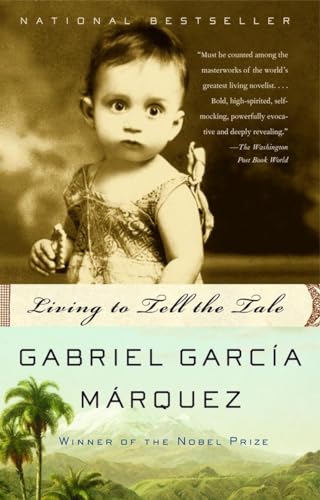
No writer of his time exerted the magical appeal of Gabriel García Márquez. In this long-awaited autobiography, the great Nobel laureate tells the story of his life from his birth in1927 to the moment in the 1950s when he proposed to his wife. The result is as spectacular as his finest fiction.
Here is García Márquez’s shimmering evocation of his childhood home of Aracataca, the basis of the fictional Macondo. Here are the members of his ebulliently eccentric family. Here are the forces that turned him into a writer. Warm, revealing, abounding in images so vivid that we seem to be remembering them ourselves, Living to Tell the Tale is a work of enchantment.
Die Inhaltsangabe kann sich auf eine andere Ausgabe dieses Titels beziehen.
Über die Autorin bzw. den Autor
Gabriel García Márquez was born in Colombia in 1927. He was awarded the Nobel Prize in Literature in 1982. He is the author of many works of fiction and nonfiction, including One Hundred Years of Solitude, Love In The Time Cholera, The Autumn Of The Patriarch, The General In His Labyrinth, and News Of A Kidnapping. He died in 2014
Von der hinteren Coverseite
No writer alive today exerts the magical appeal of Gabriel Garcia Marquez. Now, in the long-awaited first volume of his autobiography, he tells the story of his life from his birth in 1927 to the moment in the 1950s when he proposed to his wife. The result is as spectacular as his finest fiction.
Here is Garcia Marquez's shimmering evocation of his childhood home of Aracataca, the basis of the fictional Macondo. Here are the members of his ebulliently eccentric family. Here are the forces that turned him into a writer. Warm, revealing, abounding in images so vivid that we seem to be remembering them ourselves, Living to Tell the Tale" is a work of enchantment.
Aus dem Klappentext
-awaited first volume of a planned trilogy, the most acclaimed and revered living Nobel laureate begins to tell us the story of his life.
Like all his work, Living to Tell the Tale is a magnificent piece of writing. It spans Gabriel García Márquez s life from his birth in 1927 through the start of his career as a writer to the moment in the 1950s when he proposed to the woman who would become his wife. It has the shape, the quality, and the vividness of a conversation with the reader a tale of people, places, and events as they occur to him: the colorful stories of his eccentric family members; the great influence of his mother and maternal grandfather; his consuming career in journalism, and the friends and mentors who encouraged him; the myths and mysteries of his beloved Colombia; personal details, undisclosed until now, that would appear later, transmuted and transposed, in his fiction; and, above all, his fervent desire to become a writer. And, as
Auszug. © Genehmigter Nachdruck. Alle Rechte vorbehalten.
1
My mother asked me to go with her to sell the house. She had come that morning from the distant town where the family lived, and she had no idea how to find me. She asked around among acquaintances and was told to look for me at the Librería Mundo, or in the nearby cafés, where I went twice a day to talk with my writer friends. The one who told her this warned her: “Be careful, because they’re all out of their minds.” She arrived at twelve sharp. With her light step she made her way among the tables of books on display, stopped in front of me, looking into my eyes with the mischievous smile of her better days, and before I could react she said:
“I’m your mother.”
Something in her had changed, and this kept me from recognizing her at first glance. She was forty-five. Adding up her eleven births, she had spent almost ten years pregnant and at least another ten nursing her children. She had gone gray before her time, her eyes seemed larger and more startled behind her first bifocals, and she wore strict, somber mourning for the death of her mother, but she still preserved the Roman beauty of her wedding portrait, dignified now by an autumnal air. Before anything else, even before she embraced me, she said in her customary, ceremonial way:
“I’ve come to ask you to please go with me to sell the house.”
She did not have to tell me which one, or where, because for us only one existed in the world: my grandparents’ old house in Aracataca, where I’d had the good fortune to be born, and where I had not lived again after the age of eight. I had just dropped out of the faculty of law after six semesters devoted almost entirely to reading whatever I could get my hands on, and reciting from memory the unrepeatable poetry of the Spanish Golden Age. I already had read, in translation, and in borrowed editions, all the books I would have needed to learn the novelist’s craft, and had published six stories in newspaper supplements, winning the enthusiasm of my friends and the attention of a few critics. The following month I would turn twenty-three, I had passed the age of military service and was a veteran of two bouts of gonorrhea, and every day I smoked, with no foreboding, sixty cigarettes made from the most barbaric tobacco. I divided my leisure between Barranquilla and Cartagena de Indias, on Colombia’s Caribbean coast, living like a king on what I was paid for my daily commentaries in the newspaper El Heraldo, which amounted to almost less than nothing, and sleeping in the best company possible wherever I happened to be at night. As if the uncertainty of my aspirations and the chaos of my life were not enough, a group of inseparable friends and I were preparing to publish without funds a bold magazine that Alfonso Fuenmayor had been planning for the past three years. What more could anyone desire?
For reasons of poverty rather than taste, I anticipated what would be the style in twenty years’ time: untrimmed mustache, tousled hair, jeans, flowered shirts, and a pilgrim’s sandals. In a darkened movie theater, not knowing I was nearby, a girl I knew told someone: “Poor Gabito is a lost cause.” Which meant that when my mother asked me to go with her to sell the house, there was nothing to prevent me from saying I would. She told me she did not have enough money, and out of pride I said I would pay my own expenses.
At the newspaper where I worked, this was impossible to arrange. They paid me three pesos for a daily commentary and four for an editorial when one of the staff writers was out, but it was barely enough to live on. I tried to borrow money, but the manager reminded me that I already owed more than fifty pesos. That afternoon I was guilty of an abuse that none of my friends would have been capable of committing. At the door of the Café Colombia, next to the bookstore, I approached Don Ramón Vinyes, the old Catalan teacher and bookseller, and asked for a loan of ten pesos. He had only six.
Neither my mother nor I, of course, could even have imagined that this simple two-day trip would be so decisive that the longest and most diligent of lives would not be enough for me to finish recounting it. Now, with more than seventy-five years behind me, I know it was the most important of all the decisions I had to make in my career as a writer. That is to say: in my entire life.
Before adolescence, memory is more interested in the future than the past, and so my recollections of the town were not yet idealized by nostalgia. I remembered it as it was: a good place to live where everybody knew everybody else, located on the banks of a river of transparent water that raced over a bed of polished stones as huge and white as prehistoric eggs. At dusk, above all in December, when the rains had ended and the air was like a diamond, the Sierra Nevada de Santa Marta and its white peaks seemed to come right down to the banana plantations on the other side of the river. From there you could see the Arawak Indians moving in lines like ants along the cliffs of the sierra, carrying sacks of ginger on their backs and chewing pellets of coca to make life bearable. As children we dreamed of shaping balls of the perpetual snow and playing war on the parched, burning streets. For the heat was so implausible, in particular at siesta time, that the adults complained as if it were a daily surprise. From the day I was born I had heard it said, over and over again, that the rail lines and camps of the United Fruit Company had been built at night because during the day the sun made the tools too hot to pick up.
The only way to get to Aracataca from Barranquilla was by dilapidated motor launch through a narrow channel excavated by slave labor during colonial times, and then across the ciénaga, a vast swamp of muddy, desolate water, to the mysterious town that was also called Ciénaga. There you took the daily train that had started out as the best in the country and traveled the last stretch of the journey through immense banana plantations, making many pointless stops at hot, dusty villages and deserted stations. This was the trip my mother and I began at seven in the evening on Saturday, February 19, 1950—the eve of Carnival—in an unseasonable rainstorm and with thirty-two pesos that would be just enough to get us home if the house was not sold for the amount she had anticipated.
The trade winds were so fierce that night that I had trouble at the river port convincing my mother to board the boat. She was not being unreasonable. The launches were abbreviated imitations of the steamships out of New Orleans, but with gasoline motors that transmitted the tremors of a high fever to everything on board. There was a small salon that had hooks for hanging hammocks at different levels, and wooden benches where people elbowed their way to a seat with all their baggage, bundles of merchandise, crates of chickens, and even live pigs. There were a few suffocating cabins, each furnished with two army cots, almost always occupied by threadbare little whores who offered emergency services during the crossing. Since by now none of the cabins was free, and we had not brought hammocks, my mother and I took by storm two iron chairs in the central passageway, and there we prepared to spend the night.
Just as she had feared, the squall lashed the reckless ship as we crossed the Magdalena River, which has an oceanic temperament so close to its estuary. In the port I had bought a good supply of the least expensive cigarettes, made of black tobacco and a cheap paper that could have been used to wrap packages, and I began to smoke the way I did in those days, using the butt end of one cigarette to light the next, as I reread Light in August: at the time, William Faulkner...
„Über diesen Titel“ kann sich auf eine andere Ausgabe dieses Titels beziehen.
Suchergebnisse für Living to Tell the Tale: An Autobiography (Vintage...

Foto des Verkäufers
Living to Tell the Tale: An Autobiography (Vintage International)
Anbieter: Dream Books Co., Denver, CO, USA
Verkäuferbewertung 5 von 5 Sternen

Zustand: acceptable. This copy has clearly been enjoyedâ"expect noticeable shelf wear and some minor creases to the cover. Binding is strong, and all pages are legible. May contain previous library markings or stamps. Bestandsnummer des Verkäufers DBV.140003454X.A
Gebraucht kaufen
EUR 3,81
Versand gratis
Versand innerhalb von USA
Versand innerhalb von USA
Anzahl: 2 verfügbar
Beispielbild für diese ISBN
Living to Tell the Tale: An Autobiography
Anbieter: World of Books (was SecondSale), Montgomery, IL, USA
Verkäuferbewertung 5 von 5 Sternen
Zustand: Very Good. Item in very good condition! Textbooks may not include supplemental items i.e. CDs, access codes etc. Bestandsnummer des Verkäufers 00103956043
Gebraucht kaufen
EUR 3,86
Versand gratis
Versand innerhalb von USA
Versand innerhalb von USA
Anzahl: 1 verfügbar
Beispielbild für diese ISBN
Living to Tell the Tale: An Autobiography
Anbieter: World of Books (was SecondSale), Montgomery, IL, USA
Verkäuferbewertung 5 von 5 Sternen
Zustand: Acceptable. Item in acceptable condition! Textbooks may not include supplemental items i.e. CDs, access codes etc. Bestandsnummer des Verkäufers 00082875849
Gebraucht kaufen
EUR 3,86
Versand gratis
Versand innerhalb von USA
Versand innerhalb von USA
Anzahl: 4 verfügbar
Beispielbild für diese ISBN
Living to Tell the Tale: An Autobiography
Anbieter: World of Books (was SecondSale), Montgomery, IL, USA
Verkäuferbewertung 5 von 5 Sternen
Zustand: Good. Item in good condition. Textbooks may not include supplemental items i.e. CDs, access codes etc. Bestandsnummer des Verkäufers 00090876590
Gebraucht kaufen
EUR 3,86
Versand gratis
Versand innerhalb von USA
Versand innerhalb von USA
Anzahl: 16 verfügbar
Foto des Verkäufers
Living to Tell the Tale: An Autobiography (Vintage International)
Anbieter: Zoom Books East, Glendale Heights, IL, USA
Verkäuferbewertung 5 von 5 Sternen
Zustand: good. Book is in good condition and may include underlining highlighting and minimal wear. The book can also include "From the library of" labels. May not contain miscellaneous items toys, dvds, etc. . We offer 100% money back guarantee and 24 7 customer service. Bestandsnummer des Verkäufers ZEV.140003454X.G
Gebraucht kaufen
EUR 3,97
Versand gratis
Versand innerhalb von USA
Versand innerhalb von USA
Anzahl: 1 verfügbar
Beispielbild für diese ISBN
Living to Tell the Tale: An Autobiography
Anbieter: World of Books (was SecondSale), Montgomery, IL, USA
Verkäuferbewertung 5 von 5 Sternen
Zustand: Good. Good condition ex-library book with usual library markings and stickers. Bestandsnummer des Verkäufers 00104305683
Gebraucht kaufen
EUR 4,07
Versand gratis
Versand innerhalb von USA
Versand innerhalb von USA
Anzahl: 1 verfügbar
Foto des Verkäufers
Living to Tell the Tale: An Autobiography (Vintage International)
Anbieter: Zoom Books Company, Lynden, WA, USA
Verkäuferbewertung 5 von 5 Sternen
Zustand: very_good. Book is in very good condition and may include minimal underlining highlighting. The book can also include "From the library of" labels. May not contain miscellaneous items toys, dvds, etc. . We offer 100% money back guarantee and 24 7 customer service. Bestandsnummer des Verkäufers ZBV.140003454X.VG
Gebraucht kaufen
EUR 4,18
Versand gratis
Versand innerhalb von USA
Versand innerhalb von USA
Anzahl: 2 verfügbar
Beispielbild für diese ISBN
Living to Tell the Tale: An Autobiography (Vintage International)
Verlag:
Vintage (edition Reprint), 2004
ISBN 10: 140003454X
ISBN 13: 9781400034543
Gebraucht
Paperback
Anbieter: BooksRun, Philadelphia, PA, USA
Verkäuferbewertung 5 von 5 Sternen
Paperback. Zustand: Very Good. Reprint. It's a well-cared-for item that has seen limited use. The item may show minor signs of wear. All the text is legible, with all pages included. It may have slight markings and/or highlighting. Bestandsnummer des Verkäufers 140003454X-11-1
Gebraucht kaufen
EUR 4,62
Versand gratis
Versand innerhalb von USA
Versand innerhalb von USA
Anzahl: 1 verfügbar
Beispielbild für diese ISBN
Living to Tell the Tale
Anbieter: Wonder Book, Frederick, MD, USA
Verkäuferbewertung 5 von 5 Sternen
Zustand: Good. Good condition. Slightly dampstained. Bestandsnummer des Verkäufers F25D-00153
Gebraucht kaufen
EUR 4,75
Versand gratis
Versand innerhalb von USA
Versand innerhalb von USA
Anzahl: 1 verfügbar
Foto des Verkäufers
Living to Tell the Tale: An Autobiography (Vintage International)
Anbieter: Greenworld Books, Arlington, TX, USA
Verkäuferbewertung 5 von 5 Sternen
Zustand: good. Fast Free Shipping â" Good condition. It may show normal signs of use, such as light writing, highlighting, or library markings, but all pages are intact and the book is fully readable. A solid, complete copy that's ready to enjoy. Bestandsnummer des Verkäufers GWV.140003454X.G
Gebraucht kaufen
EUR 5,14
Versand gratis
Versand innerhalb von USA
Versand innerhalb von USA
Anzahl: 4 verfügbar