
Verwandte Artikel zu The Ten Most Beautiful Experiments
Inhaltsangabe
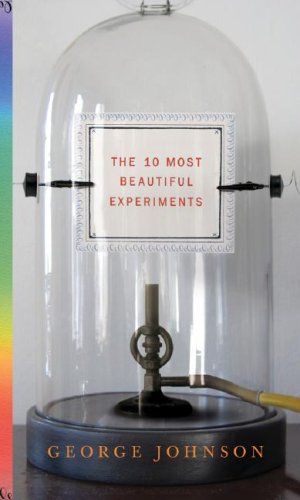
From the acclaimed New York Times science writer George Johnson, an irresistible book on the ten most fascinating experiments in the history of science—moments when a curious soul posed a particularly eloquent question to nature and received a crisp, unambiguous reply.
Johnson takes us to those times when the world seemed filled with mysterious forces, when scientists were dazzled by light, by electricity, and by the beating of the hearts they laid bare on the dissecting table.
We see Galileo singing to mark time as he measures the pull of gravity, and Newton carefully inserting a needle behind his eye to learn how light causes vibrations in the retina. William Harvey ties a tourniquet around his arm and watches his arteries throb above and his veins bulge below, proving that blood circulates. Luigi Galvani sparks electrical currents in dissected frog legs, wondering at the twitching muscle fibers, and Ivan Pavlov makes his now-famous dogs salivate at ascending chord progressions.
For all of them, diligence was rewarded. In an instant, confusion was swept aside and something new about nature leaped into view. In bringing us these stories, Johnson restores some of the romance to science, reminding us of the existential excitement of a single soul staring down the unknown.
Die Inhaltsangabe kann sich auf eine andere Ausgabe dieses Titels beziehen.
Über die Autorin bzw. den Autor
George Johnson writes regularly about science for The New York Times. He has also written forScientific American, The Atlantic Monthly, Time, Slate, and Wired, and his work has been included inThe Best American Science Writing. He has received awards from PEN and the American Association for the Advancement of Science, and his books were twice finalists for the Rhone-Poulenc Prize. He is a co-director of the Santa Fe Science Writing Workshop, and he lives in Santa Fe.
Auszug. © Genehmigter Nachdruck. Alle Rechte vorbehalten.
chapter 1
Galileo
The Way Things Really Move
Galileo Galilei, by Ottavio Leoni
It is very unpleasant and annoying to see men, who claim to be peers of anyone in a certain field of study, take for granted certain conclusions which later are quickly and easily shown by another to be false.
—Salviati, in Galileo, Two New Sciences
When you throw a rock, catch a ball, or jump just hard enough to clear a hurdle, the older, unconscious part of the brain, the cerebellum, reveals an effortless grasp of the fundamental laws of motion. Force equals mass times acceleration. Every action results in an equal and opposite reaction. But this ingrained physics is sealed off from the newer, upper brain-the cerebrum, seat of intelligence and self-awareness. One can leap as gracefully as a cat but be just as powerless to explain the inverse square law of gravity.
Aristotle, in the fourth century BC, made the first ambitious attempt to articulate the rules of motion. An object falls in proportion to its weight-the heavier a rock, the sooner it will reach the ground. For other kinds of movement (pushing a book across a table or a plow across a field), a force must be constantly applied. The harder you push, the faster the object will go. Stop pushing and it will come to a halt.
It all sounds eminently sensible and obvious and, of course, is exactly wrong.
What if you place the book on a sheet of ice and give it a gentle shove? It will keep moving long after the impetus is removed. (Asked why an arrow keeps going after it leaves the bowstring, the Aristotelians said that it was pushed along by the incoming rush of air.) Now we know that something set in motion stays in motion until stopped by something else, or worn down by friction. And a one-pound weight and a five-pound weight, dropped at the same moment, will fall side by side to the ground. Galileo showed it was so.
It's entirely predictable that the great debunker of Aristotle-celebrated in a play by Bertolt Brecht, an opera by Philip Glass, and a pop song by the Indigo Girls-would come in for his own debunking. It is doubtful, historians tell us, that Galileo dropped two weights from the Leaning Tower of Pisa. Nor do they believe that he hit on his insight about pendulums-that each swing is of equal duration-while watching a certain chandelier in the cathedral of Pisa and timing it with his heartbeat.
His credentials as a cosmologist have also dimmed under scrutiny. Galileo was the most eloquent advocate of Copernicus's sun-centered solar system-his Dialogue Concerning the Two Chief World Systems is the first great piece of popular science writing-but he never accepted Kepler's crucial insight: that the planets move in ellipses. The orbits, Galileo assumed, had to be perfect circles. Here he was following Aristotle, who proclaimed that while motion on Earth (in the “sublunar” realm) must have a beginning and an end, celestial motion is necessarily circular.
For that to be true and match what was happening in the sky, the planets would have to move not just in circles but in circles within circles-the same old epicycles that had weighed down Ptolemy's geocentric universe. Galileo brushed off the problem. Most disappointing of all, he probably did not, as legend has it, follow his forced apology to the Inquisitors of Rome by muttering under his breath, Eppur si muove, “And yet it moves.” He was no martyr. Knowing he had been beaten, he retired to the solitude of Arcetri to lick his wounds.
Galileo's strongest claim to greatness lies in work he did long before his troubles with the Vatican. He was studying nothing so grand as stars or planets but the movement of simple, mundane objects-a subject far more perplexing than anyone had imagined.
Whether or not the research actually began at the Tower of Pisa hardly matters. He described a similar experiment in his other masterpiece, Discourses Concerning Two New Sciences, completed during his final years of exile. Like the earlier work it is cast as a long conversation among three Italian noblemen-Salviati, Sagredo, and Simplicio-who are try¬ing to understand how the world works.
Salviati is the stand-in for Galileo, and on the first day of the gathering he insists that, dropped simultaneously, a cannonball weighing 100 pounds and a musket ball weighing 1 pound will hit the ground at almost the same time. In an experiment, he concedes, the heavier one did in fact land “two finger-breadths” sooner, but Salviati recognized that other factors, like air resistance, muddied the results. The important point was that the impacts were almost in unison: when the cannonball hit the ground, the musket ball had not traveled just the distance-a single cubit-as common sense would have predicted. “Now you would not hide behind these two fingers the ninety-nine cubits of Aristotle,” he chided,“nor would you mention my small error and at the same time pass over in silence his very large one.” All other things being equal, the speed at which an object falls is independent of its weight.
A harder question was what happened between the time a ball was released and the time it struck the ground. It would pick up speed along the way-everybody knew that. But how? Was there a large spurt of motion at the beginning, or a lot of little spurts continuing all the way down?
With nothing like time-lapse photography or electronic sensors to clock a falling body, all you could do was speculate. What Galileo needed was an equivalent experiment, one in which the fall would be slower and easier to observe: a ball rolling down a smooth, gentle plane. What was true for its motion should be true for a steeper incline-and for the steep¬est: straight down. He had found a way to ask the question.
The year was probably 1604. Three decades later he, or rather Salviati, described the thrust of the experiment:
A piece of wooden moulding or scantling, about 12 cubits long, half a cubit wide, and three finger-breadths thick, was taken. On its edge was cut a channel a little more than one finger in breadth. Having made this groove very straight, smooth, and polished, and having lined it with parchment, also as smooth and polished as possible, we rolled along it a hard, smooth, and very round bronze ball.
A scantling is a piece of wood, and a Florentine cubit was twenty inches, so we can imagine Galileo with a twenty-foot long board, ten inches wide, propping it up at an angle.
Having placed this board in a sloping position, by lifting one end some one or two cubits above the other, we rolled the ball, as I was just saying, along the channel, noting, in a manner presently to be described, the time required to make the descent. We repeated this experiment more than once in order to measure the time with an accuracy such that the deviation between two observations never exceeded one-tenth of a pulse-beat.
Once they had perfected the technique, Salviati went on to explain, they timed how long it took the ball to traverse one-fourth of the track, then two-thirds, then three-fourths. They repeated the experiment with the board set at different slopes-100 measurements in all. These were taken with a simple device called a water clock, essentially an hourglass that parcels out seconds with liquid instead of sand:
We employed a large vessel of water placed in an elevated position. To the bottom of this vessel was soldered a pipe of small diameter giving a thin jet of water, which we collected in a small glass during the time of each descent, whether for the whole length of the channel or for a part of its length. The water thus collected was weighed, after each descent, on a very accurate balance. The differences and ratios of these...
„Über diesen Titel“ kann sich auf eine andere Ausgabe dieses Titels beziehen.
Suchergebnisse für The Ten Most Beautiful Experiments

Beispielbild für diese ISBN
The Ten Most Beautiful Experiments
Anbieter: World of Books (was SecondSale), Montgomery, IL, USA
Verkäuferbewertung 5 von 5 Sternen

Hardback. Zustand: Very Good. A dazzling, irresistible collection of the ten most groundbreaking and beautiful experiments in scientific history. With the attention to detail of a historian and the storytelling ability of a novelist, New York Times science writer George Johnson celebrates these groundbreaking experiments and re-creates a time when the world seemed filled with mysterious forces and scientists were in awe of light, electricity, and the human body. Here, we see Galileo staring down gravity, Newton breaking apart light, and Pavlov studying his now famous dogs. This is science in its most creative, hands-on form, when ingenuity of the mind is the most useful tool in the lab and the rewards of a well-considered experiment are on exquisite display. Bestandsnummer des Verkäufers 00109488687
Gebraucht kaufen
EUR 3,62
Versand gratis
Versand innerhalb von USA
Versand innerhalb von USA
Anzahl: 1 verfügbar
Beispielbild für diese ISBN
The Ten Most Beautiful Experiments
Anbieter: World of Books (was SecondSale), Montgomery, IL, USA
Verkäuferbewertung 5 von 5 Sternen
Hardback. Zustand: Good. A dazzling, irresistible collection of the ten most groundbreaking and beautiful experiments in scientific history. With the attention to detail of a historian and the storytelling ability of a novelist, New York Times science writer George Johnson celebrates these groundbreaking experiments and re-creates a time when the world seemed filled with mysterious forces and scientists were in awe of light, electricity, and the human body. Here, we see Galileo staring down gravity, Newton breaking apart light, and Pavlov studying his now famous dogs. This is science in its most creative, hands-on form, when ingenuity of the mind is the most useful tool in the lab and the rewards of a well-considered experiment are on exquisite display. Bestandsnummer des Verkäufers 00097606840
Gebraucht kaufen
EUR 3,62
Versand gratis
Versand innerhalb von USA
Versand innerhalb von USA
Anzahl: 8 verfügbar
Beispielbild für diese ISBN
The Ten Most Beautiful Experiments
Anbieter: BRT Resales, DeLand, FL, USA
Verkäuferbewertung 5 von 5 Sternen
Hardcover. Zustand: Fair. 1st Edition. Library discard with stickers and markings. Pages very good. Hardcover 9781400041015. /per/. Bestandsnummer des Verkäufers ABE-1786822494390
Gebraucht kaufen
EUR 3,62
Versand gratis
Versand innerhalb von USA
Versand innerhalb von USA
Anzahl: 1 verfügbar
Foto des Verkäufers
The Ten Most Beautiful Experiments
Anbieter: Zoom Books Company, Lynden, WA, USA
Verkäuferbewertung 5 von 5 Sternen
Zustand: very_good. Book is in very good condition and may include minimal underlining highlighting. The book can also include "From the library of" labels. May not contain miscellaneous items toys, dvds, etc. . We offer 100% money back guarantee and 24 7 customer service. Bestandsnummer des Verkäufers ZBV.1400041015.VG
Gebraucht kaufen
EUR 4,01
Versand gratis
Versand innerhalb von USA
Versand innerhalb von USA
Anzahl: 1 verfügbar
Foto des Verkäufers
The Ten Most Beautiful Experiments
Anbieter: ZBK Books, Carlstadt, NJ, USA
Verkäuferbewertung 5 von 5 Sternen
Zustand: good. Fast & Free Shipping â" Good condition. It may show normal signs of use, such as light writing, highlighting, or library markings, but all pages are intact and the book is fully readable. A solid, complete copy that's ready to enjoy. Bestandsnummer des Verkäufers ZWV.1400041015.G
Gebraucht kaufen
EUR 4,63
Versand gratis
Versand innerhalb von USA
Versand innerhalb von USA
Anzahl: 1 verfügbar
Beispielbild für diese ISBN
The Ten Most Beautiful Experiments
Anbieter: World of Books Inc, Montgomery, IL, USA
Verkäuferbewertung 4 von 5 Sternen

Hardback. Zustand: Good. A dazzling, irresistible collection of the ten most groundbreaking and beautiful experiments in scientific history. With the attention to detail of a historian and the storytelling ability of a novelist, New York Times science writer George Johnson celebrates these groundbreaking experiments and re-creates a time when the world seemed filled with mysterious forces and scientists were in awe of light, electricity, and the human body. Here, we see Galileo staring down gravity, Newton breaking apart light, and Pavlov studying his now famous dogs. This is science in its most creative, hands-on form, when ingenuity of the mind is the most useful tool in the lab and the rewards of a well-considered experiment are on exquisite display. Bestandsnummer des Verkäufers CIN1400041015G
Gebraucht kaufen
EUR 5,43
Versand gratis
Versand innerhalb von USA
Versand innerhalb von USA
Anzahl: 8 verfügbar
Beispielbild für diese ISBN
The Ten Most Beautiful Experiments
Anbieter: HPB-Movies, Dallas, TX, USA
Verkäuferbewertung 4 von 5 Sternen
hardcover. Zustand: Very Good. Connecting readers with great books since 1972! Used books may not include companion materials, and may have some shelf wear or limited writing. We ship orders daily and Customer Service is our top priority! Bestandsnummer des Verkäufers S_442628544
Gebraucht kaufen
EUR 2,72
EUR 3,31 Versand
Versand innerhalb von USA
Versand innerhalb von USA
Anzahl: 1 verfügbar
Beispielbild für diese ISBN
The Ten Most Beautiful Experiments
Anbieter: HPB-Ruby, Dallas, TX, USA
Verkäuferbewertung 5 von 5 Sternen
hardcover. Zustand: Very Good. Connecting readers with great books since 1972! Used books may not include companion materials, and may have some shelf wear or limited writing. We ship orders daily and Customer Service is our top priority! Bestandsnummer des Verkäufers S_459934775
Gebraucht kaufen
EUR 2,72
EUR 3,31 Versand
Versand innerhalb von USA
Versand innerhalb von USA
Anzahl: 1 verfügbar
Beispielbild für diese ISBN
The Ten Most Beautiful Experiments
Verlag:
Knopf Doubleday Publishing Group, 2008
ISBN 10: 1400041015
ISBN 13: 9781400041015
Gebraucht
Hardcover
Anbieter: Better World Books, Mishawaka, IN, USA
Verkäuferbewertung 5 von 5 Sternen
Zustand: Very Good. Former library copy. Pages intact with possible writing/highlighting. Binding strong with minor wear. Dust jackets/supplements may not be included. Includes library markings. Stock photo provided. Product includes identifying sticker. Better World Books: Buy Books. Do Good. Bestandsnummer des Verkäufers GRP85924236
Gebraucht kaufen
EUR 6,11
Versand gratis
Versand innerhalb von USA
Versand innerhalb von USA
Anzahl: 1 verfügbar
Beispielbild für diese ISBN
The Ten Most Beautiful Experiments
Anbieter: Wonder Book, Frederick, MD, USA
Verkäuferbewertung 5 von 5 Sternen
Zustand: Good. Good condition. Good dust jacket. A copy that has been read but remains intact. May contain markings such as bookplates, stamps, limited notes and highlighting, or a few light stains. Bestandsnummer des Verkäufers Y00F-00444
Gebraucht kaufen
EUR 6,35
Versand gratis
Versand innerhalb von USA
Versand innerhalb von USA
Anzahl: 1 verfügbar