
Verwandte Artikel zu The View from Castle Rock: Stories
Inhaltsangabe
A powerful new collection from one of our most beloved, admired, and honored writers.
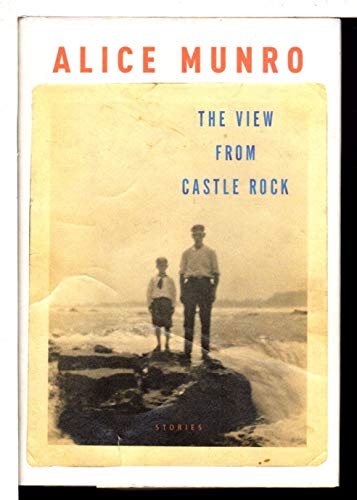
In stories that are more personal than any that she’s written before, Alice Munro pieces her family’s history into gloriously imagined fiction. A young boy is taken to Edinburgh’s Castle Rock, where his father assures him that on a clear day he can see America, and he catches a glimpse of his father’s dream. In stories that follow, as the dream becomes a reality, two sisters-in-law experience very different kinds of passion on the long voyage to the New World; a baby is lost and magically reappears on a journey from an Illinois homestead to the Canadian border.
Other stories take place in more familiar Munro territory, the towns and countryside around Lake Huron, where the past shows through the present like the traces of a glacier on the landscape and strong emotions stir just beneath the surface of ordinary comings and goings. First love flowers under the apple tree, while a stronger emotion presents itself in the barn. A girl hired as summer help, and uneasy about her “place” in the fancy resort world she’s come to, is transformed by her employer’s perceptive parting gift. A father whose early expectations of success at fox farming have been dashed finds strange comfort in a routine night job at an iron foundry. A clever girl escapes to college and marriage.
Evocative, gripping, sexy, unexpected—these stories reflect a depth and richness of experience. The View from Castle Rock is a brilliant achievement from one of the finest writers of our time.
Die Inhaltsangabe kann sich auf eine andere Ausgabe dieses Titels beziehen.
Über die Autorin bzw. den Autor
Alice Munro grew up in Wingham, Ontario, and attended the University of Western Ontario. She has published eleven new collections of stories—Dance of the Happy Shades; Something I’ve Been Meaning to Tell You; The Beggar Maid; The Moons of Jupiter; The Progress of Love; Friend of My Youth; Open Secrets; The Love of a Good Woman; Hateship, Friendship, Courtship, Loveship, Marriage; Runaway; and a volume of Selected Stories—as well as a novel, Lives of Girls and Women. During her distinguished career she has been the recipient of many awards and prizes, including three of Canada’s Governor General’s Literary Awards and two of its Giller Prizes, the Rea Award for the Short Story, the Lannan Literary Award, England’s W. H. Smith Book Award, the United States’ National Book Critics Circle Award, and the Edward MacDowell Medal in literature. Her stories have appeared in The New Yorker, The Atlantic Monthly, The Paris Review, and other publications, and her collections have been translated into thirteen languages.
Auszug. © Genehmigter Nachdruck. Alle Rechte vorbehalten.
No Advantages
This parish possesses no advantages. Upon the hills the soil is in many places mossy and fit for nothing. The air in general is moist. This is occasioned by the height of the hills which continually attract the clouds and the vapour that is continually exhaled from the mossy ground . . . The nearest market town is fifteen miles away and the roads so deep as to be almost impassable. The snow also at times is a great inconvenience, often for many months we can have no intercourse with mankind. And a great disadvantage is the want of bridges so that the traveller is obstructed when the waters are swelled . . . Barley oats and potatoes are the only crops raised. Wheat rye turnips and cabbage are never attempted . . .
There are ten proprietors of land in this parish: none of them resides in it.
Contribution by the Minister of Ettrick Parish, in the county of Selkirk, to the Statistical Account of Scotland, 1799
The Ettrick Valley lies about fifty miles due south of Edinburgh, and thirty or so miles north of the English border, which runs close to the wall Hadrian built to keep out the wild people from the north. The Romans pushed farther, and built some sort of fortifications called Antonine's Wall between the Firth of Clyde and the Firth of Forth, but those did not last long. The land between the two walls has been occupied for a long time by a mix of people—Celtic people, some of whom came from Ireland and were actually called Scots, Anglo-Saxons from the south, Norse from across the North Sea, and possibly some leftover Picts as well.
The high stony farm where my family lived for some time in the Ettrick Valley was called Far-Hope. The word hope, as used in the local geography, is an old word, a Norse word--Norse, Anglo-Saxon, and Gaelic words being all mixed up together in that part of the country, as you would expect, with some old Brythonic thrown in to indicate an early Welsh presence. Hope means a bay, not a bay filled with water but with land, partly enclosed by hills, which in this case are the high bare hills, the near mountains of the Southern Uplands. The Black Knowe, Bodesbeck Law, Ettrick Pen—there you have the three big hills, with the word hill in three languages. Some of these hills are now being reforested, with plantations of Sitka spruce, but in the seventeenth and eighteenth centuries they would have been bare, or mostly bare—the great Forest of Ettrick, the hunting grounds of the Kings of Scotland, having been cut down and turned into pasture or waste heath a century or two before.
The height of land above Far-Hope, which stands right at the end of the valley, is the spine of Scotland, marking the division of the waters that flow to the west into the Solway Firth and the Atlantic Ocean, from those that flow east into the North Sea. Within ten miles to the north is the country's most famous waterfall, the Grey Mare's Tail. Five miles from Moffat, which would be the market town to those living at the valley head, is the Devil's Beef Tub, a great cleft in the hills believed to be the hiding place for stolen cattle—English cattle, that is, taken by the reivers in the lawless sixteenth century. In the lower Ettrick Valley was Aikwood, the home of Michael Scott, the philosopher and wizard of the twelfth and thirteenth centuries, who appears in Dante's Inferno. And if that were not enough, William Wallace, the guerrilla hero of the Scots, is said to have hidden out here from the English, and there is a story of Merlin—Merlin—being hunted down and murdered, in the old forest, by Ettrick shepherds.
(As far as I know, my ancestors, generation after generation, were Ettrick shepherds. It may sound odd to have shepherds employed in a forest, but it seems that hunting forests were in many places open glades.)
Nevertheless the valley disappointed me the first time I saw it. Places are apt to do that when you've set them up in your imagination. The time of year was very early spring, and the hills were brown, or a kind of lilac brown, reminding me of the hills around Calgary. Ettrick Water was running fast and clear, but it was hardly as wide as the Maitland River, which flows past the farm where I grew up, in Ontario. The circles of stones which I had at first taken to be interesting remnants of Celtic worship were too numerous and well kept up to be anything but handy sheep pens.
I was travelling by myself, and I had come from Selkirk on the twice-a-week Shoppers' Bus, which took me no farther than Ettrick Bridge. There I wandered around, waiting for the postman. I'd been told that he would take me up the valley. The chief thing to be seen in Ettrick Bridge was a sign on a closed shop, advertising Silk Cut. I couldn't figure out what that might be. It turned out to be a well-known brand of cigarette.
After a while the postman came along and I rode with him to Ettrick Church. By that time it had begun to rain, hard. The church was locked. It disappointed me, too. Having been built in 1824, it did not compare, in historic appearance, or grim character, to the churches I had already seen in Scotland. I felt conspicuous, out of place, and cold. I huddled by the wall till the rain let up for a bit, and then I explored the churchyard, with the long wet grass soaking my legs.
There I found, first, the gravestone of William Laidlaw, my direct ancestor, born at the end of the seventeenth century, and known as Will O'Phaup. This was a man who took on, at least locally, something of the radiance of myth, and he managed that at the very last time in history—that is, in the history of the people of the British Isles—when a man could do so. The same stone bears the names of his daughter Margaret Laidlaw Hogg, who upbraided Sir Walter Scott, and of Robert Hogg, her husband, the tenant of Ettrickhall. Then right next to it I saw the stone of the writer James Hogg, who was their son and Will O'Phaup's grandson. He was known as The Ettrick Shepherd. And not far from that was the stone of the Reverend Thomas Boston, at one time famous throughout Scotland for his books and preaching, though fame never took him to any more important ministry.
Also, among various Laidlaws, a stone bearing the name of Robert Laidlaw, who died at Hopehouse January 29th 1800 aged seventy-two years. Son of Will, brother of Margaret, uncle of James, who probably never knew that he would be remembered by his link to these others, any more than he would know the date of his own death.
My great-great-great-great-grandfather.
As I was reading these inscriptions the rain came on again, lightly, and I thought I had better start to walk back to Tushielaw, where I was to catch the school bus for my return ride to Selkirk. I couldn't loiter, because the bus might be early, and the rain might get heavier.
I was struck with a feeling familiar, I suppose, to many people whose long history goes back to a country far away from the place where they grew up. I was a naive North American, in spite of my stored knowledge. Past and present lumped together here made a reality that was commonplace and yet disturbing beyond anything I had imagined.
MEN OF ETTRICK
Will O'Phaup
Here lyeth William Laidlaw, the far-famed Will o' Phaup, who for feats of frolic, agility and strength, had no equal in his day . . .
Epitaph composed by his grandson, James Hogg, on Will O'Phaup's tombstone in Ettrick Kirkyard.
His name was William Laidlaw, but his story-name was Will O'Phaup, Phaup being simply the local version of Far-Hope, the...
„Über diesen Titel“ kann sich auf eine andere Ausgabe dieses Titels beziehen.
Suchergebnisse für The View from Castle Rock: Stories

Beispielbild für diese ISBN
The View from Castle Rock: Stories
Anbieter: World of Books (was SecondSale), Montgomery, IL, USA
Verkäuferbewertung 5 von 5 Sternen

Zustand: Acceptable. Item in very good condition! Textbooks may not include supplemental items i.e. CDs, access codes etc. Bestandsnummer des Verkäufers 00074546681
Gebraucht kaufen
EUR 3,94
Versand gratis
Versand innerhalb von USA
Versand innerhalb von USA
Anzahl: 1 verfügbar
Beispielbild für diese ISBN
The View from Castle Rock: Stories
Anbieter: World of Books (was SecondSale), Montgomery, IL, USA
Verkäuferbewertung 5 von 5 Sternen
Zustand: Good. Item in good condition. Textbooks may not include supplemental items i.e. CDs, access codes etc. Bestandsnummer des Verkäufers 00071325279
Gebraucht kaufen
EUR 3,94
Versand gratis
Versand innerhalb von USA
Versand innerhalb von USA
Anzahl: 13 verfügbar
Beispielbild für diese ISBN
The View from Castle Rock: Stories
Anbieter: Orion Tech, Kingwood, TX, USA
Verkäuferbewertung 5 von 5 Sternen
Hardcover. Zustand: Good. Bestandsnummer des Verkäufers 1400042828-3-21302484
Gebraucht kaufen
EUR 3,94
Versand gratis
Versand innerhalb von USA
Versand innerhalb von USA
Anzahl: 1 verfügbar
Foto des Verkäufers
The View from Castle Rock: Stories
Anbieter: 3Brothers Bookstore, Egg harbor township, NJ, USA
Verkäuferbewertung 5 von 5 Sternen
Zustand: very_good. Cover may have light wear, pages in very good condition and binding is sturdy; may have other light shelf wear or creases. May have notes or highlighting. Bestandsnummer des Verkäufers EVV.1400042828.VG
Gebraucht kaufen
EUR 3,98
Versand gratis
Versand innerhalb von USA
Versand innerhalb von USA
Anzahl: 1 verfügbar
Beispielbild für diese ISBN
The View from Castle Rock: Stories
Anbieter: More Than Words, Waltham, MA, USA
Verkäuferbewertung 5 von 5 Sternen
Zustand: Good. A sound copy with only light wear. Overall a solid copy at a great price! Bestandsnummer des Verkäufers BOS-C-08g-01938
Gebraucht kaufen
EUR 1,12
EUR 3,44 Versand
Versand innerhalb von USA
Versand innerhalb von USA
Anzahl: 7 verfügbar
Beispielbild für diese ISBN
The View from Castle Rock: Stories
Anbieter: More Than Words, Waltham, MA, USA
Verkäuferbewertung 5 von 5 Sternen
Zustand: Very Good. A bright, square, and overall a nice copy. Bestandsnummer des Verkäufers BOS-X-14g-01331
Gebraucht kaufen
EUR 1,12
EUR 3,44 Versand
Versand innerhalb von USA
Versand innerhalb von USA
Anzahl: 3 verfügbar
Beispielbild für diese ISBN
The View from Castle Rock: Stories
Anbieter: Bookmonger.Ltd, HILLSIDE, NJ, USA
Verkäuferbewertung 5 von 5 Sternen
hardcover. Zustand: Good. Marks on edge * Ex-library book* Crease on cover and a few pages*. Bestandsnummer des Verkäufers mon0000700639
Gebraucht kaufen
EUR 1,34
EUR 3,45 Versand
Versand innerhalb von USA
Versand innerhalb von USA
Anzahl: 1 verfügbar
Foto des Verkäufers
The View from Castle Rock: Stories
Anbieter: Off The Shelf, Antonia, MO, USA
Verkäuferbewertung 5 von 5 Sternen
Zustand: good. The item shows wear from consistent use, but it remains in good condition and works perfectly. All pages and cover are intact including the dust cover, if applicable . Spine may show signs of wear. Pages may include limited notes and highlighting. May NOT include discs, access code or other supplemental materials. Bestandsnummer des Verkäufers 4WILKM00M3VL
Gebraucht kaufen
EUR 1,34
EUR 4,31 Versand
Versand innerhalb von USA
Versand innerhalb von USA
Anzahl: 1 verfügbar
Beispielbild für diese ISBN
The View from Castle Rock: Stories
Anbieter: BooksRun, Philadelphia, PA, USA
Verkäuferbewertung 5 von 5 Sternen
Hardcover. Zustand: Very Good. With dust jacket. It's a well-cared-for item that has seen limited use. The item may show minor signs of wear. All the text is legible, with all pages included. It may have slight markings and/or highlighting. Bestandsnummer des Verkäufers 1400042828-11-1-29
Gebraucht kaufen
EUR 5,69
Versand gratis
Versand innerhalb von USA
Versand innerhalb von USA
Anzahl: 1 verfügbar
Beispielbild für diese ISBN
The View from Castle Rock: Stories
Anbieter: World of Books Inc, Montgomery, IL, USA
Verkäuferbewertung 2 von 5 Sternen

Hardback. Zustand: Good. WINER OF THE NOBEL PRIZE(R) IN LITERATURE 2013 Alice Munro mines her rich family background, melding it with her own experiences and the transforming power of her brilliant imagination, to create perhaps her most powerful and personal collection yet. A young boy, taken to Edinburgh's Castle Rock to look across the sea to America, catches a glimpse of his father's dream. Scottish immigrants experience love and loss on a journey that leads them to rural Ontario. Wives, mothers, fathers, and children move through uncertainty, ambivalence, and contemplation in these stories of hopes, adversity, and wonder. The View from Castle Rock reveals what is most essential in Munro's art: her compassionate understanding of ordinary lives. Bestandsnummer des Verkäufers CIN1400042828G
Gebraucht kaufen
EUR 5,71
Versand gratis
Versand innerhalb von USA
Versand innerhalb von USA
Anzahl: 13 verfügbar