
Verwandte Artikel zu Essentials of Inventory Management
Inhaltsangabe
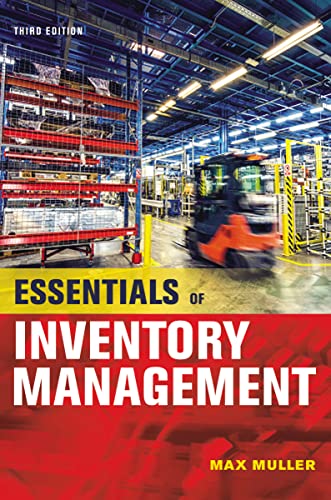
The invaluable resource?is the answer book that practitioners and students rely on. It breaks down the job into easy concepts and concrete steps.
The bar is set high for inventory control professionals—and well-ordered stock rooms and records are just the beginning. Beyond core tasks such as locating items, you’ve got to project future business needs, hold down costs, and fix supply chain problems. You need strategic and financial knowledge, and the skills to manage many moving parts.
With examples, charts, review questions, formulas, and clear explanations, Essentials of Inventory Management will help you:
- Track inventory costs
- Read balance sheets
- Calculate gross profit
- Set up a locator system
- Weigh pros and cons of bar codes and RFID
- Factor in replenishment costs
- Decide when to get rid of dead stock
- Pinpoint system dysfunctions
- Mitigate risks in the supply chain
Maintaining physical spaces and databases are only part of your responsibilities. From forecasting to troubleshooting to the fundamentals of finance, Essentials of Inventory Management gives you the tools to optimize efficiency—and drive profits.
Die Inhaltsangabe kann sich auf eine andere Ausgabe dieses Titels beziehen.
Über die Autorin bzw. den Autor
Max Muller (Overland Park, KS) has served as CEO or COO for numerous companies. An attorney and authorized OSHA trainer, his seminars have drawn more than 100,000 attendees.
Auszug. © Genehmigter Nachdruck. Alle Rechte vorbehalten.
Essentials of Inventory Management
By Max MullerHarperCollins Publishers
Copyright © 2019 Max Muller
All rights reserved.
ISBN: 978-1-4002-1237-8All rights reserved.
Contents
Introduction to the Third Edition, xiii,
Chapter 1 Inventory as Both a Tangible and an Intangible Object, 1,
Chapter 2 Inventory as Money, 17,
Chapter 3 Physical Location and Control of Inventory, 49,
Chapter 4 Automatic Identification, 109,
Chapter 5 Planning and Replenishment Concepts, 143,
Chapter 6 Why Inventory Systems Fail and How to Fix Them, 175,
Chapter 7 Core Purchasing Inventory Considerations, 231,
Chapter 8 Basics of Supply Chain Risk Management, 277,
Chapter 9 Handling Inventory Safely, 305,
Bibliography, 353,
Index, 357,
CHAPTER 1
INVENTORY AS BOTH A TANGIBLE AND AN INTANGIBLE OBJECT
The objective of this chapter is to provide you with a basic understanding of the nature of inventory as both a tangible, physical item actually kept within the facility ("real life" or "shelf count") and as an intangible item existing within the company's records ("paper life" or "record count"). Since you frequently make purchasing, sales, customer service, production planning, and other decisions based on whether an item is shown as being in-house as per your records, an item's paper life can be just as important as its real life.
Inventory — Who Needs It?
All organizations keep inventory. "Inventory" includes a company's raw materials, work-in-process, supplies used in operations, and finished goods.
Inventory can be as simple as a bottle of glass cleaner used as part of a building's custodial program or as complex as a mix of raw materials and subassemblies used as part of a manufacturing process.
INVENTORY COSTS
Inventory brings with it a number of costs, including:
* Dollars
* Space
* Labor to receive, check quality, put away, retrieve, select, pack, ship, and account for the item(s)
* Deterioration, damage, and obsolescence
* Theft
Inventory costs generally fall into ordering costs and holding costs. Ordering, or acquisition, costs come about regardless of the actual value of the goods. These costs include the salaries of those purchasing the product, costs of expediting the inventory, and so on. For a complete discussion of ordering costs, see Chapter 5, "Planning and Replenishment Concepts." For a complete discussion of carrying costs, see Chapter 2, "Inventory as Money."
As discussed in Chapter 2, holding costs include the cost of capital tied up in inventory (the opportunity cost of money1); storage costs such as rent; and costs of handling the product such as equipment, warehouse and stock-keeping staff, stock losses/ wastage, taxes, and so on.
As discussed in Chapter 5, acquisition/ordering costs come about regardless of the actual value of the goods. These costs include the salaries of those purchasing the product, costs of expediting the inventory, and so on.
THE PURPOSE OF INVENTORY
So why do you need inventory? In a just-in-time manufacturing environment, inventory is considered waste. However, in environments where an organization suffers from poor cash flow or lacks strong control over (1) electronic information transfer among all departments and all significant suppliers, (2) lead times, and (3) quality of materials received, inventory plays important roles. Some of the more important reasons for obtaining and holding inventory are:
* Predictability: To engage in capacity planning and production scheduling, you need to control how much raw material and how many parts and subassemblies you process at a given time. Inventory buffers what you need from what you process.
* Fluctuations in demand: A supply of inventory on hand is protection. You don't always know how much you are likely to need at any given time, but you still need to satisfy customer or production demand on time. If you can see how customers are acting in the supply chain, surprises in fluctuations in demand are held to a minimum.
* Unreliability of supply: Inventory protects you from unreliable suppliers or when an item is scarce and a steady supply is difficult to ensure. Whenever possible, unreliable suppliers should be rehabilitated through discussions or replaced. Rehabilitation can be accomplished through master purchase orders with timed product releases, price or term penalties for nonperformance, better verbal and electronic communications between the parties, and so on. This will lower your on-hand inventory needs.
* Price protection: Buying quantities of inventory at appropriate times helps avoid the impact of cost inflation. Note that contracting to assure a price does not require actually taking delivery at the time of purchase. Many suppliers prefer to deliver periodically rather than to ship an Inventory as Both a Tangible and an Intangible Object 3 entire year's supply of a particular stock keeping unit (SKU) at one time. (Note: The acronym "SKU" is a common term in the inventory world. It generally stands for a specific numeric or alpha-numeric identifier for a specific item.)
* Quantity discounts: Often bulk discounts are available if you buy in large rather than in small quantities.
* Lower ordering costs: If you buy a larger quantity of an item less frequently, the ordering costs are less than buying smaller quantities over and over again. (The costs of holding the item for a longer period of time, however, will be greater.) See Chapter 5, "Planning and Replenishment Concepts." To hold down ordering costs and to lock in favorable pricing, many organizations issue blanket purchase orders coupled with periodic release and receiving dates of the SKUs.
TYPES OF STOCK
Inventory is basically divided into raw materials, finished goods, and work-in-process. Remember:
* Raw materials: Used to produce partial products or completed goods.
* Finished product: This is product ready for current customer sales. It can also be used to buffer manufacturing from predictable or unpredictable market demand. In other words, a manufacturing company can make up a supply of toys during the year for predictably higher sales during the holiday season.
* Work-in-process (WIP): Items are considered to be WIP during the time raw material is being converted into partial product, subassemblies, and finished product. WIP should be kept to a minimum. WIP occurs because of such things as work delays, long movement times between operations, and queuing bottlenecks.
Other categories of inventory should be considered from a functional standpoint:
* Consumables: Light bulbs, hand towels, computer and photocopying paper, brochures, tape, envelopes, cleaning materials, lubricants, fertilizer, paint, dunnage (packing materials), and so on are used in many operations. These are often treated like raw materials.
* Service, repair, replacement, and spare items (S&R items): These are after-market items used to "keep things going." As long as a machine or device of some type is being used (in the market) and will need service and repair in the future, it will never be obsolete. S&R items should not be treated like finished goods for purposes of forecasting the quantity level of your normal stock.
* Quantity levels of S&R items will be based on such considerations as preventive maintenance schedules, predicted failure rates, and dates of various...
„Über diesen Titel“ kann sich auf eine andere Ausgabe dieses Titels beziehen.
Suchergebnisse für Essentials of Inventory Management

Beispielbild für diese ISBN
Essentials of Inventory Management
Verlag:
HarperCollins Leadership (edition 3), 2019
ISBN 10: 1400212375
ISBN 13: 9781400212378
Gebraucht
Hardcover
Anbieter: BooksRun, Philadelphia, PA, USA
Verkäuferbewertung 5 von 5 Sternen

Hardcover. Zustand: Very Good. 3. With dust jacket. It's a well-cared-for item that has seen limited use. The item may show minor signs of wear. All the text is legible, with all pages included. It may have slight markings and/or highlighting. Bestandsnummer des Verkäufers 1400212375-11-1-29
Gebraucht kaufen
EUR 35,23
Versand gratis
Versand innerhalb von USA
Versand innerhalb von USA
Anzahl: 1 verfügbar
Foto des Verkäufers
Essentials of Inventory Management
Verlag:
HarperCollins Leadership, 2019
ISBN 10: 1400212375
ISBN 13: 9781400212378
Gebraucht
Hardcover
Anbieter: Rust Belt Books, Buffalo, NY, USA
Verkäuferbewertung 5 von 5 Sternen
Hardcover. Zustand: Fine. 3rd Edition. Fine condition. Bestandsnummer des Verkäufers ABE-1763918986155
Gebraucht kaufen
EUR 32,20
EUR 5,36 Versand
Versand innerhalb von USA
Versand innerhalb von USA
Anzahl: 1 verfügbar
Beispielbild für diese ISBN
Essentials of Inventory Management
Anbieter: World of Books (was SecondSale), Montgomery, IL, USA
Verkäuferbewertung 5 von 5 Sternen
Hardback. Zustand: Very Good. The bar is set high for inventory control professionals---and well-ordered stock rooms and records are just the beginning. Bestandsnummer des Verkäufers 00109117522
Gebraucht kaufen
EUR 38,51
Versand gratis
Versand innerhalb von USA
Versand innerhalb von USA
Anzahl: 1 verfügbar
Beispielbild für diese ISBN
Essentials of Inventory Management
Anbieter: World of Books Inc, Montgomery, IL, USA
Verkäuferbewertung 4 von 5 Sternen

Hardback. Zustand: Very Good. The bar is set high for inventory control professionals---and well-ordered stock rooms and records are just the beginning. Bestandsnummer des Verkäufers CIN1400212375VG
Gebraucht kaufen
EUR 40,43
Versand gratis
Versand innerhalb von USA
Versand innerhalb von USA
Anzahl: 1 verfügbar
Beispielbild für diese ISBN
Essentials of Inventory Management
Verlag:
HarperCollins Leadership, 2019
ISBN 10: 1400212375
ISBN 13: 9781400212378
Gebraucht
Hardcover
Anbieter: Once Upon A Time Books, Siloam Springs, AR, USA
Verkäuferbewertung 4 von 5 Sternen
hardcover. Zustand: Acceptable. This is a used book. It may contain highlighting/underlining and/or the book may show heavier signs of wear . It may also be ex-library or without dustjacket. This is a used book. It may contain highlighting/underlining and/or the book may show heavier signs of wear . It may also be ex-library or without dustjacket. Bestandsnummer des Verkäufers mon0003560709
Gebraucht kaufen
EUR 48,15
EUR 3,53 Versand
Versand innerhalb von USA
Versand innerhalb von USA
Anzahl: 1 verfügbar
Beispielbild für diese ISBN
Essentials of Inventory Management
Verlag:
HarperCollins Leadership, 2019
ISBN 10: 1400212375
ISBN 13: 9781400212378
Gebraucht
Hardcover
Anbieter: YESIBOOKSTORE, MIAMI, FL, USA
Verkäuferbewertung 5 von 5 Sternen
hardcover. Zustand: As New. Bestandsnummer des Verkäufers 1400212375-VB
Gebraucht kaufen
EUR 129,11
Versand gratis
Versand innerhalb von USA
Versand innerhalb von USA
Anzahl: 1 verfügbar
Beispielbild für diese ISBN
Essentials of Inventory Management Max Muller
Verlag:
HarperCollins Leadership, 2019
ISBN 10: 1400212375
ISBN 13: 9781400212378
Gebraucht
Hardcover
Anbieter: BUCHSERVICE / ANTIQUARIAT Lars Lutzer, Wahlstedt, Deutschland
Verkäuferbewertung 5 von 5 Sternen
Zustand: gut. Essentials of Inventory Management In englischer Sprache. pages. Bestandsnummer des Verkäufers BN279507
Gebraucht kaufen
EUR 179,99
EUR 39,95 Versand
Versand von Deutschland nach USA
Versand von Deutschland nach USA
Anzahl: 1 verfügbar