
Verwandte Artikel zu The Last Lecture Rough Cut
Inhaltsangabe
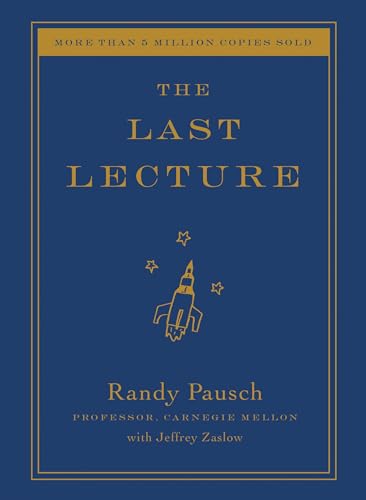
After being diagnosed with terminal cancer, a professor shares the lessons he's learned about living in the present, building a legacy, and taking full advantage of the time you have in this life-changing classic.
"We cannot change the cards we are dealt, just how we play the hand." ―Randy Pausch
A lot of professors give talks titled "The Last Lecture." Professors are asked to consider their demise and to ruminate on what matters most to them. And while they speak, audiences can't help but mull over the same question: What wisdom would we impart to the world if we knew it was our last chance? If we had to vanish tomorrow, what would we want as our legacy?
When Randy Pausch, a computer science professor at Carnegie Mellon, was asked to give such a lecture, he didn't have to imagine it as his last, since he had recently been diagnosed with terminal cancer. But the lecture he gave―"Really Achieving Your Childhood Dreams"―wasn't about dying. It was about the importance of overcoming obstacles, of enabling the dreams of others, of seizing every moment (because "time is all you have ... and you may find one day that you have less than you think"). It was a summation of everything Randy had come to believe. It was about living.
In this book, Randy Pausch has combined the humor, inspiration and intelligence that made his lecture such a phenomenon and given it an indelible form. It is a book that will be shared for generations to come.
Die Inhaltsangabe kann sich auf eine andere Ausgabe dieses Titels beziehen.
Über die Autorin bzw. den Autor
Randy Pausch was a Professor of Computer Science, Human-Computer Interaction, and Design at Carnegie Mellon, where he was the co-founder of Carnegie Mellon's Entertainment Technology Center (ETC). He was a National Science Foundation Presidential Young Investigator and a Lilly Foundation Teaching Fellow. He had sabbaticals at Walt Disney Imagineering and Electronic Arts (EA), and consulted with Google on user interface design. Dr. Pausch received his bachelors in Computer Science from Brown University and his Ph.D. in Computer Science from Carnegie Mellon University. He was the director of the Alice (www.alice.org) software project, and had traveled in zero-gravity. He lived with his wife, Jai, and their three young children in Virginia.
Jeff Zaslow wrote the Wall Street Journal column that fueled the initial interest in Randy Pausch's lecture. He was also the co-author of Captain Chesley Sullenberger's The Highest Duty and the author of The Girls from Ames, both bestsellers.
Von der hinteren Coverseite
After being diagnosed with terminal cancer, a professor shares the lessons he's learned—about living in the present, building a legacy, and taking full advantage of the time you have—in this life-changing classic.
"We cannot change the cards we are dealt, just how we play the hand." —Randy Pausch
A lot of professors give talks titled "The Last Lecture." Professors are asked to consider their demise and to ruminate on what matters most to them. And while they speak, audiences can't help but mull over the same question: What wisdom would we impart to the world if we knew it was our last chance? If we had to vanish tomorrow, what would we want as our legacy?
When Randy Pausch, a computer science professor at Carnegie Mellon, was asked to give such a lecture, he didn't have to imagine it as his last, since he had recently been diagnosed with terminal cancer. But the lecture he gave—"Really Achieving Your Childhood Dreams"—wasn't about dying. It was about the importance of overcoming obstacles, of enabling the dreams of others, of seizing every moment (because "time is all you have . . . and you may find one day that you have less than you think"). It was a summation of everything Randy had come to believe. It was about living.
In this book, Randy Pausch has combined the humor, inspiration and intelligence that made his lecture such a phenomenon and given it an indelible form. It is a book that will be shared for generations to come.
Auszug. © Genehmigter Nachdruck. Alle Rechte vorbehalten.
The Last Lecture
By Randy PauschHyperion
Copyright © 2008 Randy PauschAll right reserved.
ISBN: 978-1-4013-2325-7
Chapter One
An Injured Lion Still Wants to Roar
A LOT OF professors give talks titled "The Last Lecture." Maybe you've seen one.
It has become a common exercise on college campuses. Professors are asked to consider their demise and to ruminate on what matters most to them. And while they speak, audiences can't help but mull the same question: What wisdom would we impart to the world if we knew it was our last chance? If we had to vanish tomorrow, what would we want as our legacy?
For years, Carnegie Mellon had a "Last Lecture Series." But by the time organizers got around to asking me to do it, they'd renamed their series "Journeys," asking selected professors "to offer reflections on their personal and professional journeys." It wasn't the most exciting description, but I agreed to go with it. I was given the September slot.
At the time, I already had been diagnosed with pancreatic cancer, but I was optimistic. Maybe I'd be among the lucky ones who'd survive.
While I went through treatment, those running the lecture series kept sending me emails. "What will you be talking about?" they asked. "Please provide an abstract." There's a formality in academia that can't be ignored, even if a man is busy with other things, like trying not to die. By mid-August, I was told that a poster for the lecture had to be printed, so I'd have to decide on a topic.
That very week, however, I got the news: My most recent treatment hadn't worked. I had just months to live.
I knew I could cancel the lecture. Everyone would understand. Suddenly, there were so many other things to be done. I had to deal with my own grief and the sadness of those who loved me. I had to throw myself into getting my family's affairs in order. And yet, despite everything, I couldn't shake the idea of giving the talk. I was energized by the idea of delivering a last lecture that really was a last lecture. What could I say? How would it be received? Could I even get through it?
"They'll let me back out," I told my wife, Jai, "but I really want to do it."
Jai (pronounced "Jay") had always been my cheerleader. When I was enthusiastic, so was she. But she was leery of this whole last-lecture idea. We had just moved from Pittsburgh to Southeastern Virginia so that after my death, Jai and the kids could be near her family. Jai felt that I ought to be spending my precious time with our kids, or unpacking our new house, rather than devoting my hours to writing the lecture and then traveling back to Pittsburgh to deliver it.
"Call me selfish," Jai told me. "But I want all of you. Any time you'll spend working on this lecture is lost time, because it's time away from the kids and from me."
I understood where she was coming from. From the time I'd gotten sick, I had made a pledge to myself to defer to Jai and honor her wishes. I saw it as my mission to do all I could to lessen the burdens in her life brought on by my illness. That's why I spent many of my waking hours making arrangements for my family's future without me. Still, I couldn't let go of my urge to give this last lecture.
Throughout my academic career, I'd given some pretty good talks. But being considered the best speaker in a computer science department is like being known as the tallest of the Seven Dwarfs. And right then, I had the feeling that I had more in me, that if I gave it my all, I might be able to offer people something special. "Wisdom" is a strong word, but maybe that was it.
Jai still wasn't happy about it. We eventually took the issue to Michele Reiss, the psychotherapist we'd begun seeing a few months earlier. She specializes in helping families when one member is confronting a terminal illness.
"I know Randy," Jai told Dr. Reiss. "He's a workaholic. I know just what he'll be like when he starts putting the lecture together. It'll be all-consuming." The lecture, she argued, would be an unnecessary diversion from the overwhelming issues we were grappling with in our lives.
Another matter upsetting Jai: To give the talk as scheduled, I would have to fly to Pittsburgh the day before, which was Jai's forty-first birthday. "This is my last birthday we'll celebrate together," she told me. "You're actually going to leave me on my birthday?"
Certainly, the thought of leaving Jai that day was painful to me. And yet, I couldn't let go of the idea of the lecture. I had come to see it as the last moment of my career, as a way to say goodbye to my "work family." I also found myself fantasizing about giving a last lecture that would be the oratorical equivalent of a retiring baseball slugger driving one last ball into the upper deck. I had always liked the final scene in The Natural, when the aging, bleeding ballplayer Roy Hobbs miraculously hits that towering home run.
Dr. Reiss listened to Jai and to me. In Jai, she said, she saw a strong, loving woman who had intended to spend decades building a full life with a husband, raising children to adulthood. Now our lives together had to be squeezed into a few months. In me, Dr. Reiss saw a man not yet ready to fully retreat to his home life, and certainly not yet ready to climb into his deathbed. "This lecture will be the last time many people I care about will see me in the flesh," I told her flatly. "I have a chance here to really think about what matters most to me, to cement how people will remember me, and to do whatever good I can on the way out."
More than once, Dr. Reiss had watched Jai and me sit together on her office couch, holding tightly to each other, both of us in tears. She told us she could see the great respect between us, and she was often viscerally moved by our commitment to getting our final time together right. But she said it wasn't her role to weigh in on whether or not I gave the lecture. "You'll have to decide that on your own," she said, and encouraged us to really listen to each other, so we could make the right decision for both of us.
Given Jai's reticence, I knew I had to look honestly at my motivations. Why was this talk so important to me? Was it a way to remind me and everyone else that I was still very much alive? To prove I still had the fortitude to perform? Was it a limelight-lover's urge to show off one last time? The answer was yes on all fronts. "An injured lion wants to know if he can still roar," I told Jai. "It's about dignity and self-esteem, which isn't quite the same as vanity."
There was something else at work here, too. I had started to view the talk as a vehicle for me to ride into the future I would never see.
I reminded Jai of the kids' ages: five, two and one. "Look," I said. "At five, I suppose that Dylan will grow up to have a few memories of me. But how much will he really remember? What do you and I even remember from when we were five? Will Dylan remember how I played with him, or what he and I laughed about? It may be hazy at best.
"And how about Logan and Chloe? They may have no memories at all. Nothing. Especially Chloe. And I can tell you this: When the kids are older, they're going to go through this phase where they absolutely, achingly need to know: 'Who was my dad? What was he like?' This lecture could help give them an answer to that." I told Jai I'd make sure Carnegie Mellon would record the lecture. "I'll get you a DVD. When the kids are older, you can show it to them. It'll help them...
„Über diesen Titel“ kann sich auf eine andere Ausgabe dieses Titels beziehen.
Suchergebnisse für The Last Lecture Rough Cut

Beispielbild für diese ISBN
The Last Lecture
Anbieter: World of Books (was SecondSale), Montgomery, IL, USA
Verkäuferbewertung 5 von 5 Sternen

Hardback. Zustand: Fair. After being diagnosed with terminal cancer, a professor shares the lessons he's learned about living in the present, building a legacy, and taking full advantage of the time you have in this life-changing classic. "We cannot change the cards we are dealt, just how we play the hand." --Randy Pausch A lot of professors give talks titled "The Last Lecture." Professors are asked to consider their demise and to ruminate on what matters most to them. And while they speak, audiences can't help but mull over the same question: What wisdom would we impart to the world if we knew it was our last chance? If we had to vanish tomorrow, what would we want as our legacy? When Randy Pausch, a computer science professor at Carnegie Mellon, was asked to give such a lecture, he didn't have to imagine it as his last, since he had recently been diagnosed with terminal cancer. But the lecture he gave--"Really Achieving Your Childhood Dreams"--wasn't about dying. It was about the importance of overcoming obstacles, of enabling the dreams of others, of seizing every moment (because "time is all you have . and you may find one day that you have less than you think"). It was a summation of everything Randy had come to believe. It was about living. In this book, Randy Pausch has combined the humor, inspiration and intelligence that made his lecture such a phenomenon and given it an indelible form. It is a book that will be shared for generations to come. Bestandsnummer des Verkäufers 00098687330
Gebraucht kaufen
EUR 3,67
Versand gratis
Versand innerhalb von USA
Versand innerhalb von USA
Anzahl: Mehr als 20 verfügbar
Beispielbild für diese ISBN
The Last Lecture
Anbieter: World of Books (was SecondSale), Montgomery, IL, USA
Verkäuferbewertung 5 von 5 Sternen
Hardback. Zustand: Good. After being diagnosed with terminal cancer, a professor shares the lessons he's learned about living in the present, building a legacy, and taking full advantage of the time you have in this life-changing classic. "We cannot change the cards we are dealt, just how we play the hand." --Randy Pausch A lot of professors give talks titled "The Last Lecture." Professors are asked to consider their demise and to ruminate on what matters most to them. And while they speak, audiences can't help but mull over the same question: What wisdom would we impart to the world if we knew it was our last chance? If we had to vanish tomorrow, what would we want as our legacy? When Randy Pausch, a computer science professor at Carnegie Mellon, was asked to give such a lecture, he didn't have to imagine it as his last, since he had recently been diagnosed with terminal cancer. But the lecture he gave--"Really Achieving Your Childhood Dreams"--wasn't about dying. It was about the importance of overcoming obstacles, of enabling the dreams of others, of seizing every moment (because "time is all you have . and you may find one day that you have less than you think"). It was a summation of everything Randy had come to believe. It was about living. In this book, Randy Pausch has combined the humor, inspiration and intelligence that made his lecture such a phenomenon and given it an indelible form. It is a book that will be shared for generations to come. Bestandsnummer des Verkäufers 00087155585
Gebraucht kaufen
EUR 3,67
Versand gratis
Versand innerhalb von USA
Versand innerhalb von USA
Anzahl: Mehr als 20 verfügbar
Beispielbild für diese ISBN
The Last Lecture
Anbieter: Orion Tech, Kingwood, TX, USA
Verkäuferbewertung 5 von 5 Sternen
Hardcover. Zustand: Good. Bestandsnummer des Verkäufers 1401323251-3-22639460
Gebraucht kaufen
EUR 3,68
Versand gratis
Versand innerhalb von USA
Versand innerhalb von USA
Anzahl: 7 verfügbar
Beispielbild für diese ISBN
The Last Lecture
Anbieter: Gulf Coast Books, Cypress, TX, USA
Verkäuferbewertung 5 von 5 Sternen
Hardcover. Zustand: Good. Bestandsnummer des Verkäufers 1401323251-3-22021905
Gebraucht kaufen
EUR 3,68
Versand gratis
Versand innerhalb von USA
Versand innerhalb von USA
Anzahl: 10 verfügbar
Beispielbild für diese ISBN
The Last Lecture
Anbieter: Orion Tech, Kingwood, TX, USA
Verkäuferbewertung 5 von 5 Sternen
Hardcover. Zustand: Fair. Bestandsnummer des Verkäufers 1401323251-4-21611687
Gebraucht kaufen
EUR 3,68
Versand gratis
Versand innerhalb von USA
Versand innerhalb von USA
Anzahl: 15 verfügbar
Beispielbild für diese ISBN
The Last Lecture
Anbieter: Your Online Bookstore, Houston, TX, USA
Verkäuferbewertung 5 von 5 Sternen
Hardcover. Zustand: Good. Bestandsnummer des Verkäufers 1401323251-3-21677481
Gebraucht kaufen
EUR 3,68
Versand gratis
Versand innerhalb von USA
Versand innerhalb von USA
Anzahl: 4 verfügbar
Beispielbild für diese ISBN
The Last Lecture
Anbieter: Your Online Bookstore, Houston, TX, USA
Verkäuferbewertung 5 von 5 Sternen
Hardcover. Zustand: Fair. Bestandsnummer des Verkäufers 1401323251-4-21688818
Gebraucht kaufen
EUR 3,68
Versand gratis
Versand innerhalb von USA
Versand innerhalb von USA
Anzahl: 1 verfügbar
Beispielbild für diese ISBN
The Last Lecture
Anbieter: Gulf Coast Books, Cypress, TX, USA
Verkäuferbewertung 5 von 5 Sternen
Hardcover. Zustand: Fair. Bestandsnummer des Verkäufers 1401323251-4-22566005
Gebraucht kaufen
EUR 3,68
Versand gratis
Versand innerhalb von USA
Versand innerhalb von USA
Anzahl: 5 verfügbar
Foto des Verkäufers
The Last Lecture
Anbieter: Used Book Company, Egg Harbor Township, NJ, USA
Verkäuferbewertung 5 von 5 Sternen
Zustand: Very Good. Shows minimal signs of wear and previous use. Can include minimal notes/highlighting. A portion of your purchase benefits nonprofits! - Note: Edition & format may differ from what is shown in stock photo & item details. May not include supplementary material (toys, access code, dvds, etc). Bestandsnummer des Verkäufers 584UZG000E65_ns
Gebraucht kaufen
EUR 3,76
Versand gratis
Versand innerhalb von USA
Versand innerhalb von USA
Anzahl: 1 verfügbar
Foto des Verkäufers
The Last Lecture
Anbieter: 3Brothers Bookstore, Egg harbor township, NJ, USA
Verkäuferbewertung 5 von 5 Sternen
Zustand: good. Missing dust jacket. Books may contain some notes and highlighting. Supplements such as Access Codes, Cd's Dust Jackets, etc. are not guaranteed with used book purchases. Bestandsnummer des Verkäufers EVV.1401323251.G
Gebraucht kaufen
EUR 3,86
Versand gratis
Versand innerhalb von USA
Versand innerhalb von USA
Anzahl: 1 verfügbar