
Verwandte Artikel zu Global Risk Governance: Concept and Practice Using...
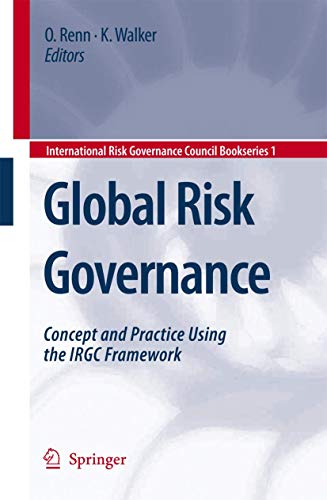
Global Risk Governance: Concept and Practice Using the IRGC Framework (International Risk Governance Council Bookseries, 1, Band 1) - Hardcover
Inhaltsangabe
Japanese government planners set out in the 1960s to build a barrage on the Nagara River, one of the last major free?owing rivers in Japan. Conceived during a period of rapid growth in the Japanese economy, the barrage was part of a national effort to ensure adequate water supplies for future economic development as well as to reduce ?oodingrisks to downstream communities. A string of lawsuits brought by groups concerned about the impact of the dam on ecological and ?sheries - sourcesresulted incostlydelays:thedamwasnotcompletedformorethan25years. The 1990s witnessed the start of a kind of biotech gold rush toward the use of genetic modi?cation (GM) as tool to develop more productive crops through the introduction of herbicide, insect and disease resistance to feed a growing world. Opponents of the rapid deployment of GM crops have raised concerns about the safety of the technology and about its socio-economic, cultural, and ethical implications. The debate over this issue divided the world – for example, the US allowed the development of GM crops to move forward and now accounts for over half the GM crops grown worldwide whereas the European Union only recently lifted a de facto moratorium imposed in 1998 and now authorises products on a case by case basis. Worldwide, the development and use of GM crops is still barely covered by a patchwork of regulations and guidelines, ranging from strict prohibition to none at all, and creating its own sets of disparities and risks.
Die Inhaltsangabe kann sich auf eine andere Ausgabe dieses Titels beziehen.
Von der hinteren Coverseite
Global risks, global opportunities, global risk governance challenges.
Global risks are not confined to national borders; they cannot be managed through the actions of a single sector. The governance of global, systemic risks requires an integrative approach involving governments, intergovernmental organizations, industry, academia and civil society.
Risk accompanies change. It is a permanent and important part of life and the willingness and capacity to take and accept risk is crucial for achieving economic development and introducing new technologies. Many risks, and in particular those arising from emerging technologies, are accompanied by potential benefits and opportunities. The challenge of better risk governance lies here: to enable societies to benefit from change while minimizing the negative consequences of the associated risks.
The International Risk Governance Council (IRGC) is an independent organisation whose purpose is to help the understanding and management of emerging global risks that have impacts on human health and safety, the environment, the economy and society at large. IRGC’s work includes developing concepts of risk governance, anticipating major risk issues and providing risk governance policy recommendations for key decision makers. IRGC believes that improvements in risk governance are essential if optimal risk-related decisions are to be made and to maximise trust in the processes and structures by which they are made.
This book, Global Risk Governance: Concept and Practice Using the IRGC Framework, presents IRGC’s innovative risk governance framework, the careful reviews it received from internationally recognized scientists, and the results of several case studies in which the framework has been applied to a number of significant but different risks. The IRGC’s framework provides a structure for how particular risks may be investigated, communicated andmanaged by taking into account not only scientific evidence but also risk perceptions, social concerns and societal values. It seeks to provide a comprehensive and integrated view of risk governance and, so, assist decision makers with asking the right questions and developing more effective risk governance strategies for the increasingly complex opportunities and risks we face in the world.
"The IRGC framework represents a new and important contribution to the broad body of work on risk management and sheds light on the kind of risk framework necessary to address 21st century global risk issues. It challenges the sustainability and scalability of generally accepted approaches adopted by the commercial sector. I look forward to road-testing some of IRGC’s concepts within my company!"
Peter Sutherland
Head of Group Risk & Compliance
Insurance Australia Group, Sydney, Australia
"There is little question that the integrated framework developed (by IRGC) will prove to be effective guidance for risk policymakers and managers at all levels of society and government. It will inform risk policy and practice."
Eugene A. Rosa
Edward R. Meyer Professor of Natural Resource and Environmental Policy
Washington State University
„Über diesen Titel“ kann sich auf eine andere Ausgabe dieses Titels beziehen.
Suchergebnisse für Global Risk Governance: Concept and Practice Using...

Foto des Verkäufers
Global Risk Governance
Verlag:
Springer Netherlands, Springer Netherlands Nov 2007, 2007
ISBN 10: 1402067984
ISBN 13: 9781402067983
Neu
Hardcover
Anbieter: BuchWeltWeit Ludwig Meier e.K., Bergisch Gladbach, Deutschland
Verkäuferbewertung 5 von 5 Sternen

Buch. Zustand: Neu. This item is printed on demand - it takes 3-4 days longer - Neuware -Japanese government planners set out in the 1960s to build a barrage on the Nagara River, one of the last major free owing rivers in Japan. Conceived during a period of rapid growth in the Japanese economy, the barrage was part of a national effort to ensure adequate water supplies for future economic development as well as to reduce oodingrisks to downstream communities. A string of lawsuits brought by groups concerned about the impact of the dam on ecological and sheries - sourcesresulted incostlydelays:thedamwasnotcompletedformorethan25years. The 1990s witnessed the start of a kind of biotech gold rush toward the use of genetic modi cation (GM) as tool to develop more productive crops through the introduction of herbicide, insect and disease resistance to feed a growing world. Opponents of the rapid deployment of GM crops have raised concerns about the safety of the technology and about its socio-economic, cultural, and ethical implications. The debate over this issue divided the world - for example, the US allowed the development of GM crops to move forward and now accounts for over half the GM crops grown worldwide whereas the European Union only recently lifted a de facto moratorium imposed in 1998 and now authorises products on a case by case basis. Worldwide, the development and use of GM crops is still barely covered by a patchwork of regulations and guidelines, ranging from strict prohibition to none at all, and creating its own sets of disparities and risks. 400 pp. Englisch. Bestandsnummer des Verkäufers 9781402067983
Neu kaufen
EUR 160,49
EUR 23,00 Versand
Versand von Deutschland nach USA
Versand von Deutschland nach USA
Anzahl: 2 verfügbar
Foto des Verkäufers
Global Risk Governance
Print-on-DemandAnbieter: moluna, Greven, Deutschland
Verkäuferbewertung 5 von 5 Sternen
Zustand: New. Dieser Artikel ist ein Print on Demand Artikel und wird nach Ihrer Bestellung fuer Sie gedruckt. Timely topic, first volume in a new seriesTimely topic, first volume in a new seriesThe establishment of the International Risk Governance Council (IRGC) was the direct result of widespread concern that the complexity and interdependence o. Bestandsnummer des Verkäufers 4094674
Neu kaufen
EUR 136,16
EUR 48,99 Versand
Versand von Deutschland nach USA
Versand von Deutschland nach USA
Anzahl: Mehr als 20 verfügbar
Beispielbild für diese ISBN
Global Risk Governance : Concept and Practice Using the IRGC Framework
Anbieter: GreatBookPrices, Columbia, MD, USA
Verkäuferbewertung 5 von 5 Sternen
Zustand: New. Bestandsnummer des Verkäufers 5435862-n
Neu kaufen
EUR 192,13
EUR 2,35 Versand
Versand innerhalb von USA
Versand innerhalb von USA
Anzahl: 15 verfügbar
Foto des Verkäufers
Global Risk Governance : Concept and Practice Using the IRGC Framework
Anbieter: AHA-BUCH GmbH, Einbeck, Deutschland
Verkäuferbewertung 5 von 5 Sternen
Buch. Zustand: Neu. Druck auf Anfrage Neuware - Printed after ordering - Japanese government planners set out in the 1960s to build a barrage on the Nagara River, one of the last major free owing rivers in Japan. Conceived during a period of rapid growth in the Japanese economy, the barrage was part of a national effort to ensure adequate water supplies for future economic development as well as to reduce oodingrisks to downstream communities. A string of lawsuits brought by groups concerned about the impact of the dam on ecological and sheries - sourcesresulted incostlydelays:thedamwasnotcompletedformorethan25years. The 1990s witnessed the start of a kind of biotech gold rush toward the use of genetic modi cation (GM) as tool to develop more productive crops through the introduction of herbicide, insect and disease resistance to feed a growing world. Opponents of the rapid deployment of GM crops have raised concerns about the safety of the technology and about its socio-economic, cultural, and ethical implications. The debate over this issue divided the world - for example, the US allowed the development of GM crops to move forward and now accounts for over half the GM crops grown worldwide whereas the European Union only recently lifted a de facto moratorium imposed in 1998 and now authorises products on a case by case basis. Worldwide, the development and use of GM crops is still barely covered by a patchwork of regulations and guidelines, ranging from strict prohibition to none at all, and creating its own sets of disparities and risks. Bestandsnummer des Verkäufers 9781402067983
Neu kaufen
EUR 170,19
EUR 35,00 Versand
Versand von Deutschland nach USA
Versand von Deutschland nach USA
Anzahl: 1 verfügbar
Foto des Verkäufers
Global Risk Governance
Verlag:
Springer Netherlands, Springer Nov 2007, 2007
ISBN 10: 1402067984
ISBN 13: 9781402067983
Neu
Hardcover
Anbieter: buchversandmimpf2000, Emtmannsberg, BAYE, Deutschland
Verkäuferbewertung 5 von 5 Sternen
Buch. Zustand: Neu. This item is printed on demand - Print on Demand Titel. Neuware -Japanese government planners set out in the 1960s to build a barrage on the Nagara River, one of the last major free owing rivers in Japan. Conceived during a period of rapid growth in the Japanese economy, the barrage was part of a national effort to ensure adequate water supplies for future economic development as well as to reduce oodingrisks to downstream communities. A string of lawsuits brought by groups concerned about the impact of the dam on ecological and sheries - sourcesresulted incostlydelays:thedamwasnotcompletedformorethan25years. The 1990s witnessed the start of a kind of biotech gold rush toward the use of genetic modi cation (GM) as tool to develop more productive crops through the introduction of herbicide, insect and disease resistance to feed a growing world. Opponents of the rapid deployment of GM crops have raised concerns about the safety of the technology and about its socio-economic, cultural, and ethical implications. The debate over this issue divided the world ¿ for example, the US allowed the development of GM crops to move forward and now accounts for over half the GM crops grown worldwide whereas the European Union only recently lifted a de facto moratorium imposed in 1998 and now authorises products on a case by case basis. Worldwide, the development and use of GM crops is still barely covered by a patchwork of regulations and guidelines, ranging from strict prohibition to none at all, and creating its own sets of disparities and risks.Springer-Verlag GmbH, Tiergartenstr. 17, 69121 Heidelberg 400 pp. Englisch. Bestandsnummer des Verkäufers 9781402067983
Neu kaufen
EUR 160,49
EUR 60,00 Versand
Versand von Deutschland nach USA
Versand von Deutschland nach USA
Anzahl: 1 verfügbar
Beispielbild für diese ISBN
Global Risk Governance: Concept and Practice Using the IRGC Framework (International Risk Governance Council Bookseries, 1)
Anbieter: Ria Christie Collections, Uxbridge, Vereinigtes Königreich
Verkäuferbewertung 5 von 5 Sternen
Zustand: New. In English. Bestandsnummer des Verkäufers ria9781402067983_new
Neu kaufen
EUR 225,36
EUR 13,30 Versand
Versand von Vereinigtes Königreich nach USA
Versand von Vereinigtes Königreich nach USA
Anzahl: Mehr als 20 verfügbar
Beispielbild für diese ISBN
Global Risk Governance: Concept and Practice Using the IRGC Framework
Anbieter: Revaluation Books, Exeter, Vereinigtes Königreich
Verkäuferbewertung 5 von 5 Sternen
Hardcover. Zustand: Brand New. 1st edition. 367 pages. 9.25x6.25x0.75 inches. In Stock. Bestandsnummer des Verkäufers x-1402067984
Neu kaufen
EUR 245,00
EUR 14,73 Versand
Versand von Vereinigtes Königreich nach USA
Versand von Vereinigtes Königreich nach USA
Anzahl: 2 verfügbar
Beispielbild für diese ISBN
Global Risk Governance: Concept and Practice Using the IRGC Framework (International Risk Governance Council Bookseries)
Anbieter: Mispah books, Redhill, SURRE, Vereinigtes Königreich
Verkäuferbewertung 4 von 5 Sternen

Hardcover. Zustand: Like New. LIKE NEW. SHIPS FROM MULTIPLE LOCATIONS. book. Bestandsnummer des Verkäufers ERICA77314020679846
Gebraucht kaufen
EUR 267,03
EUR 29,46 Versand
Versand von Vereinigtes Königreich nach USA
Versand von Vereinigtes Königreich nach USA
Anzahl: 1 verfügbar
Beispielbild für diese ISBN
Global Risk Governance : Concept and Practice Using the IRGC Framework
Anbieter: GreatBookPrices, Columbia, MD, USA
Verkäuferbewertung 5 von 5 Sternen
Zustand: As New. Unread book in perfect condition. Bestandsnummer des Verkäufers 5435862
Gebraucht kaufen
EUR 303,53
EUR 2,35 Versand
Versand innerhalb von USA
Versand innerhalb von USA
Anzahl: 15 verfügbar