
Verwandte Artikel zu Identity Politics Reconsidered (Future of Minority...
Inhaltsangabe
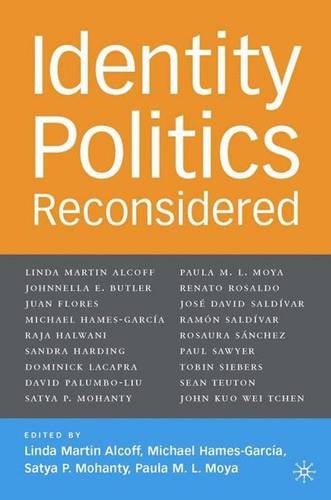
Based on the ongoing work of the agenda-setting Future of Minority Studies national research project, Redefining Identity Politics reconceptualizes the scholarly and political significance of social identity. It focuses on the deployment of “identity” within ethnic-, women’s-, disability-, and gay and lesbian studies in order to stimulate discussion about issues that are simultaneously theoretical and practical, ranging from ethics and epistemology to political theory and pedagogical practice. This collection of powerful essays by both well-known and emerging scholars offers original answers to questions concerning the analytical legitimacy of “identity” and “experience,” and the relationships among cultural autonomy, moral universalism, and progressive politics.
Die Inhaltsangabe kann sich auf eine andere Ausgabe dieses Titels beziehen.
Über die Autorinnen und Autoren
Satya P. Mohanty is Professor of English and member of the South Asia Program, Cornell University.
Linda Martin is Professor of Philosophy and Women's Studies, Syracuse University.
Michael Hames-Garcia is Assistant Professor of English and member of the Philosophy, Interpretation, and Culture Program, SUNY Binghamton.
Paula M. L. Moya is Assistant Professor of English and member of the Center for Comparative Studies in Race and Ethnicity, Stanford University.
Linda Martin is Professor of Philosophy and Women's Studies, Syracuse University.
Michael Hames-Garcia is Assistant Professor of English and member of the Philosophy, Interpretation, and Culture Program, SUNY Binghamton.
Paula M. L. Moya is Assistant Professor of English and member of the Center for Comparative Studies in Race and Ethnicity, Stanford University.
Linda Martín Alcoff is Professor of Philosophy and Women's Studies at Syracuse University. She is the author of Real Knowing: New Versions of the Coherence Theory (1996) and the co-editor of Feminist Epistemologies (1993), Thinking From the Underside of History (2000), and Identities: Race, Class, Gender, and Nationality (2002). Her most recent book, Visible Identities: Race, Gender and the Self, is forthcoming from Oxford. Michael Hames-García is Associate Professor of English and Comparative Literature at Binghamton University (State University of New York). He is the author of Fugitive Thought: Prison Movements, Race, and the Meaning of Justice (2004) and the co-editor, with Paula M. L. Moya, of Reclaiming Identity: Realist Theory and the Predicament of Postmodernism (2000). Satya P. Mohanty is Professor of English at Cornell University and Director of the Future of Minority Studies Summer Institute. He is the author of Literary Theory and the Claims of History: Postmodernism, Objectivity, Multicultural Politics (1997). His research interests include critical theory, the novel, social and cultural identity, ethics and aesthetics, and "comparative Indian literature." Paula M. L. Moya is Associate Professor of English and Director of the Undergraduate Program in the Center for Comparative Studies in Race and Ethnicity (CCSRE) at Stanford University. She is the author of Learning from Experience: Minority Identities, Multicultural Struggles (2002) and the co-editor, with Michael Hames-García, of Reclaiming Identity: Realist Theory and the Predicament of Postmodernism (2000).
„Über diesen Titel“ kann sich auf eine andere Ausgabe dieses Titels beziehen.
Suchergebnisse für Identity Politics Reconsidered (Future of Minority...

Beispielbild für diese ISBN
Identity Politics Reconsidered (Future of Minority Studies)
Anbieter: Midtown Scholar Bookstore, Harrisburg, PA, USA
Verkäuferbewertung 5 von 5 Sternen

Hardcover. Zustand: Very Good. Very Good - Crisp, clean, unread book with some shelfwear/edgewear, may have a remainder mark - NICE Standard-sized. Bestandsnummer des Verkäufers M1403964459Z2
Gebraucht kaufen
EUR 33,38
EUR 5,35 Versand
Versand innerhalb von USA
Versand innerhalb von USA
Anzahl: 3 verfügbar
Beispielbild für diese ISBN
Identity Politics Reconsidered (Future of Minority Studies)
Anbieter: Midtown Scholar Bookstore, Harrisburg, PA, USA
Verkäuferbewertung 5 von 5 Sternen
Hardcover. Zustand: Good. Good - Bumped and creased book with tears to the extremities, but not affecting the text block, may have remainder mark or previous owner's name - GOOD Standard-sized. Bestandsnummer des Verkäufers M1403964459Z3
Gebraucht kaufen
EUR 74,22
EUR 5,35 Versand
Versand innerhalb von USA
Versand innerhalb von USA
Anzahl: 1 verfügbar