
Verwandte Artikel zu Globalization: The Making of World Society
Inhaltsangabe
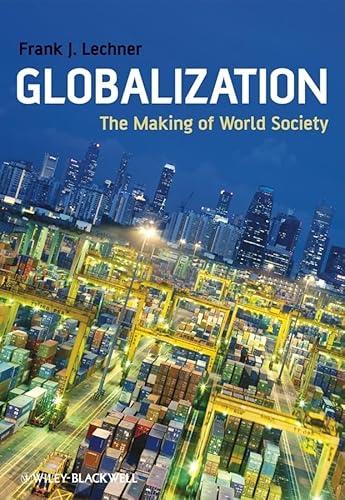
GLOBALIZATION
“Lechner has drawn on his extensive work on, and his deep knowledge of, globalization to write a brief, accessible, and highly successful introduction to the field. The early chapters on food, sport, and mass media should pique the student’s interest and lure them into a deeper involvement with later chapters and the field in general.”
George Ritzer, University of Maryland
“Frank Lechner’s text takes on key issues in the study of globalization with real clarity and critical power. An authoritative account of the major issues, theories, and debates in the field, aptly illustrated by diverse contemporary examples, this text offers a clear analysis of a complex topic that will be an invaluable resource for students and scholars.”
Fran Tonkiss, London School of Economics
Written in a lively and accessible style, Globalization: The Making of World Society shows how globalization affects everyday experience, creates new institutions, and presents new challenges.
With many examples, Lechner describes how the process unfolds in a wide range of fields, from sports and media to law and religion. While sketching the outlines of a world society in the making, the book also demonstrates that globalization is inherently diverse and contentious. In this concise analysis of a complex subject, Lechner presents some of the best work in the social sciences in clear and readable fashion.
Globalization: The Making of World Society will serve as a stimulating, state-of-the-art text for any student of globalization, beginner or advanced.
Die Inhaltsangabe kann sich auf eine andere Ausgabe dieses Titels beziehen.
Über die Autorin bzw. den Autor
Frank J. Lechner is Professor of Sociology at Emory University in Atlanta. Among his publications dealing with globalization are World Culture: Origins and Consequences (with John Boli) (Blackwell, 2005) and The Netherlands: Globalization and National Identity (2008) as well as an edited volume, The Globalization Reader (with John Boli) (third edition, Wiley-Blackwell, 2008). He has also written extensively about religion and social theory.
Von der hinteren Coverseite
Written in a lively and accessible style, Globalization: The Making of World Society shows how globalization affects everyday experience, creates new institutions, and presents new challenges.
With many examples, Lechner describes how the process unfolds in a wide range of fields, from sports and media to law and religion. While sketching the outlines of a world society in the making, the book also demonstrates that globalization is inherently diverse and contentious. In this concise analysis of a complex subject, Lechner presents some of the best work in the social sciences in clear and readable fashion.
Globalization: The Making of World Society will serve as a stimulating, state-of-the-art text for any student of globalization, beginner or advanced.
Aus dem Klappentext
Written in a lively and accessible style, Globalization: The Making of World Society shows how globalization affects everyday experience, creates new institutions, and presents new challenges.
With many examples, Lechner describes how the process unfolds in a wide range of fields, from sports and media to law and religion. While sketching the outlines of a world society in the making, the book also demonstrates that globalization is inherently diverse and contentious. In this concise analysis of a complex subject, Lechner presents some of the best work in the social sciences in clear and readable fashion.
Globalization: The Making of World Society will serve as a stimulating, state-of-the-art text for any student of globalization, beginner or advanced.
Auszug. © Genehmigter Nachdruck. Alle Rechte vorbehalten.
Globalization
The Making of World SocietyBy Frank J. LechnerJohn Wiley & Sons
Copyright © 2009 Frank J. LechnerAll right reserved.
ISBN: 978-1-4051-6906-6
Chapter One
INTRODUCTION
As more people become more connected across larger distances in different ways, they are creating a new world society in which they do more similar things, affect each other's lives more deeply, follow more of the same norms, and grow more aware of what they share. "Globalization" is one name for that process. With many examples, this book describes how and why it happens. As a preview, this introduction summarizes my main themes and the thrust of the chapters to come. Readers who prefer to plunge in can skip straight to the next chapter.
Themes
Globalization refers to the growth of ties that span space. Since people can link up across wider spaces in many ways, that definition is quite generic. Businesses that sell their wares abroad, or missionaries eager to save souls, or migrants leaving home in search of opportunity are all globalizers. Globalization occurs in many fields, world society has many dimensions. The definition therefore takes a broad and inclusive view: globalization is not a single thing or force but rather a set of human actions that share a similar quality and point in the same direction. In Chapter 2, I break the definition into four components, implicit in the opening paragraph, as a convenient tool for further analysis. "Ties that span space" minimally involve spreading or diffusing things or information, greater interdependence among more people, new forms of organization, and a wider awareness of commonalities. Applied to a great variety of social practices, from economic to legal to religious, this conveys the inherent diversity of globalization. To capture some underlying patterns that help to build world society, I still prefer to use the singular, globalization, but the plural, globalizations, does at least equal justice to what is happening.
Since globalization is still unfolding, describing it is a bit like charting the course or gauging the flow of a river from midstream. Yet while we cannot see exactly where we are going, the shape of world society is becoming clearer. For all the diversity described in later chapters, it has its own features, its own institutions, its own problems. In an earlier book, World Culture: Origins and Consequences, John Boli and I examined world culture as part of world society, arguing that this culture increasingly informs how we think and shapes much of what we do (Lechner and Boli 2005). Here I expand our argument to show how globalization creates a new framework for social life around the globe. My subtitle deliberately hedges a little: this book is about "the making" of world society - still incomplete, still in process. As later chapters will show, it involves many brakes and barriers that limit globalization in some way. At the risk of disappointing global enthusiasts, my point is not that everything or everyone is "going global," that world society somehow will sweep all before it. Rather, I want to show how new kinds of social organization intertwine with older ways of doing things.
The very term world society sounds ambitious. It captures something big and implicitly makes a grand claim. One reason it sounds ambitious is that most of us identify "society" with the state or country we live in. "Society" means Japanese society, American society, and so on. This kind of society is a package deal, containing a state that organizes a people, controls a territory, and fosters a culture. If the world consists of societies in this sense, how could there be room for "world" society? It is an interesting global fact that we often equate society and nation-state, but we are free to decline the package deal offered by world culture and instead think of world society in a different way. It will not be, and cannot be, a nation-state on a global scale. But we do need a name for the ways in which relations-across-spaces are crystallizing and congealing, for new ways of organizing and interpreting distant-but-common activities and experiences, and I use "world society" simply as a convenient name for that complex social reality. (Among scholars, the term is sometimes used as a label for one way of thinking about globalization (Meyer, Boli, et al. 1997), which has in fact influenced my own perspective; to avoid confusion I will describe this way of thinking by its older name, "world polity theory.")
If some kind of "world society" is emerging, it is also tempting to think that this will leave nation-states behind as hopelessly old-fashioned. If we have more in common with distant peoples, what we have in common with those nearby should matter less. This makes intuitive sense but we should resist the intellectual temptation. Nation-states are not going away; neither will national identities. Globalization will have to work in and through nation-states. At the same time, what nation-states do, and how people identify with them, will change. That was the topic of my book The Netherlands: Globalization and National Identity, which focused on the way the Dutch have dealt with their national identity in response to globalization (Lechner 2008). If anything, the problem for world society is not how to overcome nation-states but how to build them where they do not exist. After all, many so-called nation-states are neither - they are countries that have neither competent states nor coherent nations. Yet a reasonably stable world society will need responsive and competent states that manage the affairs of particular areas and carry the hopes of particular peoples.
Globalization is a big enough theme for one book, but I also view it as part of a still-greater transformation, both technical and social. In just a few centuries, human beings have learned how to put nature to work for us more effectively, how to move things and people more easily, and how to share information more quickly. "Human beings" is vague and misleading, of course: some groups in some places have done all this, and the benefits have not spread to everyone. Yet the massive technical transformation, from electricity to engines to telephones to the Internet, does affect everyone. World society would be impossible without it. Along with new ways of doing things, we have devised new ways of organizing social affairs. Again, the "we" did not include everyone - a caveat that applies elsewhere in the book though I sometimes leave it unstated - but a particular kind of social change nonetheless ripples around the world. Modern societies do not all follow a single path to a single destination, but typically they do work differently than those that came before: they have more specialized institutions, they grant more leeway to individuals as consumers and citizens, and they overturn all sorts of hierarchies based on naked power, traditional privilege, or old beliefs. For centuries, these technical and social revolutions have spilled across the borders of states. Globalization follows from, complements, and reinforces them.
The idea that a social transformation upsets old hierarchies would hearten enthusiasts who think globalization creates a "flat" world, in which more people have more equal access to more opportunities (Friedman 2007). Critics would counter, of course, that the world is hardly flat, since quite apart from the abject poverty of billions not everyone can partake equally of all its opportunities....
„Über diesen Titel“ kann sich auf eine andere Ausgabe dieses Titels beziehen.
Suchergebnisse für Globalization: The Making of World Society

Beispielbild für diese ISBN
Globalization: The Making of World Society
Anbieter: -OnTimeBooks-, Phoenix, AZ, USA
Verkäuferbewertung 5 von 5 Sternen

Zustand: good. A copy that has been read, remains in good condition. All pages are intact, and the cover is intact. The spine and cover show signs of wear. Pages can include notes and highlighting and show signs of wear, and the copy can include "From the library of" labels or previous owner inscriptions. 100% GUARANTEE! Shipped with delivery confirmation, if you're not satisfied with purchase please return item! Ships via media mail. Bestandsnummer des Verkäufers OTV.1405169060.G
Gebraucht kaufen
EUR 33,62
Versand gratis
Versand innerhalb von USA
Versand innerhalb von USA
Anzahl: 2 verfügbar
Beispielbild für diese ISBN
Globalization: The Making of World Society
Anbieter: ThriftBooks-Dallas, Dallas, TX, USA
Verkäuferbewertung 5 von 5 Sternen
Hardcover. Zustand: Very Good. No Jacket. May have limited writing in cover pages. Pages are unmarked. ~ ThriftBooks: Read More, Spend Less. Bestandsnummer des Verkäufers G1405169060I4N00
Gebraucht kaufen
EUR 33,95
Versand gratis
Versand innerhalb von USA
Versand innerhalb von USA
Anzahl: 1 verfügbar
Beispielbild für diese ISBN
Globalization The Making of World Society
Anbieter: HPB-Red, Dallas, TX, USA
Verkäuferbewertung 5 von 5 Sternen
unknown_binding. Zustand: Good. Connecting readers with great books since 1972! Used textbooks may not include companion materials such as access codes, etc. May have some wear or writing/highlighting. We ship orders daily and Customer Service is our top priority! Bestandsnummer des Verkäufers S_444873916
Gebraucht kaufen
EUR 36,97
EUR 3,37 Versand
Versand innerhalb von USA
Versand innerhalb von USA
Anzahl: 1 verfügbar
Beispielbild für diese ISBN
Globalization : The Making of World Society
Verlag:
Wiley & Sons, Incorporated, John, 2009
ISBN 10: 1405169060
ISBN 13: 9781405169066
Gebraucht
Hardcover
Anbieter: Better World Books, Mishawaka, IN, USA
Verkäuferbewertung 5 von 5 Sternen
Zustand: Good. Former library copy. Pages intact with minimal writing/highlighting. The binding may be loose and creased. Dust jackets/supplements are not included. Includes library markings. Stock photo provided. Product includes identifying sticker. Better World Books: Buy Books. Do Good. Bestandsnummer des Verkäufers 13103451-6
Gebraucht kaufen
EUR 45,10
Versand gratis
Versand innerhalb von USA
Versand innerhalb von USA
Anzahl: 1 verfügbar
Beispielbild für diese ISBN
Globalization: The Making of World Society
Anbieter: Books-R-Keen, DuBois, PA, USA
Verkäuferbewertung 5 von 5 Sternen
hardcover. Zustand: Good. Used items may contain, highlighting, writing, and other previous signs of use. Used items may not contain CD's. access codes and other accompanying items when applicable. Bestandsnummer des Verkäufers 7A45853
Gebraucht kaufen
EUR 69,33
EUR 3,58 Versand
Versand innerhalb von USA
Versand innerhalb von USA
Anzahl: 1 verfügbar
Foto des Verkäufers
Globalization : The Making of World Society
Anbieter: GreatBookPrices, Columbia, MD, USA
Verkäuferbewertung 5 von 5 Sternen
Zustand: New. Bestandsnummer des Verkäufers 5541310-n
Neu kaufen
EUR 109,18
EUR 2,37 Versand
Versand innerhalb von USA
Versand innerhalb von USA
Anzahl: Mehr als 20 verfügbar
Beispielbild für diese ISBN
Globalization: The Making of World Society
Anbieter: DeckleEdge LLC, Albuquerque, NM, USA
Verkäuferbewertung 5 von 5 Sternen
hardcover. Zustand: new. Bestandsnummer des Verkäufers Shelfdream1405169060
Beispielbild für diese ISBN
Globalization - The Making of World Society (eng)
Anbieter: Brook Bookstore On Demand, Napoli, NA, Italien
Verkäuferbewertung 5 von 5 Sternen
Zustand: new. Bestandsnummer des Verkäufers f41456d1af39526feb74435aef8f0de7
Neu kaufen
EUR 105,58
EUR 6,80 Versand
Versand von Italien nach USA
Versand von Italien nach USA
Anzahl: Mehr als 20 verfügbar
Beispielbild für diese ISBN
Globalization
Anbieter: PBShop.store UK, Fairford, GLOS, Vereinigtes Königreich
Verkäuferbewertung 5 von 5 Sternen
HRD. Zustand: New. New Book. Shipped from UK. Established seller since 2000. Bestandsnummer des Verkäufers FW-9781405169066
Neu kaufen
EUR 106,49
EUR 7,04 Versand
Versand von Vereinigtes Königreich nach USA
Versand von Vereinigtes Königreich nach USA
Anzahl: 15 verfügbar
Foto des Verkäufers
Globalization : The Making of World Society
Anbieter: GreatBookPrices, Columbia, MD, USA
Verkäuferbewertung 5 von 5 Sternen
Zustand: As New. Unread book in perfect condition. Bestandsnummer des Verkäufers 5541310
Gebraucht kaufen
EUR 118,37
EUR 2,37 Versand
Versand innerhalb von USA
Versand innerhalb von USA
Anzahl: Mehr als 20 verfügbar