
Verwandte Artikel zu A Moveable Feast: The Restored Edition: Foreword by...
Inhaltsangabe
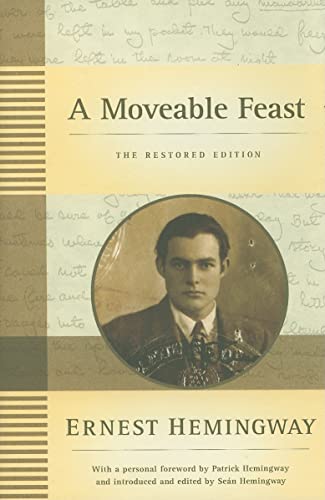
Ernest Hemingway’s classic memoir of Paris in the 1920s, now available in a restored edition, includes the original manuscript along with insightful recollections and unfinished sketches.
Published posthumously in 1964, A Moveable Feast remains one of Ernest Hemingway’s most enduring works. Since Hemingway’s personal papers were released in 1979, scholars have examined the changes made to the text before publication. Now, this special restored edition presents the original manuscript as the author prepared it to be published.
Featuring a personal foreword by Patrick Hemingway, Ernest’s sole surviving son, and an introduction by grandson of the author, Seán Hemingway, editor of this edition, the book also includes a number of unfinished, never-before-published Paris sketches revealing experiences that Hemingway had with his son, Jack, and his first wife Hadley. Also included are irreverent portraits of literary luminaries, such as F. Scott Fitzgerald and Ford Maddox Ford, and insightful recollections of Hemingway’s own early experiments with his craft.
Widely celebrated and debated by critics and readers everywhere, the restored edition of A Moveable Feast brilliantly evokes the exuberant mood of Paris after World War I and the unbridled creativity and unquenchable enthusiasm that Hemingway himself epitomized.
Die Inhaltsangabe kann sich auf eine andere Ausgabe dieses Titels beziehen.
Über die Autorin bzw. den Autor
Ernest Hemingway did more to change the style of English prose than any other writer of his time. Publication of The Sun Also Rises and A Farewell to Arms immediately established Hemingway as one of the greatest literary lights of the twentieth century. His classic novel The Old Man and the Sea won the Pulitzer Prize in 1953. Hemingway was awarded the Nobel Prize for Literature in 1954. Known for his larger-than-life personality and his passions for bullfighting, fishing, and big-game hunting, he died in Ketchum, Idaho, on July 2, 1961.
Von der hinteren Coverseite
Ernest Hemingway’s classic memoir of Paris in the 1920s, now available in a restored edition, includes the original manuscript along with insightful recollections and unfinished sketches.
Published posthumously in 1964, A Moveable Feast remains one of Ernest Hemingway’s most enduring works. Since Hemingway’s personal papers were released in 1979, scholars have examined the changes made to the text before publication. Now, this special restored edition presents the original manuscript as the author prepared it to be published.
Featuring a personal foreword by Patrick Hemingway, Ernest’s sole surviving son, and an introduction by grandson of the author, Seán Hemingway, editor of this edition, the book also includes a number of unfinished, never-before-published Paris sketches revealing experiences that Hemingway had with his son, Jack, and his first wife Hadley. Also included are irreverent portraits of literary luminaries, such as F. Scott Fitzgerald and Ford Maddox Ford, and insightful recollections of Hemingway’s own early experiments with his craft.
Widely celebrated and debated by critics and readers everywhere, the restored edition of A Moveable Feast brilliantly evokes the exuberant mood of Paris after World War I and the unbridled creativity and unquenchable enthusiasm that Hemingway himself epitomized.
Auszug. © Genehmigter Nachdruck. Alle Rechte vorbehalten.
A Moveable Feast
The Restored EditionBy Ernest HemingwayScribner
Copyright © 2009 Ernest HemingwayAll right reserved.
ISBN: 9781416591313
Introduction
In November 1956, the management of the Ritz Hotel in Paris convinced Ernest Hemingway to repossess two small steamer trunks that he had stored there in March 1928. The trunks contained forgotten remnants from his first years in Paris: pages of typed fiction, notebooks of material relating to The Sun Also Rises, books, newspaper clippings, and old clothes. To bring this precious cargo home to the Finca in Cuba on their transatlantic voyage aboard the Ile de France, Ernest and his wife Mary purchased a large Louis Vuitton steamer trunk. I recall as a child seeing that trunk in my godmother Mary's apartment in New York, and I can still remember its smart leather trim with brass fittings, pervasive Louis Vuitton logo, and the gold embossed initials, "EH." The trunk itself was easily big enough for me to fit into, and it filled me with wonder at the grand, adventurous life my grandfather led.
Hemingway may well have had earlier inklings of writing a memoir about his early years in Paris, such as during the long recuperation after his near-death plane crashes in Africa in 1954, but his reacquaintance with this material -- a time capsule from that seminal period in his life -- stirred him to action. In the summer of 1957, he began work on "The Paris Sketches," as he called the book. He worked on it in Cuba, and in Ketchum, and even brought it with him to Spain in the summer of 1959, and to Paris in the fall that same year. By November 1959, Hemingway had completed and delivered to Scribner's a draft of a manuscript that lacked only an introduction and the final chapter. A Moveable Feast, published posthumously in 1964, concerns the author's time in Paris from 1921 to 1926. Careful study of the manuscripts for A Moveable Feast reveals that relatively little material was reused from Hemingway's early papers and manuscripts. Of particular note is the chapter on the poet Cheever Dunning, which can be directly linked to a very early draft of the story that Hemingway describes in a letter to Ezra Pound, dated October 15, 1924. Additionally, parts of the chapter "Ford Madox Ford and the Devil's Disciple" were culled from material that Hemingway excised from The Sun Also Rises and had rediscovered in the notebooks he found in the trunks at the Ritz. While A Moveable Feast is the first and most complete posthumously published book by Ernest Hemingway, Mary Hemingway states, in her editor's note, that the book was finished in the spring of 1960, when he had completed another round of edits to the manuscript at the Finca. In actuality, the book was never finished in Hemingway's eyes.
This new special edition of A Moveable Feast celebrates my grandfather's classic memoir of his early days in Paris fifty years after he completed the first draft of the book. Presented here for the first time is Ernest Hemingway's original manuscript text as he had it at the time of his death in 1961. Although Hemingway had completed several drafts of the main text in prior years, he had not written an introduction or final chapter to his satisfaction, nor had he decided on a title. In fact, Hemingway continued to work on the book at least into April of 1961.
During the nearly three years between the author's death and the first publication of A Moveable Feast in the spring of 1964, significant changes were made to the manuscript by the editors, Mary Hemingway and Harry Brague of Scribner's. A small amount of material that Hemingway had intended to include was deleted, and other material that he had written for the book but had decided not to include, notably the chapter entitled "Birth of A New School," a large section of the chapter on Ezra Pound, now entitled "Ezra Pound and the Measuring Worm," and a large section of the final chapter, previously entitled "There is Never Any End to Paris" and now renamed "Winters in Schruns," was added. The introductory letter by Ernest Hemingway in A Moveable Feast was actually fabricated by Mary Hemingway from manuscript fragments and, thus, has been left out of this edition. Likewise, the editors changed the order of some of the chapters. Chapter 7 became chapter 3, and chapter 16 on Schruns was made into the last chapter with additional material added from a chapter in which Hemingway wrote about his break up with Hadley and new marriage to Pauline Pfeiffer, a text published in its entirety here for the first time as "The Pilot Fish and the Rich." Hemingway had decided against including this material in the book because he thought of his relationship with Pauline as a beginning, not an ending.
The nineteen chapters of A Moveable Feast published here are based on a typed manuscript with original notations in Hemingway's hand -- the last draft of the last book that he ever worked on. The actual manuscript is in the Ernest Hemingway Collection at the John F. Kennedy library in Boston, Massachusetts, the primary repository for all of Hemingway's manuscripts. Although this manuscript lacks a final chapter, I believe that it provides a truer representation of the book my grandfather intended to publish.
A number of relatively minor editorial changes were also made to the published edition of A Moveable Feast, changes that I strongly doubt would have been attempted by the editor had she required the author's approval. These changes have been reinstated. The most significant of them, I think, is the changing in many places of Hemingway's use of the second person in the narrative, evident from the very first paragraph of chapter one and then throughout the book (see, e.g., Fig. 1). This intentional and carefully conceived narrative device gives the effect of the author speaking to himself and, subconsciously, through the repetition of the word "you," brings the reader into the story.
A particularly egregious edit was made to the foreword to chapter 17 on F. Scott Fitzgerald. Hemingway's final text (see Fig. 7) reads:
His talent was as natural as the pattern that was made by the dust on a butterfly's wings. At one time he understood it no more than the butterfly did and he did not know when it was brushed or marred. Later he became conscious of his damaged wings and of their construction and he learned to think. He was flying again and I was lucky to meet him just after a good time in his writing if not a good one in his life.
But in the posthumous edition, it reads:
His talent was as natural as the pattern that was made by the dust on a butterfly's wings. At one time he understood it no more than the butterfly did and he did not know when it was brushed or marred. Later he became conscious of his damaged wings and of their construction and he learned to think and could not fly any more because the love of flight was gone and he could only remember when it had been effortless.
It is clear that the editors culled this text from an earlier draft (see Fig. 6) discarded by Hemingway, but this kind of editorial decision, which casts Fitzgerald in a less sympathetic light than Hemingway's final version, seems completely unwarranted.
Hemingway had only provided titles for three chapters of his original manuscript: "Ford Madox Ford and the Devil's Disciple," "Birth of a New School," and "The Man Who Was Marked for Death" (see Fig. 4). The titles from the first publication have been retained, except as noted above, for the clarity of the reader familiar with the...
„Über diesen Titel“ kann sich auf eine andere Ausgabe dieses Titels beziehen.
Suchergebnisse für A Moveable Feast: The Restored Edition: Foreword by...

Beispielbild für diese ISBN
A Moveable Feast: The Restored Edition
Anbieter: ThriftBooks-Dallas, Dallas, TX, USA
Verkäuferbewertung 5 von 5 Sternen

Hardcover. Zustand: Fair. No Jacket. Former library book; Readable copy. Pages may have considerable notes/highlighting. ~ ThriftBooks: Read More, Spend Less. Bestandsnummer des Verkäufers G1416591311I5N10
Gebraucht kaufen
EUR 8,95
Versand gratis
Versand innerhalb von USA
Versand innerhalb von USA
Anzahl: 1 verfügbar
Foto des Verkäufers
A Moveable Feast: The Restored Edition
Anbieter: Zoom Books East, Glendale Heights, IL, USA
Verkäuferbewertung 5 von 5 Sternen
Zustand: good. Book is in good condition and may include underlining highlighting and minimal wear. The book can also include "From the library of" labels. May not contain miscellaneous items toys, dvds, etc. . We offer 100% money back guarantee and 24 7 customer service. Bestandsnummer des Verkäufers ZEV.1416591311.G
Gebraucht kaufen
EUR 9,85
Versand gratis
Versand innerhalb von USA
Versand innerhalb von USA
Anzahl: 1 verfügbar
Foto des Verkäufers
A Moveable Feast: The Restored Edition
Anbieter: ebooks Keystone, Reading, PA, USA
Verkäuferbewertung 4 von 5 Sternen

Zustand: acceptable. Bestandsnummer des Verkäufers GWKV.1416591311.A
Gebraucht kaufen
EUR 7,61
EUR 2,61 Versand
Versand innerhalb von USA
Versand innerhalb von USA
Anzahl: 1 verfügbar
Beispielbild für diese ISBN
A Moveable Feast: The Restored Edition
Anbieter: HPB Inc., Dallas, TX, USA
Verkäuferbewertung 5 von 5 Sternen
Hardcover. Zustand: Very Good. Connecting readers with great books since 1972! Used books may not include companion materials, and may have some shelf wear or limited writing. We ship orders daily and Customer Service is our top priority! Bestandsnummer des Verkäufers S_475527889
Gebraucht kaufen
EUR 7,29
EUR 3,27 Versand
Versand innerhalb von USA
Versand innerhalb von USA
Anzahl: 1 verfügbar
Beispielbild für diese ISBN
A Moveable Feast: the Restored Edition
Anbieter: Better World Books, Mishawaka, IN, USA
Verkäuferbewertung 5 von 5 Sternen
Zustand: Good. Former library copy. Pages intact with minimal writing/highlighting. The binding may be loose and creased. Dust jackets/supplements are not included. Includes library markings. Stock photo provided. Product includes identifying sticker. Better World Books: Buy Books. Do Good. Bestandsnummer des Verkäufers 5140112-6
Gebraucht kaufen
EUR 10,74
Versand gratis
Versand innerhalb von USA
Versand innerhalb von USA
Anzahl: 1 verfügbar
Beispielbild für diese ISBN
A Moveable Feast: The Restored Edition
Anbieter: HPB-Emerald, Dallas, TX, USA
Verkäuferbewertung 5 von 5 Sternen
Hardcover. Zustand: Very Good. Connecting readers with great books since 1972! Used books may not include companion materials, and may have some shelf wear or limited writing. We ship orders daily and Customer Service is our top priority! Bestandsnummer des Verkäufers S_480590011
Gebraucht kaufen
EUR 11,21
EUR 3,27 Versand
Versand innerhalb von USA
Versand innerhalb von USA
Anzahl: 1 verfügbar
Beispielbild für diese ISBN
A Moveable Feast: The Restored Edition
Anbieter: Half Price Books Inc., Dallas, TX, USA
Verkäuferbewertung 5 von 5 Sternen
Hardcover. Zustand: Very Good. Connecting readers with great books since 1972! Used books may not include companion materials, and may have some shelf wear or limited writing. We ship orders daily and Customer Service is our top priority! Bestandsnummer des Verkäufers S_484220278
Gebraucht kaufen
EUR 11,21
EUR 3,27 Versand
Versand innerhalb von USA
Versand innerhalb von USA
Anzahl: 1 verfügbar
Beispielbild für diese ISBN
A Moveable Feast: The Restored Edition
Anbieter: HPB-Diamond, Dallas, TX, USA
Verkäuferbewertung 5 von 5 Sternen
Hardcover. Zustand: Very Good. Connecting readers with great books since 1972! Used books may not include companion materials, and may have some shelf wear or limited writing. We ship orders daily and Customer Service is our top priority! Bestandsnummer des Verkäufers S_481379900
Gebraucht kaufen
EUR 11,21
EUR 3,27 Versand
Versand innerhalb von USA
Versand innerhalb von USA
Anzahl: 1 verfügbar
Beispielbild für diese ISBN
A Moveable Feast: The Restored Edition
Anbieter: Emily's Books, Brainerd, MN, USA
Verkäuferbewertung 5 von 5 Sternen
Hard Cover. Zustand: Very Good. Zustand des Schutzumschlags: Very Good. This is a clean book with light wear and the dust jacket has light wear and is in a high quality Demco protector. Size: 8vo - over 7¾" - 9¾" tall. Bestandsnummer des Verkäufers 056512
Gebraucht kaufen
EUR 13,60
EUR 4,31 Versand
Versand innerhalb von USA
Versand innerhalb von USA
Anzahl: 1 verfügbar
Foto des Verkäufers
A Moveable Feast: The Restored Edition
Anbieter: Rarewaves USA, HEBRON, KY, USA
Verkäuferbewertung 5 von 5 Sternen
Hardback. Zustand: New. Bestandsnummer des Verkäufers LU-9781416591313