
Verwandte Artikel zu He Forgot to Say Goodbye
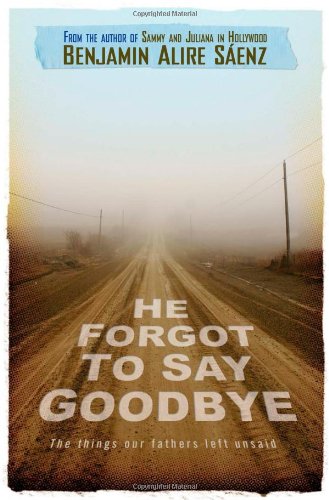
Inhaltsangabe
"I mean, it's not as if I want a father. I have a father. It's just that I don't know who he is or where he is. But I have one."
Ramiro Lopez and Jake Upthegrove don't appear to have much in common. Ram lives in the Mexican-American working-class barrio of El Paso called "Dizzy Land." His brother is sinking into a world of drugs, wreaking havoc in their household. Jake is a rich West Side white boy who has developed a problem managing his anger. An only child, he is a misfit in his mother's shallow and materialistic world. But Ram and Jake do have one thing in common: They are lost boys who have never met their fathers. This sad fact has left both of them undeniably scarred and obsessed with the men who abandoned them. As Jake and Ram overcome their suspicions of each other, they begin to move away from their loner existences and realize that they are capable of reaching out beyond their wounds and the neighborhoods that they grew up in. Their friendship becomes a healing in a world of hurt.
San Antonio Express-News wrote, "Benjamin Alire Sáenz exquisitely captures the mood and voice of a community, a culture, and a generation"; that is proven again in this beautifully crafted novel.
Die Inhaltsangabe kann sich auf eine andere Ausgabe dieses Titels beziehen.
Über die Autorin bzw. den Autor
Benjamin Alire Sáenz is an author of poetry and prose for adults and teens. He was the first Hispanic winner of the PEN/Faulkner Award and a recipient of the American Book Award for his books for adults. He is the author of Aristotle and Dante Discover the Secrets of the Universe, which was a Printz Honor Book, the Stonewall Award winner, the Pura Belpré Award winner, the Lambda Literary Award winner, and a finalist for the Amelia Elizabeth Walden Award, and its sequel, Aristotle and Dante Dive into the Waters of the World. His first novel for teens, Sammy and Juliana in Hollywood, was an ALA Top Ten Book for Young Adults and a finalist for the Los Angeles Times Book Prize. His second book for teens, He Forgot to Say Goodbye, won the Tomás Rivera Mexican American Children’s Book Award, the Southwest Book Award, and was named a New York Public Library Book for the Teen Age. He lives in El Paso, Texas.
Auszug. © Genehmigter Nachdruck. Alle Rechte vorbehalten.
ONE
Me, Ramiro Lopez
My mom says I need to stop and think about things. I think about things all the effen time. Think and think and think. You know, it's not like all that thinking has gotten me places.
Him
Sometimes I think of him. And when I do, I start to draw a picture. Not a real picture. I'm not an artist, not even close. I just draw this picture in my head.
Of him.
My dad.
It's easier for me to draw a picture of what he looks like than to imagine his voice. I mean, I don't know what he would sound like. He would use a lot of Spanish. But his voice, I don't know, I just don't know what words he'd use. He'd be angry, but that would just make him normal. A lot of fathers are like that -- especially fathers who've gone away. I think of their anger as a wind. And that wind took them away. From me. And all the others like me.
So I draw a picture in my head. Of him. Not of his voice but of his face. He has dark eyes and thick, wavy hair that was once really black -- really black. But now his hair is more white than black because that's how it goes when men get older. Their hair begins to get old too. That's the way it is and there's nothing we can do about it. And he has lines on his face, more from working out in the sun than from laughing. He doesn't like to laugh. He looks tired because he's had to work so hard. With his body, not with his mind, not like a teacher or a doctor or an insurance guy or a computer geek. You know, like construction. Working in construction -- it makes you old and tired. It kills your body because you have to work out in the sun every day, in the heat, in the cold, every day. It's not like working out in a gym and hanging out with other jocks that have nothing better to do than to muscle up -- it's not like that. If you work with your mind, then working with your body is just a hobby. But if you work with your body, then, well, your only hobby is to rest.
"Your body is nothing but a money machine." That's what Uncle Rudy says. "That's the way it is. We're all just prostitutes." My aunt hit him when he said that and told me not to pay any attention to him.
But listen, when you work in construction, your body is the car and the road and the destination. No, no, I'm getting all tangled up in my own words. That's not right. Look, I don't agree with Uncle Rudy. I get the part about using your body to make money. But the body's not a machine. When you work with your body every day of your life, well, your body's more like a punching bag -- it gets hit all the time. All day. Every day. And it's never going to stop. Not ever. I know. I hear men talk -- and they say things about their tired bodies, things like: "Ya estoy pa la patada." Mexican working guys, they talk like that. My dad's one of those guys. I know. He didn't go to college or anything like that. He didn't even graduate from high school. My Tía Lisa told me that once. She likes to tell me things I'm not supposed to know.
In the picture I've drawn in my head, my dad looks sad. Tired and sad and maybe mad, too. Definitely mad as hell. That's not a good combination. You don't see the anger in his body or his face. But if you look into his dark eyes, that's where you see all the anger -- they're like a bomb about to go off. You can almost hear the tick tick tick.
Yeah, he's mad as hell.
Mad at the world.
Mad at himself.
Mad at my mom.
Mad because he was born a poor Mexican. Mad because he never finished high school. Mad because he got a rotten deal. He thinks the world cheated him. And maybe the world did cheat him. But I don't think he helped himself out. I mean, my Uncle Rudy says, "If you know a man's gonna cheat you, then why the hell are you lending him twenty bucks?" No, I don't think my dad helped himself out. See, the way I picture him, he has so much anger in his eyes, that he's half-blind. He can't see straight. He can't see the leaves on a tree. He can't see the fact that some dogs know how to smile. That's what happens. When you get too angry you can't see the world anymore.
My dad, he looks down at the ground more than he looks up at the sky. It's like he doesn't even notice the birds anymore. He's just looking down at things that crawl. That's how I draw him -- his eyes never looking up.
He's crooked now. He's all dented up. He's a car that's been on the road too long. Too many accidents. The paint's all peeled off.
He used to be handsome. Real, real handsome. Girls used to look at him, praying he'd look back. And his walk was like a dance. I guess we always want our dads to be handsome just like we want our moms to be beautiful. But now I'm thinking he's changed and he's more than just an ordinary handsome guy. Now he has the most interesting face in the world. Maybe interesting is better than handsome. But interesting doesn't mean happy, and I mean he looks beat-up as an old, chained-up dog. And disappointed, as if somehow a part of him is missing. Me. It's me that's missing. He's thinking of me and he's missing me, and sometimes he looks out at the sky and whispers my name and tries to imagine me just like I'm imagining him.
Look, I don't know what I'm talking about. It's not as if I really know what he looks like because I've never seen him. My mother once said he was beautiful. "He was like an ocean -- beautiful to look at." The way she said that, right then she looked soft as a cloud. And then all of a sudden she turned real hard. "I almost drowned in that ocean." I knew she wasn't about to go near another man ever again. All men had become oceans she might drown in.
Once, when we'd gone to my cousin's wedding, my mom looked at me and said. "I ripped up all our wedding pictures -- and then I burned them." She looked at me like maybe she was sorry she'd blurted that out, and she gave me a look like I wasn't supposed to be asking her any questions about him. Him. I don't think she blurted out that piece of information to be mean. I think sometimes our minds get so full of something that we just have to empty them out. I think that's what happened to her. Sure. That's a good theory. I mean, she sounded so mad when she said that. Really, really mad. Not mad at me, but mad at the way things had turned out -- and well, sad, too. It's as if some of my dad's anger and some of his sadness rubbed off on my mother every time he touched her. And I know she carries his face somewhere inside her (and for all I know, somewhere in her purse). I mean, you can't rip up all the pictures you carry in your head. You can't. Even if you want to. I think sometimes she cries for him. But she doesn't cry in front of me or my little brother. My little brother, Tito, wasn't even born when he left. He was still inside her. And I was almost two.
I sometimes try to imagine him on the day he left. I see him packing all his clothes. I see him looking around the room -- trying to figure out what else he should pack in his suitcase. Maybe he thinks he should stay, but he knows he has to go. I picture him with a confused look on his face and I picture my mother sitting in the kitchen. Saying nothing. Just waiting. Waiting for him to leave so she can have herself a good cry. I wonder if he said good-bye to us and said something to us, you know, like fathers do, talk to their sons, tell them things. Important things like I'll miss you, I'll think of you every day, I'll come back, you'll see, I'll come back, and don't ever forget that I love you, hijito de mi vida. I don't know. Maybe he just left. Maybe he didn't say a damn thing.
My dad must have held me in his arms when I was a baby. He must have kissed me like I see other fathers kiss their babies. He must have done that.
His breath might have smelled of cigarettes and garlic.
His breath might have smelled like cilantro.
...
„Über diesen Titel“ kann sich auf eine andere Ausgabe dieses Titels beziehen.
Suchergebnisse für He Forgot to Say Goodbye

Beispielbild für diese ISBN
He Forgot to Say Goodbye
ISBN 10: 1416949631
ISBN 13: 9781416949633
Gebraucht
Hardcover
Erstausgabe
Anbieter: BooksRun, Philadelphia, PA, USA
Verkäuferbewertung 5 von 5 Sternen

Hardcover. Zustand: Very Good. First Edition. With dust jacket. It's a well-cared-for item that has seen limited use. The item may show minor signs of wear. All the text is legible, with all pages included. It may have slight markings and/or highlighting. Bestandsnummer des Verkäufers 1416949631-11-1-29
Gebraucht kaufen
EUR 4,76
Versand gratis
Versand innerhalb von USA
Versand innerhalb von USA
Anzahl: 1 verfügbar
Beispielbild für diese ISBN
He Forgot to Say Goodbye
Verlag:
Simon & Schuster Books for Young Readers, 2008
ISBN 10: 1416949631
ISBN 13: 9781416949633
Gebraucht
Hardcover
Anbieter: ThriftBooks-Atlanta, AUSTELL, GA, USA
Verkäuferbewertung 5 von 5 Sternen
Hardcover. Zustand: Good. No Jacket. Former library book; Pages can have notes/highlighting. Spine may show signs of wear. ~ ThriftBooks: Read More, Spend Less. Bestandsnummer des Verkäufers G1416949631I3N10
Gebraucht kaufen
EUR 5,87
Versand gratis
Versand innerhalb von USA
Versand innerhalb von USA
Anzahl: 1 verfügbar
Beispielbild für diese ISBN
He Forgot to Say Goodbye
Verlag:
Simon & Schuster, Incorporated, 2008
ISBN 10: 1416949631
ISBN 13: 9781416949633
Gebraucht
Hardcover
Anbieter: Better World Books, Mishawaka, IN, USA
Verkäuferbewertung 5 von 5 Sternen
Zustand: Good. Former library copy. Pages intact with minimal writing/highlighting. The binding may be loose and creased. Dust jackets/supplements are not included. Includes library markings. Stock photo provided. Product includes identifying sticker. Better World Books: Buy Books. Do Good. Bestandsnummer des Verkäufers GRP102344314
Gebraucht kaufen
EUR 5,98
Versand gratis
Versand innerhalb von USA
Versand innerhalb von USA
Anzahl: 2 verfügbar
Beispielbild für diese ISBN
He Forgot to Say Goodbye
Verlag:
Simon & Schuster, Incorporated, 2008
ISBN 10: 1416949631
ISBN 13: 9781416949633
Gebraucht
Hardcover
Anbieter: Better World Books, Mishawaka, IN, USA
Verkäuferbewertung 5 von 5 Sternen
Zustand: Very Good. Former library copy. Pages intact with possible writing/highlighting. Binding strong with minor wear. Dust jackets/supplements may not be included. Includes library markings. Stock photo provided. Product includes identifying sticker. Better World Books: Buy Books. Do Good. Bestandsnummer des Verkäufers 4348175-75
Gebraucht kaufen
EUR 5,98
Versand gratis
Versand innerhalb von USA
Versand innerhalb von USA
Anzahl: 1 verfügbar
Beispielbild für diese ISBN
He Forgot to Say Goodbye
Verlag:
Simon & Schuster Books for Young, 2008
ISBN 10: 1416949631
ISBN 13: 9781416949633
Gebraucht
Hardcover
Anbieter: Cathy's Half Price Books, Havertown, PA, USA
Verkäuferbewertung 4 von 5 Sternen

hardcover. Zustand: Good. Shows some light wear from age and use. Interior is good with sound binding and no marks, damage or labels. Bestandsnummer des Verkäufers 211170
Gebraucht kaufen
EUR 5,32
EUR 3,44 Versand
Versand innerhalb von USA
Versand innerhalb von USA
Anzahl: 1 verfügbar