
Verwandte Artikel zu Making Life Matter: Embracing the Joy in Everyday
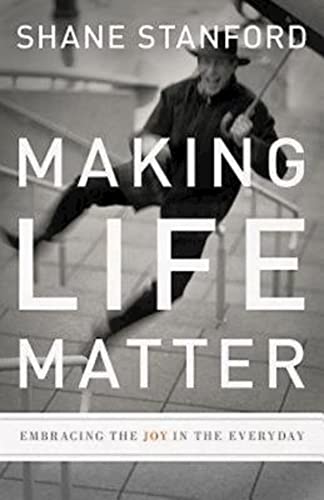
Inhaltsangabe
"In my family, my work, and my community, I want my life to matter. The remarkable teaching and writing of Shane Stanford provides an authentic direction for how to do just that. From the living room to the classroom to the boardroom, people need to read this book." --Brad Martin, retired Chair & CEO, Saks Incorporated, New York, NY Define Your Journey In a world of fast-paced schedules and priorities, conversations about what makes for a life well lived are a rarity and a luxury. But what if the daily pace of life held in itself the way to make choices more significant? What if everyday, simple steps, instead of some complex list of seemingly unattainable principles, showed how to make life matter? Making Life Matter answers these questions and shows that the steps for making life matter are found in rather ordinary decisions, attitudes, and patterns found in normal routines. This book is about our story and our journey, and what we do and feel along the way. “Shane Stanford’s teachings have encouraged me to go beyond simply attending church. Making Life Matter reminds me of the importance of making each day count and challenges me to leverage my skills to serve the church. Using simple, everyday wisdom, my life now focuses on building the Kingdom and making a difference each day.” --Bill Rhodes, CEO/President, AutoZone Inc., a Fortune 500 Company
Die Inhaltsangabe kann sich auf eine andere Ausgabe dieses Titels beziehen.
Über die Autorin bzw. den Autor
Shane Stanford (MA, Duke University; Doctorate, Asbury Theological Seminary) is Senior Pastor of a 5,000+ member church in Memphis, Tennessee. Dr. Stanford is the author of numerous books, including The Seven Next Words of Christ, The Cure for the Chronic Life, and The Eight Blessings: Rediscovering the Beatitudes. His memoir, A Positive Life, details his life as an HIV+ and HepC+ hemophiliac, husband, father, and pastor. He is the co-host of the Covenant Bible Study program, now used in over one thousand churches. Dr. Stanford married Dr. Pokey Stanford, and they have three daughters.
Auszug. © Genehmigter Nachdruck. Alle Rechte vorbehalten.
Making Life Matter
Embracing the Joy in the Everyday
By Shane StanfordAbingdon Press
Copyright © 2012 Abingdon Press
All rights reserved.
ISBN: 978-1-4267-1032-2All rights reserved.
Contents
Acknowledgments,
Introduction More than the Sum of What We Survive,
Chapter One If I Break It, I Buy It / Matthew 27:3-10,
Chapter Two It's Never Too Late to Be Sorry ... but Sorry Doesn't Settle It Luke 19:1-10,
Chapter Three They Will Walk Like Me / John 14:5-16, 21-24,
Chapter Four Never Give Up / John 17:1-26,
Chapter Five I Need a Place / Mark 9,
Chapter Six I Am How I Pray / Matthew 6:5-15,
Chapter Seven I Am Not Enough / Mark 6:30-43 and Mark 8:1-10,
Epilogue Reigniting a New Brand,
CHAPTER 1
If I Break It, I Buy It
Matthew 27:3-10
Several summers ago, my wife and I took our small children to the Mall in Washington, D.C., for the Fourth of July. It was a wonderful time as we celebrated Independence Day in our nation's capital. Just a few years after the events of 9/11, security, as you can imagine, was very tight. Being the dutiful tourists we are, we obeyed every rule. Well, almost every rule.
It was incredibly hot during July in Washington that year. It was the middle of the summer, and the heat absorbed on the granite, stone pavement, and structures intensified the already scorching situation. Some estimates put the temperature at over 105 degrees. And did I mention it was crowded? Other than the inauguration of a president, there is no larger attendance on the Mall than for the Fourth of July celebration. Of course, it is worth it. The party begins on the grounds of the west front of the Capitol with music and entertainment from across the country. Then there is the cannon salute (rather loud, but very impressive), and finally, the majestic fireworks display. By that time, however, you are toasted.
Anyone attending the event is looking for opportunities to stay cool during the day. If you have small children, it is even worse. We looked for every opportunity to cool off. This included visiting every one of the museums and facilities of the Smithsonian Institution. On one such occasion, we stopped in a gift shop located in the National Gallery of Art. If you have never been in this gift shop, you are missing a real treat; it is no ordinary gift shop—it is more of a specialty shop filled with treasures and very expensive gifts. I would be nervous by myself walking around the many treasures, but when you throw a nine-year-old, a six-year-old, and an eighteen-month-old into the equation, you are begging for disaster.
Just as we unbuckled our youngest children from their strollers, my wife and I realized where we were and, worse, what we had done. We had been so quick to find any entrance with a cool breeze that we did not pay close enough attention to where the door led. As soon as their little feet hit the ground, the kids, who were just being kids, immediately began to ooh and aah and touch. My wife and I began a furious process of grabbing, replacing, and protecting the beautiful objects, many of which cost more than our entire trip to D.C. Within minutes, I felt like a juggler on a really bad day.
After a few harried moments, my wife and I corralled our children, re-strapped them into the strollers, and made our way out of the store. Once outside, my wife turned to me and said, "Do you realize what almost happened in there? We set loose a tor-nado with absolutely no way to control the damage!" We both smiled sheepishly as we realized that we had been spared (and so had the store) from destruction—well, at least on our small scale. We were horrified at what damage could have been done.
But what about the damage we do each day with our attitudes, words, and actions that point to everything as a value in life except the one value that really matters? Many times, we worry much more about the damage our children will cause in a fine gift store than how we affect our everyday world. I am sure I am not the only one who does this.
What if every word, deed, or thought came with a relational price tag that outlined not only the effect in that moment but also how that interaction would affect others for years to come? Would that change how we speak to, work with, comfort, and guide one another? I daresay it would. And the effects might surprise us.
However, they shouldn't. I learned early that "if you break it, you buy it." In fact, pretty much everything does have a price tag, including the relationships we claim are so dear to our lives. I have been the best of friends, and, unfortunately, the worst as well. The same goes for my role as husband, father, and son.
Not long ago, I did a relationship audit in my life, and I was shocked to discover how many of the most important people to me felt left out or inconsequential against the other responsibilities in my life. I learned that while I was out doing good, important, Christian things, I was missing the most important relationships for me in Christ. I had been walking through the valuable places of my life for years, knocking over the important artifacts and gifts that God had given me. Worse yet, in most cases, I didn't even know it.
The first principle to making life matter is to appreciate the beautiful and valuable people and places in your life. Just as we walk through fragile areas physically, we must also take note of the fragile places spiritually, relationally, and emotionally. God has given those places to us as gifts that we might handle them with care, with respect, and with the understanding that how we treat these things in our journey determines, ultimately, what we value of God.
Recently, in the October 2011 issue of Chicago magazine, the newly elected mayor, Rahm Emmanuel, discussed what it meant to be back in the Windy City as leader. It is his longtime home. He grew up there and went to grammar school in Chicago. Mayor Emmanuel started his political career working in the machine of Chicago politics, eventually serving several terms in the U.S. House of Representatives. And it was in Chicago that he met an up-and-coming activist named Barack Obama. Years later, when Obama became president, Emmanuel became his chief of staff, a job that has been dubbed the second most powerful position in the country.
But, during the middle of the president's term, Emmanuel returned to Chicago to run for mayor. Conditions in his home city had deteriorated over the last ten years, including a staggering rise in crime, poverty, and most other markers where an increase is undesirable. As much as Emmanuel loved working for the president, he loved his hometown just as much, and with its fractures beginning to show, he decided to "own" it by going back home and helping it.
In the Chicago magazine article, Emmanuel details "going home" and serving the city he loves. It is more than just another elected position or another job. If everyone takes responsibility for the parts of our world that are going well—but also not so well—we can change the conditions and circumstances for the future.
Several years ago, I wrote a book entitled, You Can't Do Everything ... So Do Something. The theme of the book is that every one of us has been given a gift, a passion, and a place to put our best skills to work. Although none of us are created to meet every situation, all of us have something we can do to make a difference in our world. And, if all of us are doing our somethings, anything becomes possible....
„Über diesen Titel“ kann sich auf eine andere Ausgabe dieses Titels beziehen.
Suchergebnisse für Making Life Matter: Embracing the Joy in Everyday

Beispielbild für diese ISBN
Making Life Matter: Embracing the Joy in the Everyday
Anbieter: Gulf Coast Books, Cypress, TX, USA
Verkäuferbewertung 5 von 5 Sternen

Paperback. Zustand: Very Good. Bestandsnummer des Verkäufers 1426710321-2-22758422
Gebraucht kaufen
EUR 3,73
Versand gratis
Versand innerhalb von USA
Versand innerhalb von USA
Anzahl: 1 verfügbar
Beispielbild für diese ISBN
Making Life Matter: Embracing the Joy in the Everyday
Anbieter: World of Books (was SecondSale), Montgomery, IL, USA
Verkäuferbewertung 5 von 5 Sternen
Paperback. Zustand: Very Good. In a world of fast-paced schedules and priorities, conversations about what makes for a life well lived are a rarity and a luxury. But what if the daily pace of life held in itself the way to make choices more significant? What if the daily to-do lists gave a glimpse into how people might change their future? What if the daily grind, as arduous as it might seem, held the key to a life full of meaning and potential? What if everyday, simple steps, instead of some complex list of seemingly unattainable principles, showed how to make life matter? Making Life Matter answers these questions and shows that the steps for making life matter are found in rather ordinary decisions, attitudes, and patterns found in normal routines. Author Shane Stanford will confront the way in which God, every day, means for us to live deeper, closer, and better in him--in essence, the way God intends for life to matter. Bestandsnummer des Verkäufers 00098781809
Gebraucht kaufen
EUR 5,18
Versand gratis
Versand innerhalb von USA
Versand innerhalb von USA
Anzahl: 2 verfügbar
Beispielbild für diese ISBN
Making Life Matter : Embracing the Joy in the Everyday
Anbieter: Better World Books, Mishawaka, IN, USA
Verkäuferbewertung 5 von 5 Sternen
Zustand: Good. Pages intact with minimal writing/highlighting. The binding may be loose and creased. Dust jackets/supplements are not included. Stock photo provided. Product includes identifying sticker. Better World Books: Buy Books. Do Good. Bestandsnummer des Verkäufers 1345676-6
Gebraucht kaufen
EUR 6,17
Versand gratis
Versand innerhalb von USA
Versand innerhalb von USA
Anzahl: 3 verfügbar
Beispielbild für diese ISBN
Making Life Matter: Embracing the Joy in the Everyday
Anbieter: Wonder Book, Frederick, MD, USA
Verkäuferbewertung 5 von 5 Sternen
Zustand: Very Good. Very Good condition. A copy that may have a few cosmetic defects. May also contain light spine creasing or a few markings such as an owner's name, short gifter's inscription or light stamp. Bestandsnummer des Verkäufers A07N-00163
Gebraucht kaufen
EUR 6,41
Versand gratis
Versand innerhalb von USA
Versand innerhalb von USA
Anzahl: 1 verfügbar
Beispielbild für diese ISBN
Making Life Matter: Embracing the Joy in the Everyday
Anbieter: Orion Tech, Kingwood, TX, USA
Verkäuferbewertung 5 von 5 Sternen
paperback. Zustand: New. Bestandsnummer des Verkäufers 1426710321-11-35708187
Beispielbild für diese ISBN
Making Life Matter: Embracing the Joy in the Everyday
Anbieter: World of Books Inc, Montgomery, IL, USA
Verkäuferbewertung 4 von 5 Sternen

Paperback. Zustand: Very Good. In a world of fast-paced schedules and priorities, conversations about what makes for a life well lived are a rarity and a luxury. But what if the daily pace of life held in itself the way to make choices more significant? What if the daily to-do lists gave a glimpse into how people might change their future? What if the daily grind, as arduous as it might seem, held the key to a life full of meaning and potential? What if everyday, simple steps, instead of some complex list of seemingly unattainable principles, showed how to make life matter? Making Life Matter answers these questions and shows that the steps for making life matter are found in rather ordinary decisions, attitudes, and patterns found in normal routines. Author Shane Stanford will confront the way in which God, every day, means for us to live deeper, closer, and better in him--in essence, the way God intends for life to matter. Bestandsnummer des Verkäufers CIN1426710321VG
Gebraucht kaufen
EUR 7,01
Versand gratis
Versand innerhalb von USA
Versand innerhalb von USA
Anzahl: 2 verfügbar
Beispielbild für diese ISBN
Making Life Matter: Embracing the Joy in the Everyday
Anbieter: ThriftBooks-Atlanta, AUSTELL, GA, USA
Verkäuferbewertung 5 von 5 Sternen
Paperback. Zustand: Fair. No Jacket. Readable copy. Pages may have considerable notes/highlighting. ~ ThriftBooks: Read More, Spend Less. Bestandsnummer des Verkäufers G1426710321I5N00
Gebraucht kaufen
EUR 7,17
Versand gratis
Versand innerhalb von USA
Versand innerhalb von USA
Anzahl: 1 verfügbar
Beispielbild für diese ISBN
Making Life Matter: Embracing the Joy in the Everyday
Anbieter: Half Price Books Inc., Dallas, TX, USA
Verkäuferbewertung 5 von 5 Sternen
paperback. Zustand: Very Good. Connecting readers with great books since 1972! Used books may not include companion materials, and may have some shelf wear or limited writing. We ship orders daily and Customer Service is our top priority! Bestandsnummer des Verkäufers S_480485647
Gebraucht kaufen
EUR 4,77
EUR 3,34 Versand
Versand innerhalb von USA
Versand innerhalb von USA
Anzahl: 1 verfügbar
Foto des Verkäufers
Making Life Matter: Embracing the Joy in the Everyday
Anbieter: Shakespeare Book House, Rockford, IL, USA
Verkäuferbewertung 5 von 5 Sternen
Zustand: new. Bestandsnummer des Verkäufers EBBV.1426710321.N
Beispielbild für diese ISBN
Making Life Matter: Embracing the Joy in the Everyday
Verlag:
Abingdon Press April 2012, 2012
ISBN 10: 1426710321
ISBN 13: 9781426710322
Gebraucht
Soft Cover
Anbieter: Burke's Book Store, Memphis, TN, USA
Verkäuferbewertung 5 von 5 Sternen
Soft Cover. Zustand: Very Good. Minor thumbing, else tight and clean. Bestandsnummer des Verkäufers 254797
Gebraucht kaufen
EUR 5,50
EUR 8,02 Versand
Versand innerhalb von USA
Versand innerhalb von USA
Anzahl: 1 verfügbar