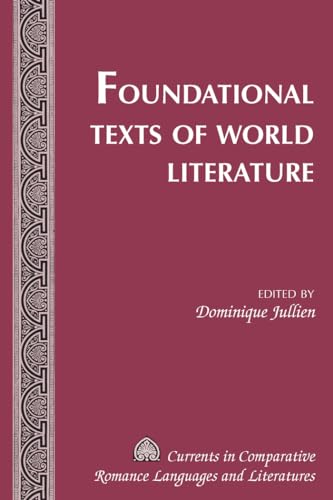
Foundational Texts of World Literature (184) (Currents in Comparative Romance Languages & Literatures) - Hardcover
Inhaltsangabe
What makes a world author? How did Homer become a cosmopolitan author? How does a Mayan creation narrative challenge our Western logocentric ideas of foundational texts? What might world literature look like to a fourth-century Roman reader? How do past and more recent translations of Dante's Commedia help us to rethink the changing definitions of world literature? How did the Alexander romance adapt to an Islamic context? How did Tasso's epic adapt to a later cultural context dominated by the Turkish Fear? What shaped the West's first impression of The Tale of Genji? How does the Ovidian myth of Arachne migrate from Japan to the Caribbean? What are the foundational metaphors at the root of Goethe's weltliteratur paradigm? What happens when cultures import canonical texts for lack of their own? By what process does an eccentric writer reconstruct a new foundational text from heterogeneous fragments of other cultures? How did literary criticism contribute to the canonization of the Thousand and One Nights in Western literature? What is left of the primacy of the national language when writers are published simultaneously in various translations? How do modern misreadings shape our understanding of national epics and ensure their survival?
World literature, first intuited in Goethe's foundational idea of weltliteratur as literature that seeks to transcend national boundaries, is viewed here in its essential mobility and migratory capacity, which relies on the centrality of the reading act. This volume focuses on foundational texts as they are read across cultures, languages and historical contexts. Its goal is to reflect on canonical texts - from Homer's Odyssey to Murakami's Genji, from Cervantes to Mayan hieroglyphs, from Dante to Coetzee, from Goethe to Lezama Lima, from the Thousand and One Nights to Jorge Luis Borges - in a global perspective: how they are translated, appropriated, transformed, how they travel across different cultures and languages, their foundational status evolving accordingly in a post-European world.
Foundational Texts of World Literature includes contributions by Gerardo Aldana, Sandra Bermann, Piero Boitani, Michael Emmerich, Azadeh Yamini Hamedani, Stefan Helgesson, Paulo Lemos Horta, Juan Pablo Lupi, Peter Madsen, Ulrich Marzolph, Suzanne Saïd, Evanghelia Stead, Mads Rosendahl Thomsen, and Richard Van Leeuwen.
Die Inhaltsangabe kann sich auf eine andere Ausgabe dieses Titels beziehen.
Über die Autorin bzw. den Autor
Dominique Jullien is Professor of French and Comparative Literature at the University of California, Santa Barbara. She is the author of Proust et ses modèles : les Mille et Une Nuits et les Mémoires de Saint-Simon (1989), Récits du Nouveau Monde : les voyageurs français en Amérique de Chateaubriand à nos jours (1992), Les Amoureux de Schéhérazade: variations modernes sur les Mille et Une Nuits (2009), as well as numerous articles on French and comparative literature of the nineteenth and twentieth centuries.
„Über diesen Titel“ kann sich auf eine andere Ausgabe dieses Titels beziehen.
Suchergebnisse für Foundational Texts of World Literature (184) (Currents...

Beispielbild für diese ISBN
Foundational Texts of World Literature
Anbieter: PBShop.store UK, Fairford, GLOS, Vereinigtes Königreich
Verkäuferbewertung 5 von 5 Sternen

HRD. Zustand: New. New Book. Shipped from UK. Established seller since 2000. Bestandsnummer des Verkäufers CX-9781433112690
Neu kaufen
EUR 75,55
Versand:
EUR 5,76
Von Vereinigtes Königreich nach USA
Anzahl: 15 verfügbar
Foto des Verkäufers
Foundational Texts of World Literature
Verlag:
Peter Lang Inc., International Academic Publishers, 2011
ISBN 10: 1433112698
ISBN 13: 9781433112690
Neu
Hardcover
Anbieter: GreatBookPrices, Columbia, MD, USA
Verkäuferbewertung 5 von 5 Sternen
Zustand: New. Bestandsnummer des Verkäufers 14292517-n
Neu kaufen
EUR 81,27
Versand:
EUR 2,27
Innerhalb der USA
Anzahl: Mehr als 20 verfügbar
Beispielbild für diese ISBN
Foundational Texts of World Literature (Currents in Comparative Romance Languages and Literatures)
Verlag:
Peter Lang Inc., International Academic Publishers, 2011
ISBN 10: 1433112698
ISBN 13: 9781433112690
Neu
Hardcover
Anbieter: Ria Christie Collections, Uxbridge, Vereinigtes Königreich
Verkäuferbewertung 5 von 5 Sternen
Zustand: New. In. Bestandsnummer des Verkäufers ria9781433112690_new
Neu kaufen
EUR 75,76
Versand:
EUR 13,73
Von Vereinigtes Königreich nach USA
Anzahl: Mehr als 20 verfügbar
Foto des Verkäufers
Foundational Texts of World Literature
Verlag:
Peter Lang Inc., International Academic Publishers, 2011
ISBN 10: 1433112698
ISBN 13: 9781433112690
Gebraucht
Hardcover
Anbieter: GreatBookPrices, Columbia, MD, USA
Verkäuferbewertung 5 von 5 Sternen
Zustand: As New. Unread book in perfect condition. Bestandsnummer des Verkäufers 14292517
Gebraucht kaufen
EUR 88,92
Versand:
EUR 2,27
Innerhalb der USA
Anzahl: Mehr als 20 verfügbar
Foto des Verkäufers
Foundational Texts of World Literature
Verlag:
Peter Lang Inc., International Academic Publishers, 2011
ISBN 10: 1433112698
ISBN 13: 9781433112690
Neu
Hardcover
Anbieter: GreatBookPricesUK, Woodford Green, Vereinigtes Königreich
Verkäuferbewertung 5 von 5 Sternen
Zustand: New. Bestandsnummer des Verkäufers 14292517-n
Neu kaufen
EUR 75,86
Versand:
EUR 17,20
Von Vereinigtes Königreich nach USA
Anzahl: Mehr als 20 verfügbar
Beispielbild für diese ISBN
Foundational Texts of World Literature
Anbieter: PBShop.store US, Wood Dale, IL, USA
Verkäuferbewertung 5 von 5 Sternen
HRD. Zustand: New. New Book. Shipped from UK. Established seller since 2000. Bestandsnummer des Verkäufers CX-9781433112690
Beispielbild für diese ISBN
Foundational Texts of World Literature
Print-on-DemandAnbieter: THE SAINT BOOKSTORE, Southport, Vereinigtes Königreich
Verkäuferbewertung 5 von 5 Sternen
Hardback. Zustand: New. This item is printed on demand. New copy - Usually dispatched within 5-9 working days 480. Bestandsnummer des Verkäufers C9781433112690
Neu kaufen
EUR 90,26
Versand:
EUR 17,83
Von Vereinigtes Königreich nach USA
Anzahl: Mehr als 20 verfügbar
Foto des Verkäufers
Foundational Texts of World Literature
Verlag:
Peter Lang Inc., International Academic Publishers, 2011
ISBN 10: 1433112698
ISBN 13: 9781433112690
Gebraucht
Hardcover
Anbieter: GreatBookPricesUK, Woodford Green, Vereinigtes Königreich
Verkäuferbewertung 5 von 5 Sternen
Zustand: As New. Unread book in perfect condition. Bestandsnummer des Verkäufers 14292517
Gebraucht kaufen
EUR 90,90
Versand:
EUR 17,20
Von Vereinigtes Königreich nach USA
Anzahl: Mehr als 20 verfügbar
Beispielbild für diese ISBN
Foundational Texts of World Literature (Hardcover)
Verlag:
Peter Lang Publishing Inc, 2011
ISBN 10: 1433112698
ISBN 13: 9781433112690
Neu
Hardcover
Erstausgabe
Anbieter: Grand Eagle Retail, Bensenville, IL, USA
Verkäuferbewertung 5 von 5 Sternen
Hardcover. Zustand: new. Hardcover. What makes a world author? How did Homer become a cosmopolitan author? How does a Mayan creation narrative challenge our Western logocentric ideas of foundational texts? What might world literature look like to a fourth-century Roman reader? How do past and more recent translations of Dantes Commedia help us to rethink the changing definitions of world literature? How did the Alexander romance adapt to an Islamic context? How did Tassos epic adapt to a later cultural context dominated by the Turkish Fear? What shaped the Wests first impression of The Tale of Genji? How does the Ovidian myth of Arachne migrate from Japan to the Caribbean? What are the foundational metaphors at the root of Goethes weltliteratur paradigm? What happens when cultures import canonical texts for lack of their own? By what process does an eccentric writer reconstruct a new foundational text from heterogeneous fragments of other cultures? How did literary criticism contribute to the canonization of the Thousand and One Nights in Western literature? What is left of the primacy of the national language when writers are published simultaneously in various translations? How do modern misreadings shape our understanding of national epics and ensure their survival? World literature, first intuited in Goethes foundational idea of weltliteratur as literature that seeks to transcend national boundaries, is viewed here in its essential mobility and migratory capacity, which relies on the centrality of the reading act. This volume focuses on foundational texts as they are read across cultures, languages and historical contexts. Its goal is to reflect on canonical texts from Homers Odyssey to Murakamis Genji, from Cervantes to Mayan hieroglyphs, from Dante to Coetzee, from Goethe to Lezama Lima, from the Thousand and One Nights to Jorge Luis Borges in a global perspective: how they are translated, appropriated, transformed, how they travel across different cultures and languages, their foundational status evolving accordingly in a post-European world. Foundational Texts of World Literature includes contributions by Gerardo Aldana, Sandra Bermann, Piero Boitani, Michael Emmerich, Azadeh Yamini Hamedani, Stefan Helgesson, Paulo Lemos Horta, Juan Pablo Lupi, Peter Madsen, Ulrich Marzolph, Suzanne Said, Evanghelia Stead, Mads Rosendahl Thomsen, and Richard Van Leeuwen. Foundational Texts of World Literature Shipping may be from multiple locations in the US or from the UK, depending on stock availability. Bestandsnummer des Verkäufers 9781433112690
Foto des Verkäufers
Foundational Texts of World Literature
Print-on-DemandAnbieter: BuchWeltWeit Ludwig Meier e.K., Bergisch Gladbach, Deutschland
Verkäuferbewertung 5 von 5 Sternen
Buch. Zustand: Neu. This item is printed on demand - it takes 3-4 days longer - Neuware -What makes a world author How did Homer become a «cosmopolitan» author How does a Mayan creation narrative challenge our Western logocentric ideas of foundational texts What might world literature look like to a fourth-century Roman reader How do past and more recent translations of Dante's Commedia help us to rethink the changing definitions of world literature How did the Alexander romance adapt to an Islamic context How did Tasso's epic adapt to a later cultural context dominated by the «Turkish Fear» What shaped the West's first impression of The Tale of Genji How does the Ovidian myth of Arachne migrate from Japan to the Caribbean What are the foundational metaphors at the root of Goethe's weltliteratur paradigm What happens when cultures import canonical texts for lack of their own By what process does an eccentric writer reconstruct a new foundational text from heterogeneous fragments of other cultures How did literary criticism contribute to the canonization of the Thousand and One Nights in Western literature What is left of the primacy of the national language when writers are published simultaneously in various translations How do modern misreadings shape our understanding of national epics and ensure their survival World literature, first intuited in Goethe's foundational idea of weltliteratur as literature that seeks to transcend national boundaries, is viewed here in its essential mobility and migratory capacity, which relies on the centrality of the reading act. This volume focuses on foundational texts as they are read across cultures, languages and historical contexts. Its goal is to reflect on canonical texts - from Homer's Odyssey to Murakami's Genji, from Cervantes to Mayan hieroglyphs, from Dante to Coetzee, from Goethe to Lezama Lima, from the Thousand and One Nights to Jorge Luis Borges - in a global perspective: how they are translated, appropriated, transformed, how they travel across different cultures and languages, their foundational status evolving accordingly in a post-European world. Foundational Texts of World Literature includes contributions by Gerardo Aldana, Sandra Bermann, Piero Boitani, Michael Emmerich, Azadeh Yamini Hamedani, Stefan Helgesson, Paulo Lemos Horta, Juan Pablo Lupi, Peter Madsen, Ulrich Marzolph, Suzanne Saïd, Evanghelia Stead, Mads Rosendahl Thomsen, and Richard Van Leeuwen. 238 pp. Englisch. Bestandsnummer des Verkäufers 9781433112690
Neu kaufen
EUR 91,55
Versand:
EUR 23,00
Von Deutschland nach USA
Anzahl: 2 verfügbar