
Verwandte Artikel zu Unorthodox: The Scandalous Rejection of My Hasidic...
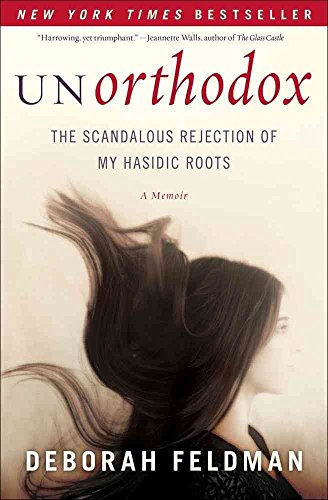
Inhaltsangabe
The instant New York Times bestselling memoir of a young Jewish woman’s escape from a religious sect, in the tradition of Ayaan Hirsi Ali’s Infidel and Carolyn Jessop’s Escape.
The Satmar sect of Hasidic Judaism is as mysterious as it is intriguing to outsiders. In this arresting memoir, Deborah Feldman reveals what life is like trapped within a religious tradition that values silence and suffering over individual freedoms.
Deborah grew up under a code of relentlessly enforced customs governing everything from what she could wear and to whom she could speak to what she was allowed to read. It was stolen moments spent with the empowered literary characters of Jane Austen and Louisa May Alcott that helped her to imagine an alternative way of life. Trapped as a teenager in a sexually and emotionally dysfunctional marriage to a man she barely knew, the tension between Deborah’s desires and her responsibilities as a good Satmar girl grew more explosive until she gave birth at nineteen and realized that, for the sake of herself and her son, she had to escape.
Die Inhaltsangabe kann sich auf eine andere Ausgabe dieses Titels beziehen.
Über die Autorin bzw. den Autor
Deborah Feldman was raised in the Hasidic community of Satmar in the Williamsburg section of Brooklyn, New York. She attends Sarah Lawrence College and lives in New York City with her son.
Auszug. © Genehmigter Nachdruck. Alle Rechte vorbehalten.
Unorthodox
Prologue
On the eve of my twenty-fourth birthday I interview my mother. We meet at a vegetarian restaurant in Manhattan, one that announces itself as organic and farm-fresh, and despite my recent penchant for all things pork and shellfish, I am looking forward to the simplicity the meal promises. The waiter who serves us is conspicuously gentile-looking, with scruffy blond hair and big blue eyes. He treats us like royalty because we are on the Upper East Side and are prepared to shell out a hundred bucks for a lunch consisting largely of vegetables. I think it is ironic that he doesn’t know that the two of us are outsiders, that he automatically takes our existence for granted. I never thought this day would come.
Before we met, I told my mother that I had some questions for her. Although we’ve spent more time together over the past year than we did in all my teenage years put together, thus far I’ve mostly avoided talking about the past. Perhaps I did not want to know. Maybe I didn’t want to find out that whatever information had been fed to me about my mother was wrong, or maybe I didn’t want to accept that it was right. Still, publishing my life story calls for scrupulous honesty, and not just my own.
A year ago to this date I left the Hasidic community for good. I am twenty-four and I still have my whole life ahead of me. My son’s future is chock-full of possibilities. I feel as if I have made it to the starting line of a race just in time to hear the gun go off. Looking at my mother, I understand that there might be similarities between us, but the differences are more glaringly obvious. She was older when she left, and she didn’t take me with her. Her journey speaks more of a struggle for security than happiness. Our dreams hover above us like clouds, and mine seem bigger and fluffier than her wispy strip of cirrus high in a winter sky.
As far back as I can remember, I have always wanted everything from life, everything it can possibly give me. This desire separates me from people who are willing to settle for less. I cannot even comprehend how people’s desires can be small, their ambitions narrow and limited, when the possibilities are so endless. I do not know my mother well enough to understand her dreams; for all I know, they seem big and important to her, and I want to respect that. Surely, for all our differences, there is that thread of common ground, that choice we both made for the better.
My mother was born and raised in a German Jewish community in England. While her family was religious, they were not Hasidic. A child of divorce, she describes her young self as troubled, awkward, and unhappy. Her chances of marrying, let alone marrying well, were slim, she tells me. The waiter puts a plate of polenta fries and some black beans in front of her, and she shoves her fork in a fry.
When the choice of marrying my father came along, it seemed like a dream, she says between bites. His family was wealthy, and they were desperate to marry him off. He had siblings waiting for him to get engaged so that they could start their own lives. He was twenty-four, unthinkably old for a good Jewish boy, too old to be single. The older they get, the less likely they are to be married off. Rachel, my mother, was my father’s last shot.
Everyone in my mother’s life was thrilled for her, she remembers. She would get to go to America! They were offering a beautiful, brand-new apartment, fully furnished. They offered to pay for everything. She would receive beautiful clothes and jewelry. There were many sisters-in-law who were excited to become her friends.
“So they were nice to you?” I ask, referring to my aunts and uncles, who, I remember, mostly looked down on me for reasons I could never fully grasp.
“In the beginning, yes,” she says. “I was the new toy from England, you know. The thin, pretty girl with the funny accent.”
She saved them all, the younger ones. They were spared the fate of getting older in their singlehood. In the beginning, they were grateful to see their brother married off.
“I made him into a mensch,” my mother tells me. “I made sure he always looked neat. He couldn’t take care of himself, but I did. I made him look better; they didn’t have to be so ashamed of him anymore.”
Shame is all I can recall of my feelings for my father. When I knew him, he was always shabby and dirty, and his behavior was childlike and inappropriate.
“What do you think of my father now?” I ask. “What do you think is wrong with him?”
“Oh, I don’t know. Delusional, I suppose. Mentally ill.”
“Really? You think it’s all that? You don’t think he was just plain mentally retarded?”
“Well, he saw a psychiatrist once after we were married, and the psychiatrist told me he was pretty sure your father had some sort of personality disorder, but there was no way to tell, because your father refused to cooperate with further testing and never went back for treatment.”
“Well, I don’t know,” I say thoughtfully. “Aunt Chaya told me once that he was diagnosed as a child, with retardation. She said his IQ was sixty-six. There’s not much you can do about that.”
“They didn’t even try, though,” my mother insists. “They could have gotten him some treatment.”
I nod. “So in the beginning, they were nice to you. But what happened after?” I remember my aunts talking about my mother behind her back, saying hateful things.
“Well, after the fuss calmed down, they started to ignore me. They would do things and leave me out of it. They looked down on me because I was from a poor family, and they had all married money and come from money and they lived different lives. Your father couldn’t earn any money, and neither could I, so your grandfather supported us. But he was stingy, counting out the bare minimum for groceries. He was very smart, your zeide, but he didn’t understand people. He was out of touch with reality.”
I still feel a little sting when someone says something bad about my family, as if I have to defend them.
“Your bubbe, on the other hand, she had respect for me, I could tell. No one ever listened to her, and certainly she was more intelligent and open-minded than anyone gave her credit for.”
“Oh, I agree with that!” I’m thrilled to find we have some common ground, one family member whom we both see the same way. “She was like that to me too; she respected me even when everyone else thought I was just troublesome.”
“Yes, well . . . she had no power, though.”
“True.”
So in the end she had nothing to cling to, my mother. No husband, no family, no home. In college, she would exist, would have purpose, direction. You leave when there’s nothing left to stay for; you go where you can be useful, where people accept you.
The waiter comes to the table holding a chocolate brownie with a candle stuck in it. “Happy birthday to you . . . ,” he sings softly, meeting my eyes for a second. I look down, feeling my cheeks redden.
“Blow out the candle,” my mother urges, taking out her camera. I want to laugh. I bet the waiter thinks that I’m just like every other birthday girl going out with her mom, and that we do this every year. Would anyone guess that my mother missed most of my birthdays growing up? How can she be so quick to jump back into things? Does it feel natural to...
„Über diesen Titel“ kann sich auf eine andere Ausgabe dieses Titels beziehen.
Suchergebnisse für Unorthodox: The Scandalous Rejection of My Hasidic...

Beispielbild für diese ISBN
Unorthodox: The Scandalous Rejection of My Hasidic Roots
Anbieter: World of Books (was SecondSale), Montgomery, IL, USA
Verkäuferbewertung 5 von 5 Sternen

Zustand: Acceptable. Item in good condition. Textbooks may not include supplemental items i.e. CDs, access codes etc. Bestandsnummer des Verkäufers 00066387036
Gebraucht kaufen
EUR 3,71
Versand gratis
Versand innerhalb von USA
Versand innerhalb von USA
Anzahl: 3 verfügbar
Beispielbild für diese ISBN
Unorthodox: The Scandalous Rejection of My Hasidic Roots
Anbieter: World of Books (was SecondSale), Montgomery, IL, USA
Verkäuferbewertung 5 von 5 Sternen
Zustand: Good. Item in good condition. Textbooks may not include supplemental items i.e. CDs, access codes etc. Bestandsnummer des Verkäufers 00096179494
Gebraucht kaufen
EUR 3,71
Versand gratis
Versand innerhalb von USA
Versand innerhalb von USA
Anzahl: Mehr als 20 verfügbar
Beispielbild für diese ISBN
Unorthodox: The Scandalous Rejection of My Hasidic Roots
Anbieter: World of Books (was SecondSale), Montgomery, IL, USA
Verkäuferbewertung 5 von 5 Sternen
Zustand: Very Good. Item in very good condition! Textbooks may not include supplemental items i.e. CDs, access codes etc. Bestandsnummer des Verkäufers 00108651862
Gebraucht kaufen
EUR 3,71
Versand gratis
Versand innerhalb von USA
Versand innerhalb von USA
Anzahl: 1 verfügbar
Beispielbild für diese ISBN
Unorthodox: The Scandalous Rejection of My Hasidic Roots
Anbieter: Your Online Bookstore, Houston, TX, USA
Verkäuferbewertung 5 von 5 Sternen
Hardcover. Zustand: Good. Bestandsnummer des Verkäufers 1439187002-3-19490254
Gebraucht kaufen
EUR 3,72
Versand gratis
Versand innerhalb von USA
Versand innerhalb von USA
Anzahl: 1 verfügbar
Foto des Verkäufers
Unorthodox: The Scandalous Rejection of My Hasidic Roots
Anbieter: Greenworld Books, Arlington, TX, USA
Verkäuferbewertung 5 von 5 Sternen
Zustand: good. Fast Free Shipping â" Good condition. It may show normal signs of use, such as light writing, highlighting, or library markings, but all pages are intact and the book is fully readable. A solid, complete copy that's ready to enjoy. Bestandsnummer des Verkäufers GWV.1439187002.G
Gebraucht kaufen
EUR 4,45
Versand gratis
Versand innerhalb von USA
Versand innerhalb von USA
Anzahl: 1 verfügbar
Beispielbild für diese ISBN
Unorthodox: The Scandalous Rejection of My Hasidic Roots
Anbieter: More Than Words, Waltham, MA, USA
Verkäuferbewertung 5 von 5 Sternen
Zustand: Good. A sound copy with only light wear. Overall a solid copy at a great price! Bestandsnummer des Verkäufers BOS-A-03j-01596
Gebraucht kaufen
EUR 1,13
EUR 3,46 Versand
Versand innerhalb von USA
Versand innerhalb von USA
Anzahl: 2 verfügbar
Foto des Verkäufers
Unorthodox: The Scandalous Rejection of My Hasidic Roots
Anbieter: 3Brothers Bookstore, Egg harbor township, NJ, USA
Verkäuferbewertung 5 von 5 Sternen
Zustand: very_good. Cover may have light wear, pages in very good condition and binding is sturdy; may have other light shelf wear or creases. May have notes or highlighting. Bestandsnummer des Verkäufers EVV.1439187002.VG
Gebraucht kaufen
EUR 4,70
Versand gratis
Versand innerhalb von USA
Versand innerhalb von USA
Anzahl: 1 verfügbar
Foto des Verkäufers
Unorthodox: The Scandalous Rejection of My Hasidic Roots
Anbieter: Zoom Books Company, Lynden, WA, USA
Verkäuferbewertung 5 von 5 Sternen
Zustand: very_good. Book is in very good condition and may include minimal underlining highlighting. The book can also include "From the library of" labels. May not contain miscellaneous items toys, dvds, etc. . We offer 100% money back guarantee and 24 7 customer service. Bestandsnummer des Verkäufers ZBV.1439187002.VG
Gebraucht kaufen
EUR 4,92
Versand gratis
Versand innerhalb von USA
Versand innerhalb von USA
Anzahl: 1 verfügbar
Beispielbild für diese ISBN
Unorthodox: The Scandalous Rejection of My Hasidic Roots
Verlag:
Simon & Schuster (edition 42801st), 2012
ISBN 10: 1439187002
ISBN 13: 9781439187005
Gebraucht
Hardcover
Anbieter: BooksRun, Philadelphia, PA, USA
Verkäuferbewertung 5 von 5 Sternen
Hardcover. Zustand: Fair. 42801st. The item might be beaten up but readable. May contain markings or highlighting, as well as stains, bent corners, or any other major defect, but the text is not obscured in any way. Bestandsnummer des Verkäufers 1439187002-7-1-13
Gebraucht kaufen
EUR 5,08
Versand gratis
Versand innerhalb von USA
Versand innerhalb von USA
Anzahl: 1 verfügbar
Beispielbild für diese ISBN
Unorthodox: The Scandalous Rejection of My Hasidic Roots
Anbieter: World of Books Inc, Montgomery, IL, USA
Verkäuferbewertung 2 von 5 Sternen

Hardback. Zustand: Very Good. The instant New York Times bestselling memoir of a young Jewish woman's escape from a religious sect, in the tradition of Ayaan Hirsi Ali's Infidel and Carolyn Jessop's Escape, featuring a new epilogue by the author.As a member of the strictly religious Satmar sect of Hasidic Judaism, Deborah Feldman grew up under a code of relentlessly enforced customs governing everything from what she could wear and to whom she could speak to what she was allowed to read. It was stolen moments spent with the empowered literary characters of Jane Austen and Louisa May Alcott that helped her to imagine an alternative way of life. Trapped as a teenager in a sexually and emotionally dysfunctional marriage to a man she barely knew, the tension between Deborah's desires and her responsibilities as a good Satmar girl grew more explosive until she gave birth at nineteen and realized that, for the sake of herself and her son, she had to escape. Bestandsnummer des Verkäufers CIN1439187002VG
Gebraucht kaufen
EUR 5,49
Versand gratis
Versand innerhalb von USA
Versand innerhalb von USA
Anzahl: 1 verfügbar