
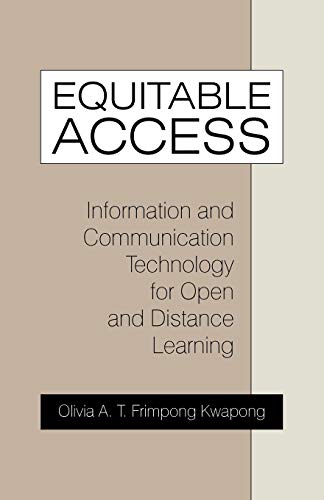
Equitable Access: Information and Communication Technology for Open and Distance Learning - Softcover
Inhaltsangabe
Concerns about new learning environments have spurred the debate as to whether the new world of online teaching and virtual studying might be as closed to the developing world, especially the women, as the traditional universities were until the turn of the twentieth century. Gender specific and feminist research shows that women often have less access to technology, less control over the ICT (Information and Communication Technology) in their homes and places of work, and less confidence and competency in using these technologies. According to the United Nations, lack of access to information is the third most important issue facing women globally, after poverty and violence against women. Equitable Access looks in detail at the ODL (Online Distance Learning) and ICT situations in Ghana. The author provides a critical assessment of the strengths and threats to the development of an effective distance education program in tertiary institutions in Ghana, surfacing the need to promote equity in educational access. Based on a survey of distance learners in four public universities, the author navigates to the heart of issues and determines that in Ghana and for that matter Africa, the digital and gender divides could further widen if conscious effort is not made to mainstream ICT in all gender issues.
Die Inhaltsangabe kann sich auf eine andere Ausgabe dieses Titels beziehen.
Über die Autorin bzw. den Autor
Olivia A. T. Frimpong Kwapong holds a PhD from the University of Ghana. She has studied as a special Doctoral Candidate at Harvard University. She is currently a senior lecturer at the Institute of Adult Education, University of Ghana. She promotes empowerment of women through adult education, distance learning, and the use of ICTs.
Auszug. © Genehmigter Nachdruck. Alle Rechte vorbehalten.
Equitable Access
Information and Communication Technology For Open and Distance LearningBy Olivia A. T. Frimpong KwapongiUniverse, Inc.
Copyright © 2010 Olivia A. T. Frimpong KwapongAll right reserved.
ISBN: 978-1-4401-9417-7
Contents
Part 1 Education and ICT in Ghana.............................................1Chapter 1 Education in Ghana: A Contextual Overview...........................3Chapter 2 Education in Ghana: Access and Equity Issues........................15Chapter 3 ICT for Education: Policy Initiatives...............................41Chapter 4 The State of ICT Service Provision in Ghana.........................52Part 2 Open and Distance Learning (ODL).......................................69Chapter 5 Open and Distance Learning: An Overview.............................71Chapter 6 Features of ODL.....................................................95Chapter 7 The Practice of Distance Education in Ghana.........................125Part 3 ODL and ICT for Women..................................................141Chapter 8 ICT Knowledge and Usage among Distance Learners.....................143Chapter 9 Women and ODL.......................................................171Chapter 10 Tying the Knots: ICT for ODL for Women.............................193References....................................................................209
Chapter One
Education in Ghana: A Contextual Overview
Background
Ghana's formal educational system has gone through several phases of reform to identify an educational system that responds to the times as well as national aspirations. In most cases, the reforms have dealt with content, methods, or duration. During the missionary and colonial era, education focused on transformation of the individual to suit the Western lifestyle, particularly in the areas of religion and occupation.
The traditional notion of education is the type of teaching and learning that occurs in personal contact between the teacher and the learner in the classroom setting. This is anchored in the reality that teaching and learning take place at the same time and same place. With the introduction of new technology, including printed materials for correspondence, it became clear that formal, informal, or non-formal teaching and learning could also be done via technology. The rapid development in learning theories and advancement in technology has made it possible to shift from institution-led learning to own-time self-learning at a distance. Thus the trend has moved from face-to-face teaching to self-paced learning, which is gradually moving toward flexibility and openness. It is this experience that has progressed to the alternative delivery system known as the ODL system (Infoplease n.d.)
The views on the use of ICT for teaching and learning and sustainable development in the developing world are divergent. There has been the argument that developing countries should focus on more immediate and pressing needs such as jobs, food, water, education, and electricity instead of ICT for development and education, which requires considerable expenditure of scarce resources (Gulati 2008). Others have responded in support of a full exploration of the use of ICT as a tool for attacking the difficult problem of poverty alleviation (Abdulkafi 2008; Robinson 2008). For most scholars and policy leaders, ICT is one of the contributing factors to social and economic disparities across different social and economic groups, disparities between developed and developing countries, between rural and urban dwellers, between men and women, and between the elite and the illiterate. Hence the need to explore its potential to bridge the various divides through education (Opoku 2004).
Educational Reforms in Ghana
After independence, Ghana continued to search for a system of education that was relevant to the world of work and adequate for rural development and the modernization of its agriculture-based economy. The country has also been interested in a system of education that seeks to promote national and cultural identity and citizenship.
Some of the laws, policy documents, and reports that have been adopted over the years by the various governments for meeting the educational needs and aspirations of the people include the following:
Accelerated Development Plan for Education, 1951 Education Act of 1961 (Act 87) Dzobo Report of 1973 (recommended the Junior Secondary School/Senior Secondary School concept) New Structure and Content of Education 1974 Ghana Education Service Decree 1974 Education Commission Report on Basic and Secondary Education 1987/88 Education Reform Program 1987/88 University Relationalization Committee Report 1988 Constitution of the Republic of Ghana 1992 Ghana Education Service Act of 1995 Free Compulsory Universal Basic Education Program, 1996 (1992 Constitution) FCUBE Policy Document and Program of Operations, 1996 Ghana Education Trust Fund-GET Fund Act 2000 (Act 581) Ghana Vision 2020 document Review of Education Reforms in Ghana 2002 White Paper Report on Education Reform Review 2004
These initiatives have contributed to structural transformation of the educational system in improving access, high-quality teaching, and learning. Infrastructural delivery as well as management efficiency has also been improved. There have, however, been some identifiable weaknesses that have led to the various reviews in the educational system. For instance, much as President Nkrumah's Accelerated Development Plan of Education contributed to the expansion of enrollment in elementary and secondary education in the country, it also affected the standard of education at the basic and secondary levels and produced a lot of unemployed school leavers. The policy was also popularly described as too elitist. The implementation of the Dzobo Report of 1973 in the year 1987 made a tremendous impact on the system of education of the country by introducing the Junior Secondary School (JSS) system for teaching both academic and practical skills. After more than twenty years of practice, the assessment report revealed that the system had produced a large number of older teenage school leavers, most of whom were deficient in basic math and literacy skills. Graduates of the JSS level had also been described as ill-prepared for either formal second-cycle education or the life of work and lifelong learning for self-actualization (Ghana 2004; Ghana 2007a; Ghana 2003a).
The Current Review of Education
Recognizing the drawbacks in previous educational reforms, a committee was set up in 2002 to review the entire educational system to make it more responsive to current challenges. The task of the committee focused on an examination of the structure of education, issues affecting development and delivery of education, the constrained access to different levels of the educational ladder, information and communication technology application, and distance education, among others.
Based on the report of the committee, the country decided to settle on a philosophy of education that seeks to create well-balanced, all-around people with adequate knowledge, skills, values, aptitudes, and attitudes to become functional and productive citizens. The underlying principle is that as the human resource of a country that has a great economic ambition, Ghanaians should be trained to...
„Über diesen Titel“ kann sich auf eine andere Ausgabe dieses Titels beziehen.
Weitere beliebte Ausgaben desselben Titels

Suchergebnisse für Equitable Access: Information and Communication Technology...

Foto des Verkäufers
Equitable Access : Information and Communication Technology for Open and Distance Learning
Anbieter: GreatBookPrices, Columbia, MD, USA
Verkäuferbewertung 5 von 5 Sternen

Zustand: As New. Unread book in perfect condition. Bestandsnummer des Verkäufers 8547938
Gebraucht kaufen
EUR 14,35
EUR 2,28 Versand
Versand innerhalb von USA
Versand innerhalb von USA
Anzahl: Mehr als 20 verfügbar
Beispielbild für diese ISBN
Equitable Access: Information and Communication Technology for Open and Distance Learning
Anbieter: Lucky's Textbooks, Dallas, TX, USA
Verkäuferbewertung 5 von 5 Sternen
Zustand: New. Bestandsnummer des Verkäufers ABLIING23Mar2411530282462
Neu kaufen
EUR 14,24
EUR 3,44 Versand
Versand innerhalb von USA
Versand innerhalb von USA
Anzahl: Mehr als 20 verfügbar
Foto des Verkäufers
Equitable Access : Information and Communication Technology for Open and Distance Learning
Anbieter: GreatBookPrices, Columbia, MD, USA
Verkäuferbewertung 5 von 5 Sternen
Zustand: New. Bestandsnummer des Verkäufers 8547938-n
Neu kaufen
EUR 15,43
EUR 2,28 Versand
Versand innerhalb von USA
Versand innerhalb von USA
Anzahl: Mehr als 20 verfügbar
Beispielbild für diese ISBN
Equitable Access Information and Communication Technology for Open and Distance Learning
Print-on-DemandAnbieter: PBShop.store US, Wood Dale, IL, USA
Verkäuferbewertung 5 von 5 Sternen
PAP. Zustand: New. New Book. Shipped from UK. THIS BOOK IS PRINTED ON DEMAND. Established seller since 2000. Bestandsnummer des Verkäufers L0-9781440194177
Neu kaufen
EUR 20,59
Versand gratis
Versand innerhalb von USA
Versand innerhalb von USA
Anzahl: Mehr als 20 verfügbar
Beispielbild für diese ISBN
Equitable Access Information and Communication Technology for Open and Distance Learning
Print-on-DemandAnbieter: PBShop.store UK, Fairford, GLOS, Vereinigtes Königreich
Verkäuferbewertung 5 von 5 Sternen
PAP. Zustand: New. New Book. Delivered from our UK warehouse in 4 to 14 business days. THIS BOOK IS PRINTED ON DEMAND. Established seller since 2000. Bestandsnummer des Verkäufers L0-9781440194177
Neu kaufen
EUR 18,84
EUR 4,81 Versand
Versand von Vereinigtes Königreich nach USA
Versand von Vereinigtes Königreich nach USA
Anzahl: Mehr als 20 verfügbar
Beispielbild für diese ISBN
Equitable Access
Print-on-DemandAnbieter: Majestic Books, Hounslow, Vereinigtes Königreich
Verkäuferbewertung 4 von 5 Sternen

Zustand: New. Print on Demand pp. 260 22:B&W 5.5 x 8.5 in or 216 x 140 mm (Demy 8vo) Perfect Bound on White w/Gloss Lam. Bestandsnummer des Verkäufers 127967939
Neu kaufen
EUR 19,08
EUR 7,52 Versand
Versand von Vereinigtes Königreich nach USA
Versand von Vereinigtes Königreich nach USA
Anzahl: 4 verfügbar
Beispielbild für diese ISBN
Equitable Access
Print-on-DemandAnbieter: Books Puddle, New York, NY, USA
Verkäuferbewertung 4 von 5 Sternen
Zustand: New. Print on Demand pp. 260. Bestandsnummer des Verkäufers 26131538204
Neu kaufen
EUR 25,02
EUR 3,44 Versand
Versand innerhalb von USA
Versand innerhalb von USA
Anzahl: 4 verfügbar
Beispielbild für diese ISBN
Equitable Access
Print-on-DemandAnbieter: Biblios, Frankfurt am main, HESSE, Deutschland
Verkäuferbewertung 4 von 5 Sternen
Zustand: New. PRINT ON DEMAND pp. 260. Bestandsnummer des Verkäufers 18131538198
Neu kaufen
EUR 19,45
EUR 9,95 Versand
Versand von Deutschland nach USA
Versand von Deutschland nach USA
Anzahl: 4 verfügbar
Beispielbild für diese ISBN
Equitable Access: Information and Communication Technology for Open and Distance Learning
Anbieter: Ria Christie Collections, Uxbridge, Vereinigtes Königreich
Verkäuferbewertung 5 von 5 Sternen
Zustand: New. In. Bestandsnummer des Verkäufers ria9781440194177_new
Neu kaufen
EUR 19,00
EUR 13,86 Versand
Versand von Vereinigtes Königreich nach USA
Versand von Vereinigtes Königreich nach USA
Anzahl: Mehr als 20 verfügbar
Foto des Verkäufers
Equitable Access : Information and Communication Technology for Open and Distance Learning
Anbieter: GreatBookPricesUK, Woodford Green, Vereinigtes Königreich
Verkäuferbewertung 5 von 5 Sternen
Zustand: New. Bestandsnummer des Verkäufers 8547938-n
Neu kaufen
EUR 18,83
EUR 17,36 Versand
Versand von Vereinigtes Königreich nach USA
Versand von Vereinigtes Königreich nach USA
Anzahl: Mehr als 20 verfügbar