
Verwandte Artikel zu Handbook of Sample Preparation for Scanning Electron...
Inhaltsangabe
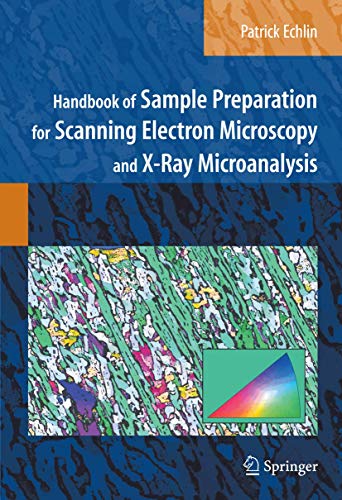
Scanning electr on microscopy (SEM) and x-ray microanalysis can produce magnified images and in situ chemical information from virtually any type of specimen. The two instruments generally operate in a high vacuum and a very dry environment in order to produce the high energy beam of electrons needed for imaging and analysis. With a few notable exceptions, most specimens destined for study in the SEM are poor conductors and composed of beam sensitive light elements containing variable amounts of water. In the SEM, the imaging system depends on the specimen being sufficiently electrically conductive to ensure that the bulk of the incoming electrons go to ground. The formation of the image depends on collecting the different signals that are scattered as a consequence of the high energy beam interacting with the sample. Backscattered electrons and secondary electrons are generated within the primary beam-sample interactive volume and are the two principal signals used to form images. The backscattered electron coefficient ( ? ) increases with increasing atomic number of the specimen, whereas the secondary electron coefficient ( ? ) is relatively insensitive to atomic number. This fundamental diff- ence in the two signals can have an important effect on the way samples may need to be prepared. The analytical system depends on collecting the x-ray photons that are generated within the sample as a consequence of interaction with the same high energy beam of primary electrons used to produce images.
Die Inhaltsangabe kann sich auf eine andere Ausgabe dieses Titels beziehen.
Über die Autorin bzw. den Autor
Patrick Echlin was a lecturer in the Department of Plant Sciences and Director of the Multi-Imaging Centre, School of Biological Science, University of Cambridge until he retired in 1999. He has taught for more than thirty years at the Lehigh University Microscopy School and is the author and co-auther of eight books on scanning electron microscopy and x-ray microanalysis. He is an Honorary Fellow of the Royal Microscopical Society and received the Distinguished Scientist Award in Biological Sciences from the Microscope Society of America in 2001.
Von der hinteren Coverseite
This Handbook is a complete guide to preparing a wide variety of specimens for the scanning electron microscope and x-ray microanalyzers. Specimens range from inorganic, organic, biological, and geological samples to materials such as metals, polymers, and semiconductors which can exist as solids, liquids and gases. While the Handbook complements the best-selling textbook, Scanning Electron Microscopy and X-Ray Microanalysis, Third Edition, by Goldstein, et al., it is entirely self-contained and describes what is needed up to the point the sample is put into the instrument. Photomicrographs of each specimen complement the many sample preparation "recipes." Additional chapters describe the general features of specimen preparation in relation to the different needs of scanning electron microscopes and x-ray microanalyzers, and an appendix covers chemicals and equipment applicable to any of the recipes. This practical Handbook is an essential reference for anyone who uses these instruments. It assumes only an elementary knowledge of preparation techniques but also serves as an authoritative guide for more experienced microscopists.
„Über diesen Titel“ kann sich auf eine andere Ausgabe dieses Titels beziehen.
Suchergebnisse für Handbook of Sample Preparation for Scanning Electron...

Beispielbild für diese ISBN
Handbook of Sample Preparation for Scanning Electron Microscopy and X-Ray Microanalysis
Verlag:
Springer, New York, NY, 2010
ISBN 10: 1441946748
ISBN 13: 9781441946744
Gebraucht
Soft cover
Anbieter: Robert Fulgham, Bookseller, Idaho Falls, ID, USA
Verkäuferbewertung 5 von 5 Sternen

Soft cover. Zustand: Near Fine. Near Fine softcover. Appears unread. Name and date on the first page, else no writing or other marks. We wrap and box our books for shipping. Bestandsnummer des Verkäufers 24607
Gebraucht kaufen
EUR 82,41
EUR 3,56 Versand
Versand innerhalb von USA
Versand innerhalb von USA
Anzahl: 1 verfügbar
Beispielbild für diese ISBN
Handbook of Sample Preparation for Scanning Electron Microscopy and X-Ray Microanalysis (eng)
Print-on-DemandAnbieter: Brook Bookstore On Demand, Napoli, NA, Italien
Verkäuferbewertung 5 von 5 Sternen
Zustand: new. Questo è un articolo print on demand. Bestandsnummer des Verkäufers d870f712de3c45bc410ab5fc422d7f06
Neu kaufen
EUR 126,26
EUR 6,80 Versand
Versand von Italien nach USA
Versand von Italien nach USA
Anzahl: Mehr als 20 verfügbar
Foto des Verkäufers
Handbook of Sample Preparation for Scanning Electron Microscopy and X-Ray Microanalysis
Verlag:
Springer US, Springer US Nov 2010, 2010
ISBN 10: 1441946748
ISBN 13: 9781441946744
Neu
Taschenbuch
Anbieter: BuchWeltWeit Ludwig Meier e.K., Bergisch Gladbach, Deutschland
Verkäuferbewertung 5 von 5 Sternen
Taschenbuch. Zustand: Neu. This item is printed on demand - it takes 3-4 days longer - Neuware -Scanning electr on microscopy (SEM) and x-ray microanalysis can produce magnified images and in situ chemical information from virtually any type of specimen. The two instruments generally operate in a high vacuum and a very dry environment in order to produce the high energy beam of electrons needed for imaging and analysis. With a few notable exceptions, most specimens destined for study in the SEM are poor conductors and composed of beam sensitive light elements containing variable amounts of water. In the SEM, the imaging system depends on the specimen being sufficiently electrically conductive to ensure that the bulk of the incoming electrons go to ground. The formation of the image depends on collecting the different signals that are scattered as a consequence of the high energy beam interacting with the sample. Backscattered electrons and secondary electrons are generated within the primary beam-sample interactive volume and are the two principal signals used to form images. The backscattered electron coefficient ( ) increases with increasing atomic number of the specimen, whereas the secondary electron coefficient ( ) is relatively insensitive to atomic number. This fundamental diff- ence in the two signals can have an important effect on the way samples may need to be prepared. The analytical system depends on collecting the x-ray photons that are generated within the sample as a consequence of interaction with the same high energy beam of primary electrons used to produce images. 344 pp. Englisch. Bestandsnummer des Verkäufers 9781441946744
Neu kaufen
EUR 160,49
EUR 23,00 Versand
Versand von Deutschland nach USA
Versand von Deutschland nach USA
Anzahl: 2 verfügbar
Foto des Verkäufers
Handbook of Sample Preparation for Scanning Electron Microscopy and X-Ray Microanalysis
Print-on-DemandAnbieter: moluna, Greven, Deutschland
Verkäuferbewertung 5 von 5 Sternen
Zustand: New. Dieser Artikel ist ein Print on Demand Artikel und wird nach Ihrer Bestellung fuer Sie gedruckt. Identifies problems that all specimens present in examining their structure and analysis in the SEMDescribes a series of protocols to ensure that a specimen is properly prepared once the particular problems are identifiedGuides the reader t. Bestandsnummer des Verkäufers 4175007
Neu kaufen
EUR 136,16
EUR 48,99 Versand
Versand von Deutschland nach USA
Versand von Deutschland nach USA
Anzahl: Mehr als 20 verfügbar
Foto des Verkäufers
Handbook of Sample Preparation for Scanning Electron Microscopy and X-Ray Microanalysis
Anbieter: AHA-BUCH GmbH, Einbeck, Deutschland
Verkäuferbewertung 5 von 5 Sternen
Taschenbuch. Zustand: Neu. Druck auf Anfrage Neuware - Printed after ordering - Scanning electr on microscopy (SEM) and x-ray microanalysis can produce magnified images and in situ chemical information from virtually any type of specimen. The two instruments generally operate in a high vacuum and a very dry environment in order to produce the high energy beam of electrons needed for imaging and analysis. With a few notable exceptions, most specimens destined for study in the SEM are poor conductors and composed of beam sensitive light elements containing variable amounts of water. In the SEM, the imaging system depends on the specimen being sufficiently electrically conductive to ensure that the bulk of the incoming electrons go to ground. The formation of the image depends on collecting the different signals that are scattered as a consequence of the high energy beam interacting with the sample. Backscattered electrons and secondary electrons are generated within the primary beam-sample interactive volume and are the two principal signals used to form images. The backscattered electron coefficient ( ) increases with increasing atomic number of the specimen, whereas the secondary electron coefficient ( ) is relatively insensitive to atomic number. This fundamental diff- ence in the two signals can have an important effect on the way samples may need to be prepared. The analytical system depends on collecting the x-ray photons that are generated within the sample as a consequence of interaction with the same high energy beam of primary electrons used to produce images. Bestandsnummer des Verkäufers 9781441946744
Neu kaufen
EUR 170,19
EUR 35,00 Versand
Versand von Deutschland nach USA
Versand von Deutschland nach USA
Anzahl: 1 verfügbar
Foto des Verkäufers
Handbook of Sample Preparation for Scanning Electron Microscopy and X-Ray Microanalysis
Anbieter: preigu, Osnabrück, Deutschland
Verkäuferbewertung 5 von 5 Sternen
Taschenbuch. Zustand: Neu. Handbook of Sample Preparation for Scanning Electron Microscopy and X-Ray Microanalysis | Patrick Echlin | Taschenbuch | xii | Englisch | 2010 | Springer US | EAN 9781441946744 | Verantwortliche Person für die EU: Springer Verlag GmbH, Tiergartenstr. 17, 69121 Heidelberg, juergen[dot]hartmann[at]springer[dot]com | Anbieter: preigu. Bestandsnummer des Verkäufers 107152075
Neu kaufen
EUR 140,10
EUR 70,00 Versand
Versand von Deutschland nach USA
Versand von Deutschland nach USA
Anzahl: 5 verfügbar
Foto des Verkäufers
Handbook of Sample Preparation for Scanning Electron Microscopy and X-Ray Microanalysis
Verlag:
Springer US, Springer US Nov 2010, 2010
ISBN 10: 1441946748
ISBN 13: 9781441946744
Neu
Taschenbuch
Anbieter: buchversandmimpf2000, Emtmannsberg, BAYE, Deutschland
Verkäuferbewertung 5 von 5 Sternen
Taschenbuch. Zustand: Neu. This item is printed on demand - Print on Demand Titel. Neuware -Scanning electr on microscopy (SEM) and x-ray microanalysis can produce magnified images and in situ chemical information from virtually any type of specimen. The two instruments generally operate in a high vacuum and a very dry environment in order to produce the high energy beam of electrons needed for imaging and analysis. With a few notable exceptions, most specimens destined for study in the SEM are poor conductors and composed of beam sensitive light elements containing variable amounts of water. In the SEM, the imaging system depends on the specimen being sufficiently electrically conductive to ensure that the bulk of the incoming electrons go to ground. The formation of the image depends on collecting the different signals that are scattered as a consequence of the high energy beam interacting with the sample. Backscattered electrons and secondary electrons are generated within the primary beam-sample interactive volume and are the two principal signals used to form images. The backscattered electron coefficient ( ) increases with increasing atomic number of the specimen, whereas the secondary electron coefficient ( ) is relatively insensitive to atomic number. This fundamental diff- ence in the two signals can have an important effect on the way samples may need to be prepared. The analytical system depends on collecting the x-ray photons that are generated within the sample as a consequence of interaction with the same high energy beam of primary electrons used to produce images.Springer Verlag GmbH, Tiergartenstr. 17, 69121 Heidelberg 344 pp. Englisch. Bestandsnummer des Verkäufers 9781441946744
Neu kaufen
EUR 160,49
EUR 60,00 Versand
Versand von Deutschland nach USA
Versand von Deutschland nach USA
Anzahl: 1 verfügbar
Beispielbild für diese ISBN
Handbook of Sample Preparation for Scanning Electron Microscopy and X-Ray Microanalysis
Anbieter: Books Puddle, Woodside, NY, USA
Verkäuferbewertung 4 von 5 Sternen

Zustand: New. pp. XII + 330. Bestandsnummer des Verkäufers 263067095
Neu kaufen
EUR 219,91
EUR 3,55 Versand
Versand innerhalb von USA
Versand innerhalb von USA
Anzahl: 4 verfügbar
Beispielbild für diese ISBN
Handbook of Sample Preparation for Scanning Electron Microscopy and X-Ray Microanalysis
Print-on-DemandAnbieter: Biblios, Frankfurt am main, HESSE, Deutschland
Verkäuferbewertung 4 von 5 Sternen
Zustand: New. PRINT ON DEMAND pp. XII + 330. Bestandsnummer des Verkäufers 183067101
Neu kaufen
EUR 242,75
EUR 9,95 Versand
Versand von Deutschland nach USA
Versand von Deutschland nach USA
Anzahl: 4 verfügbar
Beispielbild für diese ISBN
Handbook of Sample Preparation for Scanning Electron Microscopy and X-Ray Microanalysis
Anbieter: Revaluation Books, Exeter, Vereinigtes Königreich
Verkäuferbewertung 5 von 5 Sternen
Paperback. Zustand: Brand New. 342 pages. 9.90x6.90x0.90 inches. In Stock. Bestandsnummer des Verkäufers zk1441946748
Neu kaufen
EUR 238,99
EUR 14,67 Versand
Versand von Vereinigtes Königreich nach USA
Versand von Vereinigtes Königreich nach USA
Anzahl: 1 verfügbar