
Verwandte Artikel zu Where Things Come Back
Inhaltsangabe
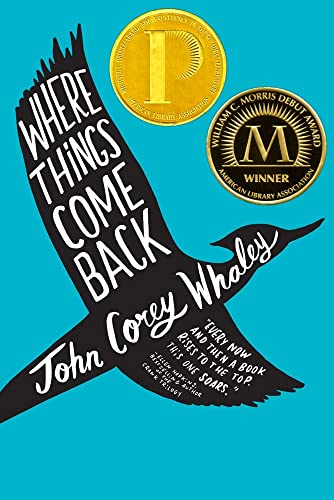
Winner of the 2012 Michael L. Printz and William C. Morris Awards, this poignant and hilarious story of loss and redemption “explores the process of grief, second chances, and even the meaning of life” (Kirkus Reviews).
In the remarkable, bizarre, and heart-wrenching summer before Cullen Witter’s senior year of high school, he is forced to examine everything he thinks he understands about his small and painfully dull Arkansas town. His cousin overdoses; his town becomes absurdly obsessed with the alleged reappearance of an extinct woodpecker; and most troubling of all, his sensitive, gifted fifteen-year-old brother, Gabriel, suddenly and inexplicably disappears.
Meanwhile, the crisis of faith spawned by a young missionary’s disillusion in Africa prompts a frantic search for meaning that has far-reaching consequences. As distant as the two stories initially seem, they are woven together through masterful plotting and merge in a surprising and harrowing climax.
This extraordinary tale from a rare literary voice finds wonder in the ordinary and illuminates the hope of second chances.
Die Inhaltsangabe kann sich auf eine andere Ausgabe dieses Titels beziehen.
Über die Autorin bzw. den Autor
John Corey Whaley grew up in Louisiana. His debut novel, Where Things Come Back, was the 2012 winner of the Michael L. Printz and the William C. Morris Awards. You can learn more about him at JohnCoreyWhaley.com and follow him on Twitter: @Corey_Whaley.
Auszug. © Genehmigter Nachdruck. Alle Rechte vorbehalten.
CHAPTER ONE
All the Idealism in the World Couldn’t Shake This Feeling
I was seventeen years old when I saw my first dead body. It wasn’t my cousin Oslo’s. It was a woman who looked to have been around fifty or at least in her late forties. She didn’t have any visible bullet holes or scratches, cuts, or bruises, so I assumed that she had just died of some disease or something; her body barely hidden by the thin white sheet as it awaited its placement in the lockers. The second dead body I ever sawwas my cousin Oslo’s. I recognized his dirty brown shoes immediately as the woman wearing the bright white coat grasped the metallic handle and yanked hard to slide the body out from the silvery wall.
“That’s him,” I said to her.
“You sure?”
“Positive.”
His eyes were closed. His lips purple. His arms had bruises and track marks. Nothing was hidden from view, as he had died in a sleeveless white T-shirt, one of the same he had worn nearly every day of his life. There was something white in the corners of his mouth, but I didn’t ask what it might be. I didn’t really say much after that. The woman waited there for me to cry or say “I’m done,” or something. But I didn’t do a thing. I just stared at him. And I’m not sure if I was thinking anything at that moment either. I wasn’t thinking about missing him or pitying him or even about how angry I was at him. I was just standing there like some ass-hat, mouth half-open and eyes glued to one spot. Eventually the white coat woman broke the silence.
“Do you need any more time?” she asked.
“No thanks. I’m good.”
My mother cried on the way home. My little brother, Gabriel, looked anxious, but he kept his headphones on and didn’t say much for the duration of our trip. I drove, but I didn’t want to because I thought it might rain. I hate driving in the rain. I’d wanted my dad to come along so I wouldn’t have to play man for the evening by driving the whole way and making sure everyone ate and all. I didn’t so much mind the body identifying. That part was bound to happen, one way or another. Oslo had been shooting shit into his arm since I could remember. He had also frequently been an inconvenience to me. Picking him up at truck stops or crack houses. Telling lies to his mom to cover up his dumb-ass behavior and save him an argument. Loaning him ten dollars here and there and hoping he would buy food with it, but knowing he probably wouldn’t. I did it all. We all did. Me. My dad. Even my aunt Julia gave him money so long as he showed up every other day or so, long enough to make her forget that she had failed to raise him right, long enough to make her love him again.
My dad couldn’t come because he got a call around five thirty that afternoon to haul some oil well equipment up to Harrison. That’s what he does. He hauls things that I don’t know anything about and never really care to. All I know is that somebody needs these large pieces of metal that have something to do with pumping oil as soon as possible when they call him. And so he goes at all hours of the day and night. Sometimes he sits at the house for days, reading the paper or novels about dead people (because, apparently, men in their forties are only interested in reading about the lives of presidents, explorers, or criminals). Sometimes we don’t see him for two weeks at a time, only hear the sound of him switching trailers in the backyard at three in the morning or leaving messages on the machine to remind Mom to fill a prescription or pay the mortgage.
When we got home from Little Rock, Dad was still gone and the kitchen light was the only thing we could see from the driveway. Gabriel had fallen asleep about twenty minutes before and Mom wasn’t far behind him. She leaned over and kissed the side of my head before she got out of the car and walked toward the house. Opening the back door, I kicked at the bottom of Gabriel’s shoe. He shot up quick and threw his arms up, as if someone were about to cut his throat. I looked at him the way you look at someone when you’re waiting for them to come to their senses—like you’re both frustrated with and feeling sorry for them—and then I helped him get his footing. I followed him into the house and Mom was already in his bedroom, already crying again as she talked to a half-asleep Aunt Julia. Soon there was one more crying voice, and Gabriel and I sat up on my bed and listened through the wall as Aunt Julia rambled on and on about wanting to die.
Gabriel was asleep within minutes and the voices in the room next door had nearly gone silent. If they were still talking, they had decided to whisper, perhaps taking into consideration the two teenagers in the next room who had to get up and go to school the next day. Before lying down, I grabbed my leather-bound journal off the nightstand and turned to the first blank page I could find. I jotted downOslo After Death. This would be a great title for a book, I thought. That is what I do sometimes. I jot down titles for books that I one day intend to write.Oslo After Death was #71.
I closed the journal, turned off the lamp, and looked at my brother to make sure I hadn’t stirred him. He still slept, an impossibly sincere smile on his face. He had a habit of shutting out the world. Habits like this meant that he didn’t look up when he walked down the hallway at school. If you look up, then you can avoid being pushed or running into someone or being the convenient target for some ass-hat standing by the water fountain waiting intently for innocent-looking freshmen to walk by with their heads down. My problem was that I wasn’t big or tough enough to really protect or defend my little brother in any manner save for my sometimes creative use of sarcasm as distraction. Lucas Cader, though, was quite effective in staving off those common shitheads who liked to pick on Gabriel and his friends. I think, in a way, Lucas felt like it was part of his duty in the world to protect those kids. I’m glad, because it wasn’t mine. You see, Lucas had power. He walked down the hall and you noticed him. You noticed his six-two swimmer’s build and his messy brown hair that always looked like it was ready for a photo shoot. You noticed how he smiled at the pretty girls but always managed to say something nice or sweet to the not-so-pretty ones. Lucas was the only other guy besides Gabriel that I could stand to be around, simply for the fact that I just didn’t like guys all that much. I liked girls and women, but guys really put me off most of the time. Everything is a pissing contest with most guys. With Lucas, I could be my insecure shell of a man and not feel threatened. And Gabriel could walk down the hall and not risk having his backpack thrown into the trash can. And Elizabeth Strawn could feel good about herself for maybe the only time that day she had a huge zit on her cheek.
Being seventeen and bored in a small town, I like to pretend sometimes that I’m a pessimist.This is the way it is and nothing can sway me from that. Life sucks most of the time. Everything is bullshit. High school sucks. You go to school, work for fifty years, then you die. Only I can’t seem to keep that up for too long before my natural urge to idealize goes into effect. I can’t seem to be a pessimist long enough to overlook the possibility of things being overwhelmingly good. But as I lay there in my bed that night with my brother asleep beside me, I couldn’t seem to muster up any...
„Über diesen Titel“ kann sich auf eine andere Ausgabe dieses Titels beziehen.
Suchergebnisse für Where Things Come Back

Beispielbild für diese ISBN
Where Things Come Back
Verlag:
Atheneum Books for Young Readers, 2012
ISBN 10: 1442413344
ISBN 13: 9781442413344
Gebraucht
Paperback
Anbieter: World of Books (was SecondSale), Montgomery, IL, USA
Verkäuferbewertung 5 von 5 Sternen

Paperback. Zustand: Good. Winner of the 2012 Michael L. Printz and William C. Morris Awards, this poignant and hilarious story of loss and redemption "explores the process of grief, second chances, and even the meaning of life" (Kirkus Reviews). In the remarkable, bizarre, and heart-wrenching summer before Cullen Witter's senior year of high school, he is forced to examine everything he thinks he understands about his small and painfully dull Arkansas town. His cousin overdoses; his town becomes absurdly obsessed with the alleged reappearance of an extinct woodpecker; and most troubling of all, his sensitive, gifted fifteen-year-old brother, Gabriel, suddenly and inexplicably disappears. Meanwhile, the crisis of faith spawned by a young missionary's disillusion in Africa prompts a frantic search for meaning that has far-reaching consequences. As distant as the two stories initially seem, they are woven together through masterful plotting and merge in a surprising and harrowing climax. This extraordinary tale from a rare literary voice finds wonder in the ordinary and illuminates the hope of second chances. Bestandsnummer des Verkäufers 00043375654
Gebraucht kaufen
EUR 3,71
Versand gratis
Versand innerhalb von USA
Versand innerhalb von USA
Anzahl: 2 verfügbar
Beispielbild für diese ISBN
Where Things Come Back
Verlag:
Atheneum Books for Young Readers, 2012
ISBN 10: 1442413344
ISBN 13: 9781442413344
Gebraucht
paperback
Anbieter: Your Online Bookstore, Houston, TX, USA
Verkäuferbewertung 5 von 5 Sternen
paperback. Zustand: Fair. Bestandsnummer des Verkäufers 1442413344-4-29630608
Gebraucht kaufen
EUR 3,71
Versand gratis
Versand innerhalb von USA
Versand innerhalb von USA
Anzahl: 1 verfügbar
Beispielbild für diese ISBN
Where Things Come Back
Verlag:
Atheneum Books for Young Readers, 2012
ISBN 10: 1442413344
ISBN 13: 9781442413344
Gebraucht
Paperback
Anbieter: Your Online Bookstore, Houston, TX, USA
Verkäuferbewertung 5 von 5 Sternen
Paperback. Zustand: Good. Bestandsnummer des Verkäufers 1442413344-3-24531038
Gebraucht kaufen
EUR 3,71
Versand gratis
Versand innerhalb von USA
Versand innerhalb von USA
Anzahl: 3 verfügbar
Beispielbild für diese ISBN
Where Things Come Back
Verlag:
Atheneum Books for Young Readers, 2012
ISBN 10: 1442413344
ISBN 13: 9781442413344
Gebraucht
Paperback
Anbieter: Orion Tech, Kingwood, TX, USA
Verkäuferbewertung 5 von 5 Sternen
Paperback. Zustand: Good. Bestandsnummer des Verkäufers 1442413344-3-21204165
Gebraucht kaufen
EUR 3,71
Versand gratis
Versand innerhalb von USA
Versand innerhalb von USA
Anzahl: 3 verfügbar
Beispielbild für diese ISBN
Where Things Come Back
Verlag:
Atheneum Books for Young Readers, 2012
ISBN 10: 1442413344
ISBN 13: 9781442413344
Gebraucht
paperback
Anbieter: Orion Tech, Kingwood, TX, USA
Verkäuferbewertung 5 von 5 Sternen
paperback. Zustand: Fair. Bestandsnummer des Verkäufers 1442413344-4-30346963
Gebraucht kaufen
EUR 3,71
Versand gratis
Versand innerhalb von USA
Versand innerhalb von USA
Anzahl: 1 verfügbar
Beispielbild für diese ISBN
Where Things Come Back
Verlag:
Atheneum Books for Young Readers, 2012
ISBN 10: 1442413344
ISBN 13: 9781442413344
Gebraucht
paperback
Anbieter: Gulf Coast Books, Cypress, TX, USA
Verkäuferbewertung 5 von 5 Sternen
paperback. Zustand: Fair. Bestandsnummer des Verkäufers 1442413344-4-32453805
Gebraucht kaufen
EUR 3,71
Versand gratis
Versand innerhalb von USA
Versand innerhalb von USA
Anzahl: 1 verfügbar
Beispielbild für diese ISBN
Where Things Come Back
Verlag:
Atheneum Books for Young Readers, 2012
ISBN 10: 1442413344
ISBN 13: 9781442413344
Gebraucht
Paperback
Anbieter: Gulf Coast Books, Cypress, TX, USA
Verkäuferbewertung 5 von 5 Sternen
Paperback. Zustand: Good. Bestandsnummer des Verkäufers 1442413344-3-25190586
Gebraucht kaufen
EUR 3,71
Versand gratis
Versand innerhalb von USA
Versand innerhalb von USA
Anzahl: 4 verfügbar
Beispielbild für diese ISBN
Where Things Come Back
Verlag:
Atheneum Books for Young Readers, 2012
ISBN 10: 1442413344
ISBN 13: 9781442413344
Gebraucht
Softcover
Anbieter: More Than Words, Waltham, MA, USA
Verkäuferbewertung 5 von 5 Sternen
Zustand: Good. A sound copy with only light wear. Overall a solid copy at a great price! Bestandsnummer des Verkäufers BOS-J-03c-01931
Gebraucht kaufen
EUR 1,10
EUR 3,55 Versand
Versand innerhalb von USA
Versand innerhalb von USA
Anzahl: 1 verfügbar
Beispielbild für diese ISBN
Where Things Come Back
Verlag:
Atheneum Books 2012-07-24, 2012
ISBN 10: 1442413344
ISBN 13: 9781442413344
Gebraucht
Paperback
Anbieter: BookOutlet, Jefferson City, TN, USA
Verkäuferbewertung 5 von 5 Sternen
Paperback. Zustand: Good. Paperback. Publisher overstock, may contain remainder mark on edge, may contain dents, scratches, and/or various other cosmetic issues. Bestandsnummer des Verkäufers 9781442413344S
Gebraucht kaufen
EUR 1,96
EUR 2,89 Versand
Versand innerhalb von USA
Versand innerhalb von USA
Anzahl: 1 verfügbar
Beispielbild für diese ISBN
Where Things Come Back
Verlag:
Atheneum Books for Young Readers, 2012
ISBN 10: 1442413344
ISBN 13: 9781442413344
Gebraucht
paperback
Anbieter: Once Upon A Time Books, Siloam Springs, AR, USA
Verkäuferbewertung 4 von 5 Sternen

paperback. Zustand: Good. This is a used book in good condition and may show some signs of use or wear . This is a used book in good condition and may show some signs of use or wear . Bestandsnummer des Verkäufers mon0003434117
Gebraucht kaufen
EUR 1,94
EUR 3,51 Versand
Versand innerhalb von USA
Versand innerhalb von USA
Anzahl: 1 verfügbar