
Verwandte Artikel zu The Perfect Engine: Driving Manufacturing Breakthroughs...
Inhaltsangabe
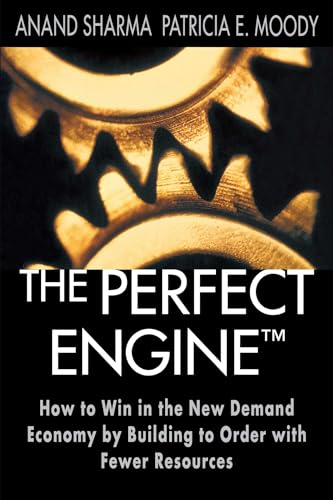
Most manufacturing companies with batch-and-queue "push" production systems have been blindsided by today's consumer who expects quality products and services delivered on demand and customized to individual taste. In The Perfect Engine, manufacturing experts Anand Sharma and Patricia E. Moody describe for the first time how leading "pull" production pioneers build to order by reducing inventory, decreasing cycle time, minimizing floor space, and eliminating waste.
Drawing on scores of examples and detailed case studies of three leaders in the demand economy field -- Maytag, Pella, and Mercedes-Benz -- Sharma and Moody demonstrate how these companies achieved astonishing results using the pathbreaking LeanSigmaSM Transformation. Combining lean production and quality elements from the famous Six Sigma process, LeanSigma produces annual productivity gains of 15 percent to 20 percent. In addition, the authors show, inventory turns more than quadruple; cycle times drop by more than 70 percent; and floor space reductions of 30 percent to 50 percent are not uncommon. Sharma and Moody provide immensely readable explanations of key technical aspects of the process--for example, how cell-based one-piece flow can replace batch-and-queue with dramatically improved lead times and inventory turnover. A chapter on a revolutionary design technique the authors call Design for LeanSigma or 3P (product and production preparation) shows how to build flexibility into the product design and the production systems at very low risk, which will be especially helpful when forecasts and customer orders deviate from original projections, as they usually do. Further, the Design for LeanSigma method is devised to produce profitability at short-term volume projections, which makes it a perfect tool for the new demand economy. Essential, timely, and important, The Perfect Engine is perfect reading for this new manufacturing era.
Die Inhaltsangabe kann sich auf eine andere Ausgabe dieses Titels beziehen.
Über die Autorin bzw. den Autor
Anand Sharma, named one of "America's Heroes of Manufacturing" by Fortune, is the founder, president, and CEO of TBM Consulting Group, the fastest-growing manufacturing consulting firm in the world. He has spent the last two decades developing and implementing manufacturing improvement programs in a variety of companies throughout the world. He has worked extensively with some of the leading consultants responsible for the Japanese Industrial Miracle at Toyota Motor Company.
Auszug. © Genehmigter Nachdruck. Alle Rechte vorbehalten.
Chapter 1: A Better Way
The Grind
Stepping into the huge kitchen cabinet assembly plant, you are assaulted by the sights, sounds, smells, and by-products of a very busy operation. There is a thick haze of sawdust in the air and on the floor. Mile-high racks of parts storage hold an accumulation of dusty laminated doors and trim pieces. A fleet of fork trucks race down the aisles, moving empty bins and depositing fresh crates of piece parts in open areas that become acres of in-process inventory storage.
Your eyes, stung by paint and glue fumes, burn, and you start to sniffle and sneeze as the vapors and dust settle in on your clothing. Tiny bits of particulate matter float by.
At shift change, operators blow the sawdust off their equipment with air hoses; the material makes fine grit underfoot until hours later, when a sweeper comes by to stir up new piles of sawdust and pieces of laminate. He works his way through the plant, pushing and piling mountains of accumulated trimmings -- evidence of yesterday's, and last week's, and last month's endless attempt to make schedule. Please customers. Fill trucks. Get paid.
Out at the shipping dock, trucks appear hourly to unload heavy sheets of plywood and laminate. Suppliers hustle boxes of hardware and drawer fixtures while shipping clerks, overwhelmed with the press of paperwork and fork trucks and upstream demands for more raw material, move from one disconnected operation to another.
On the floor, fork trucks rush pallets of raw material to cutting machines; the big saws' high whine makes it impossible to understand operators' shouted explanations of their process. Everything about this plant is busier, noisier, dirtier, and heavier than what one would expect from a twenty-first-century North American manufacturing giant.
This particular building houses final assembly for a high-volume producer of premium wood cabinetry. It's a complex operation and, with a booming construction economy fueling strong demand, every day is an opportunity.
The best way to understand the scope and rhythm of any facility is to follow one complete product from receipt of raw material down to various processing steps, into final assembly, packaging, and the shipping dock. This plant, however, presents a special challenge because its multiple subassembly and processing departments feed huge variety to the final assembly lines. It is possible to walk through key subassembly areas that feed the final assembly line, and each one of them is an eye-opener.
Down on the white door line a team is tackling one gigantic lamination machine that seems to stall out once per shift. The work stoppage ripples outward and causes immediate downstream disruption as four expeditors from final assembly converge on a lone table saw operator. Larry is a six-year veteran of endless rush orders, expedites, and firefighting. The expeditors are impatient and they wave scraps of paper bearing endless parts shortage lists in his face -- "line's down," "gotta have it," "can't find it," "big customer," and "won't wait" punctuate their demands.
Confronted with four orders for hot shortages, Larry silently moves to his small work cell and begins, one by one, to cut parts. There's a quiet determination about him that belies the hopelessness of his task. Every day, Larry's work routine becomes a long series of interrupted and equally frantic calls for help from downstream assembly workers who cannot keep their lines running, who must pull incomplete cabinets off to the side while they wait for missing pieces.
In fact, what was designed to be a smooth line-of-sight assembly has been transformed by a nightmare process filled with missing doors and damaged trim pieces into a line interrupted, a broken series of incomplete customer orders. Everything waits; nothing flows. And yet, final assembly is where all the sins, all the missed deliveries and quality issues and design problems make their very visible appearance. While operators can still be expected to work the occasional miracle, they simply cannot run lines with no parts. Henry Ford knew this, countless appliance and electronics and computer factories proved this, and certainly the competitors know this.
It's every operations manager's nightmare, every customer's frustration, and Larry's problem. But this hurry-up-and-wait way of running manufacturing is not atypical -- thousands of factories across the world struggle from day to day with the same uneven pace, the same horrific ergonomics and the same frustrated customers.
Throughout the plant there are other signs of a bad operation -- an imbalance of huge computer-controlled machines played off against highly used, small, manually operated equipment. Long lines are broken by accumulations of mismatched parts, operators working to keep up a desperate pace, and workers who wander from one operation to another. At the end of the day they return home not knowing exactly what they have produced, or how they may have accomplished some vital piece of the company's mission.
For years customers have ordered semicustom products -- oak, maple, or birch cabinets of any size or height configuration -- for promised delivery within six to eight weeks. A few orders make the quoted lead times, most don't. Marketing has learned the danger of exact promises and production doesn't know the difference.
Recently, Custom Kitchen Cabinets, Inc., has encountered strong competition from lean producers who quote two-week deliveries on most items. Management would like to improve lead times and continue to grow volumes -- but the usual fixes, such as overtime, more operators, the addition of seven high-speed cutting machines, are not working.
It doesn't have to be this way. After 150 years of integrating various manufacturing processes into smooth flows that balance associates with process and materials, lean producers are proving every day that there is a better way.
Why Become Lean?
- Customer-centric focus
- Quality product and service
- Increased responsiveness
- Employee empowerment
- Intense competition
- Focus on waste elimination
- Action and results orientation
- Speed
Lean and Beyond
What Custom Cabinets wants to do -- make money and grow the business -- is what every manufacturer in every industry wants. Despite all marketing and strategic plans, however, Custom is prevented by its own broken and flawed manufacturing processes from accomplishing anything greater than simply making payroll. Bad manufacturing simply won't support good growth and profits.
A map of Custom's main assembly process shows a dangerous mix of batch-and-queue or "push" production. They have a heavy dependence on large, automated equipment and spaghetti-like flows that frequently circle and loop back on each other. With such flows, line-of-sight manufacturing is an impossibility.
Feed the Machine
Further, Custom is drowning in piles of work-in-process and raw material inventory. With so much cash tied up in inventory and storage and handling systems, it will be difficult for Custom to refocus on new products or faster deliveries, especially when the market takes a cyclic downturn. E-commerce will produce a predictable back-room response for Custom. Even as customers go online to place their orders, Custom's stressed manufacturing system will run faster and faster to meet nanosecond waves of demand with nineteenth-century methods. It simply won't work.
Batch-and-queue production is inefficient and expensive. Lean manufacturing, especially comprehensive systems like the LeanSigma Transformation, offers producers the opportunity to work smarter with fewer associates, less material, and lower costs. Moving to pull systems such as...
„Über diesen Titel“ kann sich auf eine andere Ausgabe dieses Titels beziehen.
Suchergebnisse für The Perfect Engine: Driving Manufacturing Breakthroughs...

Beispielbild für diese ISBN
The Perfect Engine: Driving Manufacturing Breakthroughs with the Globa
Anbieter: Lakeside Books, Benton Harbor, MI, USA
Verkäuferbewertung 5 von 5 Sternen

Zustand: New. Brand New! Not Overstocks or Low Quality Book Club Editions! Direct From the Publisher! We're not a giant, faceless warehouse organization! We're a small town bookstore that loves books and loves it's customers! Buy from Lakeside Books! Bestandsnummer des Verkäufers OTF-S-9781451640854
Neu kaufen
EUR 13,91
EUR 3,56 Versand
Versand innerhalb von USA
Versand innerhalb von USA
Anzahl: Mehr als 20 verfügbar
Foto des Verkäufers
Perfect Engine : How to Win in the New Demand Economy by Building to Order with Fewer Resources
Anbieter: GreatBookPrices, Columbia, MD, USA
Verkäuferbewertung 5 von 5 Sternen
Zustand: New. Bestandsnummer des Verkäufers 12560865-n
Neu kaufen
EUR 15,14
EUR 2,35 Versand
Versand innerhalb von USA
Versand innerhalb von USA
Anzahl: Mehr als 20 verfügbar
Foto des Verkäufers
The Perfect Engine: Driving Manufacturing Breakthroughs with the Globa (Paperback or Softback)
Verlag:
Free Press 4/2/2011, 2011
ISBN 10: 1451640854
ISBN 13: 9781451640854
Neu
Paperback or Softback
Anbieter: BargainBookStores, Grand Rapids, MI, USA
Verkäuferbewertung 5 von 5 Sternen
Paperback or Softback. Zustand: New. The Perfect Engine: Driving Manufacturing Breakthroughs with the Globa. Book. Bestandsnummer des Verkäufers BBS-9781451640854
Beispielbild für diese ISBN
The Perfect Engine: Driving Manufacturing Breakthroughs with the Globa
Anbieter: California Books, Miami, FL, USA
Verkäuferbewertung 5 von 5 Sternen
Zustand: New. Bestandsnummer des Verkäufers I-9781451640854
Neu kaufen
EUR 20,21
Versand gratis
Versand innerhalb von USA
Versand innerhalb von USA
Anzahl: Mehr als 20 verfügbar
Foto des Verkäufers
The Perfect Engine
Anbieter: Rarewaves.com USA, London, LONDO, Vereinigtes Königreich
Verkäuferbewertung 5 von 5 Sternen
Paperback. Zustand: New. Reprint. Most manufacturing companies with batch-and-queue "push" production systems have been blindsided by today's consumer who expects quality products and services delivered on demand and customized to individual taste. In The Perfect Engine, manufacturing experts Anand Sharma and Patricia E. Moody describe for the first time how leading "pull" production pioneers build to order by reducing inventory, decreasing cycle time, minimizing floor space, and eliminating waste. Drawing on scores of examples and detailed case studies of three leaders in the demand economy field -- Maytag, Pella, and Mercedes-Benz -- Sharma and Moody demonstrate how these companies achieved astonishing results using the pathbreaking LeanSigmaSM Transformation. Combining lean production and quality elements from the famous Six Sigma process, LeanSigma produces annual productivity gains of 15 percent to 20 percent. In addition, the authors show, inventory turns more than quadruple; cycle times drop by more than 70 percent; and floor space reductions of 30 percent to 50 percent are not uncommon. Sharma and Moody provide immensely readable explanations of key technical aspects of the process--for example, how cell-based one-piece flow can replace batch-and-queue with dramatically improved lead times and inventory turnover. A chapter on a revolutionary design technique the authors call Design for LeanSigma or 3P (product and production preparation) shows how to build flexibility into the product design and the production systems at very low risk, which will be especially helpful when forecasts and customer orders deviate from original projections, as they usually do. Further, the Design for LeanSigma method is devised to produce profitability at short-term volume projections, which makes it a perfect tool for the new demand economy. Essential, timely, and important, The Perfect Engine is perfect reading for this new manufacturing era. Bestandsnummer des Verkäufers LU-9781451640854
Neu kaufen
EUR 20,64
Versand gratis
Versand von Vereinigtes Königreich nach USA
Versand von Vereinigtes Königreich nach USA
Anzahl: Mehr als 20 verfügbar
Beispielbild für diese ISBN
The Perfect Engine
Print-on-DemandAnbieter: Chiron Media, Wallingford, Vereinigtes Königreich
Verkäuferbewertung 5 von 5 Sternen
PF. Zustand: New. This item is printed on demand. Brand new book, sourced directly from publisher. Dispatch time is 6-7 days from our warehouse. Book will be sent in robust, secure packaging to ensure it reaches you securely. Bestandsnummer des Verkäufers 6666-IUK-9781451640854
Neu kaufen
EUR 15,20
EUR 5,91 Versand
Versand von Vereinigtes Königreich nach USA
Versand von Vereinigtes Königreich nach USA
Anzahl: 20 verfügbar
Beispielbild für diese ISBN
The Perfect Engine
Print-on-DemandAnbieter: PBShop.store US, Wood Dale, IL, USA
Verkäuferbewertung 5 von 5 Sternen
PAP. Zustand: New. New Book. Shipped from UK. THIS BOOK IS PRINTED ON DEMAND. Established seller since 2000. Bestandsnummer des Verkäufers L0-9781451640854
Neu kaufen
EUR 21,72
Versand gratis
Versand innerhalb von USA
Versand innerhalb von USA
Anzahl: Mehr als 20 verfügbar
Beispielbild für diese ISBN
The Perfect Engine (Paperback)
Anbieter: Grand Eagle Retail, Bensenville, IL, USA
Verkäuferbewertung 5 von 5 Sternen
Paperback. Zustand: new. Paperback. Most manufacturing companies with batch-and-queue "push" production systems have been blindsided by today's consumer who expects quality products and services delivered on demand and customized to individual taste. In The Perfect Engine, manufacturing experts Anand Sharma and Patricia E. Moody describe for the first time how leading "pull" production pioneers build to order by reducing inventory, decreasing cycle time, minimizing floor space, and eliminating waste. Drawing on scores of examples and detailed case studies of three leaders in the demand economy field -- Maytag, Pella, and Mercedes-Benz -- Sharma and Moody demonstrate how these companies achieved astonishing results using the pathbreaking LeanSigmaSM Transformation. Combining lean production and quality elements from the famous Six Sigma process, LeanSigma produces annual productivity gains of 15 percent to 20 percent. In addition, the authors show, inventory turns more than quadruple; cycle times drop by more than 70 percent; and floor space reductions of 30 percent to 50 percent are not uncommon.Sharma and Moody provide immensely readable explanations of key technical aspects of the process--for example, how cell-based one-piece flow can replace batch-and-queue with dramatically improved lead times and inventory turnover. A chapter on a revolutionary design technique the authors call Design for LeanSigma or 3P (product and production preparation) shows how to build flexibility into the product design and the production systems at very low risk, which will be especially helpful when forecasts and customer orders deviate from original projections, as they usually do. Further, the Design for LeanSigma method is devised to produce profitability at short-term volume projections, which makes it a perfect tool for the new demand economy. Essential, timely, and important, The Perfect Engine is perfect reading for this new manufacturing era. Shipping may be from multiple locations in the US or from the UK, depending on stock availability. Bestandsnummer des Verkäufers 9781451640854
Foto des Verkäufers
Perfect Engine : How to Win in the New Demand Economy by Building to Order with Fewer Resources
Anbieter: GreatBookPrices, Columbia, MD, USA
Verkäuferbewertung 5 von 5 Sternen
Zustand: As New. Unread book in perfect condition. Bestandsnummer des Verkäufers 12560865
Gebraucht kaufen
EUR 21,89
EUR 2,35 Versand
Versand innerhalb von USA
Versand innerhalb von USA
Anzahl: Mehr als 20 verfügbar
Beispielbild für diese ISBN
The Perfect Engine Format: Paperback
Anbieter: INDOO, Avenel, NJ, USA
Verkäuferbewertung 5 von 5 Sternen
Zustand: As New. Unread copy in mint condition. Bestandsnummer des Verkäufers SS9781451640854
Gebraucht kaufen
EUR 24,32
Versand gratis
Versand innerhalb von USA
Versand innerhalb von USA
Anzahl: Mehr als 20 verfügbar