
Verwandte Artikel zu The True Secret of Writing: Connecting Life with Language
Inhaltsangabe
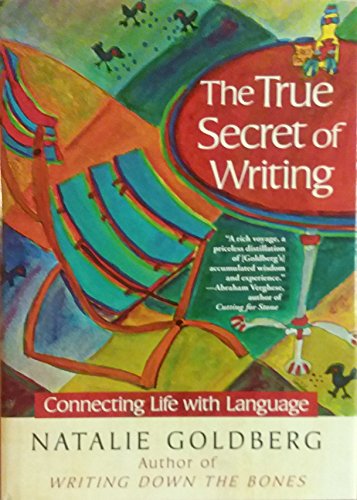
The beloved teacher and author of the million-and-a-half copy bestseller Writing Down the Bones reveals new breakthrough writing guidance as she recounts profound lessons she has learned from a lifetime of teaching and practice.
Sit. Walk. Write. These are the barest bones of Natalie Goldberg’s revolutionary writing and life practice, which she presents here in book form for the first time. A whole new slant on writing that she developed since the publication of her classic Writing Down the Bones, True Secret workshops have been limited until now to small, intensive groups at a remote center in the rural Southwest. In The True Secret of Writing, Goldberg makes this popular seminar available to any reader.
The True Secret is for everyone, like eating and sleeping. It allows you to discover something real about your life, to mine the rich awareness in your mind, and to ground and empower yourself. Goldberg guides you through your own personal or group retreat, illuminating the steps of sitting in silent open mind, walking anchored to the earth, and writing without criticism. Just as Goldberg cuts through her students’ resistance with her no-nonsense instruction—“Shut up and write”—the True Secret cuts to the core of realizing yourself and your world.
The capstone to forty years of teaching, The True Secret of Writing is Goldberg’s Zen boot camp, her legacy teaching. Stories of Natalie’s own search for truth and clarity and her students’ breakthroughs and insights give moving testament to how brilliantly her unique, tough-love method works. Beautiful homages to the work of other great teachers and observers of mind, life, and love provide further secrets and inspiration to which readers will return again and again.
In her inimitable way, Goldberg will inspire you to pick up the pen, get writing, and keep going. The True Secret of Writing will help you with your writing—and your life.
Die Inhaltsangabe kann sich auf eine andere Ausgabe dieses Titels beziehen.
Über die Autorin bzw. den Autor
Natalie Goldberg is a poet, painter, teacher, and the author of twelve books, including her classic, Writing Down the Bones: Freeing the Writer Within (which has sold more than 1.5 million copies) and Old Friend from Far Away: The Practice of Writing Memoir. She has been teaching seminars for thirty-five years to people from around the world and lives in New Mexico.
Auszug. © Genehmigter Nachdruck. Alle Rechte vorbehalten.
True Secret of Writing
Introduction
A DECADE AGO, when I initially came up with the title “The True Secret of Writing,” it was a bit tongue-in-cheek. I’ve used that phrase when a student has come late to class: “Oh, Sheila, I’m so sorry. You just missed it—a moment ago I told the students the true secret of writing. I am only able to utter it every five years or so.” I’m teasing, but it gets the point across—be on time. This is your moment. Don’t miss it.
Of course, no one possesses the one single true secret. If someone says he does, run for the hills. It’s a dangerous idea. Life is not a commodity and is not singular but full of diversity.
For the past twelve years I have held weeklong retreats at the Mabel Dodge Luhan House in Taos, New Mexico, titled “The True Secret,” where we practice sitting meditation, slow walking, and writing throughout the day. People come because they want to write, but over the years I’ve realized that it’s not just writing that they want. They want connection; a spiritual longing drives them, a groping for meaning. Maybe they once read a single book—Diary of Anne Frank, Leaving Cheyenne, The Brothers Karamazov—that shattered them and they can’t forget it. Or they desire to speak the truth to their fathers. They want this connection through language, through words on a page. Other methods exist—tai chi, yoga, Tibetan Buddhism, retreats in nature—but their yearning manifests through writing. It also encompasses something larger than writing—after all, they could have gone to a creative writing program that so many colleges and universities offer.
I’ve extended these retreats to other places, Omega Institute in New York, Hollyhock in Canada, Upaya Zen Center and Vallecitos Mountain Refuge in New Mexico—under different titles. But the ones at Mabel’s are the model, my base for experiment, my home lab.
Over these many continuous years a rhythm has been established at Mabel’s and, with this repetition, I have been able to study the mechanical bones that best make up the week. The structure is easily applicable in other situations: to one full day, an hour in a public school class, or an afternoon at home. Individuals or a group of even two or three people can use it. Ultimately, you want to internalize this structure, so you carry it inside you, as a way to sustain and connect with your life.
I have been a Zen practitioner for many years so I naturally modified and modeled the writing retreats from the basic structure of formal Zen retreats. The True Secret is backed by a two-thousand-year-old tradition of practice. It is not simply a creative idea that Natalie, an individual, came up with willy-nilly. It’s the practice of a Western woman in her time and culture meeting head-on the masterminds of ancient Eastern Zen wisdom. And voilà—something fresh, yet rooted, has evolved.
Make no mistake: the practice in this book is not limited to any sect or religion or creative urge. It’s for everyone, and it can feed and enrich whatever religion, occupation, bent of mind, or situation you find yourself in.
The one important element that I have added to a traditional meditation retreat is writing. Thus, sitting, walking, writing, are all moments of practice. The quietest, deepest sits I’ve experienced have included writing. The writing helps to empty and settle the mind. We then can sink into a quiet pool, into silence, out of which all of those tumultuous thoughts were created in the first place.
In True Secret retreats, we do timed writings as an equal practice to sitting and slow walking. The bell rings, we sit; another bell rings, we walk; a third bell, the students pull out their pens and notebooks from under their mats and accept their minds as it comes to them on the page. The bell rings again and they read aloud what they have written. Another bell, they do slow walking again.
The classroom is set up as a zendo (a place to sit) with cushions (or chairs) lined along the four walls and an altar in one corner. (You could use chairs in rows if there are a lot of students and, of course, an altar is not necessary.) But whatever the form, “structure” is the modus operandi. If you have a good structure, you make room for the mind to drop deeper, the breath deeper, the writing deeper.
“Anchor your mind with your breath,” I repeat to the students. Then, I ask, “And how do we anchor the mind in writing?”
“With pen on paper,” they answer. And then, they always ask the question: “What about computers?”
“Even though we can drive, we have to continue to remember how to walk.” I answer, “A computer is fine, only it’s a different physical activity. A slightly different bent of mind comes out. Not better or worse. Just different.”
Handwriting is the first physical way we learned to write. Hand connected to arm, to shoulder, to heart. A computer is a two-handed activity. A different structure. For many people now it is the main writing tool. That’s okay, but what if we grow poor and can’t afford a computer anymore? Or our electricity gets cut off? This retreat is a training to write and reflect under all circumstances. When we are not always reliant on outside tools, we have a flexibility and freedom.
The meditation retreats of the seventies and eighties did not include writing practice. As many of us sat still, we played out over and over in our minds an upcoming wedding, a lost love, economic worries, raging sexual desire, a recent death. These were true concerns, but we couldn’t stop the compulsive repetition of thoughts. Coming back to our breath as a way to return to the present moment was often inadequate and we sat consumed by emotional scenarios of grief, hunger, anger, desire, regret, and resentment. Even though the idea behind sitting is to finally let go of thoughts, to stop burning in hell, often the sitting only aroused and increased our internal aggression, with no relief. A few determined souls managed to rip through their thoughts, but a lot of us continued to boil. Others just checked out and fell asleep on the meditation cushion.
Oddly, I still have great respect for this method. It was a great opening, our first meeting with the ancient monastic life of China and Japan. Though I never attained eternal peace from thoughts (which actually would be a misunderstanding of mind), I learned to sit still (a huge accomplishment in our fast society) and through that to receive and listen deeply, not only to a movie or song but also to hear the trees grow and be enfolded in silence. I learned structure—of a room, of a day, of a week, of time, and of the mind. And I learned about an intimacy in moment-to-moment life, a love I never knew possible and a larger vision of human reality.
The sixties generation, my generation, was willing to drop out of society and live extreme lives until we tore through to some raw truth, some hope of saving ourselves—and all sentient beings. This determined willingness of our generation helped to plant the dharma, the ground of reality, in America. A few rounded a corner, became priests, and made Zen into a career. But many of us spent years on the cushion as lay students until we were finally tossed out into the world, wondering what we’d been doing and what we should do now. Many felt the anxiety and stress of simply figuring out how to earn a living.
Since then the life of practice has changed. People are...
„Über diesen Titel“ kann sich auf eine andere Ausgabe dieses Titels beziehen.
Suchergebnisse für The True Secret of Writing: Connecting Life with Language

Foto des Verkäufers
The True Secret of Writing: Connecting Life with Language
Anbieter: Reliant Bookstore, El Dorado, KS, USA
Verkäuferbewertung 5 von 5 Sternen

Zustand: good. This book is in good condition with very minimal damage. Pages may have minimal notes or highlighting. Cover image on the book may vary from photo. Ships out quickly in a secure plastic mailer. Bestandsnummer des Verkäufers RDV.1451641249.G
Gebraucht kaufen
EUR 4,41
Versand gratis
Versand innerhalb von USA
Versand innerhalb von USA
Anzahl: 1 verfügbar
Foto des Verkäufers
The True Secret of Writing: Connecting Life with Language
Anbieter: Greenworld Books, Arlington, TX, USA
Verkäuferbewertung 5 von 5 Sternen
Zustand: good. Fast Free Shipping â" Good condition. It may show normal signs of use, such as light writing, highlighting, or library markings, but all pages are intact and the book is fully readable. A solid, complete copy that's ready to enjoy. Bestandsnummer des Verkäufers GWV.1451641249.G
Gebraucht kaufen
EUR 5,32
Versand gratis
Versand innerhalb von USA
Versand innerhalb von USA
Anzahl: 2 verfügbar
Beispielbild für diese ISBN
The True Secret of Writing: Connecting Life with Language
Anbieter: ThriftBooks-Atlanta, AUSTELL, GA, USA
Verkäuferbewertung 5 von 5 Sternen
Hardcover. Zustand: Fair. No Jacket. Readable copy. Pages may have considerable notes/highlighting. ~ ThriftBooks: Read More, Spend Less. Bestandsnummer des Verkäufers G1451641249I5N00
Gebraucht kaufen
EUR 5,99
Versand gratis
Versand innerhalb von USA
Versand innerhalb von USA
Anzahl: 1 verfügbar
Beispielbild für diese ISBN
The True Secret of Writing: Connecting Life with Language
Anbieter: ThriftBooks-Phoenix, Phoenix, AZ, USA
Verkäuferbewertung 5 von 5 Sternen
Hardcover. Zustand: Very Good. No Jacket. Missing dust jacket; May have limited writing in cover pages. Pages are unmarked. ~ ThriftBooks: Read More, Spend Less. Bestandsnummer des Verkäufers G1451641249I4N01
Gebraucht kaufen
EUR 5,99
Versand gratis
Versand innerhalb von USA
Versand innerhalb von USA
Anzahl: 1 verfügbar
Beispielbild für diese ISBN
The True Secret of Writing: Connecting Life with Language
Anbieter: ThriftBooks-Atlanta, AUSTELL, GA, USA
Verkäuferbewertung 5 von 5 Sternen
Hardcover. Zustand: Good. No Jacket. Pages can have notes/highlighting. Spine may show signs of wear. ~ ThriftBooks: Read More, Spend Less. Bestandsnummer des Verkäufers G1451641249I3N00
Gebraucht kaufen
EUR 5,99
Versand gratis
Versand innerhalb von USA
Versand innerhalb von USA
Anzahl: 1 verfügbar
Beispielbild für diese ISBN
The True Secret of Writing: Connecting Life with Language
Anbieter: ThriftBooks-Dallas, Dallas, TX, USA
Verkäuferbewertung 5 von 5 Sternen
Hardcover. Zustand: Very Good. No Jacket. Former library book; May have limited writing in cover pages. Pages are unmarked. ~ ThriftBooks: Read More, Spend Less. Bestandsnummer des Verkäufers G1451641249I4N10
Gebraucht kaufen
EUR 5,99
Versand gratis
Versand innerhalb von USA
Versand innerhalb von USA
Anzahl: 1 verfügbar
Beispielbild für diese ISBN
The True Secret of Writing: Connecting Life with Language
Anbieter: ThriftBooks-Reno, Reno, NV, USA
Verkäuferbewertung 5 von 5 Sternen
Hardcover. Zustand: Very Good. No Jacket. Missing dust jacket; May have limited writing in cover pages. Pages are unmarked. ~ ThriftBooks: Read More, Spend Less. Bestandsnummer des Verkäufers G1451641249I4N01
Gebraucht kaufen
EUR 5,99
Versand gratis
Versand innerhalb von USA
Versand innerhalb von USA
Anzahl: 1 verfügbar
Beispielbild für diese ISBN
The True Secret of Writing: Connecting Life with Language
Anbieter: ThriftBooks-Atlanta, AUSTELL, GA, USA
Verkäuferbewertung 5 von 5 Sternen
Hardcover. Zustand: Good. No Jacket. Former library book; Pages can have notes/highlighting. Spine may show signs of wear. ~ ThriftBooks: Read More, Spend Less. Bestandsnummer des Verkäufers G1451641249I3N10
Gebraucht kaufen
EUR 5,99
Versand gratis
Versand innerhalb von USA
Versand innerhalb von USA
Anzahl: 1 verfügbar
Beispielbild für diese ISBN
The True Secret of Writing: Connecting Life with Language
Anbieter: ThriftBooks-Reno, Reno, NV, USA
Verkäuferbewertung 5 von 5 Sternen
Hardcover. Zustand: Good. No Jacket. Pages can have notes/highlighting. Spine may show signs of wear. ~ ThriftBooks: Read More, Spend Less. Bestandsnummer des Verkäufers G1451641249I3N00
Gebraucht kaufen
EUR 5,99
Versand gratis
Versand innerhalb von USA
Versand innerhalb von USA
Anzahl: 1 verfügbar
Beispielbild für diese ISBN
The True Secret of Writing: Connecting Life with Language
Anbieter: ThriftBooks-Dallas, Dallas, TX, USA
Verkäuferbewertung 5 von 5 Sternen
Hardcover. Zustand: Good. No Jacket. Pages can have notes/highlighting. Spine may show signs of wear. ~ ThriftBooks: Read More, Spend Less. Bestandsnummer des Verkäufers G1451641249I3N00
Gebraucht kaufen
EUR 5,99
Versand gratis
Versand innerhalb von USA
Versand innerhalb von USA
Anzahl: 1 verfügbar