
Verwandte Artikel zu The Words We Live By: The Creeds, Mottoes, and Pledges...
Inhaltsangabe
At one time, this nation held a profound and simple faith in the power of words. Today we have become so engulfed in public cynicism that the whole notion of "words to live by" seems to us impossibly naive.
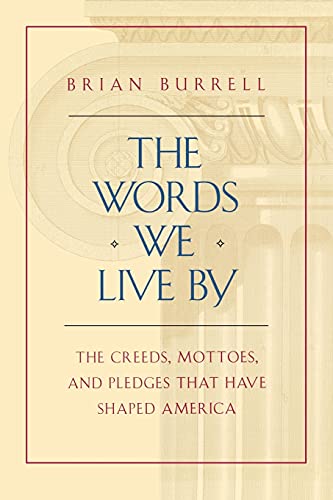
Brian Burrell's splendid collection shows that many of the phrases we once lived by can still have resonance today. A comprehensive, fascinating treasure trove of American common sense and whimsy, The Words We Live By presents a sentimental rediscovery of a lost era in American history. From fraternal loyalty oaths to marriage vows, corporate mottoes to monument inscriptions, Ben Franklin to Henry Ford, Americans for generations have committed their most cherished ideals to print, often in charming and plain-spoken language that perfectly represents our provincial, pragmatic, and romantic national character.
Burrell's work was inspired by his father, an obsessive collector of words and a chronic nostalgia buff who traveled widely with his family, introducing them to the landmarks, monuments, and other symbols of America's past. Throughout his life, he clipped or wrote down memorable phrases, quotes, mottoes, and quips, both the silly and the profound, the playful and the maudlin. Burrell has lovingly compiled his father's collection of scrapbooks, complementing them with extraordinary research into the origins of America's civic ethics, to produce a truly memorable and inspirational work of historical reference. More than just a compendium of classic American wit and wisdom, The Words We Live By brings this material to life with poignantly told stories, forgotten anecdotes, and deeply considered meditations on the meaning of the words that have shaped the American nation.
Die Inhaltsangabe kann sich auf eine andere Ausgabe dieses Titels beziehen.
Über die Autorin bzw. den Autor
Brian Burrell is a lecturer in mathematics at the University of Massachusetts at Amherst. He is author of Merriam Webster's Pocket Guide to Business and Everyday Math. Raised in Lexington, Massachusetts, he currently lives in Northampton.
Auszug. © Genehmigter Nachdruck. Alle Rechte vorbehalten.
Chapter 1
DO UNTO OTHERS
THE EVOLUTION OF THE GOLDEN RULE
Whatever happened to the Golden Rule? It seems only yesterday it was a figure of everyday speech, an idea so familiar and unassailable that it could confidently be invoked by name alone. In the booming 1920s the Western Implement Dealers Association made "Obey the Golden Rule!" the very first precept of its code of ethics. The Concatenated Order of Hoo-Hoo (also known as the Fraternal Order of Lumbermen) endorsed it as nothing less than "the basic principle of peace and prosperity for the world." Roger Ward Babson, investment wizard and the founder of Babson College, went so far as to claim that "the Golden Rule is founded on the same law of Action and Reaction about which Sir Isaac Newton wrote the Principia."
From today's perspective these breathless endorsements seem quaintly naive, if not disingenuous. We still refer to the Golden Rule, but much more tentatively. It seems to have lost its glister, tarnished to no small degree by the cataclysmic events of the twentieth century. Yet even at the height of its popularity it was something of an enigma. It was never entirely clear, even to its staunchest supporters, what was so golden about it.
To many Americans, the very name still sums up the essence of Christian ethics. The Golden Rule epitomizes the Christian virtue of charity in thought and action, which is both an extraordinary reduction and a compelling one. It naturally leads to such questions as: How can anyone be a Christian and a racist at the same time? That is, how can one embrace the Golden Rule and yet hate one's fellow man? The answer, not only for Christians but for people of all faiths (because every religion has its own version of the same golden principle), is that it's impossible -- in theory. Yet it is all too common in practice. And this is where the promise held out by the name is not fulfilled.
The Golden Rule, after all, is not a binding law but merely a figure of speech. Its strength lies in its ability to compress all of ethics into one sentence. It principal weakness, not surprisingly, is its generality. How could anything so simple serve as a rule for all men for all time? Yet the fact remains that it has done just that, and apparently continues to do so..Just as the heavens revolve around the polestar, the course of human events seems to swirl around the Golden Rule. But like the polestar, its constancy can only be appreciated through the lens of time -- through a consideration of its past. Without some sense of its history, the rule remains unavailable to us.
Is It Just?
In American culture, what goes by the name of the Golden Rule seems on the surface to be a simple proposition: Do as you would be done by. But is it really all that simple? From its apparent beginnings as a Victorian platitude promoted by children's primers, catechisms, and embroidered samplers, this modest proposition somehow acquired the status of a self-evident truth -- one of the pillars of the American way of life. When the great Civil War-era statesman Charles Sumner died, the poet John Greenleaf Whittier could write with no irony, "His statecraft was the Golden Rule/ His right of vote a sacred trust/ Clear, over threat and ridicule/ All heard his challenge: 'Is it just?'" Whittier's contemporary, William Dean Howells, in his 1884 novel The Rise of Silas Lapham, has one character reprimand another by saying, "In our dealings with each other we should be guided by the Golden Rule."
What Whittier seems to imply is that Sumner always did unto others as he wished to be done unto. But the poet was hardly in a position to know. It seems more likely that Whittier is using the term Golden Rule in a more general way. Charles Sumner apparently lived up to a standard of conduct which clearly distinguished right from wrong. We just don't know what that standard was, and neither did Whittier.
In Silas Lapham, on the other hand, Howells's down-on-his-luck character seems to be getting at something else entirely. What he wants, alas, is a handout -- a misreading of the rule which hints at another fundamental weakness: that the Golden Rule can be construed as a demand to do for others what you would wish for yourself if you were in the same pitiful plight. In both instances the rule is invoked in earnest, yet with no apparent insight. It is not at all clear what it means.
Back then it hardly mattered. In Whittier's time, as compared to today, Americans were less self-conscious, and more apt to speak and believe in platitudes. To "go by" the Golden Rule or any one of hundreds of old saws meant to draw from a common fount of received ideas which were not to be taken too literally. A populace schooled in proverbial wisdom understood in what sense "golden" meant fitting and proper, and they accepted it. But now, with our sense of disbelief not so easily suspended, we are less inclined to take things at face value. As a result, we are often left without a clue as to how some of our culture's most common axioms work. This is one of the central paradoxes of the words invoked by this book's title: we have come to accept, and even embrace, a host of expressions we barely understand. The Golden Rule is perhaps the most glaring case in point.
Like almost all aphoristic wisdom, the Golden Rule was neither new or unique to America. It was part of our inheritance. Long before even Benjamin Franklin came along someone had already pointed out that time is money, that people who live in glass houses shouldn't throw stones, and that God helps those that help themselves. Franklin's unique talent was to be able to recast these nuggets of age-old wisdom in a distinctly American voice. Although not one of Poor Richard's concoctions, the Golden Rule was also reinvented in American culture as a paragon of equity and fairness -- a rule so simple that anyone could learn it and profit by it. Naturally, almost everyone accepted it. But that was part of its problem. What started out as the gospel truth soon turned into a deceptively solemn piece of high-minded yet dissembling rhetoric -- a symbol of good faith instead of the real thing. By the 1920s the Golden Rule had become a throwaway gesture in pretentious codes of ethics, and by the 1950s an obligatory plank in every politician's political creed.
The Golden Rule's golden age (indeed the golden age of aphorisms) appears to have come and gone. Even politicians now shy away from using it. As soon as it became an artifact of popular culture, it became all too easy to write off. One of the Great Ideas that drifted into the mainstream, it has been buffeted about and cast upon the rocks of cynicism and doubt. Which naturally raises the question, is it worth rescuing?
If the name could be jettisoned, this would be a simpler matter. The problem with it, whether most people are aware of it or not (and for the most part they are not), is that it carries a wealth of historical, cultural, and religious associations that make it something more than a generic label. As a matter of historical fact, the name is a relatively recent development. The rule managed to circulate widely across all cultures for well over a thousand years without the benefit of a 10-karat name. Which is to say that what we so blithely call the Golden Rule turns out to be a complex idea with a long history -- one that lies behind every philosopher's and theologian's attempt to understand how we should relate to each other. Despite its critics (and there have been many), it still has something useful to say. It is one of those rare artifacts in which the real treasure seems to lie beneath the gliding.
The Law and the Prophets
What exactly is the Golden Rule? Most of us think we know, although the word "exactly" should give us pause, because it implies (correctly) that the question...
„Über diesen Titel“ kann sich auf eine andere Ausgabe dieses Titels beziehen.
Suchergebnisse für The Words We Live By: The Creeds, Mottoes, and Pledges...

Beispielbild für diese ISBN
The Words We Live By
Anbieter: Lakeside Books, Benton Harbor, MI, USA
Verkäuferbewertung 5 von 5 Sternen

Zustand: New. Brand New! Not Overstocks or Low Quality Book Club Editions! Direct From the Publisher! We're not a giant, faceless warehouse organization! We're a small town bookstore that loves books and loves it's customers! Buy from Lakeside Books! Bestandsnummer des Verkäufers OTF-S-9781451646757
Neu kaufen
EUR 17,00
EUR 3,56 Versand
Versand innerhalb von USA
Versand innerhalb von USA
Anzahl: Mehr als 20 verfügbar
Foto des Verkäufers
Words We Live By : The Creeds, Mottoes, and Pledges That Have Shaped America
Anbieter: GreatBookPrices, Columbia, MD, USA
Verkäuferbewertung 5 von 5 Sternen
Zustand: New. Bestandsnummer des Verkäufers 12691350-n
Neu kaufen
EUR 18,23
EUR 2,36 Versand
Versand innerhalb von USA
Versand innerhalb von USA
Anzahl: Mehr als 20 verfügbar
Foto des Verkäufers
The Words We Live by (Paperback or Softback)
Verlag:
Free Press 6/11/2011, 2011
ISBN 10: 1451646755
ISBN 13: 9781451646757
Neu
Paperback or Softback
Anbieter: BargainBookStores, Grand Rapids, MI, USA
Verkäuferbewertung 5 von 5 Sternen
Paperback or Softback. Zustand: New. The Words We Live by. Book. Bestandsnummer des Verkäufers BBS-9781451646757
Foto des Verkäufers
Words We Live By : The Creeds, Mottoes, and Pledges That Have Shaped America
Anbieter: GreatBookPrices, Columbia, MD, USA
Verkäuferbewertung 5 von 5 Sternen
Zustand: As New. Unread book in perfect condition. Bestandsnummer des Verkäufers 12691350
Gebraucht kaufen
EUR 20,52
EUR 2,36 Versand
Versand innerhalb von USA
Versand innerhalb von USA
Anzahl: Mehr als 20 verfügbar
Beispielbild für diese ISBN
The Words We Live By
Anbieter: California Books, Miami, FL, USA
Verkäuferbewertung 5 von 5 Sternen
Zustand: New. Bestandsnummer des Verkäufers I-9781451646757
Neu kaufen
EUR 22,99
Versand gratis
Versand innerhalb von USA
Versand innerhalb von USA
Anzahl: Mehr als 20 verfügbar
Foto des Verkäufers
The Words We Live By
Anbieter: Rarewaves USA, HEBRON, KY, USA
Verkäuferbewertung 5 von 5 Sternen
Paperback. Zustand: New. At one time, this nation held a profound and simple faith in the power of words. Today we have become so engulfed in public cynicism that the whole notion of "words to live by" seems to us impossibly naive.Brian Burrell's splendid collection shows that many of the phrases we once lived by can still have resonance today. A comprehensive, fascinating treasure trove of American common sense and whimsy, The Words We Live By presents a sentimental rediscovery of a lost era in American history. From fraternal loyalty oaths to marriage vows, corporate mottoes to monument inscriptions, Ben Franklin to Henry Ford, Americans for generations have committed their most cherished ideals to print, often in charming and plain-spoken language that perfectly represents our provincial, pragmatic, and romantic national character.Burrell's work was inspired by his father, an obsessive collector of words and a chronic nostalgia buff who traveled widely with his family, introducing them to the landmarks, monuments, and other symbols of America's past. Throughout his life, he clipped or wrote down memorable phrases, quotes, mottoes, and quips, both the silly and the profound, the playful and the maudlin. Burrell has lovingly compiled his father's collection of scrapbooks, complementing them with extraordinary research into the origins of America's civic ethics, to produce a truly memorable and inspirational work of historical reference. More than just a compendium of classic American wit and wisdom, The Words We Live By brings this material to life with poignantly told stories, forgotten anecdotes, and deeply considered meditations on the meaning of the words that have shaped the American nation. Bestandsnummer des Verkäufers LU-9781451646757
Neu kaufen
EUR 24,35
Versand gratis
Versand innerhalb von USA
Versand innerhalb von USA
Anzahl: Mehr als 20 verfügbar
Beispielbild für diese ISBN
The Words We Live By (Paperback)
Print-on-DemandAnbieter: Grand Eagle Retail, Bensenville, IL, USA
Verkäuferbewertung 5 von 5 Sternen
Paperback. Zustand: new. Paperback. At one time, this nation held a profound and simple faith in the power of words. Today we have become so engulfed in public cynicism that the whole notion of "words to live by" seems to us impossibly naive.Brian Burrell's splendid collection shows that many of the phrases we once lived by can still have resonance today. A comprehensive, fascinating treasure trove of American common sense and whimsy, The Words We Live By presents a sentimental rediscovery of a lost era in American history. From fraternal loyalty oaths to marriage vows, corporate mottoes to monument inscriptions, Ben Franklin to Henry Ford, Americans for generations have committed their most cherished ideals to print, often in charming and plain-spoken language that perfectly represents our provincial, pragmatic, and romantic national character.Burrell's work was inspired by his father, an obsessive collector of words and a chronic nostalgia buff who traveled widely with his family, introducing them to the landmarks, monuments, and other symbols of America's past. Throughout his life, he clipped or wrote down memorable phrases, quotes, mottoes, and quips, both the silly and the profound, the playful and the maudlin. Burrell has lovingly compiled his father's collection of scrapbooks, complementing them with extraordinary research into the origins of America's civic ethics, to produce a truly memorable and inspirational work of historical reference. More than just a compendium of classic American wit and wisdom, The Words We Live By brings this material to life with poignantly told stories, forgotten anecdotes, and deeply considered meditations on the meaning of the words that have shaped the American nation. This item is printed on demand. Shipping may be from multiple locations in the US or from the UK, depending on stock availability. Bestandsnummer des Verkäufers 9781451646757
Beispielbild für diese ISBN
The Words We Live By
Print-on-DemandAnbieter: PBShop.store US, Wood Dale, IL, USA
Verkäuferbewertung 5 von 5 Sternen
PAP. Zustand: New. New Book. Shipped from UK. THIS BOOK IS PRINTED ON DEMAND. Established seller since 2000. Bestandsnummer des Verkäufers L0-9781451646757
Neu kaufen
EUR 26,91
Versand gratis
Versand innerhalb von USA
Versand innerhalb von USA
Anzahl: Mehr als 20 verfügbar
Foto des Verkäufers
The Words We Live By
Anbieter: Rarewaves.com USA, London, LONDO, Vereinigtes Königreich
Verkäuferbewertung 5 von 5 Sternen
Paperback. Zustand: New. At one time, this nation held a profound and simple faith in the power of words. Today we have become so engulfed in public cynicism that the whole notion of "words to live by" seems to us impossibly naive.Brian Burrell's splendid collection shows that many of the phrases we once lived by can still have resonance today. A comprehensive, fascinating treasure trove of American common sense and whimsy, The Words We Live By presents a sentimental rediscovery of a lost era in American history. From fraternal loyalty oaths to marriage vows, corporate mottoes to monument inscriptions, Ben Franklin to Henry Ford, Americans for generations have committed their most cherished ideals to print, often in charming and plain-spoken language that perfectly represents our provincial, pragmatic, and romantic national character.Burrell's work was inspired by his father, an obsessive collector of words and a chronic nostalgia buff who traveled widely with his family, introducing them to the landmarks, monuments, and other symbols of America's past. Throughout his life, he clipped or wrote down memorable phrases, quotes, mottoes, and quips, both the silly and the profound, the playful and the maudlin. Burrell has lovingly compiled his father's collection of scrapbooks, complementing them with extraordinary research into the origins of America's civic ethics, to produce a truly memorable and inspirational work of historical reference. More than just a compendium of classic American wit and wisdom, The Words We Live By brings this material to life with poignantly told stories, forgotten anecdotes, and deeply considered meditations on the meaning of the words that have shaped the American nation. Bestandsnummer des Verkäufers LU-9781451646757
Neu kaufen
EUR 27,04
Versand gratis
Versand von Vereinigtes Königreich nach USA
Versand von Vereinigtes Königreich nach USA
Anzahl: Mehr als 20 verfügbar
Beispielbild für diese ISBN
The Words We Live By
Print-on-DemandAnbieter: PBShop.store UK, Fairford, GLOS, Vereinigtes Königreich
Verkäuferbewertung 5 von 5 Sternen
PAP. Zustand: New. New Book. Delivered from our UK warehouse in 4 to 14 business days. THIS BOOK IS PRINTED ON DEMAND. Established seller since 2000. Bestandsnummer des Verkäufers L0-9781451646757
Neu kaufen
EUR 23,43
EUR 5,93 Versand
Versand von Vereinigtes Königreich nach USA
Versand von Vereinigtes Königreich nach USA
Anzahl: Mehr als 20 verfügbar