
Verwandte Artikel zu Corporate Culture and Performance
Inhaltsangabe
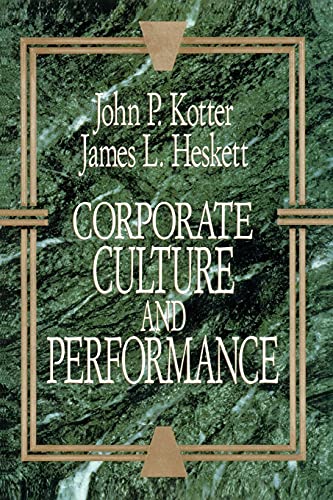
Going far beyond previous empirical work, John Kotter and James Heskett provide the first comprehensive critical analysis of how the "culture" of a corporation powerfully influences its economic performance, for better or for worse. Through painstaking research at such firms as Hewlett-Packard, Xerox, ICI, Nissan, and First Chicago, as well as a quantitative study of the relationship between culture and performance in more than 200 companies, the authors describe how shared values and unwritten rules can profoundly enhance economic success or, conversely, lead to failure to adapt to changing markets and environments.
With penetrating insight, Kotter and Heskett trace the roots of both healthy and unhealthy cultures, demonstrating how easily the latter emerge, especially in firms which have experienced much past success. Challenging the widely held belief that "strong" corporate cultures create excellent business performance, Kotter and Heskett show that while many shared values and institutionalized practices can promote good performances in some instances, those cultures can also be characterized by arrogance, inward focus, and bureaucracy -- features that undermine an organization's ability to adapt to change. They also show that even "contextually or strategically appropriate" cultures -- ones that fit a firm's strategy and business context -- will not promote excellent performance over long periods of time unless they facilitate the adoption of strategies and practices that continuously respond to changing markets and new competitive environments.
Fundamental to the process of reversing unhealthy cultures and making them more adaptive, the authors assert, is effective leadership. At the heart of this groundbreaking book, Kotter and Heskett describe how executives in ten corporations established new visions, aligned and motivated their managers to provide leadership to serve their customers, employees, and stockholders, and thus created more externally focused and responsive cultures.
Die Inhaltsangabe kann sich auf eine andere Ausgabe dieses Titels beziehen.
Über die Autorin bzw. den Autor
John P. Kotter is the Konosuke Matsushita Professor of Leadership at the Harvard Business School. His most recent book is A Force for Change, (Free Press).
Auszug. © Genehmigter Nachdruck. Alle Rechte vorbehalten.
Chapter 1
The Power of Culture
We encounter organizational cultures all the time. When they are not our own, their most visible and unusual qualities seem striking: the look of the traditionally dressed IBM salesman, the commitment to firm and product expressed by employees at Honda or Matsushita, the informality of Apple and many other high-tech companies. When the cultures are our own, they often go unnoticed -- until we try to implement a new strategy or program which is incompatible with their central norms and values. Then we observe, first hand, the power of culture.
The term "culture" originally comes from social anthropology. Late nineteenth- and early twentieth-century studies of "primitive" societies -- Eskimo, South Sea, African, Native American -- revealed ways of life that were not only different from the more technologically advanced parts of America and Europe but were often very different among themselves. The concept of culture was thus coined to represent, in a very broad and holistic sense, the qualities of any specific human group that are passed from one generation to the next. The American Heritage Dictionary defines "culture," more formally, as "the totality of socially transmitted behavior patterns, arts, beliefs, institutions, and all other products of human work and thought characteristics of a community or population."
We have found it helpful to think of organizational culture as having two levels, which differ in terms of their visibility and their resistance to change. At the deeper and less visible level, culture refers to values that are shared by the people in a group and that tend to persist over time even when group membership changes. These notions about what is important in life can vary greatly in different companies; in some settings people care deeply about money, in others about technological innovation or employee well-being. At this level culture can be extremely difficult to change, in part because group members are often unaware of many of the values that bind them together.
At the more visible level, culture represents the behavior patterns or style of an organization that new employees are automatically encouraged to follow by their fellow employees. We say, for example, that people in one group have for years been "hard workers," those in another are "very friendly" to strangers, and those in a third always wear very conservative clothes. Culture, in this sense, is still tough to change, but not nearly as difficult as at the level of basic values.
Each level of culture has a natural tendency to influence the other. This is perhaps most obvious in terms of shared values influencing a group's behavior -- a commitment to customers, for example, influencing how quickly individuals tend to respond to customer complaints. But causality can flow in the other direction too -- behavior and practices can influence values. When employees who have never had any contact with the marketplace begin to interact with customers and their problems and needs, they often begin to value the interests of customers more highly.
Conceptualized in this way, culture in a business enterprise is not the same as a firm's "strategy" or "structure," although these terms (and others such as "vision" or "mission") are sometimes used almost interchangeably because they can all play an important part, along with the competitive and regulatory environment, in shaping people's behavior (see exhibit 1.2). Strategy is simply a logic for how to achieve movement in some direction. The beliefs and practices called for in a strategy may be compatible with a firm's culture or they may not. When they are not, a company usually finds it difficult to implement the strategy successfully. But even when successfully implemented, the behavior patterns that represent a given strategy are not cultural unless most group members tend actively to encourage new members to follow those practices.
Structure refers to certain formal organizational arrangements. Such arrangements may call for behavior that is already pervasive in a firm for cultural reasons. They may call for actions that are not in the culture but are in no way incompatible with it. Or they may call for practices that are at odds with the culture. In this last case, we often find that people differentiate the "formal organization" from the "informal organization."
Although we usually talk about organizational culture in the singular, all firms have multiple cultures -- usually associated with different functional groupings or geographic locations. Even within a relatively small subunit, there may be multiple and even conflicting subcultures. Large and geographically dispersed organizations might have hundreds of different cultures. When people talk of "the corporate culture," they usually mean values and practices that are shared across all groups in a firm, at least within senior management. Using the same logic, a "divisional culture" would be the culture that is shared by all the functional and geographical groups in a division of a corporation.
Firms have cultures because the conditions needed for their creation are commonplace. As MIT's Edgar Schein and others have well demonstrated, all that seems to be required is that a group of employees interact over a significant period of time and be relatively successful at whatever they undertake. Solutions that repeatedly appear to solve the problems they encounter tend to become a part of their culture. The longer the solutions seem to work, the more deeply they tend to become embedded in the culture. Thus, if management increases advertising expenditures whenever revenues cease to grow and that action always appears to increase sales significantly, this behavioral pattern will likely become a part of the firm's corporate culture. Depending upon the specific circumstances, a related value or belief -- perhaps "Ads are great in a downturn," or "Selective advertising is valuable" -- may also become a part of that culture.
Ideas or solutions that become embedded in a culture can originate anywhere: from an individual or a group, at the bottom of the organization or the top. But in firms with strong corporate cultures, these ideas often seem to be associated with a founder or other early leaders who articulate them as a "vision," a "business strategy," a "philosophy," or all three.
Once established, organizational cultures often perpetuate themselves in a number of ways. Potential group members may be screened according to how well their values and behavior fit in. Newly selected members may be explicitly taught the group's style. Historical stories or legends may be told again and again to remind everyone of the group's values and what they mean. Managers may explicitly try to act in ways that exemplify the culture and its ideals. Senior members of the group may communicate key values over and over in their daily conversations or through special rituals and ceremonies. People who successfully achieve the ideals inherent in the culture may be recognized and made into heroes. The natural process of identification between younger and older members may encourage the younger members to take on the values and styles of their mentors. Perhaps most fundamental, people who follow cultural norms will be rewarded but those who do not will be penalized.
rdCultures can be very stable over time, but they are never static. Crises sometimes force a group to reevaluate some values or set of practices. New challenges can lead to the creation of new ways of doing things. Turnover of key members, rapid assimilation of new employees, diversification into very different businesses, and geographical expansion can all weaken or change a culture.
Sufficient crises and turnover, coupled with the lack of perpetuating mechanisms, can destroy...
„Über diesen Titel“ kann sich auf eine andere Ausgabe dieses Titels beziehen.
Suchergebnisse für Corporate Culture and Performance

Beispielbild für diese ISBN
Corporate Culture and Performance
Anbieter: World of Books (was SecondSale), Montgomery, IL, USA
Verkäuferbewertung 5 von 5 Sternen

Zustand: Good. Item in good condition. Textbooks may not include supplemental items i.e. CDs, access codes etc. Bestandsnummer des Verkäufers 00102458024
Gebraucht kaufen
EUR 4,76
Versand gratis
Versand innerhalb von USA
Versand innerhalb von USA
Anzahl: 3 verfügbar
Foto des Verkäufers
Corporate Culture and Performance
Anbieter: Zoom Books Company, Lynden, WA, USA
Verkäuferbewertung 5 von 5 Sternen
Zustand: very_good. Book is in very good condition and may include minimal underlining highlighting. The book can also include "From the library of" labels. May not contain miscellaneous items toys, dvds, etc. . We offer 100% money back guarantee and 24 7 customer service. Bestandsnummer des Verkäufers ZBV.1451655320.VG
Gebraucht kaufen
EUR 4,77
Versand gratis
Versand innerhalb von USA
Versand innerhalb von USA
Anzahl: 1 verfügbar
Beispielbild für diese ISBN
Corporate Culture and Performance
Verlag:
Free Press (edition Reprint), 2011
ISBN 10: 1451655320
ISBN 13: 9781451655322
Gebraucht
Paperback
Anbieter: BooksRun, Philadelphia, PA, USA
Verkäuferbewertung 5 von 5 Sternen
Paperback. Zustand: Very Good. Reprint. It's a well-cared-for item that has seen limited use. The item may show minor signs of wear. All the text is legible, with all pages included. It may have slight markings and/or highlighting. Bestandsnummer des Verkäufers 1451655320-11-1
Gebraucht kaufen
EUR 4,80
Versand gratis
Versand innerhalb von USA
Versand innerhalb von USA
Anzahl: 1 verfügbar
Foto des Verkäufers
Corporate Culture and Performance
Anbieter: Off The Shelf, Antonia, MO, USA
Verkäuferbewertung 5 von 5 Sternen
Zustand: good. The item shows wear from consistent use, but it remains in good condition and works perfectly. All pages and cover are intact including the dust cover, if applicable . Spine may show signs of wear. Pages may include limited notes and highlighting. May NOT include discs, access code or other supplemental materials. Bestandsnummer des Verkäufers 4WILKM00NZ8W
Gebraucht kaufen
EUR 1,55
EUR 4,35 Versand
Versand innerhalb von USA
Versand innerhalb von USA
Anzahl: 1 verfügbar
Beispielbild für diese ISBN
Corporate Culture and Performance
Anbieter: ThriftBooks-Atlanta, AUSTELL, GA, USA
Verkäuferbewertung 5 von 5 Sternen
Paperback. Zustand: Good. No Jacket. Pages can have notes/highlighting. Spine may show signs of wear. ~ ThriftBooks: Read More, Spend Less. Bestandsnummer des Verkäufers G1451655320I3N00
Gebraucht kaufen
EUR 6,03
Versand gratis
Versand innerhalb von USA
Versand innerhalb von USA
Anzahl: 1 verfügbar
Beispielbild für diese ISBN
Corporate Culture and Performance
Anbieter: Better World Books, Mishawaka, IN, USA
Verkäuferbewertung 5 von 5 Sternen
Zustand: Good. Pages intact with minimal writing/highlighting. The binding may be loose and creased. Dust jackets/supplements are not included. Stock photo provided. Product includes identifying sticker. Better World Books: Buy Books. Do Good. Bestandsnummer des Verkäufers 14724387-6
Gebraucht kaufen
EUR 6,04
Versand gratis
Versand innerhalb von USA
Versand innerhalb von USA
Anzahl: 1 verfügbar
Beispielbild für diese ISBN
Corporate Culture and Performance
Anbieter: Better World Books, Mishawaka, IN, USA
Verkäuferbewertung 5 von 5 Sternen
Zustand: Very Good. Pages intact with possible writing/highlighting. Binding strong with minor wear. Dust jackets/supplements may not be included. Stock photo provided. Product includes identifying sticker. Better World Books: Buy Books. Do Good. Bestandsnummer des Verkäufers 14622633-75
Gebraucht kaufen
EUR 6,04
Versand gratis
Versand innerhalb von USA
Versand innerhalb von USA
Anzahl: 1 verfügbar
Beispielbild für diese ISBN
Corporate Culture and Performance
Anbieter: World of Books Inc, Montgomery, IL, USA
Verkäuferbewertung 2 von 5 Sternen

Paperback. Zustand: Good. Going far beyond previous empirical work, John Kotter and James Heskett provide the first comprehensive critical analysis of how the "culture" of a corporation powerfully influences its economic performance, for better or for worse. Through painstaking research at such firms as Hewlett-Packard, Xerox, ICI, Nissan, and First Chicago, as well as a quantitative study of the relationship between culture and performance in more than 200 companies, the authors describe how shared values and unwritten rules can profoundly enhance economic success or, conversely, lead to failure to adapt to changing markets and environments.With penetrating insight, Kotter and Heskett trace the roots of both healthy and unhealthy cultures, demonstrating how easily the latter emerge, especially in firms which have experienced much past success. Challenging the widely held belief that "strong" corporate cultures create excellent business performance, Kotter and Heskett show that while many shared values and institutionalized practices can promote good performances in some instances, those cultures can also be characterized by arrogance, inward focus, and bureaucracy -- features that undermine an organization's ability to adapt to change. They also show that even "contextually or strategically appropriate" cultures -- ones that fit a firm's strategy and business context -- will not promote excellent performance over long periods of time unless they facilitate the adoption of strategies and practices that continuously respond to changing markets and new competitive environments.Fundamental to the process of reversing unhealthy cultures and making them more adaptive, the authors assert, is effective leadership. At the heart of this groundbreaking book, Kotter and Heskett describe how executives in ten corporations established new visions, aligned and motivated their managers to provide leadership to serve their customers, employees, and stockholders, and thus created more externally focused and responsive cultures. Bestandsnummer des Verkäufers CIN1451655320G
Gebraucht kaufen
EUR 6,55
Versand gratis
Versand innerhalb von USA
Versand innerhalb von USA
Anzahl: 3 verfügbar
Beispielbild für diese ISBN
Corporate Culture and Performance
Anbieter: HPB-Diamond, Dallas, TX, USA
Verkäuferbewertung 5 von 5 Sternen
Paperback. Zustand: Very Good. Connecting readers with great books since 1972! Used books may not include companion materials, and may have some shelf wear or limited writing. We ship orders daily and Customer Service is our top priority! Bestandsnummer des Verkäufers S_464175693
Gebraucht kaufen
EUR 3,59
EUR 3,27 Versand
Versand innerhalb von USA
Versand innerhalb von USA
Anzahl: 1 verfügbar
Foto des Verkäufers
Corporate Culture and Performance
Anbieter: Shakespeare Book House, Rockford, IL, USA
Verkäuferbewertung 5 von 5 Sternen
Zustand: new. Bestandsnummer des Verkäufers EBBV.1451655320.N