
Verwandte Artikel zu Soil and Sacrament: A Spiritual Memoir of Food and...
Inhaltsangabe
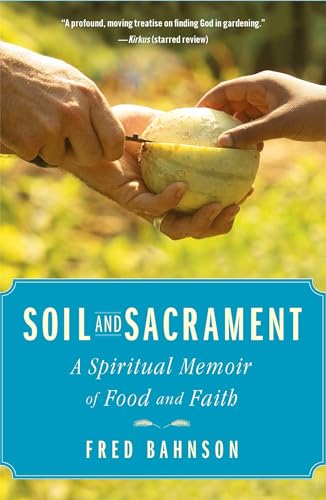
Part memoir, part spiritual quest, part agricultural travelogue, Soil and Sacrament is a moving and profound exploration of the joy and solace found in returning to the garden.
Like many seekers of the authentic life, Fred Bahnson sought answers to big questions such as, what does it mean to follow God, and how should I live my life? But after divinity school at Duke, Bahnson began to find answers not in a pulpit, but at the handle of a plow. After his agrarian conversion, Bahnson started a faith-based community garden in rural North Carolina to help its members grow real food and to feed his own spiritual hunger.
Soil and Sacrament tells the story of how Bahnson and people of faith all over America are re-rooting themselves in the land, reconnecting with their food and each other, and praying with their very lives the prayer of the early Christian monks: “We beg you, make us truly alive.” Through his journeys to four different faith communities—Catholic, Protestant, Pentecostal, and Jewish—Bahnson explores the connections between spiritual nourishment and the way we feed our bodies with the sensitivity, personal knowledge, and insight shared by Wendell Berry and Bill McKibben.
Soil and Sacrament is a book about communion in its deepest sense—an inspiring and joyful meditation on what grows above the earth, beneath it, and inside each one of us.
Die Inhaltsangabe kann sich auf eine andere Ausgabe dieses Titels beziehen.
Über die Autorin bzw. den Autor
Fred Bahnson is a permaculture gardener, a cofounder and former director of Anathoth Community Garden, coauthor of Making Peace With the Land, and the author of Soil and Sacrament. His essays have appeared in Oxford American, Image, The Sun, Christian Science Monitor, and Best American Spiritual Writing 2007. He is the recipient of a Kellogg Food & Community fellowship and a North Carolina Artist fellowship in Creative Nonfiction. He lives in western North Carolina and is the director of the Food, Faith, and Religious Leadership Initiative at Wake Forest University School of Divinity.
Auszug. © Genehmigter Nachdruck. Alle Rechte vorbehalten.
Soil & Sacrament
Prologue
Cedar Grove, North Carolina—December 2008
Winter is my favorite growing season. Anyone can toss down a few seeds in June and get a crop, but it takes a disciplined hope to garden in the dark of December. And what rewards. After several frosts, plant starches become sugars. Carrots attain the sweet crunch of apples, and kale loses all hint of bitterness. Turnips become so sugary you can eat them raw.
Mid-morning on the first Sunday in Advent, I stood beside the red-roofed barn and looked out at Anathoth Community Garden. Down the hill the greenhouse was shedding its frost in the first light. Along the creek sat the children’s playhouse, and beyond that the site of our future orchard. But the sight that always drew my eye was the wide expanse of the field itself, a wave-and-trough succession of raised vegetable beds lying dark and still in the low winter light, pregnant with life waiting to be born. Soon I would need to drive a mile down the road to the little Methodist church where my wife and sons would be arriving for the morning service, but first I needed to come here, to this five-acre piece of land that had come to feel like an extension of my own body. Over the past three years of working here I had grown attached to this garden and its people. They had fed me in so many ways. Perhaps too many ways.
I walked downhill to the greenhouse, a Gothic arch structure where we grew most of our winter crops and started all our seed. Heated entirely by the sun and ventilated by wax pistons, it was off the grid. This was my favorite of winter places, my sanctuary; I could lose myself in here for hours. What a thrill I received each morning as I entered this congregation of plants, lit as if from within by the low winter sun. The world outside the greenhouse was nineteen degrees cold; dry and lifeless. Once I stepped across the wooden threshold, the temperature rose to a balmy forty, lush and humid and alive with the earthy aroma of plants seeking light.
The soil here was deeper than in the rest of the garden, the color and consistency of chocolate sponge cake. Even on the coldest of winter days, black organic matter in the soil absorbed the sun’s heat and slowly released it at night, keeping the plants alive. The beds, each four feet wide and thirty feet long, were double-dug. While the topsoil of a rototilled garden descends a mere eight inches, our greenhouse beds reached a depth of at least two feet, mimicking the fertile, loamy soils of the American prairie or the Russian steppe. With such deep beds, roots have better access to water and minerals deep in the ground. Plants can be spaced closer together, quadrupling yield. Thousands of years ago the Greeks realized that plants grew better in mountain landslides. The deep soil there was loose and friable, allowing the roots easy access to nutrients. A double-dug bed is like an underground landslide. Roots flourish in such deep tilth, creating a vast subterranean network that feeds aboveground life.
I spent much of my time at Anathoth preparing and working and thinking about the soil. There is an entire ecosystem in a handful of soil: bacteria, fungi, protozoa, nematodes, earthworms. Through their breeding and dying such creatures vivify the world. This pattern of relationships I find a captivating mystery; I love plants, but I am most attracted to the fervent and secret work that goes on beneath the surface.
Soil is not dirt. It is a living organism, or rather a collection of organisms, and it must be fed. Soil both craves life and wants to produce more life, even a hundredfold.
The true profundity of our soil was difficult to gauge. One day I slid my hand into one of the greenhouse beds. I gently pushed down and kept pushing until my arm vanished and my shoulder touched the soil’s surface. It had seemed then as if I could keep burrowing downward, until my entire body was swallowed by the warm, dark earth.
Soil is a portal to another world.
• • •
That Sunday morning I was alone in the garden.
Anathoth was a food garden for the community—our sixty members worked the land in common and shared its bounty—yet more and more I had found myself going there at such times to escape people. I was by nature reclusive, yet my role as Anathoth’s director required me to act as a public figure, putting on a smile and chatting up the members, who worked a minimum of two hours a week in exchange for produce. The truth was that I had less and less energy for people—even my own family. Increasingly I felt accosted by so many people needing something from me, and no matter how deeply I wanted to give them what they needed, all I wanted to do was withdraw.
The Sunday morning service down the road at Cedar Grove United Methodist Church would begin soon, but I remembered that there were beds that needed cover cropping; I had a sudden desire to plant. Leaving the greenhouse I walked back up to the barn and reached for the blue hand-cranked seed spreader, opened a bag of rye, and poured in the seed. I mixed rhizobium inoculant into a bucket full of hairy vetch and crimson clover seed, added a few drops of water, and stirred them together with the rye. Vetch and clover are legumes, plants that form a beneficial relationship with rhizobium bacteria. Their roots would supply nitrogen not only to the rye but also to the crops that would follow in the rotation. It’s a beautiful symbiosis: legume roots provide the bacteria with sugars and in exchange the bacteria fix nitrogen into tiny pink nodules that cling like barnacles to the legume roots. The bacteria and legumes serve one another. The rye stalk provides a structure for the legumes to climb, and rye’s fibrous roots mine minerals from the subsoil, reaching ten feet down into the earth. It’s a trinity of abundance—rye, vetch, and clover—each freely giving up its body for the other’s nourishment, each dying so that the other may live.
I knew something of that sacrifice. For years I had labored for Anathoth, but only recently did I realize the toll it had taken on me and my family. There were too many days when I would come back to our farm and instead of being with the family who needed me, I would retreat to my little shack in the woods. My wife, Elizabeth, sacrificed her own needs for the needs of Anathoth, and mostly suffered my absences in silence. But our young sons were confused. “Why does Daddy need so much time alone?” they asked. I had started to ask that question, too.
By early May the cover crops would be five feet tall. When the rye reached milk stage and the vetch and clover flowered purple and crimson, I would walk up and down the beds swinging a scythe, the stalks falling before me, the air growing redolent with grassy perfume, and then I would rake up the cuttings to make compost. First the green layer: fresh rye, vetch, and clover stalks. Then a brown layer: old hay or leaves. The third layer would be a dusting of garden soil, containing the spark of bacteria that would set this biological pyre aflame. In a week the tiny hordes inside the compost pile would expend their oxygen, slowing their combustion, and I would turn the pile with a pitchfork to give them air. All kinds of organic matter could go into a compost pile. Once I even composted a dead field rat; a few months later there was nothing but bones.
I loved making compost. The bright green of freshly mown rye, vetch, and clover; steam arising from the pile on a cold morning; the smell of the forest floor in your...
„Über diesen Titel“ kann sich auf eine andere Ausgabe dieses Titels beziehen.
Suchergebnisse für Soil and Sacrament: A Spiritual Memoir of Food and...

Beispielbild für diese ISBN
Soil and Sacrament: A Spiritual Memoir of Food and Faith
Anbieter: World of Books (was SecondSale), Montgomery, IL, USA
Verkäuferbewertung 5 von 5 Sternen

Zustand: Good. Item in good condition. Textbooks may not include supplemental items i.e. CDs, access codes etc. Bestandsnummer des Verkäufers 00103344050
Gebraucht kaufen
EUR 4,83
Versand gratis
Versand innerhalb von USA
Versand innerhalb von USA
Anzahl: 2 verfügbar
Beispielbild für diese ISBN
Soil and Sacrament: A Spiritual Memoir of Food and Faith
Verlag:
Simon & Schuster (edition First Edition), 2013
ISBN 10: 1451663307
ISBN 13: 9781451663303
Gebraucht
Hardcover
Erstausgabe
Anbieter: BooksRun, Philadelphia, PA, USA
Verkäuferbewertung 5 von 5 Sternen
Hardcover. Zustand: Fair. First Edition. With dust jacket. The item might be beaten up but readable. May contain markings or highlighting, as well as stains, bent corners, or any other major defect, but the text is not obscured in any way. Bestandsnummer des Verkäufers 1451663307-7-1-29
Gebraucht kaufen
EUR 4,83
Versand gratis
Versand innerhalb von USA
Versand innerhalb von USA
Anzahl: 1 verfügbar
Beispielbild für diese ISBN
Soil and Sacrament : A Spiritual Memoir of Food and Faith
Anbieter: Better World Books, Mishawaka, IN, USA
Verkäuferbewertung 5 von 5 Sternen
Zustand: Very Good. First Edition first Printing. Pages intact with possible writing/highlighting. Binding strong with minor wear. Dust jackets/supplements may not be included. Stock photo provided. Product includes identifying sticker. Better World Books: Buy Books. Do Good. Bestandsnummer des Verkäufers 4274696-6
Gebraucht kaufen
EUR 6,16
Versand gratis
Versand innerhalb von USA
Versand innerhalb von USA
Anzahl: 1 verfügbar
Beispielbild für diese ISBN
Soil and Sacrament : A Spiritual Memoir of Food and Faith
Anbieter: Better World Books, Mishawaka, IN, USA
Verkäuferbewertung 5 von 5 Sternen
Zustand: Good. First Edition first Printing. Pages intact with minimal writing/highlighting. The binding may be loose and creased. Dust jackets/supplements are not included. Stock photo provided. Product includes identifying sticker. Better World Books: Buy Books. Do Good. Bestandsnummer des Verkäufers 1379008-6
Gebraucht kaufen
EUR 6,16
Versand gratis
Versand innerhalb von USA
Versand innerhalb von USA
Anzahl: 2 verfügbar
Beispielbild für diese ISBN
Soil and Sacrament : A Spiritual Memoir of Food and Faith
Anbieter: Better World Books, Mishawaka, IN, USA
Verkäuferbewertung 5 von 5 Sternen
Zustand: Good. First Edition first Printing. Former library copy. Pages intact with minimal writing/highlighting. The binding may be loose and creased. Dust jackets/supplements are not included. Includes library markings. Stock photo provided. Product includes identifying sticker. Better World Books: Buy Books. Do Good. Bestandsnummer des Verkäufers 4267637-6
Gebraucht kaufen
EUR 6,16
Versand gratis
Versand innerhalb von USA
Versand innerhalb von USA
Anzahl: 1 verfügbar
Beispielbild für diese ISBN
Soil and Sacrament : A Spiritual Memoir of Food and Faith
Anbieter: Better World Books, Mishawaka, IN, USA
Verkäuferbewertung 5 von 5 Sternen
Zustand: Very Good. First Edition first Printing. Former library copy. Pages intact with possible writing/highlighting. Binding strong with minor wear. Dust jackets/supplements may not be included. Includes library markings. Stock photo provided. Product includes identifying sticker. Better World Books: Buy Books. Do Good. Bestandsnummer des Verkäufers 4440164-6
Gebraucht kaufen
EUR 6,16
Versand gratis
Versand innerhalb von USA
Versand innerhalb von USA
Anzahl: 2 verfügbar
Beispielbild für diese ISBN
Soil and Sacrament: A Spiritual Memoir of Food and Faith
Anbieter: Wonder Book, Frederick, MD, USA
Verkäuferbewertung 5 von 5 Sternen
Zustand: Very Good. Very Good condition. Very Good dust jacket. With remainder mark. A copy that may have a few cosmetic defects. May also contain light spine creasing or a few markings such as an owner's name, short gifter's inscription or light stamp. Bestandsnummer des Verkäufers O08F-00900
Gebraucht kaufen
EUR 6,40
Versand gratis
Versand innerhalb von USA
Versand innerhalb von USA
Anzahl: 1 verfügbar
Beispielbild für diese ISBN
Soil and Sacrament: A Spiritual Memoir of Food and Faith
Anbieter: Wonder Book, Frederick, MD, USA
Verkäuferbewertung 5 von 5 Sternen
Zustand: As New. Like New condition. Very Good dust jacket. A near perfect copy that may have very minor cosmetic defects. Bestandsnummer des Verkäufers I12K-00754
Gebraucht kaufen
EUR 6,40
Versand gratis
Versand innerhalb von USA
Versand innerhalb von USA
Anzahl: 1 verfügbar
Beispielbild für diese ISBN
Soil and Sacrament: A Spiritual Memoir of Food and Faith
Anbieter: World of Books Inc, Montgomery, IL, USA
Verkäuferbewertung 4 von 5 Sternen

Hardback. Zustand: Good. Part spiritual quest, part agricultural travelogue, this moving and profound exploration of the joy and solace found in returning to the garden is inspiring and beautiful. A POWERFUL, PERSONAL STORY OF HOW GROWING AND SHARING FOD PULS US CLOSER TO GOD Like many seekers of the authentic life, Fred Bahnson sought answers to big questions like What does it mean to follow God? and How should I live my life? But after divinity school at Duke, Bahnson began to find answers not in a pulpit, but at the handle of a plow. After his agrarian conversion, Bahnson started a faith-based community garden in rural North Carolina to help its members grow real food and to feed his own spiritual hunger. Soil and Sacrament tells the story of how Bahnson and people of faith all over America are re-rooting themselves in the land, reconnecting with their food and each other, and praying with their very lives the prayer of the early Christian monks: We beg you, make us truly alive. Through his journeys to four different faith communities--Catholic, Protestant, Pentecostal, and Jewish--Bahnson explores the con-nections between spiritual nourishment and the way we feed our bodies with the sensitivity, personal knowledge, and insight shared by Wendell Berry and Bill McKibben. Soil and Sacrament is a book about communion in its deepest sense--an inspiring and joyful meditation on what grows above the earth, beneath it, and inside each one of us. Bestandsnummer des Verkäufers CIN1451663307G
Gebraucht kaufen
EUR 6,66
Versand gratis
Versand innerhalb von USA
Versand innerhalb von USA
Anzahl: 3 verfügbar
Beispielbild für diese ISBN
Soil and Sacrament: A Spiritual Memoir of Food and Faith
Anbieter: ThriftBooks-Atlanta, AUSTELL, GA, USA
Verkäuferbewertung 5 von 5 Sternen
Hardcover. Zustand: Good. No Jacket. Former library book; Pages can have notes/highlighting. Spine may show signs of wear. ~ ThriftBooks: Read More, Spend Less. Bestandsnummer des Verkäufers G1451663307I3N10
Gebraucht kaufen
EUR 6,82
Versand gratis
Versand innerhalb von USA
Versand innerhalb von USA
Anzahl: 1 verfügbar