
Verwandte Artikel zu Maximum-Likelihood Deconvolution: A Journey into Model-Based...
Maximum-Likelihood Deconvolution: A Journey into Model-Based Signal Processing (Signal Processing and Digital Filtering) - Softcover
Inhaltsangabe
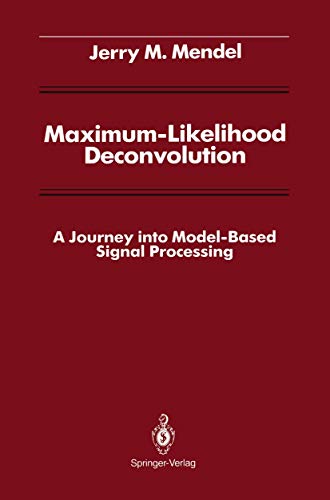
Convolution is the most important operation that describes the behavior of a linear time-invariant dynamical system. Deconvolution is the unraveling of convolution. It is the inverse problem of generating the system's input from knowledge about the system's output and dynamics. Deconvolution requires a careful balancing of bandwidth and signal-to-noise ratio effects. Maximum-likelihood deconvolution (MLD) is a design procedure that handles both effects. It draws upon ideas from Maximum Likelihood, when unknown parameters are random. It leads to linear and nonlinear signal processors that provide high-resolution estimates of a system's input. All aspects of MLD are described, from first principles in this book. The purpose of this volume is to explain MLD as simply as possible. To do this, the entire theory of MLD is presented in terms of a convolutional signal generating model and some relatively simple ideas from optimization theory. Earlier approaches to MLD, which are couched in the language of state-variable models and estimation theory, are unnecessary to understand the essence of MLD. MLD is a model-based signal processing procedure, because it is based on a signal model, namely the convolutional model. The book focuses on three aspects of MLD: (1) specification of a probability model for the system's measured output; (2) determination of an appropriate likelihood function; and (3) maximization of that likelihood function. Many practical algorithms are obtained. Computational aspects of MLD are described in great detail. Extensive simulations are provided, including real data applications.
Die Inhaltsangabe kann sich auf eine andere Ausgabe dieses Titels beziehen.
Über die Autorin bzw. den Autor
Jerry M. Mendel received the Ph.D. degree in Electrical Engineering from the Polytechnic Institute of Brooklyn, Brooklyn, NY. Currently, he is Emeritus Professor of Electrical Engineering at the University of Southern California in Los Angeles, where he worked for 44 years. He has published close to 600 technical papers and is author and/or co-author of 12 books, including Uncertain Rule-based Fuzzy Logic Systems: Introduction and New Directions (Prentice-Hall, 2001), Perceptual Computing: Aiding People in Making Subjective Judgments (Wiley & IEEE Press, 2010), Introduction to Type-2 Fuzzy Logic Control: Theory and Application (Wiley & IEEE Press, 2014) and Uncertain Rule-based Fuzzy Systems: Introduction and New Directions, 2nd ed. (Springer, 2017). He is a Life Fellow of the IEEE, a Distinguished Member of the IEEE Control Systems Society, and a Fellow of the International Fuzzy Systems Association and the Asia-Pacific AI Association. He was President of the IEEE Control Systems Society in 1986, a member of the Administrative Committee of the IEEE Computational Intelligence Society for nine years, and Chairman of its Fuzzy Systems Technical Committee and the Computing With Words Task Force of that TC. Among his awards are the 1983 Best Transactions Paper Award of the IEEE Geoscience and Remote Sensing Society, the 1992 Signal Processing Society Paper Award, the 2002 and 2014 Transactions on Fuzzy Systems Outstanding Paper Awards, a 1984 IEEE Centennial Medal, an IEEE Third Millenium Medal, a Fuzzy Systems Pioneer Award (2008) from the IEEE Computational Intelligence Society for fundamental theoretical contributions and seminal results in fuzzy systems, and the 2021 IEEE Lotfi A. Zadeh Pioneer Award for developing and promoting type-2 fuzzy logic. As of March 27, 2023, his publications have been cited (Google Scholar) more than 63,000 times, with an h-index of 100 and an i10-index of 320.
„Über diesen Titel“ kann sich auf eine andere Ausgabe dieses Titels beziehen.
Suchergebnisse für Maximum-Likelihood Deconvolution: A Journey into Model-Based...

Beispielbild für diese ISBN
Maximum-Likelihood Deconvolution (eng)
Print-on-DemandAnbieter: Brook Bookstore On Demand, Napoli, NA, Italien
Verkäuferbewertung 5 von 5 Sternen

Zustand: new. Questo è un articolo print on demand. Bestandsnummer des Verkäufers NBCS01IYP1
Neu kaufen
EUR 46,22
EUR 5,50 Versand
Versand von Italien nach USA
Versand von Italien nach USA
Anzahl: Mehr als 20 verfügbar
Foto des Verkäufers
Maximum-Likelihood Deconvolution
Verlag:
Springer, Springer Sep 2011, 2011
ISBN 10: 1461279852
ISBN 13: 9781461279853
Neu
Taschenbuch
Anbieter: BuchWeltWeit Ludwig Meier e.K., Bergisch Gladbach, Deutschland
Verkäuferbewertung 5 von 5 Sternen
Taschenbuch. Zustand: Neu. This item is printed on demand - it takes 3-4 days longer - Neuware -Convolution is the most important operation that describes the behavior of a linear time-invariant dynamical system. Deconvolution is the unraveling of convolution. It is the inverse problem of generating the system's input from knowledge about the system's output and dynamics. Deconvolution requires a careful balancing of bandwidth and signal-to-noise ratio effects. Maximum-likelihood deconvolution (MLD) is a design procedure that handles both effects. It draws upon ideas from Maximum Likelihood, when unknown parameters are random. It leads to linear and nonlinear signal processors that provide high-resolution estimates of a system's input. All aspects of MLD are described, from first principles in this book. The purpose of this volume is to explain MLD as simply as possible. To do this, the entire theory of MLD is presented in terms of a convolutional signal generating model and some relatively simple ideas from optimization theory. Earlier approaches to MLD, which are couched in the language of state-variable models and estimation theory, are unnecessary to understand the essence of MLD. MLD is a model-based signal processing procedure, because it is based on a signal model, namely the convolutional model. The book focuses on three aspects of MLD: (1) specification of a probability model for the system's measured output; (2) determination of an appropriate likelihood function; and (3) maximization of that likelihood function. Many practical algorithms are obtained. Computational aspects of MLD are described in great detail. Extensive simulations are provided, including real data applications. 244 pp. Englisch. Bestandsnummer des Verkäufers 9781461279853
Neu kaufen
EUR 53,49
EUR 23,00 Versand
Versand von Deutschland nach USA
Versand von Deutschland nach USA
Anzahl: 2 verfügbar
Beispielbild für diese ISBN
Maximum-Likelihood Deconvolution: A Journey into Model-Based Signal Processing (Signal Processing and Digital Filtering)
Anbieter: Ria Christie Collections, Uxbridge, Vereinigtes Königreich
Verkäuferbewertung 5 von 5 Sternen
Zustand: New. In English. Bestandsnummer des Verkäufers ria9781461279853_new
Neu kaufen
EUR 67,94
EUR 11,05 Versand
Versand von Vereinigtes Königreich nach USA
Versand von Vereinigtes Königreich nach USA
Anzahl: Mehr als 20 verfügbar
Beispielbild für diese ISBN
Maximum-Likelihood Deconvolution : A Journey into Modelbased Signal Processing
Anbieter: GreatBookPrices, Columbia, MD, USA
Verkäuferbewertung 5 von 5 Sternen
Zustand: New. Bestandsnummer des Verkäufers 18685820-n
Neu kaufen
EUR 77,75
EUR 2,35 Versand
Versand innerhalb von USA
Versand innerhalb von USA
Anzahl: 15 verfügbar
Beispielbild für diese ISBN
Maximum-likelihood Deconvolution: A Journey into Modelbased Signal Processing (Signal Processing and Digital Filtering)
Anbieter: Revaluation Books, Exeter, Vereinigtes Königreich
Verkäuferbewertung 5 von 5 Sternen
Paperback. Zustand: Brand New. reprint edition. 241 pages. 9.25x6.10x0.60 inches. In Stock. Bestandsnummer des Verkäufers x-1461279852
Neu kaufen
EUR 80,50
EUR 11,79 Versand
Versand von Vereinigtes Königreich nach USA
Versand von Vereinigtes Königreich nach USA
Anzahl: 2 verfügbar
Foto des Verkäufers
Maximum-Likelihood Deconvolution : A Journey into Model-Based Signal Processing
Anbieter: AHA-BUCH GmbH, Einbeck, Deutschland
Verkäuferbewertung 5 von 5 Sternen
Taschenbuch. Zustand: Neu. Druck auf Anfrage Neuware - Printed after ordering - Convolution is the most important operation that describes the behavior of a linear time-invariant dynamical system. Deconvolution is the unraveling of convolution. It is the inverse problem of generating the system's input from knowledge about the system's output and dynamics. Deconvolution requires a careful balancing of bandwidth and signal-to-noise ratio effects. Maximum-likelihood deconvolution (MLD) is a design procedure that handles both effects. It draws upon ideas from Maximum Likelihood, when unknown parameters are random. It leads to linear and nonlinear signal processors that provide high-resolution estimates of a system's input. All aspects of MLD are described, from first principles in this book. The purpose of this volume is to explain MLD as simply as possible. To do this, the entire theory of MLD is presented in terms of a convolutional signal generating model and some relatively simple ideas from optimization theory. Earlier approaches to MLD, which are couched in the language of state-variable models and estimation theory, are unnecessary to understand the essence of MLD. MLD is a model-based signal processing procedure, because it is based on a signal model, namely the convolutional model. The book focuses on three aspects of MLD: (1) specification of a probability model for the system's measured output; (2) determination of an appropriate likelihood function; and (3) maximization of that likelihood function. Many practical algorithms are obtained. Computational aspects of MLD are described in great detail. Extensive simulations are provided, including real data applications. Bestandsnummer des Verkäufers 9781461279853
Neu kaufen
EUR 57,82
EUR 35,00 Versand
Versand von Deutschland nach USA
Versand von Deutschland nach USA
Anzahl: 1 verfügbar
Foto des Verkäufers
Maximum-Likelihood Deconvolution
Print-on-DemandAnbieter: moluna, Greven, Deutschland
Verkäuferbewertung 5 von 5 Sternen
Zustand: New. Dieser Artikel ist ein Print on Demand Artikel und wird nach Ihrer Bestellung fuer Sie gedruckt. Convolution is the most important operation that describes the behavior of a linear time-invariant dynamical system. Deconvolution is the unraveling of convolution. It is the inverse problem of generating the system s input from knowledge about the system s. Bestandsnummer des Verkäufers 4190576
Neu kaufen
EUR 48,37
EUR 48,99 Versand
Versand von Deutschland nach USA
Versand von Deutschland nach USA
Anzahl: Mehr als 20 verfügbar
Foto des Verkäufers
Maximum-Likelihood Deconvolution
Verlag:
Springer, Springer Sep 2011, 2011
ISBN 10: 1461279852
ISBN 13: 9781461279853
Neu
Taschenbuch
Anbieter: buchversandmimpf2000, Emtmannsberg, BAYE, Deutschland
Verkäuferbewertung 5 von 5 Sternen
Taschenbuch. Zustand: Neu. This item is printed on demand - Print on Demand Titel. Neuware -Convolution is the most important operation that describes the behavior of a linear time-invariant dynamical system. Deconvolution is the unraveling of convolution. It is the inverse problem of generating the system's input from knowledge about the system's output and dynamics. Deconvolution requires a careful balancing of bandwidth and signal-to-noise ratio effects. Maximum-likelihood deconvolution (MLD) is a design procedure that handles both effects. It draws upon ideas from Maximum Likelihood, when unknown parameters are random. It leads to linear and nonlinear signal processors that provide high-resolution estimates of a system's input. All aspects of MLD are described, from first principles in this book. The purpose of this volume is to explain MLD as simply as possible. To do this, the entire theory of MLD is presented in terms of a convolutional signal generating model and some relatively simple ideas from optimization theory. Earlier approaches to MLD, which are couched in the language of state-variable models and estimation theory, are unnecessary to understand the essence of MLD. MLD is a model-based signal processing procedure, because it is based on a signal model, namely the convolutional model. The book focuses on three aspects of MLD: (1) specification of a probability model for the system's measured output; (2) determination of an appropriate likelihood function; and (3) maximization of that likelihood function. Many practical algorithms are obtained. Computational aspects of MLD are described in great detail. Extensive simulations are provided, including real data applications.Springer-Verlag KG, Sachsenplatz 4-6, 1201 Wien 244 pp. Englisch. Bestandsnummer des Verkäufers 9781461279853
Neu kaufen
EUR 53,49
EUR 60,00 Versand
Versand von Deutschland nach USA
Versand von Deutschland nach USA
Anzahl: 1 verfügbar
Beispielbild für diese ISBN
Maximum-Likelihood Deconvolution: A Journey into Model-Based Signal Processing (Signal Processing and Digital Filtering)
Anbieter: Mispah books, Redhill, SURRE, Vereinigtes Königreich
Verkäuferbewertung 4 von 5 Sternen

Paperback. Zustand: Like New. LIKE NEW. SHIPS FROM MULTIPLE LOCATIONS. book. Bestandsnummer des Verkäufers ERICA77314612798526
Gebraucht kaufen
EUR 120,22
EUR 29,47 Versand
Versand von Vereinigtes Königreich nach USA
Versand von Vereinigtes Königreich nach USA
Anzahl: 1 verfügbar
Beispielbild für diese ISBN
Maximum-Likelihood Deconvolution : A Journey into Modelbased Signal Processing
Anbieter: GreatBookPrices, Columbia, MD, USA
Verkäuferbewertung 5 von 5 Sternen
Zustand: As New. Unread book in perfect condition. Bestandsnummer des Verkäufers 18685820
Gebraucht kaufen
EUR 151,20
EUR 2,35 Versand
Versand innerhalb von USA
Versand innerhalb von USA
Anzahl: 15 verfügbar