
Verwandte Artikel zu Alternative Investment Strategies And Risk Management:...
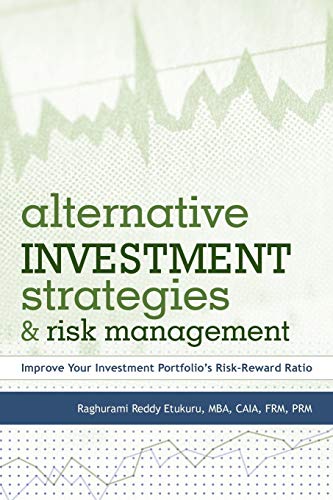
Alternative Investment Strategies And Risk Management: Improve Your Investment Portfolio's Risk-Reward Ratio - Softcover
Inhaltsangabe
In this environment, it's more important than ever to get familiar with risk management principles and seek out alternative investment strategies carefully to maintain and grow your capital. Written by Raghurami Reddy Etukuru, MBA, CAIA, FRM, PRM, this guidebook introduces you to various alternative investments and risk management concepts in straightforward language. For instance, hedge funds are often seen as risky investments, but they actually provide greater diversification than traditional common stocks. If you engage in the proper hedge fund strategy, you'll also find less volatility. In addition to hedge funds, you will find information and guidance on various phases of due diligence; risk metrics, quantitative models and exotic options; commodities, managed futures, private equities, and real estate; brokers, auditors, and legal counsel. Get the information you need to make informed decisions about your own finances. Whether you are a businessperson, student, analyst it's imperative for you to develop a deeper understanding of Alternative Investment Strategies and Risk Management.
Die Inhaltsangabe kann sich auf eine andere Ausgabe dieses Titels beziehen.
Auszug. © Genehmigter Nachdruck. Alle Rechte vorbehalten.
alternative INVESTMENT strategies and risk management
Improve Your Investment Portfolio's Risk–Reward RatioBy Raghurami Reddy EtukuruiUniverse, Inc.
Copyright © 2011 Raghurami Reddy Etukuru, MBA, CAIA, FRM, PRMAll right reserved.
ISBN: 978-1-4620-5007-9
Contents
1. Alternative Investments.............................12. Due Diligence.......................................153. Quantitative Fundamentals...........................394. Risk Measurement and Management.....................705. Hedge Funds.........................................1566. Commodities.........................................2687. Managed Futures.....................................2968. Private Equities....................................3089. Real Estate Investing...............................315
Chapter One
Alternative InvestmentsAlternative investments do not constitute a separate group of asset classes. In fact, they are an extension to existing asset classes. The main drivers that distinguish alternative investments from traditional investments are the fewer or no investment constraints and the style and risk/return characteristics of the underlying investments. Most alternative investment managers use traditional asset classes, such as equity, debt, cash, and real assets, and apply both strategic and tactic allocation to these assets. Alternative investments are private in nature and are purchased through a financial intermediary. Examples of alternative investments are hedge funds, managed futures, real estate, commodities, and private equities. Traditionally high-net-worth individuals have shown interest in alternative investments and were willing to bear the disadvantages, such as illiquidity and non-transparency. Due to the attractive risk/reward characteristics and low correlations to traditional asset classes, alternative investments became more of a favorite of institutional investors as well. Alternative investments have grown in popularity as a result of their anticipated impact on overall portfolio performance. Institutional and individual investors have been increasing their exposure to alternative investments in an attempt to improve the risk/reward balance within their investment portfolios.
Investors who invest in alternative investments use the historical returns of the fund as one of the inputs to the manager selection criteria. However, the future performance of any investment or investment portfolio is not certain, and reliance on historical information does not ensure any particular outcome. The past performance of any investment, including alternative investments, such as managed futures funds, is not necessarily indicative of future results. It can only be used as one of the factors, not the sole factor. The main reasons for the attractiveness of alternative investments are higher returns with low volatility and low correlation with traditional assets and the ability to produce absolute returns.
1.1 Sources of Returns
While the sources of returns for alternative investments depend on the type of the investment and underlying assets, the following are major and macro level sources of returns common to most of the types of alternatives.
Strategic-Tactical Allocation: Strategic-tactical allocation is also called core-satellite allocation. Strategic or core allocation is designed to accomplish long-term goals, to determine the fund's market or beta exposure, and to establish a policy risk. The returns earned through strategic allocation are called beta returns and can be estimated by using the capital asset pricing model (CAPM). Once the strategic asset allocation is set, the fund managers typically seek additional returns with the asset classes through tactical asset allocation. Tactical, or satellite, allocation is designed to accomplish short-term goals and to take advantage of dynamic market conditions. Tactical asset allocation requires more dynamic trading and is said to be more opportunistic. The additional returns earned through tactical allocation are called active returns or alpha returns. The alpha returns are in excess of the returns that are estimated by CAPM.
Mathematically,
Rp = Rf + ß(Rm - Rf) + α
Where Rp = Manager's Portfolio Returns
Rf = Risk-Free Returns
Rm = Market return
α = Excess return that is earned by using tactical allocation.
Rf + ß(Rm - Rf) = the return estimated by CAPM theory
Market Inefficiencies: Efficient market hypothesis asserts that financial markets are information efficient and one cannot achieve returns in excess of average market returns. Efficient market hypothesis comes in three forms. The weak form EMH assumes that current stock prices fully reflect all historical information. The semi-strong EMH form assumes that stock prices fully reflect all historical information and all current publicly available information. Finally, the strong-form EMH states that prices reflect not just historical and current publicly available information, but private information, too. In reality, information inefficiencies exist in all markets, and alternative investment managers take advantage of these inefficiencies to earn excess returns.
Manager Skill: Alternative investment managers build complex strategies using their skill. The strategies employ highly complex quantitative strategies and exploit pricing inefficiencies. The manager's skill at gathering information is also one of the sources of returns.
Unconstrained Investments: Traditional investment firms, such as pension funds and mutual funds, have some constraints in investing in certain types of investments. For example, they are restricted to short sell the assets and to use the leverage. Alternative investments are unconstrained and can invest anywhere and in any type of investment and to any extent of leverage. Traditional investment products earn returns through market exposure and not intended to beat market returns. Therefore, these funds are called beta drivers. The most common beta drivers are passive index funds, active index funds, long only funds, and 130/30 funds. These products do not take active risk and are not intended to earn excess returns. 130/30 funds engage in 130 percent of long assets and 30 percent of short assets, with net long exposure of 100%.
Alternative investment managers earn excess returns or alpha, and therefore these products are typically called alpha drivers. The alpha drivers' spectrum starts where the beta spectrum ends. There are several types of alpha drivers. Long/Short strategies do not have any restrictions on the portion of long or short assets. They can even be market neutral, meaning equal long and short exposure, or can be net long exposure. The goal is to earn returns from both positive and negative events. Long/Short strategy is a basic technique of alpha generation. The absolute return technique aims to earn profits regardless of the direction of the market. Managers take market-neutral or net long or net short positions to best utilize available opportunities. These are unconstrained in style and strategy and are less correlated with broad market indices. The global macro strategy is an example of an absolute return investment. Market segmentation is another source of alpha. Market segmentation occurs because not all investors have the same expectation about their investments. Some investors prefer high-liquid assets, while...
„Über diesen Titel“ kann sich auf eine andere Ausgabe dieses Titels beziehen.
Suchergebnisse für Alternative Investment Strategies And Risk Management:...

Beispielbild für diese ISBN
Alternative Investment Strategies And Risk Management: Improve Your Investment Portfolio's Risk-Reward Ratio
Anbieter: California Books, Miami, FL, USA
Verkäuferbewertung 5 von 5 Sternen

Zustand: New. Bestandsnummer des Verkäufers I-9781462050079
Neu kaufen
EUR 23,36
EUR 2,72 Versand
Versand innerhalb von USA
Versand innerhalb von USA
Anzahl: Mehr als 20 verfügbar
Beispielbild für diese ISBN
Alternative Investment Strategies and Risk Management
Print-on-DemandAnbieter: PBShop.store US, Wood Dale, IL, USA
Verkäuferbewertung 5 von 5 Sternen
PAP. Zustand: New. New Book. Shipped from UK. THIS BOOK IS PRINTED ON DEMAND. Established seller since 2000. Bestandsnummer des Verkäufers L0-9781462050079
Neu kaufen
EUR 29,87
Versand gratis
Versand innerhalb von USA
Versand innerhalb von USA
Anzahl: Mehr als 20 verfügbar
Beispielbild für diese ISBN
Alternative Investment Strategies and Risk Management
Print-on-DemandAnbieter: PBShop.store UK, Fairford, GLOS, Vereinigtes Königreich
Verkäuferbewertung 5 von 5 Sternen
PAP. Zustand: New. New Book. Delivered from our UK warehouse in 4 to 14 business days. THIS BOOK IS PRINTED ON DEMAND. Established seller since 2000. Bestandsnummer des Verkäufers L0-9781462050079
Neu kaufen
EUR 25,98
EUR 6,02 Versand
Versand von Vereinigtes Königreich nach USA
Versand von Vereinigtes Königreich nach USA
Anzahl: Mehr als 20 verfügbar
Beispielbild für diese ISBN
Alternative Investment Strategies and Risk Management
Print-on-DemandAnbieter: Majestic Books, Hounslow, Vereinigtes Königreich
Verkäuferbewertung 4 von 5 Sternen

Zustand: New. Print on Demand pp. 348. Bestandsnummer des Verkäufers 94394748
Neu kaufen
EUR 29,44
EUR 7,79 Versand
Versand von Vereinigtes Königreich nach USA
Versand von Vereinigtes Königreich nach USA
Anzahl: 4 verfügbar
Beispielbild für diese ISBN
Alternative Investment Strategies and Risk Management
Print-on-DemandAnbieter: Books Puddle, Woodside, NY, USA
Verkäuferbewertung 4 von 5 Sternen
Zustand: New. Print on Demand pp. 348. Bestandsnummer des Verkäufers 2698035363
Neu kaufen
EUR 35,10
EUR 3,62 Versand
Versand innerhalb von USA
Versand innerhalb von USA
Anzahl: 4 verfügbar
Beispielbild für diese ISBN
Alternative Investment Strategies and Risk Management
Print-on-DemandAnbieter: Biblios, Frankfurt am main, HESSE, Deutschland
Verkäuferbewertung 4 von 5 Sternen
Zustand: New. PRINT ON DEMAND pp. 348. Bestandsnummer des Verkäufers 1898035369
Neu kaufen
EUR 29,08
EUR 9,95 Versand
Versand von Deutschland nach USA
Versand von Deutschland nach USA
Anzahl: 4 verfügbar
Beispielbild für diese ISBN
Alternative Investment Strategies And Risk Management: Improve Your Investment Portfolio's Risk-Reward Ratio
Anbieter: Ria Christie Collections, Uxbridge, Vereinigtes Königreich
Verkäuferbewertung 5 von 5 Sternen
Zustand: New. In English. Bestandsnummer des Verkäufers ria9781462050079_new
Neu kaufen
EUR 28,64
EUR 13,44 Versand
Versand von Vereinigtes Königreich nach USA
Versand von Vereinigtes Königreich nach USA
Anzahl: Mehr als 20 verfügbar
Beispielbild für diese ISBN
Alternative Investment Strategies and Risk Management: Improve Your Investment Portfolio's Risk-Reward Ratio
Print-on-DemandAnbieter: THE SAINT BOOKSTORE, Southport, Vereinigtes Königreich
Verkäuferbewertung 5 von 5 Sternen
Paperback / softback. Zustand: New. This item is printed on demand. New copy - Usually dispatched within 5-9 working days 497. Bestandsnummer des Verkäufers C9781462050079
Neu kaufen
EUR 25,57
EUR 18,85 Versand
Versand von Vereinigtes Königreich nach USA
Versand von Vereinigtes Königreich nach USA
Anzahl: Mehr als 20 verfügbar
Foto des Verkäufers
Alternative Investment Strategies and Risk Management : Improve Your Investment Portfolio's Risk-Reward Ratio
Print-on-DemandAnbieter: AHA-BUCH GmbH, Einbeck, Deutschland
Verkäuferbewertung 5 von 5 Sternen
Taschenbuch. Zustand: Neu. nach der Bestellung gedruckt Neuware - Printed after ordering - The global markets continue to be volatile and the overall economy remains uncertain.In this environment, it's more important than ever to get familiar with risk management principles and seek out alternative investment strategies carefully to maintain and grow your capital.Written by Raghurami Reddy Etukuru, MBA, CAIA, FRM, PRM, this guidebook introduces you to various alternative investments and risk management concepts in straightforward language. For instance, hedge funds are often seen as risky investments, but they actually provide greater diversification than traditional common stocks. If you engage in the proper hedge fund strategy, you'll also find less volatility.In addition to hedge funds, you will find information and guidance onvarious phases of due diligence;risk metrics, quantitative models and exotic options;commodities, managed futures, private equities, and real estate;brokers, auditors, and legal counsel.Get the information you need to make informed decisions about your own finances. Whether you are a businessperson, student, analyst it's imperative for you to develop a deeper understanding of Alternative Investment Strategies and Risk Management. Bestandsnummer des Verkäufers 9781462050079
Neu kaufen
EUR 35,53
EUR 35,00 Versand
Versand von Deutschland nach USA
Versand von Deutschland nach USA
Anzahl: 1 verfügbar
Foto des Verkäufers
Alternative Investment Strategies and Risk Management
Print-on-DemandAnbieter: moluna, Greven, Deutschland
Verkäuferbewertung 5 von 5 Sternen
Zustand: New. Dieser Artikel ist ein Print on Demand Artikel und wird nach Ihrer Bestellung fuer Sie gedruckt. KlappentextrnrnThe global markets continue to be volatile and the overall economy remains uncertain.nnnnnIn this environment, it s more important than ever to get familiar with risk management principles and seek out alternative investment strat. Bestandsnummer des Verkäufers 447832311
Neu kaufen
EUR 26,65
EUR 48,99 Versand
Versand von Deutschland nach USA
Versand von Deutschland nach USA
Anzahl: Mehr als 20 verfügbar