
Inhaltsangabe
God does not punish or reward. He (or she or it) teaches love and its characteristics as a guide to heaven, a state, not a place. There is no reason to fear God, since love and fear are opposites and cannot exist simultaneously. It is up to us to create the age of divinity, this ouring all human conflicts.
Die Inhaltsangabe kann sich auf eine andere Ausgabe dieses Titels beziehen.
Auszug. © Genehmigter Nachdruck. Alle Rechte vorbehalten.
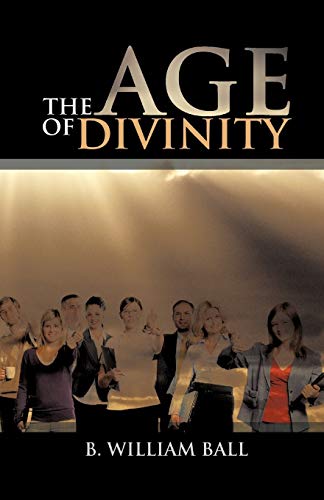
THE AGE OF DIVINITY
By B. William BallTrafford Publishing
Copyright © 2012 B. William BallAll right reserved.
ISBN: 978-1-4669-4321-6
Contents
Introduction......................viiChapter One.......................1Chapter Two.......................9Chapter Three.....................14Chapter Four......................22Chapter Five......................29Epilogue..........................35
Chapter One
Origins
We tend to believe that everything must have had a beginning and will have an ending, with a middle in between. No one has ever proved that, so it can be accepted as an article of faith. Once we do, we will then want to know when and how the beginning occurred. When someone is trying to tell a story, he's often told to just start at the beginning. When a beginning is unknown, there are those who will search for it.
We are aware that we live in a universe made up of many elements—galaxies, stars, planets, moons, random particles of matter of many sizes, meteors, comets, and other unclassified debris. Astronomers and scientists have spent many years, a lot of brainpower, and much effort in seeking information about the beginning of our universe. Many religionists will say, "God created it," and for them, that ends the matter. Scientists, however, continue to search for information upon which to base a logical conclusion. Scientists have propounded a scientific theory about the beginning of our universe. They call it the big bang theory. This theory is supported by a preponderance of evidence accumulated over a considerable period of time and tested for accuracy. This is a very complex process, and even if I were competent to explain it all, that is not the purpose here. It will help, however, to mention some of the basic elements of the theory. The story is that, about fourteen to fifteen billion years ago, all the matter in the universe was concentrated into a tiny ball, maybe about the size of a pea. It exploded, sending particles of matter and energy in all directions—first as gas, then as dust, then as consolidated bodies. Thus, the universe was formed—all the stars and all the solar systems with planets, moons, etc. (for example, our solar system) and all the milky way, our galaxy and all the known galaxies and all the unknown galaxies yet to be discovered and all the galaxies that we may never discover and all the meteorites, comets and all the other debris and all the energy—all of that, including light.
Whew! All that from one tiny ball! Yet scientists agree that all the accumulated evidence supports the theory, and no evidence has been found that opposes it. Many scientists are inclined to say, "Now we know how the universe started, so we won't believe in a creator anymore." Some, however, still believe in the existence of God.
But there are still some problems with this scenario. It is certain that the big bang theory is correct, as far as it goes, but it doesn't go far enough to satisfy all the questions. If the universe came into existence by a tiny exploding ball, where did that ball come from? It is not enough to say that it didn't come from anywhere; it just was. That ignores the question of the beginning of everything—including the exploding ball and whatever else that may exist that we as yet have still no scientific information about. Other questions left unanswered by the big bang theory are as follows: What caused the ball to explode? How was it determined when it exploded? What results are to be expected from the development of the widely diverse particles in out universe? What results are to be expected to eventually follow the development of the widely diverse elements of our universe? Can such an intricate system of particles and aggregations of matter and vast immeasurable amounts of energy, laws of physics, and the development of such a huge diversity of life-forms possibly be brought into existence randomly and for no purpose? These are questions not likely to be answered by scientific inquiry. Nor are scientists likely to perceive the answers to such questions as desirable enough to warrant the expenditure of their time, labor, and energy. Scientists seek to discover and verify facts, not to uncover truth. Yet all facts are manifestations of truth, and the truth that underlies facts is of major importance to humans.
That is why we have philosophers. Philosophers are seekers of truth, and they utilize facts, emotions, history, and creative intelligence in the search for it. In the process, they frequently create religious dogmas, which religionists appropriate for the purpose of controlling people in their group in order to bolster their own power, well-being, and for aggrandizement and the accumulation of worldly treasures and adoration by the masses of followers. Once a spiritual idea is transformed into a dogma, it is unlikely to be expanded or improved but is declared to be unchangeable, and it is required that it be accepted unconditionally.
However, not all spiritual ideas become dogmas. Those who seek the truth reject the idea of dogma and utilize their intellectual and emotional powers in a continuing search for more truth. These are referred to, and refer to themselves, as students of truth. Students are, by definition, those who seek to learn more and more. They're not interested in personal power and aggrandizement at the expense of others. I consider myself to be a student of truth, and I have pursued activities that aided me in that search. One of the things that I have already mentioned is a product of that search for truth. That is the idea that there is no conflict between science and religious truth, only one between science and unsupported dogma. Therefore, any religious contention that is refuted by scientific facts cannot be the truth and must be classified as unsupported dogma. The challenge is to find the truth that underlies the scientifically proven facts.
Now it is time to get back to the search for the truth of the beginning of all things. To go as far back in time as we know now leads us to that tiny ball that exploded and formed our universe. All that we know is that before our universe, there was all that matter and energy, which we cannot scientifically explain. Thus, we're pointed toward an explanation that we derived from our spiritual concepts and intellectual reasoning. I have followed that process over many years, and I have formulated an explanation that I believe to be the truth of the matter, and to which, I expect to adhere to until someone can show me where I am in error.
The search for a beginning leads inevitably to the idea that there can only be a beginning that preexisted all else, and that has existed forever in infinity of time. This leads to the idea that there is no time in spirit, but that the only time we have is a device constructed by mankind in order to understand, put into order, and regulate his activities in this physical life. Out of necessity, the time concept, like others, is based on observations of phenomena in our environment. Thus, our year is defined as the time it takes for our home, the earth, to completely orbit the sun. A day is the amount of time it takes for the earth to complete a rotation around its axis. The day is arbitrarily divided into twenty-four equal parts, or hours, which are divided into sixty equal parts or minutes, which are divided into sixty equal parts, or seconds. This is based on the mathematical calculations that consider the earth to be a perfect sphere, with a circumference of 360° and with the rotation at a steady pace. Of course, the basic...
„Über diesen Titel“ kann sich auf eine andere Ausgabe dieses Titels beziehen.
Weitere beliebte Ausgaben desselben Titels

Suchergebnisse für The Age of Divinity

Foto des Verkäufers
Age of Divinity
Anbieter: GreatBookPrices, Columbia, MD, USA
Verkäuferbewertung 5 von 5 Sternen

Zustand: As New. Unread book in perfect condition. Bestandsnummer des Verkäufers 18483976
Gebraucht kaufen
EUR 9,95
EUR 2,32 Versand
Versand innerhalb von USA
Versand innerhalb von USA
Anzahl: Mehr als 20 verfügbar
Foto des Verkäufers
Age of Divinity
Anbieter: GreatBookPrices, Columbia, MD, USA
Verkäuferbewertung 5 von 5 Sternen
Zustand: New. Bestandsnummer des Verkäufers 18483976-n
Neu kaufen
EUR 10,89
EUR 2,32 Versand
Versand innerhalb von USA
Versand innerhalb von USA
Anzahl: Mehr als 20 verfügbar
Foto des Verkäufers
The Age of Divinity (Paperback or Softback)
Verlag:
Trafford Publishing 6/19/2012, 2012
ISBN 10: 1466943211
ISBN 13: 9781466943216
Neu
Paperback or Softback
Anbieter: BargainBookStores, Grand Rapids, MI, USA
Verkäuferbewertung 5 von 5 Sternen
Paperback or Softback. Zustand: New. The Age of Divinity. Book. Bestandsnummer des Verkäufers BBS-9781466943216
Beispielbild für diese ISBN
The Age of Divinity
Print-on-DemandAnbieter: PBShop.store US, Wood Dale, IL, USA
Verkäuferbewertung 5 von 5 Sternen
PAP. Zustand: New. New Book. Shipped from UK. THIS BOOK IS PRINTED ON DEMAND. Established seller since 2000. Bestandsnummer des Verkäufers L0-9781466943216
Neu kaufen
EUR 13,93
Versand gratis
Versand innerhalb von USA
Versand innerhalb von USA
Anzahl: Mehr als 20 verfügbar
Beispielbild für diese ISBN
The Age of Divinity
Print-on-DemandAnbieter: PBShop.store UK, Fairford, GLOS, Vereinigtes Königreich
Verkäuferbewertung 5 von 5 Sternen
PAP. Zustand: New. New Book. Delivered from our UK warehouse in 4 to 14 business days. THIS BOOK IS PRINTED ON DEMAND. Established seller since 2000. Bestandsnummer des Verkäufers L0-9781466943216
Neu kaufen
EUR 13,28
EUR 3,81 Versand
Versand von Vereinigtes Königreich nach USA
Versand von Vereinigtes Königreich nach USA
Anzahl: Mehr als 20 verfügbar
Beispielbild für diese ISBN
The Age of Divinity
Anbieter: Ria Christie Collections, Uxbridge, Vereinigtes Königreich
Verkäuferbewertung 5 von 5 Sternen
Zustand: New. In. Bestandsnummer des Verkäufers ria9781466943216_new
Neu kaufen
EUR 11,82
EUR 13,88 Versand
Versand von Vereinigtes Königreich nach USA
Versand von Vereinigtes Königreich nach USA
Anzahl: Mehr als 20 verfügbar
Beispielbild für diese ISBN
The Age of Divinity
Verlag:
Trafford Publishing, 2012
ISBN 10: 1466943211
ISBN 13: 9781466943216
Neu
Paperback / softback
Anbieter: THE SAINT BOOKSTORE, Southport, Vereinigtes Königreich
Verkäuferbewertung 5 von 5 Sternen
Paperback / softback. Zustand: New. This item is printed on demand. New copy - Usually dispatched within 5-9 working days. Bestandsnummer des Verkäufers C9781466943216
Neu kaufen
EUR 14,24
EUR 13,66 Versand
Versand von Vereinigtes Königreich nach USA
Versand von Vereinigtes Königreich nach USA
Anzahl: Mehr als 20 verfügbar
Beispielbild für diese ISBN
Age of Divinity
Anbieter: GreatBookPricesUK, Woodford Green, Vereinigtes Königreich
Verkäuferbewertung 5 von 5 Sternen
Zustand: New. Bestandsnummer des Verkäufers 18483976-n
Neu kaufen
EUR 11,81
EUR 17,38 Versand
Versand von Vereinigtes Königreich nach USA
Versand von Vereinigtes Königreich nach USA
Anzahl: Mehr als 20 verfügbar
Foto des Verkäufers
Age of Divinity
Anbieter: GreatBookPricesUK, Woodford Green, Vereinigtes Königreich
Verkäuferbewertung 5 von 5 Sternen
Zustand: As New. Unread book in perfect condition. Bestandsnummer des Verkäufers 18483976
Gebraucht kaufen
EUR 13,89
EUR 17,38 Versand
Versand von Vereinigtes Königreich nach USA
Versand von Vereinigtes Königreich nach USA
Anzahl: Mehr als 20 verfügbar
Foto des Verkäufers
The Age of Divinity
Print-on-DemandAnbieter: moluna, Greven, Deutschland
Verkäuferbewertung 5 von 5 Sternen
Zustand: New. Dieser Artikel ist ein Print on Demand Artikel und wird nach Ihrer Bestellung fuer Sie gedruckt. KlappentextrnrnGod does not punish or reward. He (or she or it) teaches love and its characteristics as a guide to heaven, a state, not a place. There is no reason to fear God, since love and fear are opposites and cannot exist simultaneously. I. Bestandsnummer des Verkäufers 447852300
Neu kaufen
EUR 15,93
EUR 48,99 Versand
Versand von Deutschland nach USA
Versand von Deutschland nach USA
Anzahl: Mehr als 20 verfügbar