
Verwandte Artikel zu Jihadi Audiovisuality and Its Entanglements: Meanings,...
Inhaltsangabe
ISIS is often described as a terrorist organisation that uses social media to empower its supporters and reinforce its message. Through 12 case studies, this book examines the different ways in which Jihadi groups and their supporters use visualisation, sound production and aesthetic means to articulate their cause in online as well as offline contexts.
Divided into four thematic sections, the chapters probe Jihadi appropriation of traditional and popular cultural expressions and show how, in turn, political activists appropriate extremist media to oppose and resist the propaganda. By conceptualising militant Islamist audiovisual productions as part of global media aesthetics and practices, the authors shed light on how religious actors, artists, civil society activists, global youth, political forces, security agencies and researchers engage with mediated manifestations of Jihadi ideology to deconstruct, reinforce, defy or oppose the messages.
Die Inhaltsangabe kann sich auf eine andere Ausgabe dieses Titels beziehen.
Über die Autorin bzw. den Autor
Christoph Günther is the Principal Investigator of the junior research group Jihadism on the Internet: Images and Videos, their Dissemination and Appropriation in the Department of Anthropology and African Studies at Johannes Gutenberg University of Mainz. Having a background in Islamic Studies, his research interests include religio-political movements in the modern Middle East, visual cultures and iconography, and the sociology of religion. He is the author of Entrepreneurs of Identity: The Islamic State’s Symbolic Repertoire (Berghahn Books, 2022) and has co-edited Jihadi Audiovisuality and its Entanglements: Meanings, Aesthetics, Appropriations (Edinburgh University Press, 2020) with Simone Pfeifer.
Simone Pfeifer is a postdoctoral researcher at the Research Training Group anschließen-ausschließen: Cultural Dynamics Beyond Globalized Networks at the University of Cologne. She is a social and cultural anthropologist with a focus on visual, digital and media anthropology. Her research interests include transnational migration and mobility in postmigrant contexts, political violence, religion, and artistic practices, and ethics in (digital) ethnographic research. Her recent publications include Social Media im transnationalen Alltag (2020, transcript), the co-edited volume Jihadi Audiovisuality and its Entanglements: Meanings, Aesthetics, Appropriations (Edinburgh University Press, 2020) with Christoph Günther, and the co-edited special section Dark Ethnographies? (ZfE 2021: 146).
Von der hinteren Coverseite
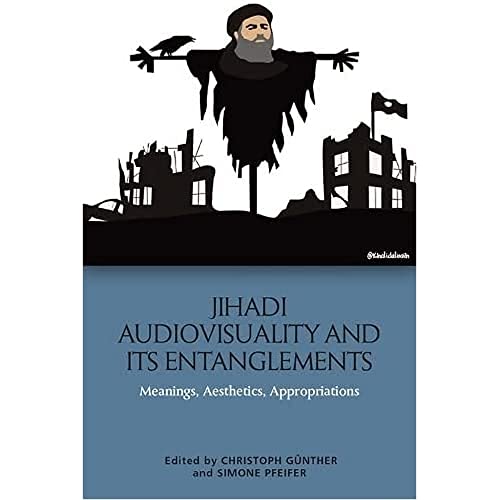
Explores the use of images, sounds and videos in Jihadi media and how people engage with themISIS is often described as a terrorist organisation that uses social media to empower its supporters and reinforce its message. Through 12 case studies, this book examines the different ways in which Jihadi groups and their supporters use visualisation, sound production and aesthetic means to articulate their cause in online as well as offline contexts.Divided into 4 thematic sections, the chapters probe Jihadi appropriation of traditional and popular cultural expressions and show how, in turn, political activists appropriate extremist media to oppose and resist the propaganda. By conceptualising militant Islamist audiovisual productions as part of global media aesthetics and practices, the authors shed light on how religious actors, artists, civil society activists, global youth, political forces, security agencies and researchers engage with mediated manifestations of Jihadi ideology to deconstruct, reinforce, defy or oppose the messages.Key Features•Fosters theoretical approaches to audiovisuality in the context of ‘propagandistic’ imagery•Points to strategies and logics of appropriation within and around Jihadi audiovisuality, such as humour, re-enactments and memetic forms of cultural resistance•Considers cultural and aesthetic expressions that evolve in response to Jihadi media output•Presents empirically grounded research, combined with historical, multi-modal, rhetorical, ethnomusicological and digital audiovisual analysis and interpretations•Case studies include: an exploration of staged violence in IS productions; the appropriation of IS’s nashid S?alil al-S?awarim in digital contexts; the responses by social workers and former supporters of jihadi groups and movements; and how researchers themselves are part of the entanglements caused by politicisation and securitisation of IslamChristoph Günther is the Principal Investigator and Simone Pfeifer is a Postdoctoral Researcher of the junior research group ‘Jihadism on the Internet: Images and Videos, their Dissemination and Appropriation’ at the Department of Anthropology and African Studies, Johannes Gutenberg University of Mainz.Cover image: Scarecrow, Khalid Albaih 2019Cover design:[EUP logo]edinburghuniversitypress.comISBN 978-1-4744-6751-3Barcode
„Über diesen Titel“ kann sich auf eine andere Ausgabe dieses Titels beziehen.
Suchergebnisse für Jihadi Audiovisuality and Its Entanglements: Meanings,...

Beispielbild für diese ISBN
Jihadi Audiovisuality and its Entanglements: Meanings Aesthetics Appropriations
Anbieter: Books Puddle, New York, NY, USA
Verkäuferbewertung 4 von 5 Sternen

Zustand: New. pp. 344. Bestandsnummer des Verkäufers 26395210662
Neu kaufen
EUR 35,93
EUR 3,44 Versand
Versand innerhalb von USA
Versand innerhalb von USA
Anzahl: 1 verfügbar
Beispielbild für diese ISBN
Jihadi Audiovisuality and Its Entanglements : Meanings, Aesthetics, Appropriations
Anbieter: GreatBookPrices, Columbia, MD, USA
Verkäuferbewertung 5 von 5 Sternen

Zustand: New. Bestandsnummer des Verkäufers 44436036-n
Neu kaufen
EUR 37,09
EUR 2,28 Versand
Versand innerhalb von USA
Versand innerhalb von USA
Anzahl: 1 verfügbar
Beispielbild für diese ISBN
Jihadi Audiovisuality and its Entanglements (Paperback)
Verlag:
Edinburgh University Press, Edinburgh, 2022
ISBN 10: 1474467520
ISBN 13: 9781474467520
Neu
Paperback
Anbieter: Grand Eagle Retail, Bensenville, IL, USA
Verkäuferbewertung 5 von 5 Sternen
Paperback. Zustand: new. Paperback. ISIS is often described as a terrorist organisation that uses social media to empower its supporters and reinforce its message. Through 12 case studies, this book examines the different ways in which Jihadi groups and their supporters use visualisation, sound production and aesthetic means to articulate their cause in online as well as offline contexts. Divided into four thematic sections, the chapters probe Jihadi appropriation of traditional and popular cultural expressions and show how, in turn, political activists appropriate extremist media to oppose and resist the propaganda. By conceptualising militant Islamist audiovisual productions as part of global media aesthetics and practices, the authors shed light on how religious actors, artists, civil society activists, global youth, political forces, security agencies and researchers engage with mediated manifestations of Jihadi ideology to deconstruct, reinforce, defy or oppose the messages. Explores the use of images, sounds and videos in Jihadi media and how people engage with them Shipping may be from multiple locations in the US or from the UK, depending on stock availability. Bestandsnummer des Verkäufers 9781474467520
Beispielbild für diese ISBN
Jihadi Audiovisuality and its Entanglements: Meanings Aesthetics Appropriations
Anbieter: Biblios, Frankfurt am main, HESSE, Deutschland
Verkäuferbewertung 4 von 5 Sternen
Zustand: New. pp. 344. Bestandsnummer des Verkäufers 18395210668
Neu kaufen
EUR 32,12
EUR 9,95 Versand
Versand von Deutschland nach USA
Versand von Deutschland nach USA
Anzahl: 1 verfügbar
Foto des Verkäufers
Jihadi Audiovisuality and Its Entanglements: Meanings, Aesthetics, Appropriations (Paperback or Softback)
Verlag:
Edinburgh University Press 8/25/2022, 2022
ISBN 10: 1474467520
ISBN 13: 9781474467520
Neu
Paperback or Softback
Anbieter: BargainBookStores, Grand Rapids, MI, USA
Verkäuferbewertung 5 von 5 Sternen
Paperback or Softback. Zustand: New. Jihadi Audiovisuality and Its Entanglements: Meanings, Aesthetics, Appropriations. Book. Bestandsnummer des Verkäufers BBS-9781474467520
Beispielbild für diese ISBN
Jihadi Audiovisuality and its Entanglements: Meanings, Aesthetics, Appropriations
Anbieter: Brook Bookstore On Demand, Napoli, NA, Italien
Verkäuferbewertung 5 von 5 Sternen
Zustand: new. Bestandsnummer des Verkäufers PKK4QICBR3
Neu kaufen
EUR 34,55
EUR 11,00 Versand
Versand von Italien nach USA
Versand von Italien nach USA
Anzahl: 10 verfügbar
Beispielbild für diese ISBN
Jihadi Audiovisuality and its Entanglements
Anbieter: PBShop.store UK, Fairford, GLOS, Vereinigtes Königreich
Verkäuferbewertung 5 von 5 Sternen
PAP. Zustand: New. New Book. Shipped from UK. Established seller since 2000. Bestandsnummer des Verkäufers FV-9781474467520
Neu kaufen
EUR 40,30
EUR 5,86 Versand
Versand von Vereinigtes Königreich nach USA
Versand von Vereinigtes Königreich nach USA
Anzahl: 1 verfügbar
Foto des Verkäufers
Jihadi Audiovisuality and Its Entanglements : Meanings, Aesthetics, Appropriations
Verlag:
Edinburgh University Press, 2022
ISBN 10: 1474467520
ISBN 13: 9781474467520
Gebraucht
Softcover
Anbieter: GreatBookPrices, Columbia, MD, USA
Verkäuferbewertung 5 von 5 Sternen
Zustand: As New. Unread book in perfect condition. Bestandsnummer des Verkäufers 44436036
Gebraucht kaufen
EUR 44,02
EUR 2,28 Versand
Versand innerhalb von USA
Versand innerhalb von USA
Anzahl: 1 verfügbar
Beispielbild für diese ISBN
Jihadi Audiovisuality and Its Entanglements: Meanings, Aesthetics, Appropriations
Anbieter: Kennys Bookshop and Art Galleries Ltd., Galway, GY, Irland
Verkäuferbewertung 5 von 5 Sternen
Zustand: New. 2022. Paperback. . . . . . Bestandsnummer des Verkäufers V9781474467520
Neu kaufen
EUR 38,43
EUR 9,50 Versand
Versand von Irland nach USA
Versand von Irland nach USA
Anzahl: 10 verfügbar
Beispielbild für diese ISBN
Jihadi Audiovisuality and Its Entanglements: Meanings, Aesthetics, Appropriations
Verlag:
Edinburgh University Press, 2022
ISBN 10: 1474467520
ISBN 13: 9781474467520
Neu
Paperback / softback
Anbieter: THE SAINT BOOKSTORE, Southport, Vereinigtes Königreich
Verkäuferbewertung 5 von 5 Sternen
Paperback / softback. Zustand: New. New copy - Usually dispatched within 4 working days. Bestandsnummer des Verkäufers B9781474467520
Neu kaufen
EUR 39,90
EUR 14,70 Versand
Versand von Vereinigtes Königreich nach USA
Versand von Vereinigtes Königreich nach USA
Anzahl: 10 verfügbar